Tales of ghosts and horrors from a renowned literary academicArthur Christopher Benson was born in 1862 one of six children fathered by Edward White Benson, an Archbishop of Canterbury. A. C. Benson (as he is usually known) was an academic who became master of Magdalene College, Cambridge and is today possibly best remembered for writing the stirring lyrics to the British patriotic song 'Land of Hope and Glory' which is part of Elgar's 'Pomp and Circumstance March No 1'. Most of the Benson family were talented, but three brothers, Arthur Christopher, Edward Frederic (E. F.) and Robert Hugh (R. H.) became especially notable in the world of supernatural fiction. There can be little doubt that the literary laurels go to E. F. Benson whose output of supernatural fiction was particularly prolific, although he is also remembered as the writer of many other works including the humorous 'Mapp and Lucia' stories of English middle class 'one-upmanship'. Nevertheless, the fiction of the weird and ghostly penned by the other Benson brothers will appeal to all aficionados of the golden age of the genre. Many of the stories written by A. C. Benson are moral allegories, although 'Basil Netherby' has been judged to be of the highest standard among horror stories despite its comparative obscurity. In the past the supernatural stories of A. C. and R. H. Benson have possibly been neglected, underrated or selectively combined to form single volumes, but Leonaur now offers collections of stories by each author separately as they undoubtedly merit.Leonaur editions are newly typeset and are not facsimiles; each title is available in softcover and hardback with dustjacket; our hardbacks are cloth bound and feature gold foil lettering on their spines and fabric head and tail bands.
Tales of ghosts and horrors from a renowned literary academicArthur Christopher Benson was born in 1862 one of six children fathered by Edward White Benson, an Archbishop of Canterbury. A. C. Benson (as he is usually known) was an academic who became master of Magdalene College, Cambridge and is today possibly best remembered for writing the stirring lyrics to the British patriotic song 'Land of Hope and Glory' which is part of Elgar's 'Pomp and Circumstance March No 1'. Most of the Benson family were talented, but three brothers, Arthur Christopher, Edward Frederic (E. F.) and Robert Hugh (R. H.) became especially notable in the world of supernatural fiction. There can be little doubt that the literary laurels go to E. F. Benson whose output of supernatural fiction was particularly prolific, although he is also remembered as the writer of many other works including the humorous 'Mapp and Lucia' stories of English middle class 'one-upmanship'. Nevertheless, the fiction of the weird and ghostly penned by the other Benson brothers will appeal to all aficionados of the golden age of the genre. Many of the stories written by A. C. Benson are moral allegories, although 'Basil Netherby' has been judged to be of the highest standard among horror stories despite its comparative obscurity. In the past the supernatural stories of A. C. and R. H. Benson have possibly been neglected, underrated or selectively combined to form single volumes, but Leonaur now offers collections of stories by each author separately as they undoubtedly merit.Leonaur editions are newly typeset and are not facsimiles; each title is available in softcover and hardback with dustjacket; our hardbacks are cloth bound and feature gold foil lettering on their spines and fabric head and tail bands.
Arthur Christopher Benson, FRSL (24 April 1862 - 17 June 1925) was an English essayist, poet, author and academic and the 28th Master of Magdalene College, Cambridge. He is noted for having written the words of the song "Land of Hope and Glory". From 1885 to 1903 he taught at Eton, but returned to Cambridge in 1904 as a Fellow of Magdalene College to lecture in English Literature. He became president of the college (the Master's deputy) in 1912, and he was Master of Magdalene (head of the college) from December 1915 until his death in 1925. From 1906, he was a governor of Gresham's School.
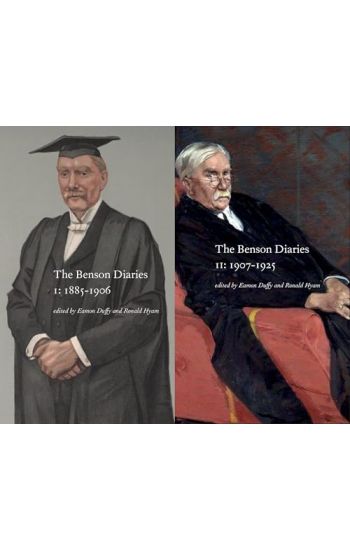
A. C. Benson (1862-1925), novelist, poet (he wrote Land of Hope and Glory), educationalist and Master of Magdalene College, Cambridge, kept a voluminous diary for most of his life. Considered too controversial at the time, it was sealed up after his death. Only now, with the publication of this extensive selection, can his witty and acute judgements on people, institutions and issues – including Henry James, Thomas Hardy, Queen Victoria, Dean Inge, Balfour, Asquith, Eton and Cambridge – be fully appreciated. He paints an endlessly fascinating and often very funny picture of a public life at the heart of the Edwardian literary, educational, church and political establishments; but also of a private life riven by the pressures of unconsummated romantic attachments to young men, and by attacks of appalling depression, an illness then barely understood. Historians Eamon Duffy and Ronald Hyam made this 300,000-word selection, adding a substantial introduction, footnotes, chronology, index and photographs. It is presented as two hardbacks in a slipcase.
A Legacy of America's Global Volunteerism: International Voluntary Services 1953-2002 explores the philosophical and organizational growth of international volunteerism. The book describes the International Voluntary Services, Inc. (IVS) innovative use of volunteers in relief and development projects and the challenges faced in both its public-private partnerships and field operations. Analysis of impacts and lessons from IVS's fifty-year lifespan may provide guidance for future international voluntary service institutions and programs. Volunteers' personal stories highlight issues inherent in international development and volunteerism. Section I, History of International Voluntary Services, Inc., covers events from the start of IVS in 1953 to its closure in 2002. Described are programs initiated by the U.S. Government and private organizations that engaged American volunteers in development and relief activities worldwide. Initially focused on sensitive areas of the Middle East and Indochina, IVS programs expanded and internationalized throughout the Global South. Section II, Volunteer Experiences And Impacts, describes the wide-ranging experiences of individual volunteers and the challenges of evaluating the impact of volunteer programs. Section III, International Voluntary Services Partners, identifies partnership programs ranging from "Peace Church" volunteer programs that inspired IVS, to recent U.S. Government volunteer initiatives, and the formation of the U. S. Peace Corps. Section IV, Implications and Questions for Future International Volunteerism, analyzes lessons learned from the IVS experience and their implications for future international volunteer activities. The author of the book's first chapter, entitled IVS Origins and Early Years, is a former Peace Corps volunteer; the following chapters were written by IVS alumni and professionals in the field of volunteerism who frame the IVS experience in the context of a broader international development picture. Individual volunteer stories throughout the book describe the challenges they faced and their wide-ranging successes and failures. The book highlights the dramatic changes throughout the world during the second half of the Twentieth Century and how these changes impacted international volunteerism. It concludes that international volunteerism remains relevant today, as reflected in the Peace Corps, which has had 241,000 volunteers serving in 143 countries since 1961.
Arthur Christopher Benson (24 April 1862 - 17 June 1925) was an English essayist, poet, author and academic and the 28th Master of Magdalene College, Cambridge. He is noted for writing the words of the song "Land of Hope and Glory". Early life and family: Benson was born on 24 April 1862 at Wellington College, Berkshire, the son of Edward White Benson (1829-1896), first headmaster of the college. He was one of six children of Edward White Benson (Archbishop of Canterbury, 1882-96) and his wife Mary Sidgwick Benson, sister of the philosopher Henry Sidgwick. Benson was born into a literary family; his brothers included Edward Frederic Benson, best remembered for his Mapp and Lucia novels, and Robert Hugh Benson, a priest of the Church of England before converting to Roman Catholicism, who wrote many popular novels. Their sister, Margaret Benson, was an artist, author, and amateur Egyptologist. The Benson family was exceptionally accomplished, but their history was somewhat tragic; a son and daughter died young; and another daughter, as well as Arthur himself, suffered from a mental condition that was possibly bipolar disorder or manic-depressive psychosis, which they had inherited from their father. None of the children married.Despite his illness, Arthur was a distinguished academic and a prolific author. From the ages of 10 to 21, he lived in cathedral closes, first at Lincoln where his father was Chancellor of Lincoln Cathedral, and then at Truro where his father was the first Bishop of Truro. He retained a love of church music and ceremony. During 1874 he won a scholarship to Eton from Temple Grove School, a preparatory school in East Sheen. He became a student of King's College, Cambridge during 1881, where he was a scholar and scored first for the Classical tripos during 1884. Career: From 1885 to 1903 he taught at Eton, returning to Cambridge in 1904 as a Fellow of Magdalene College to lecture in English Literature. He became president of the college in 1912 and Master of Magdalene in December 1915, a post he held until his death in 1925. From 1906, he was a governor of Gresham's School. The modern development of Magdalene was shaped by Benson. He was a generous benefactor to the college with a significant impact on the modern appearance of the college grounds; at least twenty inscriptions around the college refer to him. In 1930, Benson Court was constructed and named after him. He collaborated with Lord Esher in editing the correspondence of Queen Victoria (1907). His poems and volumes of essays, such as From a College Window, and The Upton Letters (essays in the form of letters) were famous during his time; and he left one of the longest diaries ever written, some four million words. Extracts from the diaries are printed in Edwardian Excursions. From the Diaries of A. C. Benson, 1898-1904, ed. David Newsome, London: John Murray, 1981. His literary criticisms of Dante Gabriel Rossetti, Edward FitzGerald, Walter Pater and John Ruskin, rank among his best work. Today, he is best remembered as the author of the words of one of Britain's best-known patriotic songs, Land of Hope and Glory, written for the coronation of King Edward VII. Like his brothers Edward Frederic (E. F.) and Robert Hugh (R. H.), A. C. Benson was noted as an author of ghost stories. The bulk of his published ghost stories in the two volumes The Hill of Trouble and Other Stories (1903) and The Isles of Sunset (1904) were written as moral allegories for his pupils. After Arthur's death, Fred Benson found a collection of unpublished ghost stories. He included two of them in a book, Basil Netherby (1927); the title story was renamed "House at Treheale" and the volume was completed by the long "The Uttermost Farthing"; the fate of the rest of the stories is unknown. The collection Paul the Minstrel and Other Stories (1911; reprint 1977, collects the contents of The Hill of Trouble and Other Stories and The Isles of Sunset.........
The 18th century was a wealth of knowledge, exploration and rapidly growing technology and expanding record-keeping made possible by advances in the printing press. In its determination to preserve the century of revolution, Gale initiated a revolution of its own: digitization of epic proportions to preserve these invaluable works in the largest archive of its kind. Now for the first time these high-quality digital copies of original 18th century manuscripts are available in print, making them highly accessible to libraries, undergraduate students, and independent scholars.Western literary study flows out of eighteenth-century works by Alexander Pope, Daniel Defoe, Henry Fielding, Frances Burney, Denis Diderot, Johann Gottfried Herder, Johann Wolfgang von Goethe, and others. Experience the birth of the modern novel, or compare the development of language using dictionaries and grammar discourses. ++++The below data was compiled from various identification fields in the bibliographic record of this title. This data is provided as an additional tool in helping to insure edition identification: ++++John Rylands University Library of ManchesterT184052Hull: printed by T. Briggs, 1789. 108p.; 12
Harper'S Encyclopedia Of United States History From 458 A.D. To 1905; With A Preface On The Study Of American History With Original Documents, Portraits, Maps, Plans, & C.; (Volume II)has been considered by academicians and scholars of great significance and value to literature. This forms a part of the knowledge base for future generations. So that the book is never forgotten we have represented this book in a print format as the same form as it was originally first published. Hence any marks or annotations seen are left intentionally to preserve its true nature.