Kirjojen hintavertailu. Mukana 11 244 527 kirjaa ja 12 kauppaa.

Kirjahaku

Etsi kirjoja tekijän nimen, kirjan nimen tai ISBN:n perusteella.

1000 tulosta hakusanalla Abdelkader Adla

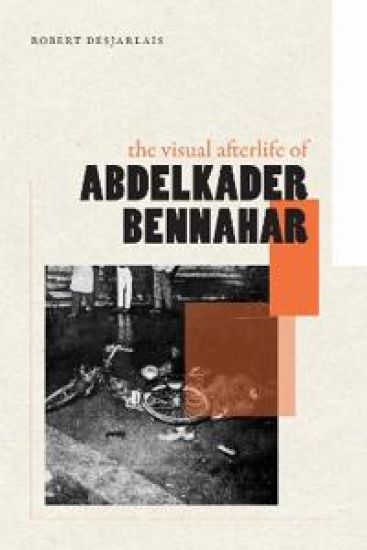
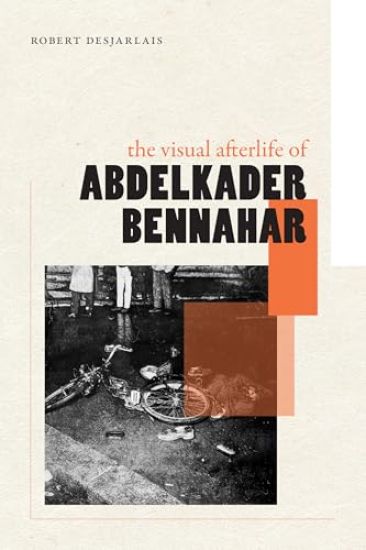
The Visual Afterlife of Abdelkader Bennahar

The Visual Afterlife of Abdelkader Bennahar

Robert Desjarlais

DUKE UNIVERSITY PRESS
2025
sidottu
On the night of October 17, 1961, thousands of Algerians peacefully demonstrated in the streets of Paris, protesting an illegal curfew imposed upon them by the French colonial government. The Paris police responded with deadly violence, by some accounts killing over two hundred people and wounding countless others. One of their victims was Abdelkader Bennahar, who was seriously beaten in Nanterre, a commune just west of Paris. Jewish-French photographer lie Kagan took a number of photographs of Bennahar as he lay bleeding in the street. Bennahar was brought to a Nanterre hospital and reportedly died the next night. In The Visual Afterlife of Abdelkader Bennahar, Robert Desjarlais analyzes Kagan's photographs and their affective force and political significance from the moment they first circulated through the decades that followed. By drawing on Kagan's photographs and archival records to consider the trace remnants of Bennahar's life and the fate of his body in death, Desjarlais offers a compelling account of one person's "life death" through complicated strands of time and memory.
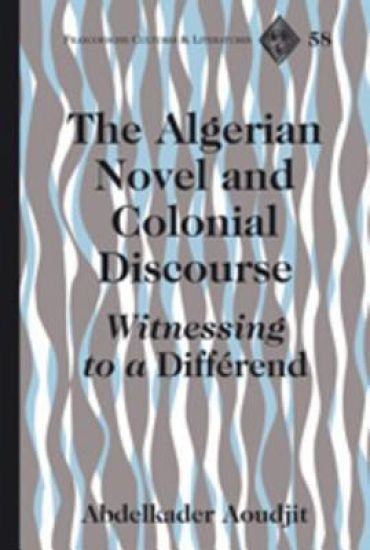
The Algerian Novel and Colonial Discourse

The Algerian Novel and Colonial Discourse

Abdelkader Aoudjit

Peter Lang Publishing Inc
2010
sidottu
During the last fifty years, Mouloud Feraoun, Mohammed Dib, Mouloud Mammeri, and Kateb Yacine achieved significant international recognition yet remain little known in the United States. Filling a pressing need, The Algerian Novel and Colonial Discourse provides a critical introduction and a new approach to the works of these Algerian novelists. Beginning with an overview of their novels, this book goes on to discuss critical approaches to them, challenging the widely held notion that they are merely ethnographic, upholding the status quo. The Algerian Novel and Colonial Discourse provides a new reading, and, most significantly, argues that they are best read as witnesses to the kind of conflict Jean-François Lyotard calls a différend – a conflict in which one suffers an injustice and is at the same time deprived of the means to argue. The Algerian Novel and Colonial Discourse then examines the issue of humanism that the novels allegedly both appeal to and reject and demonstrates that the Algerian authors’ condemnation of colonialism is both a coherent political position and consistent with their critique of liberal humanism. It concludes with a discussion on the ongoing relevance of the Algerian novels. The Algerian Novel and Colonial Discourse includes a glossary and a short history of modern Algeria to provide readers with the political and cultural contexts they need to understand its literature. This combination of innovative theoretical approach and political context makes this book of utmost importance for students of Francophone literature and for literary critics interested in colonialism, postcolonialism, and Lyotard’s philosophy.
Algerian Literature

Algerian Literature

Abdelkader Aoudjit

Peter Lang Publishing Inc
2017
sidottu
The only up-to-date and comprehensive text and reader of Algerian literature available in English, Algerian Literature: A Reader’s Guide and Anthology offers the reader a historical and critical overview of the literature from the early twentieth century to the present, introduces Algerian authors, and provides selections from a wide range of their writings, many translated here for the first time. It begins with an overview chapter that charts the evolution of Algerian literature and puts it in its proper historical context, followed by five thematic chapters: decolonization and cultural affirmation, the War of Independence, modernization and its discontents, emigration, and history. The chapters begin with introductions on the themes under discussion and the selections are preceded by biographies of the authors, as well as detailed summaries of the larger works from which they are extracted. Finally, each chapter concludes with a bibliography and sources for readers seeking additional information and insight. The selections included in Algerian Literature: A Reader’s Guide and Anthology have been carefully chosen to reflect the richness and diversity of Algerian literature. Accordingly, they are extracted from various literary genres: novels, plays, and poems. Furthermore, they are from works that belong to different literary movements: realism, modernism, and postmodernism. The variety and the outstanding quality of the selections, along with the superb introductions, summaries, and biographies make Algerian Literature: A Reader’s Guide and Anthology an ideal text for courses in Algerian, Francophone, and world literature courses. It will also be of interest to general readers outside the classroom who want to broaden their literary horizons.
The Algerian Historical Novel

The Algerian Historical Novel

Abdelkader Aoudjit

Peter Lang Publishing Inc
2021
sidottu
During the last thirty years, Algerian novelists have shown and continue to show a marked interest in the history of their country; some of them, however, approach the past in a manner that is significantly different from that of traditional historical novelists. The Algerian Historical Novel: Linking the Past to the Present and Future investigates for precisely what purpose, on what philosophical grounds, and using what techniques, novelists Rachid Boudjedra (La Prise de Gibraltar), Tahar Djaout (L’Invention du désert), Assia Djebar (Loin de Médine), Waciny Laredj (La Maison andalouse), Mohamed Sari (Pluies d’or), and Amin Zaoui (Le Dernier juif de Tamentit) engage with the history of Algeria. It also examines what the study of these authors can contribute to the larger debate concerning what this type of historical fiction can do with or reveal about the past that history as a discipline and the traditional historical novel cannot. The author advocates that La Prise de Gibraltar, L’Invention du désert, Loin de Médine, La Maison andalouse, Pluies d’or, and Le Dernier juif de Tamentit are best read as works of historiographic metafiction. He argues that these novels combine poststructuralist ideas and postmodernist narrative techniques to draw attention to previously neglected people and events in history and provide revised perspectives on them and others and, more importantly, to problematize the way Algerian history is thought and is used to address two major social and political concerns confronting Algerians: national identity and religious fundamentalism. The Algerian Historical Novel: Linking the Past to the Present and future is highly recommended to students, scholars, and general readers interested in Algerian literature and in historiographic metafiction.
Motion Coordination for VTOL Unmanned Aerial Vehicles

Motion Coordination for VTOL Unmanned Aerial Vehicles

Abdelkader Abdessameud; Abdelhamid Tayebi

Springer London Ltd
2013
sidottu
Motion Coordination for VTOL Unmanned Aerial Vehicles develops new control design techniques for the distributed coordination of a team of autonomous unmanned aerial vehicles. In particular, it provides new control design approaches for the attitude synchronization of a formation of rigid body systems. In addition, by integrating new control design techniques with some concepts from nonlinear control theory and multi-agent systems, it presents a new theoretical framework for the formation control of a class of under-actuated aerial vehicles capable of vertical take-off and landing. Several practical problems related to the systems’ inputs, states measurements, and restrictions on the interconnection topology between the aerial vehicles in the team are addressed. Worked examples with sufficient details and simulation results are provided to illustrate the applicability and effectiveness of the theoretical results discussed in the book.The material presented is primarily intended for researchers and industrial engineers from robotics, control engineering and aerospace communities. It also serves as a complementary reading for graduate students involved in research related to flying robotics, aerospace, control of under-actuated systems, and nonlinear control theory
Motion Coordination for VTOL Unmanned Aerial Vehicles

Motion Coordination for VTOL Unmanned Aerial Vehicles

Abdelkader Abdessameud; Abdelhamid Tayebi

Springer London Ltd
2015
nidottu
Motion Coordination for VTOL Unmanned Aerial Vehicles develops new control design techniques for the distributed coordination of a team of autonomous unmanned aerial vehicles. In particular, it provides new control design approaches for the attitude synchronization of a formation of rigid body systems. In addition, by integrating new control design techniques with some concepts from nonlinear control theory and multi-agent systems, it presents a new theoretical framework for the formation control of a class of under-actuated aerial vehicles capable of vertical take-off and landing. Several practical problems related to the systems’ inputs, states measurements, and restrictions on the interconnection topology between the aerial vehicles in the team are addressed. Worked examples with sufficient details and simulation results are provided to illustrate the applicability and effectiveness of the theoretical results discussed in the book.The material presented is primarily intended for researchers and industrial engineers from robotics, control engineering and aerospace communities. It also serves as a complementary reading for graduate students involved in research related to flying robotics, aerospace, control of under-actuated systems, and nonlinear control theory
An Anthology of Contemporary Arabic Literature

An Anthology of Contemporary Arabic Literature

Abdelkader (EDT) Cheref

Edinburgh University Press
2020
sidottu
Introducing the works of forty modern Arab writers, from fifteen Arab countries, this collection focuses on modern Arabic Literature and society. Organised thematically, it places particular emphasis on issues of identity, social structures and the dynamics of Arab culture in the Mashreq (Middle East), Khaleej (Gulf), and the Maghreb (North Africa). Readers can view this postcolonial literature as a cultural lens, showing not only traditions and customs but also the sociopolitical culture of the 'Arab World'.
An Anthology of Contemporary Arabic Literature

An Anthology of Contemporary Arabic Literature

Abdelkader (EDT) Cheref

Edinburgh University Press
2020
pokkari
Introducing the works of forty modern Arab writers, from fifteen Arab countries, this collection focuses on modern Arabic Literature and society. Organised thematically, it places particular emphasis on issues of identity, social structures and the dynamics of Arab culture in the Mashreq (Middle East), Khaleej (Gulf), and the Maghreb (North Africa). Readers can view this postcolonial literature as a cultural lens, showing not only traditions and customs but also the sociopolitical culture of the 'Arab World'.
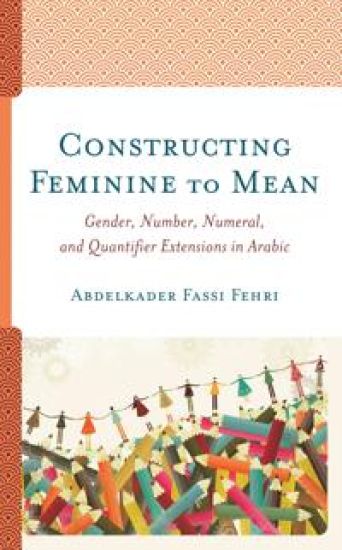
Constructing Feminine to Mean

Constructing Feminine to Mean

Abdelkader Fassi Fehri

Lexington Books
2018
sidottu
Linguistic gender is a complex and amazing category that has puzzled and still puzzles theoretical linguists, typologists, philosophers, cognitive scientists, didacticians, as well as scholars of anthropology, culture, and even mystical (divine) sufism. In Standard and colloquial Arabic varieties, feminine morphology (unlike “common sense”) is not dedicated to mark beings of the female sex (or “natural gender”). When you name the female of a “lion” (?asad) or a “donkey” (?imaar), you use different words (labu?at or ?ataan), as if the male and female of the same species are linguistically conceived as completely unrelated entities. When you “feminize” words like “bee” (na?l) or “pigeon” (?amaam), the outcome is not a noun for the animal with a different sex, but a singular of the collective “bees,” “one bee” (na?l-at), or an individual pigeon (?amaam-at). In the opposite direction, when a singular noun “carpenter” (najjar) is feminized, the (unexpected) result is a special plural, or rather a group, “carpenters as a professional group” (najjar-at). Since some of these words (contrastively) possess “normal” masculine plurals, or masculine singulars, I propose to distinguish atomicities (which are broadly “masculine”) from unities (which are “feminine”). The diversity of feminine senses is also manifested when you feminize an inherently masculine noun like “father” (?ab), “uncle” (?amm), etc. The outcome (in the appropriate performative context) is that you are endearing your father or uncle, rather than “womanizing” him. More “unorthodox” senses are evaluative, pejorative, diminutive, augmentative, etc. It is striking that gender not only plays a central role in shaping individuation, or perspectizing plurality, but it is also used to distinguish what we count, or what we quantifier over. In Arabic, when you count numbers in sequence (three, four, five, six, etc.), you use the feminine, but when you count objects, you have to “negotiate” for gender, due to the “gender polarity” constraint. Your quantifier senses, which are also subtly built in the grammar, equally negotiate for gender. Wide cross-linguistic comparison extends the inventories of features, mechanisms, and typological notions used, to languages like Hebrew, Berber, Celtic, Germanic, Romance, Amazonian, etc. On the whole, gender is far from being parasitic in the grammar of Arabic or any language (including “classifier” languages). It is central as it has never been.
Narrating the Nation in the African Novel: Chinua Achebe, Ngugi wa Thiong'o, Ayi Kwei Armah and Kofi Awoonor
The idea of the nation or nationalism in relation to Africa and African literature has been widely dealt with in modern African literature, arising from the fact that writers are bent on expressing their concern about the future of their countries. Chinua Achebe, Ayi Kwei Armah, Ngugi wa Thiong'o and Kofi Awoonor are such writers who have made great artistic efforts to portray an Afrotopia, or at best viable socio-political systems in the wake of colonial situation. The present work aims to examine closely these novelists' ideological convictions as they are expressed in their fictions and often shown to be in opposition to the practices established by the state apparatuses in place. This book shows how the African situation has been characterised in the African novels by both a common continental experience and a number of facts that dramatise the historical predicament of slavery, colonialism and a problematic independence. These representations carry dialogical voices which underpin the authoritative voice of the authors. The narratives of the nation are shown to be ambivalent, for they seem to act in defence of the novelists' culture, yet they jettison its very quintessence by the sceptical view they reflect about its significance in modern times. Caught between the imperatives of modernity and the nostalgic drives of the past, the novelists are somehow drawn to condemn the metropolis and to celebrate it at the same time. The point is to accept the construction of the nation-state in connection with universal concepts developed by the Western world and Europe essentially. The different 'utopias' offered by the writers under scrutiny cannot be divorced from the theory and practice that have led to the construction of European models of nation-states. Hence our reliance on important scholarly works in the field, particularly Elie Kedourie's Nationalism, Eric Hobsbawm's Nations and Nationalism Since 1780, Ernest Gellner's Nations and Nationalsim. But for the theoretical link between nationalism and literary interpretation, Benedict Anderson's Imagined Communities, Homi Bhabha's Nation and Narration and The Location of Culture, Edward Said's Orientalism and Culture and Imperialism and Bakhtin's The dialogical Imagination are fundamental supports for my discussion. Critics that have approached this subject are restrictive in number, but I have taken account of the studies carried out by James Ogude on Ngugi, Leif Lorentzon on Armah, for example, or general works like Abiola Irele's The African Experience in Literature and Ideology or Kanneh Kadiatu's African Identities, amongst others, to substantiate the discussion Due appreciation of the different styles used by the writers is expressed here from a modernism used by early Armah and Awoonor, to the realism of Achebe and Marxist-populist treatment of fiction and nation-building of Ngugi, as well as the essentialist slant that can be studied in Armah's later fiction. Concepts such as hybridity, ambivalence, liminality, developed by Bhabha, are useful elements of analysis in the examination of the evolution of prose fiction in Africa from the early writings of Achebe to the later works of Armah and Ngugi. They allow us to see how the African novelists produce meanings that underscore the realities and difficulties met in the construction of stable and genuinely independent nation-states in Africa.
El Nectar de la Existencia

El Nectar de la Existencia

Abdelkader Khalil; Fadhila Messai

Createspace Independent Publishing Platform
2018
nidottu
This book contains a collection of poetry quartets expressing to the senses the nectar of life to empower the soul and the spirit. This poetry is written in Arabic and translated into Spanish. Arabic and Spanish translation are included in this version of the book to delight both Arabic and Spanish readers. Este libro es una colecci n de cuarteto corto Y poemas de tresillos que capturan im genes iniciales del n ctar de la vida. Tales im genes traen una panacea calmante para el alma y el esp ritu. Esta poes a est escrita en rabe y traducida al espa ol. La traducci n al rabe y al espa ol est n incluidas en esta versi n del libro para deleitar tanto a los lectores rabes como a los espa oles.
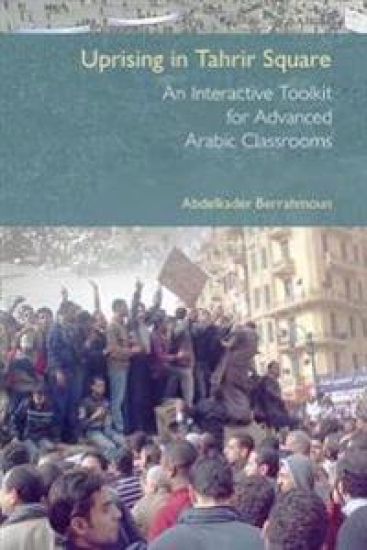
Uprising in Tahrir Square

Uprising in Tahrir Square

Abdelkader Berrahmoun

Equinox Publishing Ltd
2019
sidottu
Uprising in Tahrir Square is designed as an engaging contemporary resource for advanced Arabic learners. It immerses language students in the monumental events that unfolded in Cairo, Egypt during the mass youth uprisings of January 2011. Before toppling President Hosni Mubarak's 30-year rule in February 2011, the Egyptian youth movement had captivated the world and transmitted its message of anger, hope, and change to a global audience. The world watched as more than a million protestors gathered to press for reform, democracy and regime change. Uprising in Tahrir Square places students of Arabic at the epicenter of these real-life events through a simulated journal project and writing exchange. Students build and strengthen essential skills in reading, writing and comprehension by using the Arabic language in a vital, real-life context. They become authors in their own right as they invent personas and speak through the voices of diverse characters who all reside in the vicinity of Cairo's Tahrir Square. Writing in first-person narrative, students' journal entries bear witness to the early days of the nascent uprising, through its surprisingly rapid conclusion with Mubarak's resignation, and the uncertainty of what Egypt's future may bring. Not only do the invented characters grapple with the uprising's tragedies and triumphs through their own perspectives, but they also interact with a cast of invented neighbors, using contemporary technology tools such as Wikispaces and blogs. The book's units trace the actual sequence of the Cairo uprising and intersperse fictional scenarios - providing both historical background and interpretive content. The structure of Uprising in Tahrir Square supports learning on multiple levels. Students deepen their understanding of the cultural, political and social contexts for Egypt and other Arab youth's historic uprisings, while improving essential Arabic skills. The book's scaffolded activities and array of resources are carefully designed to promote listening and reading comprehension, vocabulary development, critical thinking and interpretation, research, peer collaboration, creative writing, and oral language fluency.