Kirjojen hintavertailu. Mukana 11 244 527 kirjaa ja 12 kauppaa.

Kirjahaku

Etsi kirjoja tekijän nimen, kirjan nimen tai ISBN:n perusteella.

1000 tulosta hakusanalla Achim Wennmann

The Political Economy of Peacemaking
This book focuses on the economic dimensions of peace processes and examines the opportunities and constraints for assisting negotiated exits out of conflict.Various works have addressed the economic characteristics and consequences of armed conflicts over the past two decades, including issues such as ‘blood diamonds’, natural resource wars, economically motivated armed violence, self-financing conflict, or the complicity of companies and state elites in conflict economies. However, rather than treating these issues as obstacles for peace, this book explores whether they can be opportunities for peacemaking by adopting a political-economy perspective. The book looks at income sharing from natural resources as an opportunity for forward-looking peacemaking strategies, and the implications of deal-making in situations in which war economies and insecurity provide strongmen with disproportionate political and economic power. The book also highlights that peace processes are not necessarily about the rectification of a conflict’s ‘root causes’, but rather about what matters most to the main stakeholders at the moment when a peace process starts taking shape. Finally, efforts to establish a lasting peace need to go beyond the traditional set of actors associated with peace processes. The strategic involvement of donor agencies, companies, and diaspora communities can strengthen forward-looking peace processes.The book will help both student and practitioner audiences to better understand armed conflicts and their belligerents, optimize the planning and management of peace initiatives, and shape expectations in peace agreements. It will be of much interest to students of peacebuilding, conflict studies, development studies, International Political Economy and International Relations in general.
The Political Economy of Peacemaking
This book focuses on the economic dimensions of peace processes and examines the opportunities and constraints for assisting negotiated exits out of conflict.Various works have addressed the economic characteristics and consequences of armed conflicts over the past two decades, including issues such as ‘blood diamonds’, natural resource wars, economically motivated armed violence, self-financing conflict, or the complicity of companies and state elites in conflict economies. However, rather than treating these issues as obstacles for peace, this book explores whether they can be opportunities for peacemaking by adopting a political-economy perspective. The book looks at income sharing from natural resources as an opportunity for forward-looking peacemaking strategies, and the implications of deal-making in situations in which war economies and insecurity provide strongmen with disproportionate political and economic power. The book also highlights that peace processes are not necessarily about the rectification of a conflict’s ‘root causes’, but rather about what matters most to the main stakeholders at the moment when a peace process starts taking shape. Finally, efforts to establish a lasting peace need to go beyond the traditional set of actors associated with peace processes. The strategic involvement of donor agencies, companies, and diaspora communities can strengthen forward-looking peace processes.The book will help both student and practitioner audiences to better understand armed conflicts and their belligerents, optimize the planning and management of peace initiatives, and shape expectations in peace agreements. It will be of much interest to students of peacebuilding, conflict studies, development studies, International Political Economy and International Relations in general.
Ending Wars, Consolidating Peace

Ending Wars, Consolidating Peace

Mats Berdal; Achim Wennmann

Routledge
2010
nidottu
The transition from war to peace is fraught with tension and the risk of a return to bloodshed. With so much at stake, it is crucial that the international community and local stakeholders make sense of the complex mosaic of challenges, to support a lasting, inclusive and prosperous peace. Recent missions, such as in Afghanistan, Somalia, or Sudan, have highlighted the fact that there can be no one-size-fits-all approach to steering countries away from violence and towards stability. This Adelphi offers a series of economic perspectives on conflict resolution, to show how the challenges of peacebuilding can be more effectively tackled. From the need to marry diplomatic peacemaking with development efforts, and activate the private sector in the service of peacebuilding aims, to the use of taxes and natural resource revenues as a financial base for sustainable peace, this book considers how economic factors can positively shape and drive peace processes. It takes an unflinching look at the complex ways in which power and order may be manifested in conflict zones, where unpalatable compromises with local warlords can often be the first step towards a more lasting settlement. A difficult balance must be struck by peacemakers and peacebuilders in assisting countries and communities in their transitions out of war, for the consequences of failure for countries and the wider world are too grave. In distilling expertise from a range of disciplines, this Adelphi seeks to inform a more economically integrated and responsive approach to helping countries leave behind their troubled pasts and take a fuller role in constructing their futures.
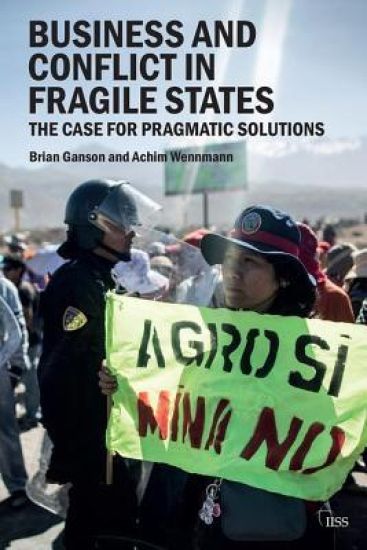
Business and Conflict in Fragile States

Business and Conflict in Fragile States

Brian Ganson; Achim Wennmann

Routledge
2016
nidottu
Large-scale investments in fragile states – in Latin America, Africa, the former Soviet Union and Asia – become magnets for conflict, which undermines business, development and security.International policy responds with regulation, state-building and institutional reform, with poor and often perverse results. Caught up in old ways of thinking about conflict and fragility, and an age-old fight over whether multinational corporations are good or bad for peaceful development, it leaves business-related conflicts in fragile states to multiply and fester.Surveying a new strategic landscape of business and conflict, Brian Ganson and Achim Wennmann conclude that neither company shareholders nor advocates for peaceful development need, or should, accept the growing cost of business-related conflict in fragile states. Drawing on decades of experience from mainstream conflict prevention and violence reduction efforts, as well as promising company practice, they show that even acute conflict is manageable when dealt with pragmatically, locally and on its own terms.The analysis and conclusions of this Adelphi book will interest policymakers, business leaders and community advocates alike – all those hoping to mitigate today’s conflicts while helping to reduce fragility and build a firmer foundation for inclusive development.
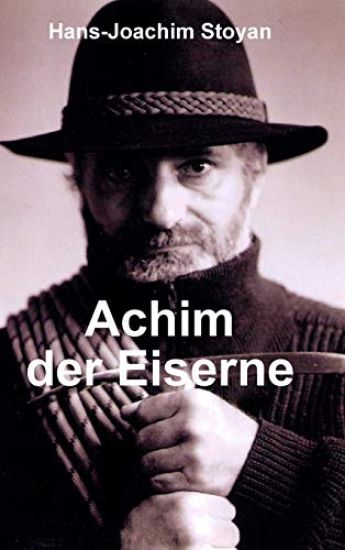
Achim der Eiserne, Eine au?ergew?hnliche Autobiographie
?berzeugtes Festhalten an deutschen Werten, praktizierte Treue zur Heimat, pochen auf deutsche Eigenart, ?berlieferung, Kultur, Sprache, Widerstand gegen ?u?ere Einfl?sse und Ablehnung von Modernisierung, Globalismus (Amerikanisierung), Masseneinwanderung sind hohe Ma?st?be die er sich selbst immer wieder setzte und setzt. [..] Heimat ist f?r ihn nicht etwas Diffuses und Verschwommenes. Nein, es ist f?r ihn ein allumfassender Begriff der Familie, der Freunde und Bekannten, der Natur, der Berge, die Kultur, die Sprache, die Umwelt, die Tradition, das Brauchtum, das nationale Verst?ndnis, Aufkl?rung, Bewu?tsein und das Soziale Gef?ge mit einschlie?t. Zu Hause f?hlt er sich mit K?rper und Seele wohl und geborgen. Die deutsche Heimat und ihre Jahrtausende alten Werte gilt es zu bewahren, zu verteidigen und so weiterzugeben, wie wir sie von unseren V?tern und M?ttern erhalten haben. Das ist Stoyans Lebensinhalt! Es gibt bei ihm keine halben Sachen.
Achim von Arnim und sein Kreis
Dieser Band fasst nach einem ersten Jahrzehnt neuer historisch-kritischer Editionsarbeiten an der Weimarer Arnim-Ausgabe (WAA) die dabei erreichten philologischen, literarischen, philosophischen und komparatistischen Konstellationen zusammen. Es entsteht ein neues Bild von einem der 'originellsten Kopfe der romantischen Schule' (Heinrich Heine) und seines viel nachhaltigeren Einflusses auf Zeitgenossen wie Nachgeborene als bisher gedacht. Sowohl werkgeschichtliche neue Untersuchungen zu Arnim, als auch neue Einsichten in Verbindungen Arnims mit dem fruhromantischen Denkkreis und wirkungsgeschichtliche Facetten fruhromantischen Dichten und Denkensergeben ein uberraschend neues Tableau romantischer Mentalitat.
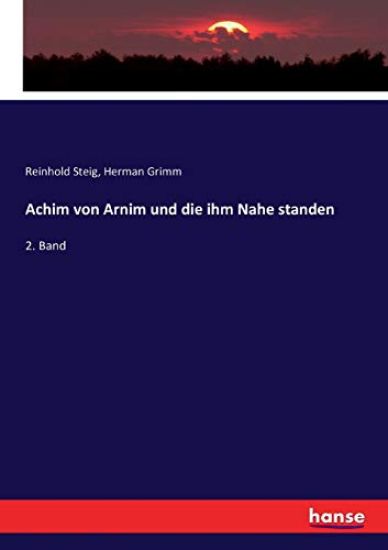
Achim von Arnim und die ihm Nahe standen

Achim von Arnim und die ihm Nahe standen

Reinhold Steig; Herman Friedrich Grimm

Hansebooks
2021
pokkari
Achim von Arnim und die ihm Nahe standen - 2. Band ist ein unver nderter, hochwertiger Nachdruck der Originalausgabe aus dem Jahr 1894. Hansebooks ist Herausgeber von Literatur zu unterschiedlichen Themengebieten wie Forschung und Wissenschaft, Reisen und Expeditionen, Kochen und Ern hrung, Medizin und weiteren Genres. Der Schwerpunkt des Verlages liegt auf dem Erhalt historischer Literatur. Viele Werke historischer Schriftsteller und Wissenschaftler sind heute nur noch als Antiquit ten erh ltlich. Hansebooks verlegt diese B cher neu und tr gt damit zum Erhalt selten gewordener Literatur und historischem Wissen auch f r die Zukunft bei.