
Kirjahaku
Etsi kirjoja tekijän nimen, kirjan nimen tai ISBN:n perusteella.
500 tulosta hakusanalla Adelard Moloto


Adelard of Bath, Conversations with his Nephew
Cambridge University Press
1998
sidottu
Adelard of Bath was one of the most colourful personalities of the Middle Ages. He travelled to the Crusader kingdoms, to Sicily and south Italy, and translated texts on astronomy, astrology and magic from Arabic into Latin. He acquired a lasting reputation as a pioneering mathematician, and he was a gifted teacher. He addressed one of these works, on cosmology and the astrolabe, to the future King Henry II, and it is in the context of the education of the nobility that the three works edited in this book are to be viewed. Adelard meant them to be both entertaining and instructive. They deal with all kinds of topics, from the nature of the soul to the cause of earthquakes, from the effects of music to how to train a hawk. A preface provides the results of research on Adelard's life and work.
Adelard of Bath, Conversations with his Nephew
Cambridge University Press
2006
pokkari
Adelard of Bath was one of the most colourful personalities of the Middle Ages. He travelled to the Crusader kingdoms, to Sicily and south Italy, and translated texts on astronomy, astrology and magic from Arabic into Latin. He acquired a lasting reputation as a pioneering mathematician, and he was a gifted teacher. He addressed one of these works, on cosmology and the astrolabe, to the future King Henry II, and it is in the context of the education of the nobility that the three works edited in this book are to be viewed. Adelard meant them to be both entertaining and instructive. They deal with all kinds of topics, from the nature of the soul to the cause of earthquakes, from the effects of music to how to train a hawk. A preface provides the results of research on Adelard's life and work.
Des Adelard Von Bath Traktat de Eodem Et Diverso
Nabu Press
2010
pokkari

Paulus Hegesippe Adelard Ladislas greve af Champignac: Patient A
Forlaget Cobolt A/S
2021
sidottu
Maj 1941. Grev Champignac og hans skotske kæreste, Blair, arbejder som kodebrydere i Bletchley Park uden for London. En nat opsnappes en chifreret meddelelse, afsendt af to af grevens kolleger og venner, en biolog og en kemiker, der mod deres vilje deltager i nazistiske forskningsprogrammer. Meddelelsen er en bøn om hjælp til at flygte fra Tyskland, og greven begiver sig sammen med Blair – som taler flydende tysk – af sted til Berlin med falske identiteter i lommen. I Nazityskland erfarer de, at de tyske soldater er blevet afhængige af amfetamin, og at det samme gælder en stor del af befolkningen. De opdager også, at nazisterne er på sporet af atomspaltningens hemmelighed – og møder raket-ingeniøren Wernher von Braun, der inviterer dem til selskab hos reichsmarschall Göring. Hvilket fører til yderligere en rejse, nu til Adolf Hitlers residens Berghof og et møde med den mystiske »Patient A« ... BeKa er et pseudonym for den franske forfatterduo Bertrand Escaich (f. 1975) og Caroline Roque (f. 1973). Allerede mens de læste henholdsvis naturvidenskab og kemi, begyndte de hver for sig at skrive manuskripter til tegneserier, og efter at de mødte hinanden på et kursus i afrikansk dans i 2001, har de skrevet sammen under pseudonymet BeKa eller Béka. Den franske tegner og farvelægger Etiens fulde navn er David Etien (f. 1981). Hans fascination af Victoriatiden afspejles i tegneserien “Baker Street Kvartetten”. Han har blandt andet også tegnet niende album i serien “Jagten på tidsfuglen”. Han var også med til at lave tegnefilmudgaven af tegneserien “Persepolis”.

Robert of Chester’s Redaction of Euclid’s Elements, the so-called Adelard II Version
H.L. Busard; M. Folkerts
Springer Basel
2012
nidottu

Robert of Chester’s Redaction of Euclid’s Elements, the so-called Adelard II Version
H.L. Busard; M. Folkerts
Springer Basel
2012
nidottu
The Latin "Version II", till now attributed to Adelard of Bath, is edited here for the first time. It was the most influential Euclid text in the Latin West in the 12th and 13th centuries. As the large number of manuscripts and the numerous quotations in other scientific and philosophical texts show, it was far better known than the three Euclid translations made from the Arabic in the 12th century (Adelard of Bath, version I; Hermann of Carinthia; Gerard of Cremona). Version II became the basis of later reworkings, in which the enunciations were taken over, but new proofs supplied; the most important text of this kind is the redaction made by Campanus in the late 1250s, which became the standard Latin "Euclid" in the later Middle Ages. The introduction deals with the questions of when and by whom version II was written. Since Marshall Clagett's fundamental article (1953) it has been generally accepted that version II is one of three Euclid texts attributable to Adelard of Bath. But a comparison of the text of version II with those of versions I and III yields little or no reason to assume that Adelard was the author of version II. Version II must have been written later than version I and before version III; its author was acquainted with Euclid texts of the Boethius tradition and with two of those transmitted from Arabic, version I (almost certainly by Adelard) and the version by Hermann of Carinthia.
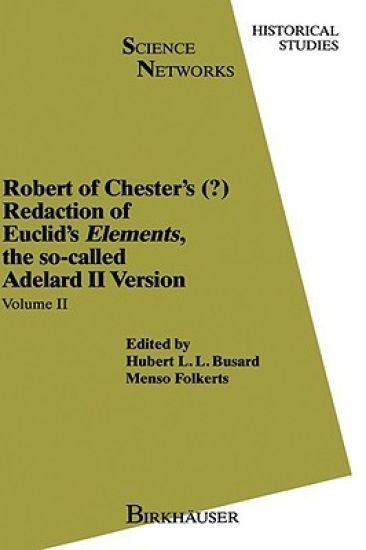
Robert of Chester’s Redaction of Euclid’s Elements, the so-called Adelard II Version
H.L. Busard; M. Folkerts
Birkhauser Verlag AG
1992
sidottu
The Latin "Version II", till now attributed to Adelard of Bath, is edited here for the first time. It was the most influential Euclid text in the Latin West in the 12th and 13th centuries. As the large number of manuscripts and the numerous quotations in other scientific and philosophical texts show, it was far better known than the three Euclid translations made from the Arabic in the 12th century (Adelard of Bath, version I; Hermann of Carinthia; Gerard of Cremona). Version II became the basis of later reworkings, in which the enunciations were taken over, but new proofs supplied; the most important text of this kind is the redaction made by Campanus in the late 1250s, which became the standard Latin "Euclid" in the later Middle Ages. The introduction deals with the questions of when and by whom version II was written. Since Marshall Clagett's fundamental article (1953) it has been generally accepted that version II is one of three Euclid texts attributable to Adelard of Bath. But a comparison of the text of version II with those of versions I and III yields little or no reason to assume that Adelard was the author of version II. Version II must have been written later than version I and before version III; its author was acquainted with Euclid texts of the Boethius tradition and with two of those transmitted from Arabic, version I (almost certainly by Adelard) and the version by Hermann of Carinthia.

Robert of Chester’s Redaction of Euclid’s Elements, the so-called Adelard II Version
H.L. Busard; M. Folkerts
Birkhauser Verlag AG
1992
sidottu

Just de Bretenières, Martyrisé En Corée Le 8 Mars 1866
Adélard-Marie Compain
Hachette Livre - BNF
2013
pokkari
Just de Bretenieres, martyrise en Coree le 8 mars 1866 / par l'abbe A.-M. Compain]Date de l'edition originale: 1867Sujet de l'ouvrage: BretenieresCe livre est la reproduction fidele d une uvre publiee avant 1920 et fait partie d une collection de livres reimprimes a la demande editee par Hachette Livre, dans le cadre d un partenariat avec la Bibliotheque nationale de France, offrant l opportunite d acceder a des ouvrages anciens et souvent rares issus des fonds patrimoniaux de la BnF.Les uvres faisant partie de cette collection ont ete numerisees par la BnF et sont presentes sur Gallica, sa bibliotheque numerique.En entreprenant de redonner vie a ces ouvrages au travers d une collection de livres reimprimes a la demande, nous leur donnons la possibilite de rencontrer un public elargi et participons a la transmission de connaissances et de savoirs parfois difficilement accessibles.Nous avons cherche a concilier la reproduction fidele d un livre ancien a partir de sa version numerisee avec le souci d un confort de lecture optimal. Nous esperons que les ouvrages de cette nouvelle collection vous apporteront entiere satisfaction.Pour plus d informations, rendez-vous sur www.hachettebnf.fr

An Assessment of the Performance of Loans Provided By Banks
Adelard Nhunde Saduka
Lap Lambert Academic Publishing
2019
nidottu
Construire un espace commun de compréhension mutuelle
Adélard Nkuanzaka
ÉDITIONS UNIVERSITAIRES EUROPÉENNES
2019
nidottu

Dans les schèmes de Théo Ngwabidje Kasi
Adelard Bashimbe
ÉDITIONS UNIVERSITAIRES EUROPÉENNES
2022
nidottu

Eine Bewertung der Leistung von Krediten, die von Banken bereitgestellt werden
Adelard Nhunde Saduka
Verlag Unser Wissen
2021
nidottu
Una evaluación del desempeño de los préstamos otorgados por los bancos
Adelard Nhunde Saduka
Ediciones Nuestro Conocimiento
2021
nidottu
Une évaluation de la performance des prêts accordés par les banques
Adelard Nhunde Saduka
Editions Notre Savoir
2021
nidottu
Una valutazione dell'andamento dei prestiti erogati dalle banche
Adelard Nhunde Saduka
Edizioni Sapienza
2021
nidottu
Een beoordeling van de prestaties van door banken verstrekte leningen
Adelard Nhunde Saduka
Uitgeverij Onze Kennis
2021
nidottu