

Kirjahaku
Etsi kirjoja tekijän nimen, kirjan nimen tai ISBN:n perusteella.
1000 tulosta hakusanalla Alain De Benoist

A Actualidade de Carl Schmitt: "Guerra Justa", Terrorismo, Estado de Urgencia e "Nomos da Terra"
Alain De Benoist
Antagonista Editora
2009
nidottu
Neste seu trabalho Alain de Benoist contesta radicalmente a legitimidade te rica, pol tica e moral do conceito de "guerra justa", contra o terrorismo "global".Demonstra como este pode ser remetido s suas dimens es mais simples e naturais, que permitiriam combat -lo sem o alimentar.Relaciona-o com o fen meno, tipicamente moderno, da criminaliza o do inimigo, segundo a an lise de Carl Schmitt, cuja actualidade apurada por Benoist. O terrorismo, com efeito, n o tem apenas ra zes isl micas, mas igualmente ocidentais e at estatais.De facto a "globaliza o" do terrorismo lembra irresistivelmente as teses de Schmitt na sua Teoria da Guerrilha.O autor chega conclus o de que o "globalitarismo" americano cont m um perigo mortal para o mundo moderno, ao ocultar a origem do elemento pol tico e conflitual na vida do homem. Consequentemente um planeta "definitivamente pacificado" pela hegemonia "ben vola" dos Estados Unidos da Am rica pode vir a produzir uma guerra civil mundial sem fim e de propor es catastr ficas.


"Populism" is what democracy is called when the people vote for the "wrong" things, like Brexit or Donald Trump or Bernie Sanders. Since 2015, populisms of both the Right and the Left have been challenging Western liberal democratic elites. Thus we are living in "the populist moment." But what does populism mean, and where is it likely to take us? In The Populist Moment: The End of Right vs. Left, Alain de Benoist argues that populism is not a political ideology like Marxism or liberalism. Nor can it be fundamentally understood in terms of the distinction between Right and Left. Instead, populism is a confrontation between "the people" and political "elites" that have become estranged from or hostile to the people. At the core of populism is the demand that governments actually reflect the interests and identities of the people they are supposed to serve.The Populist Moment is a unique contribution to contemporary debates on populism. Scholarly treatments of populism tend to be hostile, while friendly treatments tend to be na ve. Benoist, however, combines down-to-earth populist sympathies with high-level debates in political theory, including extensive discussions of important thinkers like Jean-Claude Mich a, who are little-known outside of the French-speaking world.

"Populism" is what democracy is called when the people vote for the "wrong" things, like Brexit or Donald Trump or Bernie Sanders. Since 2015, populisms of both the Right and the Left have been challenging Western liberal democratic elites. Thus we are living in "the populist moment." But what does populism mean, and where is it likely to take us? In The Populist Moment: The End of Right vs. Left, Alain de Benoist argues that populism is not a political ideology like Marxism or liberalism. Nor can it be fundamentally understood in terms of the distinction between Right and Left. Instead, populism is a confrontation between "the people" and political "elites" that have become estranged from or hostile to the people. At the core of populism is the demand that governments actually reflect the interests and identities of the people they are supposed to serve.The Populist Moment is a unique contribution to contemporary debates on populism. Scholarly treatments of populism tend to be hostile, while friendly treatments tend to be na ve. Benoist, however, combines down-to-earth populist sympathies with high-level debates in political theory, including extensive discussions of important thinkers like Jean-Claude Mich a, who are little-known outside of the French-speaking world.

Ernst J nger (1895-1998) was a soldier, an adventurer, and one of the most prolific and celebrated European writers of the twentieth century. J nger's most famous works are his First World War memoir Storm of Steel (1920), his treatise on technology and modernity The Worker (1932), and his dystopian novel On the Marble Cliffs (1939). Alain de Benoist has written an ideal introduction to J nger's long life and vast body of work. Benoist illuminates the central figures in J nger's works: the Soldier, the Worker, the Rebel, and the Anarch. Benoist devotes special attention to The Worker, as well as J nger's debts to Nietzsche and Spengler, his relationship to the German Conservative Revolutionary movement, and his dialogues with Heidegger, Drieu la Rochelle, and his brother Friedrich Georg J nger. Benoist's volume is not just a scholarly survey of the history of ideas, for he also draws upon his friendship and correspondence with J nger. This volume invites you to join their conversation.

Ernst J nger (1895-1998) was a soldier, an adventurer, and one of the most prolific and celebrated European writers of the twentieth century. J nger's most famous works are his First World War memoir Storm of Steel (1920), his treatise on technology and modernity The Worker (1932), and his dystopian novel On the Marble Cliffs (1939). Alain de Benoist has written an ideal introduction to J nger's long life and vast body of work. Benoist illuminates the central figures in J nger's works: the Soldier, the Worker, the Rebel, and the Anarch. Benoist devotes special attention to The Worker, as well as J nger's debts to Nietzsche and Spengler, his relationship to the German Conservative Revolutionary movement, and his dialogues with Heidegger, Drieu la Rochelle, and his brother Friedrich Georg J nger. Benoist's volume is not just a scholarly survey of the history of ideas, for he also draws upon his friendship and correspondence with J nger. This volume invites you to join their conversation.




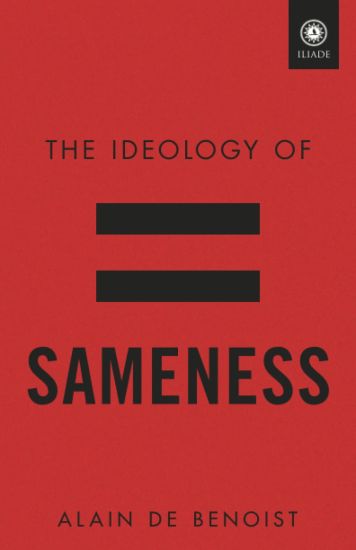
Alain de Benoist attributed liberalism and the individualism that stems from it to the idea of making man, a social animal, a being removed from the soil, uprooted from any community and therefore interchangeable. This essay gives Benoist the opportunity to return to this theme by developing a definition of what he calls 'the ideology of Sameness'. If we reject egalitarianism, should we accept all kinds of inequality? No, because equality is never an absolute. Men can be equal in certain respects - for example, their political membership in a community - and unequal in others. As communal beings, men must necessarily accept such forms of equality. What needs to be fought against, however, is the 'ideology of Sameness', which lies at the heart of modernity. This sinister dynamic aims at the complete annihilation of all differences, the neutralisation of the world, and the destruction of communities - all in the name of a purely mathematical vision of equality. This is a pathological distortion of the concept of political equality. Equality is not synonymous with Sameness.


In the West, liberalism is hegemonic. Civilization is decaying all around us, yet liberal democrats have declared their system to be "the end of history." We are told there is "no alternative" to capitalism. The Left has abandoned socialism for "neoliberalism." The Right has abandoned nation and tradition for "classical liberalism." Freedom is the only way. In Against Liberalism: Society Is Not a Market, Alain de Benoist shows the inadequacy of liberalism's philosophical premises: individualism, self-interest, progressivism, human rights, capitalism, market values, and "economic man." He shows that liberalism in practice is incompatible with genuine diversity and with democratic, communitarian, and conservative values. He suggests that society can have a market without being a market. It turns out that the best society is one in which not everything is up for sale. "Alain de Benoist's Against Liberalism offers a powerful critique of liberalism as both a philosophy and a political and economic system, based on the writer's firm belief that a viable human society must be something more than just a market. I welcome this readable and beautifully produced English translation, which will give his ideas a global reach and impact."-Michael Walker, founder of The Scorpion"Liberalism's most fundamental doctrine is that society is a mere collection of individuals, each of whom seeks to maximize his self-interest. Liberalism denies the existence of any objective human good in favor of subjective preferences. It denies that there is a common good beyond a mere aggregate of individual preferences. Alain de Benoist argues that these ideas are destructive of human identity and of much of what makes life worth living. In the present critique he points the way back to a politics based on real decisions in pursuit of the common good."-F. Roger Devlin, author of Sexual Utopia in Power




The Conservative Revolution in Germany, 1918-1932 is one the most comprehensive, most lasting, and most influential studies of the European Right--in particular, the fifteen years in Germany between the Armistice and Third Reich. This chaotic time witnessed a new type of right-wing thinking: traditionalist, yet oriented towards a new beginning . . . consciously nationalist (v lkisch), yet civilizational in scope . . . born in the despair of defeat and humiliation, yet envisioning a triumphant new age. The Conservative Revolutionaries sought an "overthrow of an overthrow."Armin Mohler, who knew many of these figures personally, traces the development of this German ideal from Friedrich Nietzsche, Richard Wagner, Oswald Spengler, Thomas Mann, Arthur Moeller van den Bruck, Ernst J nger, Carl Schmitt, and beyond. The Conservative Revolutionaries persistently thought against the grain. They stood in opposition both to Bolshevism and Anglo-American capitalism, as well as Hitler and the incipient National Socialist regime. They continue to offer a vital alternative to both Left and Right in the twenty-first century. Available in English for the first time, this edition includes new essays by Paul E. Gottfried and Alain de Benoist, who discuss the book's influence and contemporary relevance.
