The book is a research monograph. An asymptotically exact solution of the many-body scattering problem is given under the assumption a « d « ?, where a is the characteristic size of a small particle, d is the smallest distance between particles and ? is the wavelength in the medium in which the particles are embedded. Scattering of scalar and electromagnetic waves is considered. Heat transfer theory in the medium in which many small bodies are embedded is developed. Quantum-mechanical theory of scattering by many potentials with small support is constructed.On the basis of these theoretical results, important applications are presented. First, a method for creating materials with a desired refraction coefficient is given. Secondly, a method for creating wave-focusing materials is developed. Technological problems to be solved for practical usage of these applied results are discussed.This book contains the contents of the author's earlier monograph, published in 2013. New appendices, based on the author's review papers published after 2013, are added.
This book presents analytical formulas which allow one to calculate the S-matrix for the acoustic and electromagnetic wave scattering by small bodies or arbitrary shapes with arbitrary accuracy. Equations for the self-consistent field in media consisting of many small bodies are derived. Applications of these results to ultrasound mammography and electrical engineering are considered.The above formulas are not available in the works of other authors. Their derivation is based on a mathematical theory for solving integral equations of electrostatics, magnetostatics, and other static fields. These equations are at a simple characteristic value. Convergent iterative processes are constructed for stable solution of these equations. The theory completes the classical work of Rayleigh on scattering by small bodies by providing analytical formulas for polarizability tensors for bodies of arbitrary shapes.
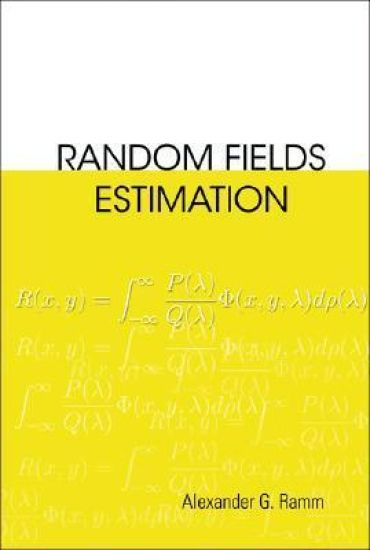
This book contains a novel theory of random fields estimation of Wiener type, developed originally by the author and presented here. No assumption about the Gaussian or Markovian nature of the fields are made. The theory, constructed entirely within the framework of covariance theory, is based on a detailed analytical study of a new class of multidimensional integral equations basic in estimation theory.This book is suitable for graduate courses in random fields estimation. It can also be used in courses in functional analysis, numerical analysis, integral equations, and scattering theory.
The book is important as it contains results many of which are not available in the literature, except in the author's papers. Among other things, it gives uniqueness theorems for inverse scattering problems when the data are non-over-determined, numerical method for solving inverse scattering problems, a method (MRC) for solving direct scattering problem.
The book is a research monograph by the author, presenting significant results with important applications in materials science. For example, it introduces a method for designing materials with a desired refraction coefficient — a method whose very existence was previously unknown.This method is based on the author's original theory for solving many-body scattering problems in cases where multiple scattering is essential. The problem is treated under the assumption a
Over the past decade, the field of image processing has made tremendous advances. One type of image processing that is currently of particular interest is "tomographic imaging," a technique for computing the density function of a body, or discontinuity surfaces of this function. Today, tomography is widely used, and has applications in such fields as medicine, engineering, physics, geophysics, and security. The Radon Transform and Local Tomography clearly explains the theoretical, computational, and practical aspects of applied tomography. It includes sufficient background information to make it essentially self-contained for most readers.
Inverse Problems is a monograph which contains a self-contained presentation of the theory of several major inverse problems and the closely related results from the theory of ill-posed problems. The book is aimed at a large audience which include graduate students and researchers in mathematical, physical, and engineering sciences and in the area of numerical analysis.
This book is intended for &tudents, research engineers, and mathematicians interested in applications or numerical analysis. Pure analysts will also find some new problems to tackle. Most of the material can be understood by a reader with a relatively modest knowledge of differential and inte gral equations and functional analysis. Readers interested in stochastic optimization will find a new theory of prac tical . importance. Readers interested in problems of static and quasi-static electrodynamics, wave scattering by small bodies of arbitrary shape, and corresponding applications in geophysics, optics, and radiophysics will find explicit analytical formulas for the scattering matrix, polarizability tensor, electrical capacitance of bodies of an arbitrary shape; numerical examples showing the practical utility of these formulas; two-sided variational estimates for the pol arizability tensor; and some open problems such as working out a standard program for calculating the capacitance and polarizability of bodies of arbitrary shape and numerical calculation of multiple integrals with weak singularities. Readers interested in nonlinear vibration theory will find a new method for qualitative study of stationary regimes in the general one-loop passive nonlinear network, including stabil ity in the large, convergence, and an iterative process for calculation the stationary regime. No assumptions concerning the smallness of the nonlinearity or the filter property of the linear one-port are made. New results in the theory of nonlinear operator equations form the basis for the study.
Iterative methods for calculating static fields are presented in this book. Static field boundary value problems are reduced to the boundary integral equations and these equations are solved by means of iterative processes. This is done for interior and exterior problems and for var ious boundary conditions. Most problems treated are three-dimensional, because for two-dimensional problems the specific and often powerful tool of conformal mapping is available. The iterative methods have some ad vantages over grid methods and, to a certain extent, variational methods: (1) they give analytic approximate formulas for the field and for some functionals of the field of practical importance (such as capacitance and polarizability tensor), (2) the formulas for the functionals can be used in a computer program for calculating these functionals for bodies of arbitrary shape, (3) iterative methods are convenient for computers. From a practical point of view the above methods reduce to the cal culation of multiple integrals. Of special interest is the case of inte grands with weak singularities. Some of the central results of the book are some analytic approximate formulas for scattering matrices for small bodies of arbitrary shape. These formulas answer many practical questions such as how does the scattering depend on the shape of the body or on the boundary conditions, how does one calculate the effective field in a medium consisting of many small particles, and many other questions.
Dynamical Systems Method for Solving Nonlinear Operator Equations is of interest to graduate students in functional analysis, numerical analysis, and ill-posed and inverse problems especially. The book presents a general method for solving operator equations, especially nonlinear and ill-posed. It requires a fairly modest background and is essentially self-contained. All the results are proved in the book, and some of the background material is also included. The results presented are mostly obtained by the author.
Over the past decade, the field of image processing has made tremendous advances. One type of image processing that is currently of particular interest is "tomographic imaging," a technique for computing the density function of a body, or discontinuity surfaces of this function. Today, tomography is widely used, and has applications in such fields as medicine, engineering, physics, geophysics, and security. The Radon Transform and Local Tomography clearly explains the theoretical, computational, and practical aspects of applied tomography. It includes sufficient background information to make it essentially self-contained for most readers.
Demonstrates the application of DSM to solve a broad range of operator equations The dynamical systems method (DSM) is a powerful computational method for solving operator equations. With this book as their guide, readers will master the application of DSM to solve a variety of linear and nonlinear problems as well as ill-posed and well-posed problems. The authors offer a clear, step-by-step, systematic development of DSM that enables readers to grasp the method's underlying logic and its numerous applications. Dynamical Systems Method and Applications begins with a general introduction and then sets forth the scope of DSM in Part One. Part Two introduces the discrepancy principle, and Part Three offers examples of numerical applications of DSM to solve a broad range of problems in science and engineering. Additional featured topics include: General nonlinear operator equations Operators satisfying a spectral assumption Newton-type methods without inversion of the derivative Numerical problems arising in applications Stable numerical differentiation Stable solution to ill-conditioned linear algebraic systems Throughout the chapters, the authors employ the use of figures and tables to help readers grasp and apply new concepts. Numerical examples offer original theoretical results based on the solution of practical problems involving ill-conditioned linear algebraic systems, and stable differentiation of noisy data. Written by internationally recognized authorities on the topic, Dynamical Systems Method and Applications is an excellent book for courses on numerical analysis, dynamical systems, operator theory, and applied mathematics at the graduate level. The book also serves as a valuable resource for professionals in the fields of mathematics, physics, and engineering.
Inverse Problems is a monograph which contains a self-contained presentation of the theory of several major inverse problems and the closely related results from the theory of ill-posed problems. The book is aimed at a large audience which include graduate students and researchers in mathematical, physical, and engineering sciences and in the area of numerical analysis.
The behavior of acoustic or electromagnetic waves reflecting off, and scattering from, intercepted bodies of any size and kind can make determinations about the materials of those bodies and help in better understanding how to manipulate such materials for desired characteristics. This book offers analytical formulas which allow you to calculate acoustic and electromagnetic waves, scattered by one and many small bodies of an arbitrary shape under various boundary conditions. Equations for the effective (self-consistent) field in media consisting of many small bodies are derived. These results and formulas are new and not available in the works of other authors.
Creating Materials with a Desired Refraction Coefficient provides a recipe for creating materials with a desired refraction coefficient, and the many-body wave scattering problem for many small impedance bodies is solved. The physical assumptions make the multiple scattering effects essential. On the basis of this theory, a recipe for creating materials with a desired refraction coefficient is given. Technological problems are formulated which, when solved, make the theory practically applicable. The Importance of a problem of producing a small particle with a desired boundary impedance is emphasized, and inverse scattering with non-over-determined scattering data is considered.
Creating Materials with a Desired Refraction Coefficient provides a recipe for creating materials with a desired refraction coefficient, and the many-body wave scattering problem for many small impedance bodies is solved. The physical assumptions make the multiple scattering effects essential. On the basis of this theory, a recipe for creating materials with a desired refraction coefficient is given. Technological problems are formulated which, when solved, make the theory practically applicable. The Importance of a problem of producing a small particle with a desired boundary impedance is emphasized, and inverse scattering with non-over-determined scattering data is considered.