Kirjojen hintavertailu. Mukana 11 244 527 kirjaa ja 12 kauppaa.

Kirjahaku

Etsi kirjoja tekijän nimen, kirjan nimen tai ISBN:n perusteella.

1000 tulosta hakusanalla Alfred J. Mac Adam

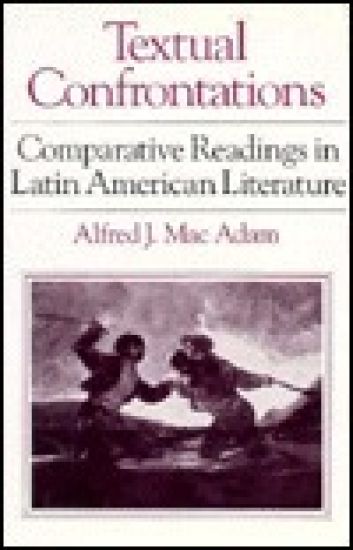
Textual Confrontations

Textual Confrontations

Alfred J. Mac Adam

University of Chicago Press
1987
sidottu
In this masterful experiment in truly comparative literary criticism, Alfred J. Mac Adam establishes Latin America's place in the Western literary tradition. By juxtaposing Latin American and Anglo-American texts, he shows how Latin American literature has gone beyond the context of Hispanic letters to borrow from, exploit, and finally extend the Western tradition. Mac Adam describes the changes that have taken place in Latin American literature since the time of Modernismo (roughly 1880-1920), when Spanish American writers tried to update their literary language by imitating foreign, mostly French, literature. Since then, as he demonstrates, Latin American writing has achieved a pioneering status by means of a different kind of imitation—parody—whereby it gives back to the former centers of Western culture their own writing, now distorted and reshaped into something new.
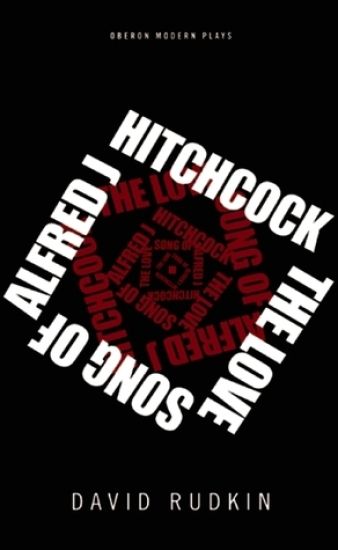
The Lovesong of Alfred J Hitchcock

The Lovesong of Alfred J Hitchcock

David Rudkin

Oberon Books Ltd
2014
nidottu
Alfred Hitchcock, at the height of his powers, is possessed by a dreamlike vision of a woman. From his director’s chair the sixty year old Hitchcock begins to unravel some of the defining films of our time, drawing us into the imagination of one of the world’s most mysterious creative minds.This poetic new play takes a unique look at the way the great filmmaker Alfred Hitchcock developed the idea of his most famous films, including Marnie, Vertigo, Psycho and Strangers on A Train. The result is a unique and haunting character study and an unprecedented journey into the mind of one our most fascinating cultural icons.
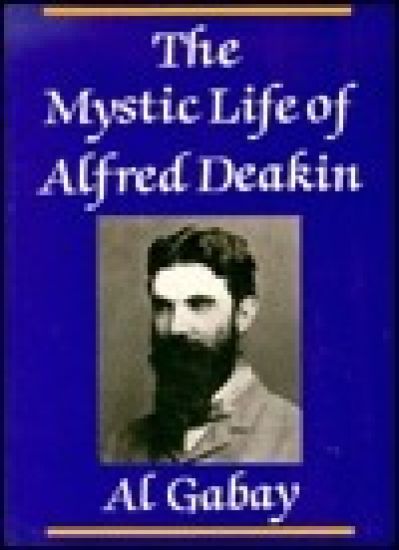
The Mystic Life of Alfred Deakin

The Mystic Life of Alfred Deakin

Alfred J. Gabay

Cambridge University Press
1993
pokkari
Alfred Deakin (1857–1919) is recognised as an architect of the Australian Federation and served three terms as Prime Minister. Though his life has been well documented, no previous biographer has studied the intense spiritual life of this would-be poet, preacher and mystic. Drawing from volumes of Deakin's private journals and prayerbooks, in this 1993 text Al Gabay presents us with a complex man who had a profound sense of history and who, being convinced that his political life had a divine mandate, yearned for an understanding of his true duty. Throughout his life he was absorbed and influenced by the Occult and this book reveals the implications of this private spirituality for the political history of Australia. This illustrates not only the intellectual climate of Deakin's era but Victorian ideas of religious doubt, evolution, and reform.
Storms over the Balkans during the Second World War

Storms over the Balkans during the Second World War

Alfred J. Rieber

Oxford University Press
2022
sidottu
In a new interpretation of the history of the Balkans during the Second World War, Alfred J. Rieber explores the tangled political rivalries, cultural clashes, and armed conflicts among the great powers and the indigenous people competing for influence and domination. The study takes an original approach to the region based on the geography, social conditions, and imperial rivalries that spans several centuries, culminating in three wars during the first half of the twentieth century. Against this background, Rieber focuses on leadership - personified by Mussolini, Hitler, Stalin, Churchill, and Tito - as the key to explaining events. For each one the Balkans represented a strategic prize vital for the fulfilment of their ambitious war aims. For the local forces the destabilization of the war offered the opportunity to reorder societies, expel ethnic minorities, and expand national borders. Storms over the Balkans during the Second World War illustrates how the leaders of the external powers were forced to improvise their tactics and compromise their ideologies under the pressure of war and the competing claims of their allies and clients. Neither the Axis nor the Allied camps were uniform blocs, and deep divisions ran through the ranks of the resistance and those collaborating with the occupying powers. These tensions contributed to the failure of all the participants in the struggle to achieve their aims. The complexities of the wartime experiences help to explain the persistence of memories and unfulfilled aspirations that continue to haunt the region. The study is based on extensive research in new sources in seven languages.
Stalin as Warlord

Stalin as Warlord

Alfred J. Rieber

YALE UNIVERSITY PRESS
2022
sidottu
An authoritative account of Stalin as a wartime leader—showing how his paradoxical policies of mass mobilization and repression affected all aspects of Soviet society “A superb new history. . . . Rieber analyses with clarity the impact of the war.”—Wendy Slater, Times Literary Supplement The Second World War was the defining moment in the history of the Soviet Union. With Stalin at the helm, it emerged victorious at a huge economic and human cost. But even before the fighting had ended, Stalin began to turn against the architects of success. In this original and comprehensive study, Alfred J. Rieber examines Stalin as a wartime leader, arguing that his policies were profoundly paradoxical. In preparation for the war, Stalin mobilized the whole of Soviet society in pursuit of his military goals and intensified the centralization of his power. Yet at the same time, his use of terror weakened the forces vital to the defense of the country. In his efforts to rebuild the country after the devastating losses and destruction, he suppressed groups that had contributed immeasurably to victory. His steady, ruthless leadership cultivated a legacy that was to burden the Soviet Union and Russia to the present day.
Analytical Theory of Biological Populations

Analytical Theory of Biological Populations

Alfred J. Lotka

Kluwer Academic/Plenum Publishers
1998
sidottu
In the 50 years that have passed since Alfred Latka's death in 1949 his position as the father of mathematical demography has been secure. With his first demographic papers in 1907 and 1911 (the latter co­ authored with F. R. Sharpe) he laid the foundations for stable population theory, and over the next decades both largely completed it and found convenient mathematical approximations that gave it practical applica­ tions. Since his time, the field has moved in several directions he did not foresee, but in the main it is still his. Despite Latka's stature, however, the reader still needs to hunt through the old journals to locate his principal works. As yet no exten­ sive collections of his papers are in print, and for his part he never as­ sembled his contributions into a single volume in English. He did so in French, in the two part Theorie Analytique des Associations Biologiques (1934, 1939). Drawing on his Elements of Physical Biology (1925) and most of his mathematical papers, Latka offered French readers insights into his biological thought and a concise and mathematically accessible summary of what he called recent contributions in demographic analy­ sis. We would be accurate in also calling it Latka's contributions in demographic analysis.
Notes on Fermat's Last Theorem

Notes on Fermat's Last Theorem

Alfred J. van der Poorten

John Wiley Sons Inc
1996
sidottu
Around 1637, the French jurist Pierre de Fermat scribbled in the margin of his copy of the book Arithmetica what came to be known as Fermat's Last Theorem, the most famous question in mathematical history. Stating that it is impossible to split a cube into two cubes, or a fourth power into two fourth powers, or any higher power into two like powers, but not leaving behind the marvelous proof he claimed to have had, Fermat prompted three and a half centuries of mathematical inquiry which culminated only recently with the proof of the theorem by Andrew Wiles. This book offers the first serious treatment of Fermat's Last Theorem since Wiles's proof. It is based on a series of lectures given by the author to celebrate Wiles's achievement, with each chapter explaining a separate area of number theory as it pertains to Fermat's Last Theorem. Together, they provide a concise history of the theorem as well as a brief discussion of Wiles's proof and its implications. Requiring little more than one year of university mathematics and some interest in formulas, this overview provides many useful tips and cites numerous references for those who desire more mathematical detail. The book's most distinctive feature is its easy-to-read, humorous style, complete with examples, anecdotes, and some of the lesser-known mathematics underlying the newly discovered proof. In the author's own words, the book deals with "serious mathematics without being too serious about it." Alf van der Poorten demystifies mathematical research, offers an intuitive approach to the subject—loosely suggesting various definitions and unexplained facts—and invites the reader to fill in the missing links in some of the mathematical claims. Entertaining, controversial, even outrageous, this book not only tells us why, in all likelihood, Fermat did not have the proof for his last theorem, it also takes us through historical attempts to crack the theorem, the prizes that were offered along the way, and the consequent motivation for the development of other areas of mathematics. Notes on Fermat's Last Theorem is invaluable for students of mathematics, and of real interest to those in the physical sciences, engineering, and computer sciences—indeed for anyone who craves a glimpse at this fascinating piece of mathematical history. An exciting introduction to modern number theory as reflected by the history of Fermat's Last Theorem This book displays the unique talents of author Alf van der Poorten in mathematical exposition for mathematicians. Here, mathematics' most famous question and the ideas underlying its recent solution are presented in a way that appeals to the imagination and leads the reader through related areas of number theory. The first book to focus on Fermat's Last Theorem since Andrew Wiles presented his celebrated proof, Notes on Fermat's Last Theorem surveys 350 years of mathematical history in an amusing and intriguing collection of tidbits, anecdotes, footnotes, exercises, references, illustrations, and more. Proving that mathematics can make for lively reading as well as intriguing thought, this thoroughly accessible treatment Helps students and professionals develop a background in number theory and provides introductions to the various fields of theory that are touched upon *Offers insight into the exciting world of mathematical research *Covers a number of areas appropriate for classroom use *Assumes only one year of university mathematics background even for the more advanced topics *Explains why Fermat surely did not have the proof to his theorem *Examines the efforts of mathematicians over the centuries to solve the problem *Shows how the pursuit of the theorem contributed to the greater development of mathematics
The Turf Problem Solver

The Turf Problem Solver

Alfred J. Turgeon; J. M. Vargas

John Wiley Sons Inc
2006
sidottu
Written by two leading experts, this practical tool offers detailed advice on defining, analyzing, and solving today’s most common turf problems. Presented in a distinguished case-based approach, it features solutions for environmental, cultural, and pest and pesticide turf problems; coverage of human resources issues; and accessible methods for evaluation, analysis, and synthesis.