Kirjojen hintavertailu. Mukana 11 244 527 kirjaa ja 12 kauppaa.

Kirjahaku

Etsi kirjoja tekijän nimen, kirjan nimen tai ISBN:n perusteella.

1000 tulosta hakusanalla Allen B. Downey

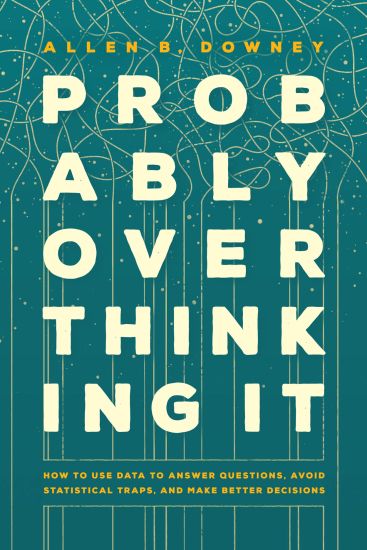
Probably Overthinking It

Probably Overthinking It

Allen B. Downey

THE UNIVERSITY OF CHICAGO PRESS
2023
sidottu
An essential guide to the ways data can improve decision making. Statistics are everywhere: in news reports, at the doctor’s office, and in every sort of forecast, from the stock market to the weather. Blogger, teacher, and computer scientist Allen B. Downey knows well that people have an innate ability both to understand statistics and to be fooled by them. As he makes clear in this accessible introduction to statistical thinking, the stakes are big. Simple misunderstandings have led to incorrect medical prognoses, underestimated the likelihood of large earthquakes, hindered social justice efforts, and resulted in dubious policy decisions. There are right and wrong ways to look at numbers, and Downey will help you see which are which. Probably Overthinking It uses real data to delve into real examples with real consequences, drawing on cases from health campaigns, political movements, chess rankings, and more. He lays out common pitfalls—like the base rate fallacy, length-biased sampling, and Simpson’s paradox—and shines a light on what we learn when we interpret data correctly, and what goes wrong when we don’t. Using data visualizations instead of equations, he builds understanding from the basics to help you recognize errors, whether in your own thinking or in media reports. Even if you have never studied statistics—or if you have and forgot everything you learned—this book will offer new insight into the methods and measurements that help us understand the world.
Probably Overthinking It

Probably Overthinking It

Allen B. Downey

THE UNIVERSITY OF CHICAGO PRESS
2025
nidottu
An essential guide to the ways data can improve decision making. Statistics are everywhere: in news reports, at the doctor’s office, and in every sort of forecast, from the stock market to the weather. Blogger, teacher, and computer scientist Allen B. Downey knows well that people have an innate ability both to understand statistics and to be fooled by them. As he makes clear in this accessible introduction to statistical thinking, the stakes are big. Simple misunderstandings have led to incorrect medical prognoses, underestimated the likelihood of large earthquakes, hindered social justice efforts, and resulted in dubious policy decisions. There are right and wrong ways to look at numbers, and Downey will help you see which are which. Probably Overthinking It uses real data to delve into real examples with real consequences, drawing on cases from health campaigns, political movements, chess rankings, and more. He lays out common pitfalls—like the base rate fallacy, length-biased sampling, and Simpson’s paradox—and shines a light on what we learn when we interpret data correctly, and what goes wrong when we don’t. Using data visualizations instead of equations, he builds understanding from the basics to help you recognize errors, whether in your own thinking or in media reports. Even if you have never studied statistics—or if you have and forgot everything you learned—this book will offer new insight into the methods and measurements that help us understand the world.
Python for Software Design

Python for Software Design

Allen B. Downey

Cambridge University Press
2009
pokkari
A no-nonsense introduction to software design using the Python programming language. Written for people with no programming experience, this book starts with the most basic concepts and gradually adds new material. Some of the ideas students find most challenging, like recursion and object-oriented programming, are divided into a sequence of smaller steps and introduced over the course of several chapters. The focus is on the programming process, with special emphasis on debugging. The book includes a wide range of exercises, from short examples to substantial projects, so that students have ample opportunity to practise each new concept. Exercise solutions and code examples are available from thinkpython.com, along with Swampy, a suite of Python programs that is used in some of the exercises.
Python for Software Design

Python for Software Design

Allen B. Downey

Cambridge University Press
2009
sidottu
A no-nonsense introduction to software design using the Python programming language. Written for people with no programming experience, this book starts with the most basic concepts and gradually adds new material. Some of the ideas students find most challenging, like recursion and object-oriented programming, are divided into a sequence of smaller steps and introduced over the course of several chapters. The focus is on the programming process, with special emphasis on debugging. The book includes a wide range of exercises, from short examples to substantial projects, so that students have ample opportunity to practise each new concept. Exercise solutions and code examples are available from thinkpython.com, along with Swampy, a suite of Python programs that is used in some of the exercises.
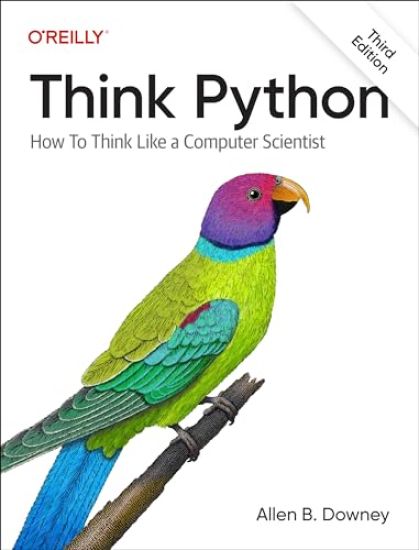
Think Python

Think Python

Allen B. Downey

O'Reilly Media
2024
nidottu
Python is an excellent way to get started in programming, and this clear, concise guide walks you through Python a step at a time-beginning with basic programming concepts before moving on to functions, data structures, and object-oriented design. This revised third edition reflects the growing role of large language models (LLMs) in programming and includes exercises on effective LLM prompts, testing code, and debugging skills. With this popular hands-on guide at your side, you'll get: A grounding in the syntax and semantics of the Python language A clear definition of each programming concept, with emphasis on clear vocabulary How to work with variables, statements, functions, and data structures in a logical progression Techniques for reading and writing files and databases A solid understanding of objects, methods, and object-oriented programming Debugging strategies for syntax, runtime, and semantic errors An introduction to recursion, interface design, data structures, and basic algorithms How to use LLMs-including effective prompts, testing code, and debugging And more
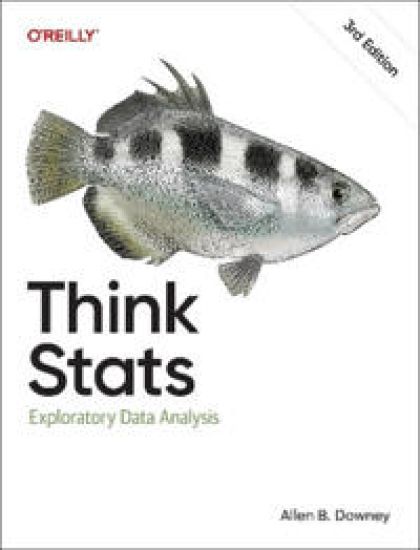
Think Stats

Think Stats

Allen B. Downey

O'Reilly Media
2025
nidottu
If you know how to program, you have the skills to turn data into knowledge. This thoroughly revised edition presents statistical concepts computationally, rather than mathematically, using programs written in Python. Through practical examples and exercises based on real-world datasets, you'll learn the entire process of exploratory data analysis-from wrangling data and generating statistics to identifying patterns and testing hypotheses.Whether you're a data scientist, software engineer, or data enthusiast, you'll get up to speed on commonly used tools including NumPy, SciPy, and Pandas. You'll explore distributions, relationships between variables, visualization, and many other concepts. And all chapters are available as Jupyter notebooks, so you can read the text, run the code, and work on exercises all in one place.Analyze data distributions and visualize patterns using Python librariesImprove predictions and insights with regression modelsDive into specialized topics like time series analysis and survival analysisIntegrate statistical techniques and tools for validation, inference, and moreCommunicate findings with effective data visualizationTroubleshoot common data analysis challengesBoost reproducibility and collaboration in data analysis projects with interactive notebooks
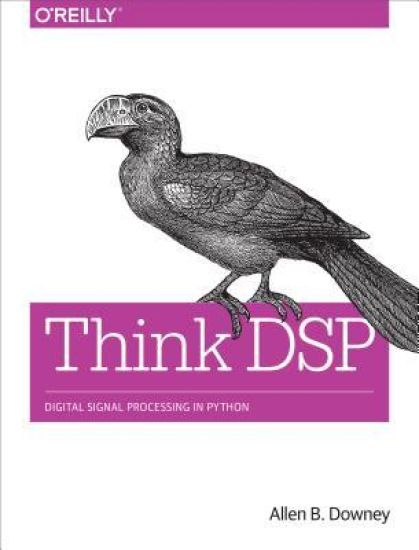
Think DSP

Think DSP

Allen B. Downey

O'Reilly Media, Inc, USA
2016
nidottu
"Think DSP: Digital Signal Processing in Python" is an introduction to signal processing and system analysis using a computational approach. The premise of this book (like the others in the Think X series) is that if you know how to program, you can use that skill to learn other things. By the end of the first chapter, you'll be able to decompose a sound into its harmonics, modify the harmonics, and generate new sounds. Subsequent chapters follow a logical progression that develops the important ideas incrementally, with a focus on applications.
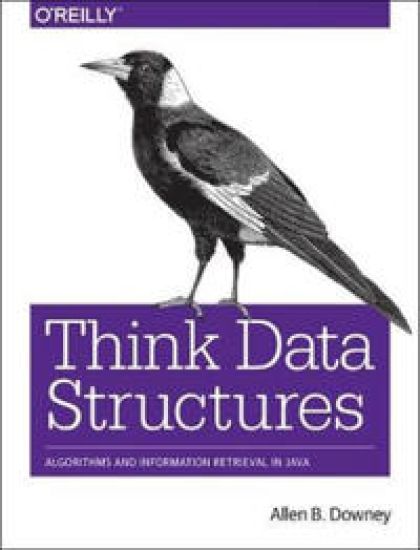
Think Data Structures

Think Data Structures

Allen B. Downey

O'Reilly Media, Inc, USA
2017
nidottu
If you’re a student studying computer science or a software developer preparing for technical interviews, this practical book will help you learn and review some of the most important ideas in software engineering—data structures and algorithms—in a way that’s clearer, more concise, and more engaging than other materials. By emphasizing practical knowledge and skills over theory, author Allen Downey shows you how to use data structures to implement efficient algorithms, and then analyze and measure their performance. You’ll explore the important classes in the Java collections framework (JCF), how they’re implemented, and how they’re expected to perform. Each chapter presents hands-on exercises supported by test code online. Use data structures such as lists and maps, and understand how they work Build an application that reads Wikipedia pages, parses the contents, and navigates the resulting data tree Analyze code to predict how fast it will run and how much memory it will require Write classes that implement the Map interface, using a hash table and binary search tree Build a simple web search engine with a crawler, an indexer that stores web page contents, and a retriever that returns user query results Other books by Allen Downey include Think Java, Think Python, Think Stats, and Think Bayes.
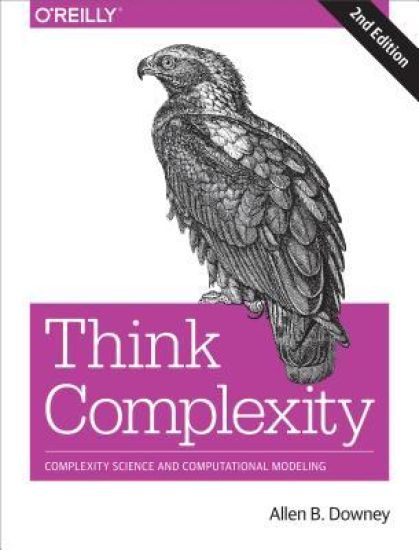
Think Complexity

Think Complexity

Allen B. Downey

O'Reilly Media, Inc, USA
2018
nidottu
Complexity science uses computation to explore the physical and social sciences. In Think Complexity, you’ll use graphs, cellular automata, and agent-based models to study topics in physics, biology, and economics. Whether you’re an intermediate-level Python programmer or a student of computational modeling, you’ll delve into examples of complex systems through a series of worked examples, exercises, case studies, and easy-to-understand explanations. In this updated second edition, you will: Work with NumPy arrays and SciPy methods, including basic signal processing and Fast Fourier Transform Study abstract models of complex physical systems, including power laws, fractals and pink noise, and Turing machines Get Jupyter notebooks filled with starter code and solutions to help you re-implement and extend original experiments in complexity; and models of computation like Turmites, Turing machines, and cellular automata Explore the philosophy of science, including the nature of scientific laws, theory choice, and realism and instrumentalism Ideal as a text for a course on computational modeling in Python, Think Complexity also helps self-learners gain valuable experience with topics and ideas they might not encounter otherwise.
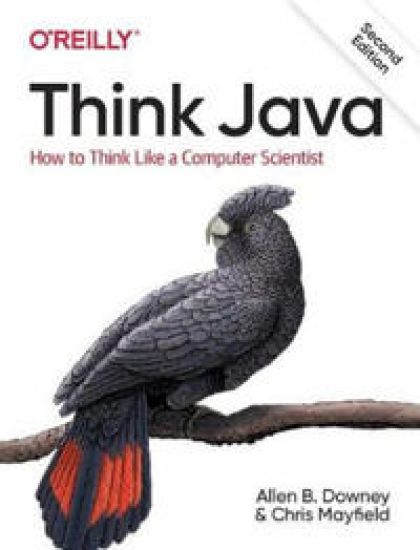
Think Java

Think Java

Allen B Downey; Chris Mayfield

O'Reilly Media, Inc, USA
2019
pokkari
Think Java is a hands-on introduction to computer science and programming used by many universities and high schools around the world. Its conciseness, emphasis on vocabulary, and informal tone make it particularly appealing for readers with little or no experience. The book starts with the most basic programming concepts and gradually works its way to advanced object-oriented techniques. In this fully updated and expanded edition, authors Allen Downey and Chris Mayfield introduce programming as a means for solving interesting problems. Each chapter presents material for one week of a college course and includes exercises to help you practice what you’ve learned. Along the way, you’ll see nearly every topic required for the AP Computer Science A exam and Java SE Programmer I certification. Discover one concept at a time: tackle complex topics in a series of small steps with multiple examples Understand how to formulate problems, think creatively about solutions, and develop, test, and debug programs Learn about input and output, decisions and loops, classes and methods, strings and arrays, recursion and polymorphism Determine which program development methods work best for you, and practice the important skill of debugging
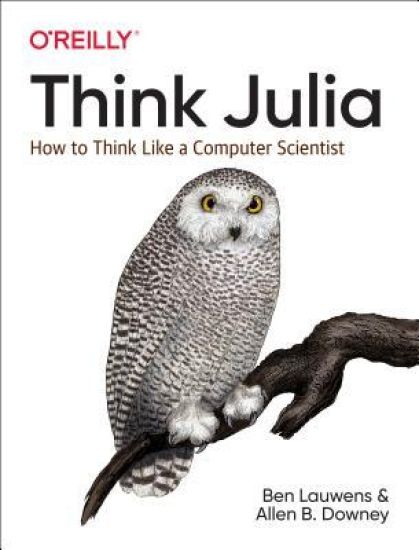
Think Julia

Think Julia

Ben Lauwens; Allen B Downey

O'Reilly Media, Inc, USA
2019
pokkari
If you’re just learning how to program, Julia is an excellent JIT-compiled, dynamically typed language with a clean syntax. This hands-on guide uses Julia 1.0 to walk you through programming one step at a time, beginning with basic programming concepts before moving on to more advanced capabilities, such as creating new types and multiple dispatch. Designed from the beginning for high performance, Julia is a general-purpose language ideal for not only numerical analysis and computational science but also web programming and scripting. Through exercises in each chapter, you’ll try out programming concepts as you learn them. Think Julia is perfect for students at the high school or college level as well as self-learners and professionals who need to learn programming basics. Start with the basics, including language syntax and semantics Get a clear definition of each programming concept Learn about values, variables, statements, functions, and data structures in a logical progression Discover how to work with files and databases Understand types, methods, and multiple dispatch Use debugging techniques to fix syntax, runtime, and semantic errors Explore interface design and data structures through case studies
Client-Centered Software Development

Client-Centered Software Development

Allen B. Tucker

CRC Press
2020
nidottu
Client-Centered Software Development: The CO-FOSS Approach introduces a method to creating a customized software product for a single client, either from scratch or by reusing open source components. The clients are typically non-profit humanitarian, educational, or public service organizations. This approach has been used in undergraduate courses where students learn the principles of software development while implementing a real-world software product. This book provides instructors, students, clients, and professional software developers with detailed guidance for developing a new CO-FOSS product from conceptualization to completion.Features Provides instructors, students, clients, and professional software developers with a roadmap for the development of a new CO-FOSS product from conceptualization to completion Motivates students with real-world projects and community service experiences Teaches all elements of the software process, including requirements gathering, design, collaboration, coding, testing, client communication, refactoring, and writing developer and user documentation Uses source code that can be reused and refitted to suit the needs of future projects, since each CO-FOSS product is free and open source software Provides links to a rich variety of resources for instructors and students to freely use in their own courses that develop new CO-FOSS products for other non-profits.
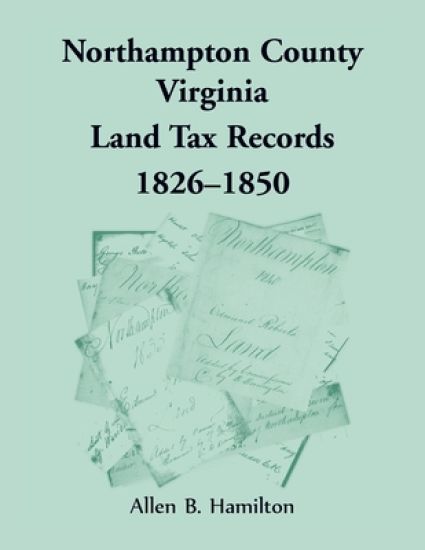
Northampton County, Virginia Land Tax Records, 1826-1850
This is the third volume in a series of land tax records, which offer a wealth of valuable genealogical data presented in a convenient table format with entries listed alphabetically by surname within each section. This volume includes twelve complete years: 1826, 1828, 1830, 1832, 1835, 1838, 1840, 1842, 1843, 1845, 1848, and 1850 and the totals for all the years during the period. The totals sheet also includes the tax rate and commissioner for each year. Column headings include: Name of Owners (Residence is Northampton unless otherwise noted), Estate whether held in fee or life etc., Number of Acres of Land, District of Land, Distance and bearing from Court Yard, Value of Land per acre including buildings, Sum added on account of buildings, Total value of the land and buildings, Amount of tax at the current rate per every $100, and Explanation of alterations during the preceding year. Tables include: 1826 Land Tax by Levin Y. Winder Com: Rev:, 1828 Land Tax by Levin Y. Winder Com: Rev:, 1830 Land Tax by Levin Y. Winder Com: Rev:, 1832 Land Tax by Levin Y. Winder Com: Rev:, 1835 Land Tax by Levin Y. Winder Com: Rev:, 1838 Land Tax by Edmund Roberts Com: Rev:, 1840 Land Tax by Edmund Roberts Com: Rev:, 1842 Land Tax by Edmund Roberts Com: Rev:, 1843 Land Tax by Edward P. Roberts Com: Rev:, 1845 Land Tax by Edward P. Roberts Com: Rev:, 1848 Land Tax by Edward P. Roberts Com: Rev:, 1850 Land Tax by Edward P. Roberts Com: Rev:, and Land Tax Totals by year 1826-1850.
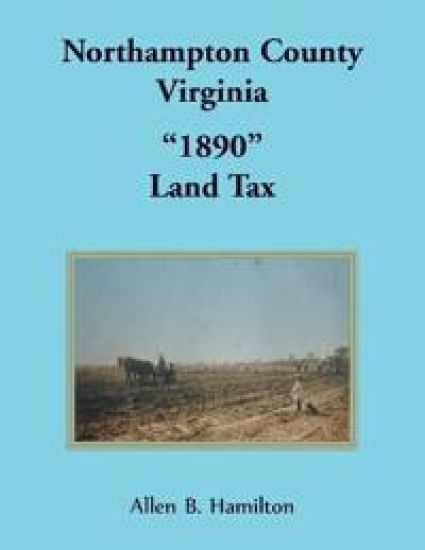
Northampton County, Virginia 1890 Land Tax

Northampton County, Virginia 1890 Land Tax

Allen B Hamilton

Heritage Books
2020
pokkari
This volume is presented in the same double-page format as Northampton County, Virginia, 1890 Personal Property Tax List due to the volume of information. It offers a wealth of valuable genealogical data presented in a convenient table format with entries listed alphabetically by surname within most sections. Column headings include: Name of Person who by himself or by his tenant has the freehold in possession the land charged (residence of the owner of the tract of land - both in column 1); Nature of the owner's estate whether held in fee or for life; Number of acres in each tract; Name of tract and description of the land; Distance and Bearing from the courthouse; Value of land per acre, including buildings; Sum included in the value of each tract of land on account of buildings; Total value of the land and buildings; Amt. of tax on the land and buildings at 30 cts. on every $100 value thereof; Amt. of tax on the land and buildings at 10 cts. on every $100 value thereof; TOTAL TAX; Amt. of tax levied for county free school purposes; Amt. of tax levied for district free school purposes; Total levy for county and district free school purposes; and Amt. of Tax levied for County Purposes. Chapters include: Capeville District, Recapitulation, Eastville District, Recapitulation, Franktown District, Recapitulation, Cape Charles City, Recapitulation, County Recapitulation, Cape Charles (map and lots), Oaths & Certificates, Largest Landowners, and Largest taxpayers. Several facsimile reprints of original documents and a full-name index add to the value of this work.