

Kirjahaku
Etsi kirjoja tekijän nimen, kirjan nimen tai ISBN:n perusteella.
1000 tulosta hakusanalla Ambassador Denis G Antoine


What's an ambassador? Where do ambassadors go? Who do they meet? What do they do?"Let's All be Ambassadors for a Better World" teaches children exactly what the exciting job of an ambassador entails. This engaging book not only teaches children that they could be ambassadors when they grow up, but that they could be ambassadors right now They could be ambassadors for their family, school, sport, or for any cause that matters deeply to them - as long as they want to be ambassadors for a better world.

If you ever wondered who becomes an American ambassador and why, this is the book for you. It describes how Foreign Service officers become ambassadors by rising up through the ranks, and why they typically make up about 70 percent of the total number of ambassadors. It also covers where the other 30 percent come from—the political appointees who get the job because they helped elect the president by supporting him as a campaign contributor, a political ally, or a personal friend. It explains why, despite being illegal and a threat to national security, selling the title of ambassador remains a common practice that is also unique to the United States. It considers why some suggestions for reform are misguided, what might be done, and why who the president is matters so much in determining how well the United States will be represented abroad. This updated and revised edition of Jett's classic book not only provides a timely overview of American ambassadorship for Foreign Service Officers, aspiring diplomats, and interested citizens, but also calls for much-needed reform, describing the dire implications of failing to change our ambassadorial appointments process for the future of American diplomatic practice and foreign policy.

Gabe Fuentes is in for the ride of his life when he becomes Earth's ambassador to the galaxy in this alien sci-fi adventure from the National Book Award-winning author of Goblin Secrets. Gabe Fuentes is reading under the covers one summer night when he is interrupted by a creature who looks like a purple sock puppet. The sock puppet introduces himself as the Envoy and asks if Gabe wants to be Earth's ambassador to the galaxy. What sane eleven-year-old could refuse? Some ingenious tinkering with the washing machine sends Gabe's "entangled" self out to the center of the galaxy. There he finds that Earth is in the path of a destructive alien force--and Gabe himself is the target of an assassination plot. Exactly who wants him out of the way? And why? Back home, Gabe discovers that his undocumented immigrant parents are in danger of being deported. Can Gabe survive long enough to solve two sets of "alien" problems? He runs for his life, through Minneapolis and outer space, in this fast-paced adventure from a National Book Award-winning author. "Physics lovers will enjoy this clever series opener--but so will those who enjoy comedy, politics, diplomacy or strange-looking aliens" (Kirkus Reviews, starred review).







Ambassador Frederic Sackett and the Collapse of the Weimar Republic, 1930–1933
Bernard V. Burke
Cambridge University Press
1995
sidottu
This book details a striking political relationship between American Ambassador Frederic Sackett and German Chancellor Heinrich Brüning and their attempts to save the Weimar Republic, achieve German nationalist goals, and thwart Adolf Hitler's drive to power. Sackett believed that financial policy was at the heart of German problems and, unless resolved, could be the basis for Hitler's success. Very early in his tenure in Berlin, Sackett saw Hitler and the Nazis as a serious danger to the Weimar Republic and to peace in Europe. The American thought that misrule by incompetent and inefficient Nazis would pave the way for a communist state. Although at first he saw the Nazis as harbingers of worse to come, in time he came to see Hitler as the real threat to democracy in Germany.
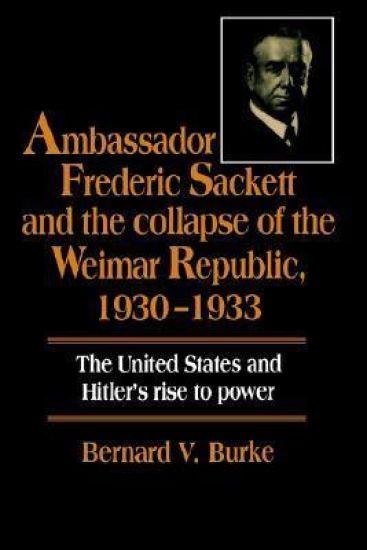
Ambassador Frederic Sackett and the Collapse of the Weimar Republic, 1930–1933
Bernard V. Burke
Cambridge University Press
2003
pokkari
This book details a striking political relationship between American Ambassador Frederic Sackett and German Chancellor Heinrich Brüning and their attempts to save the Weimar Republic, achieve German nationalist goals, and thwart Adolf Hitler’s drive to power. Sackett believed that financial policy was at the heart of German problems and, unless resolved, could be the basis for Hitler’s success. Very early in his tenure in Berlin, Sackett saw Hitler and the Nazis as a serious danger to the Weimar Republic and to peace in Europe. The American thought that misrule by incompetent and inefficient Nazis would pave the way for a communist state. Although at first he saw the Nazis as harbingers of worse to come, in time he came to see Hitler as the real threat to democracy in Germany.

Cassandra Crossing is beginning to feel like the bishop on the President's chess board. She is moved around to keep the country's enemies at bay. Cassandra is no longer an unknown intelligence operative. Now she's a celebrity and hero after a very public assignment protecting the southern border. This time Cassandra is being assigned to foreign soil and to a very dangerous job. She will be a very public target for those who would sabotage her vital mission to help keep a continent at peace. It is a job she is uniquely qualified for by heritage, experience and training. To complete her mission the first order of business will be survival. She will also unexpectedly have to deal with something new; a serious romantic interest. It is an assignment that will require the balance of a tight rope walker, the Wisdom of Solomon, the courage of a hero, and unusual diplomacy. It is a unique challenge for an unusual woman.
Spanning a long and unusually turbulent phase of Greek history, this collection of Lincoln MacVeagh's papers constitutes a record of high historical value, bringing together a selection of rich source material Originally published in 1980. The Princeton Legacy Library uses the latest print-on-demand technology to again make available previously out-of-print books from the distinguished backlist of Princeton University Press. These editions preserve the original texts of these important books while presenting them in durable paperback and hardcover editions. The goal of the Princeton Legacy Library is to vastly increase access to the rich scholarly heritage found in the thousands of books published by Princeton University Press since its founding in 1905.

Spanning a long and unusually turbulent phase of Greek history, this collection of Lincoln MacVeagh's papers constitutes a record of high historical value, bringing together a selection of rich source material Originally published in 1980. The Princeton Legacy Library uses the latest print-on-demand technology to again make available previously out-of-print books from the distinguished backlist of Princeton University Press. These editions preserve the original texts of these important books while presenting them in durable paperback and hardcover editions. The goal of the Princeton Legacy Library is to vastly increase access to the rich scholarly heritage found in the thousands of books published by Princeton University Press since its founding in 1905.

After Jesus had done his main work on earth and had returned to his Father, the total number of his followers amounted to 120 people... How did that little band of 120 simple people become part of a vast multitude of Christians? "The explanation of this amazing increase," writes Professor Barclay, "is none other than Paul." In this stimulating book the story of the pure-blooded Jew, Pharisee, Roman citizen, persecutor of Christians, dramatically converted into the first and greatest Christian missionary, is told with great force. The reader is made to feel the stresses and strains of life in first century Asia Minor and the Mediterranean, especially as they affected small Christian communities. Here one can appreciate the stature of the apostle Paul as he overcame his physical handicap to bring the gospel of Jesus to the centre of the known world.

Dogs are ambassadors to the world and our own local communities. They come to serve and love us as only they know how. Accompanied by 175 color images, discover the remarkable connection between dogs and humans through the inspiring stories of 24 dogs and the owners whose lives they have made better. Meet Paddington, the official greeter at Thorncroft Equestrian Center, and Cody, a search and rescue dog. Learn the story behind Pals for Life, an organization that provides therapy animal visits, and Francisvale, a safe haven for abandoned dogs. The stories range from service dogs that make life easier for those in need to much-loved household pets that offer love and companionship each day for family members. Dog lovers everywhere will delight in these wonderfully witty and entertaining stories.

Originally published in 1918, Ambassador Morgenthau's Story is one of the most insightful and compelling accounts of what became a recurring horror during the twentieth century: ethnic cleansing and genocide. While he served as the U.S. ambassador to the Ottoman Empire under Woodrow Wilson from 1913 to 1916, Henry Morgenthau witnessed the rise of a new nationalism in Turkey, one that declared ""Turkey for the Turks."" He grew alarmed as he received reports from missionaries and consuls in the interior of Turkey that described the deportation and massacre of the Armenians, The ambassador beseeched the U.S. government to intervene, but it refrained, leaving Morgenthau without official leverage. His recourse was to appeal personally to the consciences of Ottoman rulers and their German allies; when that failed, he drew international media attention to the genocide and spearheaded private relief efforts. ""The power of Morgenthau's book to move and instruct us eighty years after its publication,"" writes Roger Smith in his introduction, ""is intimately connected with its truthfulness about the atrocities and the men behind them, but also about the capacities of humans to commit enormous evil with a light heart."" The memoir also documents the beginnings of U.S. interest in international human rights as well as patterns and symptoms of genocidal tendencies, foreshadowing most notably the Nazi Holocaust.

Ambassador Ortiz's memoir is as fascinating as has been his career over four decades in the United States Foreign Service. An Air Force veteran of World War II, Ambassador Ortiz's first assignments were in the Middle East and Ethiopia. His most significant diplomatic work was done in Latin America. There, he took on missions in Mexico, Peru, Uruguay, the Caribbean, Panama, Guatemala, and Argentina. He held posts in Washington, D. C. at the very center of U.S. power.Ambassador Ortiz reflects on the hazards and challenges of diplomatic life; he was falsely accused of being a top CIA agent. He recounts a little known aspect of the Cuban missile crisis. His assignments in Peru, Uruguay, and Guatemala exposed him to the terrorism of Marxist guerrilla groups.Ortiz served under six U. S. presidents, worked directly for Henry Kissinger, and shares many intimate moments, including a remarkable meeting between President Jimmy Carter and Sir Eric Gairy, the prime minister of Grenada, who regularly spoke to God and the crews of flying saucers.From Bill Richardson's Introduction""Ambassador Ortiz's autobiography, to which I contribute these lines, is [a] collaboration in which we share a commitment to the coming generations by inspiring them to reach for the stars. In writing his autobiography, Ambassador Ortiz, an 'ordinary but curious kid from Santa Fe,' as he would have it, tells us how he made that stretch. We have faith that our joint aspirations will again be fulfilled as new generations rise to the challenges our world presents.""