This is the 1910 edition of the Raccolta. Ambrose St John was a convert to Catholicism at the same time as John Henry Cardinal Newman and was ordained subdeacon along side Newman. The translation of the Raccolta by Father St John was one of the first books of popular devotion issued by the Fathers of the Birmingham Oratory, and it supplied them with the congregational prayers, still in use in their church, for the Stations of the Cross, for the 1110nth of May, the Triduo and Novenas in preparation for the Feasts of our Lady, and similar devotions. The fifth edition of the book, brought out after Father St John's death, was printed in Birmingham by the direction and under the supervision of Cardinal Newman himself. Concurrently with the issue of the English Raccolta Father St John translated and published a work on Indulgences by the Abbate Dominico Sarra, Recorder of the Sacred Congregation of Indulgences and Holy Relics, a handy popular treatise on the doctrine and use of Indulgences published by authority at Rome. This Edition has been conformed to the latest Roman Raccolta, approved July 23, 1898, and the Supplement, approved July 31, 1902; and contains also the Indulgences and decisions since recorded in the Acta Sanctae Sedis up to the present time. This edition contains the original or 'long' Saint Michael's prayer composed by Pope Leo XIII after his vision. This prayer was shortened in later editions of the Raccolta.
The Raccolta: Or Collection Of Indulgenced Prayers And Good Works (1910) is a book written by St. John Ambrose. It is a compilation of prayers and good works that have been granted indulgences by the Catholic Church. The book includes a wide range of prayers and devotions, including prayers for the dead, prayers for the sick, and prayers for various occasions. It also includes a list of the holy days of obligation, as well as instructions on how to gain indulgences. The Raccolta is a valuable resource for Catholics looking to deepen their spiritual practice and gain a better understanding of the Catholic faith. It is a timeless classic that has been used by generations of Catholics to help them grow in their faith and deepen their relationship with God.This Is A New Release Of The Original 1910 Edition.This scarce antiquarian book is a facsimile reprint of the old original and may contain some imperfections such as library marks and notations. Because we believe this work is culturally important, we have made it available as part of our commitment for protecting, preserving, and promoting the world's literature in affordable, high quality, modern editions, that are true to their original work.
The Raccolta (literally, "collection" in Italian) is a book that listed Roman Catholic prayers and other acts of piety, such as novenas for which specific indulgances were granted by Popes. It was translated by Father St. John who was a convert to Catholicism and was one of the first books of popular devotion issued by the Fathers of the Birmingham Oratory, supplying them with the congregational prayers, still in use in their church, for the Stations of the Cross, for the 1110nth of May, the Triduo and Novenas in preparation for the Feasts of our Lady, and similar devotions. This Edition has been conformed to the latest Roman Raccolta, approved July 23, 1898, and the Supplement, approved July 31, 1902; and contains also the Indulgences and decisions since recorded in the Acta Sanctae Sedis up to the present time.
The Raccolta; Or, Collection Of Indulgenced Prayers And Good Works has been considered by academicians and scholars of great significance and value to literature. This forms a part of the knowledge base for future generations. So that the book is never forgotten we have represented this book in a print format as the same form as it was originally first published. Hence any marks or annotations seen are left intentionally to preserve its true nature.
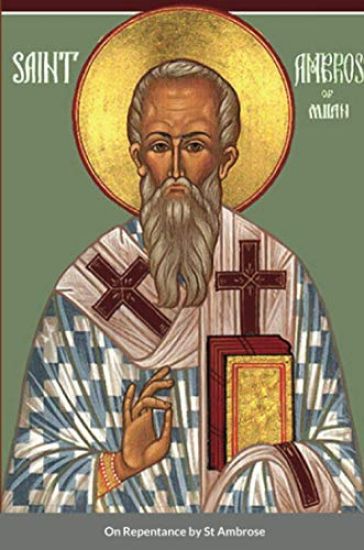
Aurelius Ambrosius (c. 340-397), better known in English as Ambrose, an Archbishop of Milan, became one of the most influential ecclesiastical figures of the 4th century. He served as the Roman governor of Liguria and Emilia, headquartered in Milan, before popular acclamation propelled him into becoming Bishop of Milan in 374. Ambrose staunchly opposed Arianism. Western Christianity identified Ambrose as one of its four traditional Doctors of the Church, and as the patron saint of Milan. He had notable influence on Augustine of Hippo (354-430).
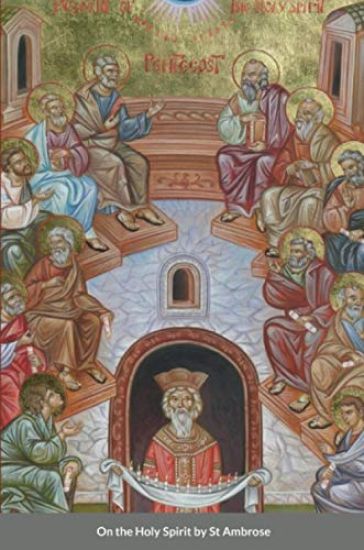
In the first section St. Ambrose commences by allegorizing the history of Gideon and the fleece, seeing in the drying of the fleece and the moistening of the threshing-floor a type of the Holy Spirit leaving the Jews and being poured out on the Gentiles. Passing to his more immediate subject, he proves that the Holy Spirit is above the whole Creation and is truly God, alleging as a special argument that the sin against the Holy Spirit can never be forgiven, here or hereafter. He shows how the Holy Spirit is in Scripture called the Spirit of God; that He spoke by the prophets and apostles; that He sanctifies men, and is typified by the mystical ointment spoken of in Scripture. Next, St. Ambrose treats of His oneness with the other two Persons of the Holy Trinity, and shows that His mission in no way detracts from this oneness, but that there is in all the Divine Persons a perfect unity of peace, love, and other virtues. The second section commences with a treatment of the history of Samson in the same way as that of Gideon in Book I. Samson always succeeded so long as the Holy Spirit was with him, but fell into misfortune so soon as he was forsaken. It is shown that the power of the Holy Spirit is the same as that of the Father and the Son, and that there is an agreement in design and working, and in vivifying man. He is Creator and therefore to be worshipped, and He worked with the Father and the Son in founding the Church, and in conclusion is proved the unity of operation in the Three Persons. The third section continues the same argument, showing that the mission of prophets and apostles, and even of the Son Himself, is to be referred to the Spirit, yet without any subjection on the part of the Son, seeing that the Spirit also receives His mission from the Father and the Son. The Godhead of the Holy Spirit is next taken up and proved, when occasion is taken also to show that there are not three Gods or three Lords, for the Three Divine Persons are one in holiness and nature; and the work is concluded with a summary of some of the principal arguments.
Aurelius Ambrosius (c. 340-397), better known in English as Ambrose, an Archbishop of Milan, became one of the most influential ecclesiastical figures of the 4th century. He served as the Roman governor of Liguria and Emilia, headquartered in Milan, before popular acclamation propelled him into becoming Bishop of Milan in 374. Ambrose staunchly opposed Arianism. Western Christianity identified Ambrose as one of its four traditional Doctors of the Church, and as the patron saint of Milan. He had notable influence on Augustine of Hippo (354-430).
Aurelius Ambrosius (c. 340-397), better known in English as Ambrose, an Archbishop of Milan, became one of the most influential ecclesiastical figures of the 4th century. He served as the Roman governor of Liguria and Emilia, headquartered in Milan, before popular acclamation propelled him into becoming Bishop of Milan in 374. Ambrose staunchly opposed Arianism. Western Christianity identified Ambrose as one of its four traditional Doctors of the Church, and as the patron saint of Milan. He had notable influence on Augustine of Hippo (354-430).
Tom Brown at Oxford is a novel by Thomas Hughes, first published in serial form in Macmillan Magazine in 1859. It was published in two volumes in book form in 1861.It is a sequel to the better-known Tom Brown's School Days. The story follows the character of Tom Brown to St Ambrose's College, Oxford. The novel offers a vivid impression of university life in the mid nineteenth centuryThe book was out of print for many years but is available in Britain from Wordsworth Classics with 'Tom Brown's Schooldays' and as the copyright on the text has expired is now available on the Project Gutenberg ebook site. Editions of the serialized form are available at from the Hathi Trust. The illustrator Sydney Prior Hall (1842-1922), portrait painter and illustrator, was one of the leading reportage artists of the later Victorian period........ Thomas Hughes QC (20 October 1822 - 22 March 1896) was an English lawyer, judge, politician and author. He is most famous for his novel Tom Brown's School Days (1857), a semi-autobiographical work set at Rugby School, which Hughes had attended. It had a lesser-known sequel, Tom Brown at Oxford (1861). Hughes had numerous other interests, in particular as a Member of Parliament, in the British co-operative movement, and in a settlement in Tennessee reflecting his values. Early life Hughes was the second son of John Hughes, editor of the Boscobel Tracts (1830) and was born in Uffington, Berkshire (now Oxfordshire). He had six brothers, and one sister, Jane Senior who later became Britain's first female civil servant. At the age of eight he was sent to Twyford School, a preparatory public school near Winchester, where he remained until the age of eleven. In February 1834 he went to Rugby School, which was then under the celebrated Thomas Arnold, a contemporary of his father at Oriel College, Oxford. Hughes excelled at sports rather than in scholarship, and his school career culminated in a cricket match at Lord's Cricket Ground. In 1842 he went on to Oriel College, and graduated B.A. in 1845. At Oxford, he played cricket for the university team in the annual University Match against Cambridge University, also at Lord's, and a match that is still now regarded as first-class cricket. Legal career Hughes was called to the bar in 1848, became Queen's Counsel in 1869 and a bencher in 1870. He was appointed to a county court judgeship in the Chester district in July 1882. Works While living at Wimbledon, Hughes wrote his famous story Tom Brown's School Days, which was published in April 1857. He is associated with the novelists of the "muscular school", a loose classification but centred on the fiction of the Crimean War period.Although Hughes had never been a member of the sixth form at Rugby, his impressions of the headmaster Thomas Arnold were reverent. Hughes also wrote The Scouring of the White Horse (1859), Tom Brown at Oxford (1861), Religio Laici (1868), Life of Alfred the Great (1869) and the Memoir of a Brother. His brother, George Hughes, was the model for the Tom Brown character...........
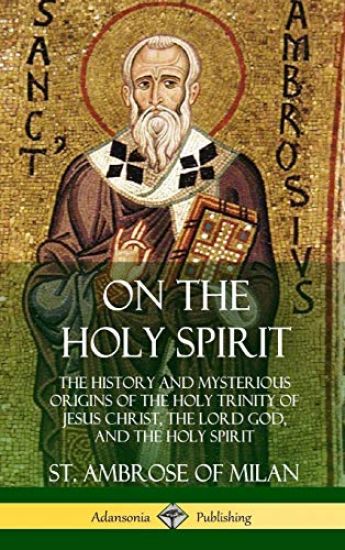
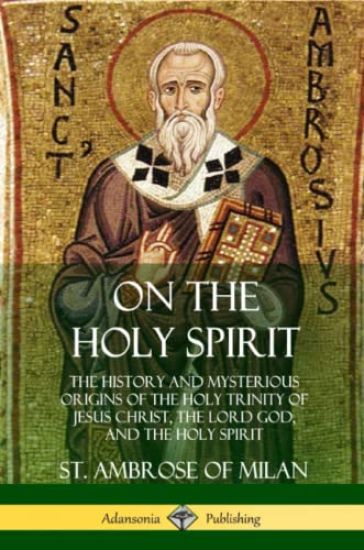
In his role as learned bishop of Milan in the 4th century, Saint Ambrose published this work concerning the holy trinity of Christ, God and the Holy Spirit. Though not formally educated or trained in a university or seminary, St. Ambrose possessed gifts of intuition for matters of faith. His studies spanned wide, and he duly gained recognition and prominence as a scholar of great understanding and faith. Setting out to first define the tenets of the Christian Holy Trinity, Ambrose here uses his knowledge of Bible texts to support clear and well-founded explanation of what the holy spirit is and its subtle influence upon believers. The establishment of a clear theology was a great concern of the early figures in Christianity. St. Ambrose spent years battling the rival doctrines of Arianism, at one point almost losing his own church to the movement. Eventually, he and fellow believers overcame the Arian faith; many of the writings and actions of St. Ambrose led to the formation of the Catholic church.
In his role as learned bishop of Milan in the 4th century, Saint Ambrose published this work concerning the holy trinity of Christ, God and the Holy Spirit. Though not formally educated or trained in a university or seminary, St. Ambrose possessed gifts of intuition for matters of faith. His studies spanned wide, and he duly gained recognition and prominence as a scholar of great understanding and faith. Setting out to first define the tenets of the Christian Holy Trinity, Ambrose here uses his knowledge of Bible texts to support clear and well-founded explanation of what the holy spirit is and its subtle influence upon believers. The establishment of a clear theology was a great concern of the early figures in Christianity. St. Ambrose spent years battling the rival doctrines of Arianism, at one point almost losing his own church to the movement. Eventually, he and fellow believers overcame the Arian faith; many of the writings and actions of St. Ambrose led to the formation of the Catholic church.
These two books were written against the Novatian heresy, which took its name, and to a considerable extent its form, from Novatus, a priest of the Church of Carthage, and Novatian, schismatically consecrated bishop at Rome. It was the outcome of a struggle which had long existed in the Church upon the question of the restitution to Church privileges of those who had fallen into grievous sin, and the possibility of their repentance.The severest ground was taken by the Novatians, who were condemned successively by many councils, which maintained the power of the Church to admit those guilty of any sin whatsoever to repentance, and prescribed various rules and penalties applicable to different cases. The heresy, however, lasted for some time, becoming weaker in the fifth century, and gradually fading away as a separate body with a distinctive name. Novatianism, in the tests which it used, its efforts after a perfectly pure communion, its crotchetty interpretations of Scripture, and many other features, presents a striking parallel to many modern sects. See Dict. Chr. Biog., Blunt, Sects and heresies, Ceillier, II. 427, etc.]St. Ambrose, in writing against the Novatians, seems to have had some recent publication of theirs in his mind, which is now unknown. He begins by commending gentleness, a quality singularly wanting in the sect; speaks of the power committed to the Church of forgiving the greatest sins, and points out how God is more inclined to mercy than to severity, and refutes the arguments of the Novatians based on certain passages of holy Scripture. In the second book, after urging the necessity of careful and speedy repentance, and the necessity of confessing one's sins, St. Ambrose meets the Novatian arguments based on Heb. vi. 4-6, from which they inferred the impossibility of restoration; and on St. Matthew 12:31-32, our Lord's words concerning sin against the Holy Spirit.As regards the date of this treatise, it must have been somewhat before the exposition of Ps. xxxvii., which refers to it, but there is nothing else which can be taken as a certain guide. Possibly the Benedictine Editors are right in assigning it to about a.d. 384.Some few persons, probably on doctrinal grounds, have been led to question the authorship of this treatise, but it is quoted by St. Augustine, and there has never been any real doubt on the subject.
This is St. Ambrose's thorough overview of the Christian faith. What it is, what it means and how we apply it to our lives. Not only was it a necessity for the early Church, but it applies equally for us today.