Kirjojen hintavertailu. Mukana 11 213 693 kirjaa ja 12 kauppaa.

Kirjahaku

Etsi kirjoja tekijän nimen, kirjan nimen tai ISBN:n perusteella.

1000 tulosta hakusanalla Andreas Takis

Law's Moral Indifference

Law's Moral Indifference

Andreas Takis

Hart Publishing
2022
sidottu
We usually pay far less attention to what the law actually tells us than to the possible consequences of our disobeying it. Yet, if we try to take it at face value, we discover that the law expects us to comply not out of fear of the harmful consequences of disobedience, but because it is the law that tells us to do this or that – that, at least, seems to be the law's claim. Whence does this authority over our lives derive, and why should we take the fact that it is the law that tells us to do something as a reason to do it? Legal positivism, by far the most influential theoretical doctrine on what the law is, insists that our being under a legal obligation cannot in any way entail that we should really act accordingly. Positivists claim that if we are really to act as the law requires us to, this is not because of some supposed general moral obligation to obey the law, but rather because we think that we personally have a concrete moral, or other, reason of our own, to act thus. Yet, according to positivists, whether we happen to morally approve of the law's requirements or not is a matter of indifference to the law: law doesn't need morality in order to exist or to become knowable. For positivists the law is the law whether we like it or not. Despite its intuitive plausibility this thesis - of law's moral indifference - does not go unchallenged. This book traces the developments that established legal positivism as an almost insurmountable horizon in legal theory. But it also attempts to show that modern positivism's enduring success is due to the gradual abandonment of its core position on law's moral indifference, which, paradoxically, renders it less and less positivistic.
Andreas

Andreas

Natacha Sprunger

Natacha Sprunger
2019
pokkari
"Maman a d cid de reprendre sa plume pour vous raconter mon histoire. Moi, Andreas, j' tais install dans le ventre de ma maman depuis presque 20 semaines quand mes parents ont d cid de mettre fin mon passage sur cette terre. Maman raconte si bien ce que nous avons travers ensemble. J'esp re qu'apr s cette lecture votre vie en sera chang e et boulevers e. J'esp re que d'autres parents trouveront la force de suivre ce que Dieu a pr vu pour eux. Mes parents pr sent sont lib r s."
Andréas

Andréas

Estelle Every

Afnil
2021
pokkari
Il veut sauver les humains, elle souhaiterait gu rir ses propres blessures. Jusqu' pr sent, Andr as Cupidon, p diatre sexy, consacrait sa vie enti re ses jeunes patients, mais l'arriv e de Penny Lake remet en cause ses priorit s. La jeune femme cache un secret: elle est atteinte d'un mal myst rieux qui provoque des hallucinations... comme ces ailes attach es au dos d'Andr as. Puisque la maladie la ronge, elle ne peut se lier un homme, aussi beau et g n reux soit-il. Mais lorsque le pass de Penny la rattrape et que les ennemis d'Andr as se d voilent, c'est avec les yeux du coeur qu'ils devront faire face ensemble pour s'en sortir.
Andreas

Andreas

Robert Root

Hansebooks
2017
pokkari
Andreas: the legend of St. Andrew - Translated from the Old English by Robert Kilburn Root is an unchanged, high-quality reprint of the original edition of 1899. Hansebooks is editor of the literature on different topic areas such as research and science, travel and expeditions, cooking and nutrition, medicine, and other genres. As a publisher we focus on the preservation of historical literature. Many works of historical writers and scientists are available today as antiques only. Hansebooks newly publishes these books and contributes to the preservation of literature which has become rare and historical knowledge for the future.
Andreas

Andreas

Robert K Root; Saint Andrew

Hansebooks
2017
pokkari
Andreas - the Legend of St. Andrew is an unchanged, high-quality reprint of the original edition of 1899. Hansebooks is editor of the literature on different topic areas such as research and science, travel and expeditions, cooking and nutrition, medicine, and other genres. As a publisher we focus on the preservation of historical literature. Many works of historical writers and scientists are available today as antiques only. Hansebooks newly publishes these books and contributes to the preservation of literature which has become rare and historical knowledge for the future.
Andreas

Andreas

Robert K Root

ALPHA EDITION
2021
pokkari
The book "" Andreas: The Legend of St. Andrew, has been considered important throughout the human history, and so that this work is never forgotten we have made efforts in its preservation by republishing this book in a modern format for present and future generations. This whole book has been reformatted, retyped and designed. These books are not made of scanned copies and hence the text is clear and readable.
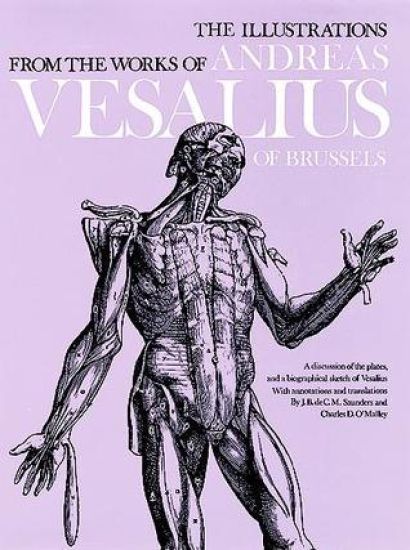
The Illustrations from the Works of Andreas Vesalius of Brussels

The Illustrations from the Works of Andreas Vesalius of Brussels

Andreas Vesalius; C.D. O'Malley

Dover Publications Inc.
2000
nidottu
The works of Andreas Vesalius (1514-1564) have long been regarded among the great treasures of the Renaissance. Published as medical books while he was teaching anatomy and dissection at the University of Padua, they include the Tabulae Sex (1538), intended as an aid to students; the magnificently illustrated De Humani Corporis Fabrica (1543), and the companion volume, the Epitome (1543). Individually, these books are milestones in the history of medicine. They also offer one of the most magnificent collections of anatomical drawings ever published. The plates were executed with such vitality and originality that they have been attributed to the most talented illustrators of the sixteenth century, not to mention Vesalius himself. Many of the drawings, in fact, were products of Titian's famous atelier.For this edition of the Vesalius illustrations, Dover has combined the best existing plates and text. The illustrations have been reproduced from the sumptuous (1934) Munich edition of Vesalius titled Icones Anatomicae. The Munich plates were struck for the most part from the original wood blocks then in the collection of the Library of the University of Munich. These priceless art objects were destroyed in the bombing of Munich during World War II. Aside from the original copies of the woodcuts (of which only a few complete sets are known), the Munich restrikes are the best representations of the Vesalian anatomical drawings, for they preserve much of the freshness and richness of the 1543 edition.The text of this Dover edition has been faithfully reproduced from an edition of Vesalius published by World Publishing Company in 1950. The editors, distinguished authorities on sixteenth-century medicine, have provided a very comprehensive history of Vesalius, his career, and excellent explanations of the legends surrounding the illustrators, artists, and publishers involved with the production of his books. No other source will provide the general reader, bibliophile, art historian, artist, or historian of science and medicine with such complete data on Vesalius and his fabulous anatomical illustrations.
Andreas and the Ambiguity of Courtly Love

Andreas and the Ambiguity of Courtly Love

Paolo Cherchi

University of Toronto Press
1994
sidottu
A resolution to the vexed problem whether a troubadour's love is erotic or spiritual is offered by Paolo Cherchi through a new reading of Andreas Capellanus' De Amore (written around 1186-1196). He suggests that Andreas, using a rhetorical strategy that creates ambiguity, condemns courtly love because its claim that passion generates virtue is untenable and deceitful. Although Andreas grasped the core of the courtly love 'system,' namely, the relation between passion and ethics, he failed to consider the notion of mezura, that courtly virtue through which troubadours transformed nature into culture, and erotic passion into social discourse. Cherchi offers an innovative interpretation and a close reading of selected poems. He traces the history of Provençal lyric poetry, highlighting some of the significant personalities and movements.
Andreas Alciatus

Andreas Alciatus

University of Toronto Press
1985
sidottu
The Emblemata of Andreas Alciatus was published in 1551 in Lyon and was soon translated into at least four languages. These volumes allow a researcher to consult all versions at once and compare them with considerable ease. In Part 1 each of the emblems is reproduced in facsimilie, the motto and epigram transcribed and translated, the pictorial emblem analysed into its key motifs, and the relevant sources listed. Part 2 is organized in parallel fashion and deals with the translations of Marnef, Hunger, Held, Marquale, and Cadomosto. Part 1 also contains thorough introductory sections, including a biography of Alciatus as it relates to his Emblemata, a useful bibliography, extensive cumulative indexes to the key motifs and mottoes, and lists all mottoes by language of origin and of the translations By making the emblem books accessible to modern scholars in this fashion, the Index will enhance the study not only of literature, but also of the history of art, culture, religion, and symbol.
Andreas Capellanus, Scholasticism, and the Courtly Tradition

Andreas Capellanus, Scholasticism, and the Courtly Tradition

Don A. Monson

The Catholic University of America Press
2005
sidottu
This book, the first study in English devoted entirely to Andreas Capellanus's ""De Amore"", presents a comprehensive inquiry into the influence of scholasticism on the structure and organization of the work, applying methods of medieval philosophy and intellectual history to an important problem in medieval literary studies. Eschewing polemics over authorial intentions, Don Monson develops an approach to the work's meaning through an examination of its form. The first part of the book explores the generic identity of the work, both a scientific treatise and a practical manual. It relates this generic complexity to a tension between rhetoric and dialectic and explores the work's intertextual character in terms of the authorities cited and the literary models structuring the discourse. In light of these considerations, Monson examines the modern debate over ironic intentions. The second part of the book studies the work's meaning in terms of a dialectic between four traditions: vernacular poetry, feudal society, Christianity, and Ovid. The author examines the scholastic definition, which defines love generically as an ""emotion"" (passio innata) and specifically in terms of Aristotelian causality. He then explores Andreas's love psychology and physiology, including the roles of sight, meditation, desire, and will, the physical and mental requirements for loving, and the dynamics of love relationships. Next, the social ramifications of love are discussed: the competing claims of nobility of birth and of merit, and the roles of service, generosity, courtesy, and reputation. The final chapter studies the ethical dimension of the treatise, identifying two complementary components: an attempt to reconcile sexual love with Christian morality, followed by the rejection of love on the grounds of their incompatibility. Monson's thorough examination of the text calls for a recognition of the profound complexity of the ""De Amore"", visible in its form and contents. Although not a key to ""courtly love,"" the text occupies a unique position at the crossroads of several medieval traditions and will greatly contribute to the understanding of love in medieval literature and culture.