Kirjojen hintavertailu. Mukana 11 213 693 kirjaa ja 12 kauppaa.

Kirjahaku

Etsi kirjoja tekijän nimen, kirjan nimen tai ISBN:n perusteella.

1000 tulosta hakusanalla Andreas Wimmer

Ethnic Boundary Making

Ethnic Boundary Making

Andreas Wimmer

Oxford University Press Inc
2013
sidottu
It is hard to avoid seeing ethnicity, race, or nationality wherever one looks. Differences in education, income, and health are often patterned along ethnic or racial lines. But how do we disentangle discrimmation and preferences for certain groups from the everyday working of labor markets and educational institutions or privileging family members or those with similar educational backgrounds? Drawing on a boundary-making perspective first championed by anthropologist Fredrick Barth, Andreas Wimmer introduces a new comparative theory of ethnicity. It explains precisely how and why ethnicity matters in certain societies and contexts but not in others, and why it is sometimes associated with inequality and exclusion, with political and public debate, with closely-held identity, while in other cases ethnicity, race and nationhood do not structure the allocation of resources, invite little political passion, and represent secondary aspects of individual identity. Wimmer argues that when ethnic and racial differences matter they matter because of institutional incentives, differences in power, and pre-existing social networks. Wimmer first provides a broad overview of different ethnic configurations around the world, outlines the new theory, and proposes a set of research designs based on non-ethnic units of observation. Next, he draws on these methods to demonstrate how the utility of the boundary-making approach through a qualitative study of immigrant ethnicity in Switzerland, a network analysis of racial and ethnic boundaries of U.S. college students on Facebook, and a statistical analysis of cultural values in the European Union.
Ethnic Boundary Making

Ethnic Boundary Making

Andreas Wimmer

Oxford University Press Inc
2013
nidottu
It is hard to avoid seeing ethnicity, race, or nationality wherever one looks. Differences in education, income, and health are often patterned along ethnic or racial lines. But how do we disentangle discrimmation and preferences for certain groups from the everyday working of labor markets and educational institutions or privileging family members or those with similar educational backgrounds? Drawing on a boundary-making perspective first championed by anthropologist Fredrick Barth, Andreas Wimmer introduces a new comparative theory of ethnicity. It explains precisely how and why ethnicity matters in certain societies and contexts but not in others, and why it is sometimes associated with inequality and exclusion, with political and public debate, with closely-held identity, while in other cases ethnicity, race and nationhood do not structure the allocation of resources, invite little political passion, and represent secondary aspects of individual identity. Wimmer argues that when ethnic and racial differences matter they matter because of institutional incentives, differences in power, and pre-existing social networks. Wimmer first provides a broad overview of different ethnic configurations around the world, outlines the new theory, and proposes a set of research designs based on non-ethnic units of observation. Next, he draws on these methods to demonstrate how the utility of the boundary-making approach through a qualitative study of immigrant ethnicity in Switzerland, a network analysis of racial and ethnic boundaries of U.S. college students on Facebook, and a statistical analysis of cultural values in the European Union.
Nationalist Exclusion and Ethnic Conflict

Nationalist Exclusion and Ethnic Conflict

Andreas Wimmer

Cambridge University Press
2002
pokkari
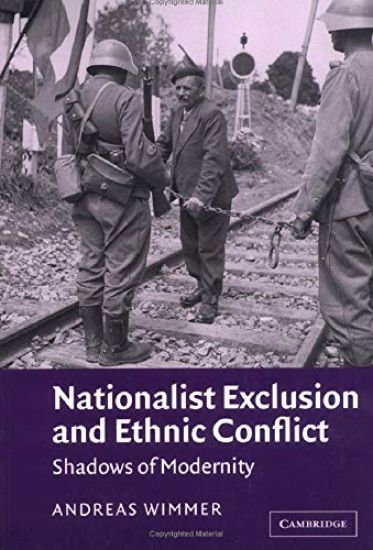
Andreas Wimmer argues that nationalist and ethnic politics have shaped modern societies to a far greater extent than has been acknowledged by social scientists. The modern state governs in the name of a people defined in ethnic and national terms. Democratic participation, equality before the law and protection from arbitrary violence were offered only to the ethnic group in a privileged relationship with the emerging nation-state. Depending on circumstances, the dynamics of exclusion took on different forms. Where nation building was ‘successful’, immigrants and ‘ethnic minorities’ are excluded from full participation; they risk being targets of xenophobia and racism. In weaker states, political closure proceeded along ethnic, rather than national lines and leads to corresponding forms of conflict and violence. In chapters on Mexico, Iraq and Switzerland, Wimmer provides extended case studies that support and contextualise this argument.
Nationalist Exclusion and Ethnic Conflict

Nationalist Exclusion and Ethnic Conflict

Andreas Wimmer

Cambridge University Press
2002
sidottu
Andreas Wimmer argues that nationalist and ethnic politics have shaped modern societies to a far greater extent than has been acknowledged by social scientists. The modern state governs in the name of a people defined in ethnic and national terms. Democratic participation, equality before the law and protection from arbitrary violence were offered only to the ethnic group in a privileged relationship with the emerging nation-state. Depending on circumstances, the dynamics of exclusion took on different forms. Where nation building was 'successful', immigrants and 'ethnic minorities' are excluded from full participation; they risk being targets of xenophobia and racism. In weaker states, political closure proceeded along ethnic, rather than national lines and leads to corresponding forms of conflict and violence. In chapters on Mexico, Iraq and Switzerland, Wimmer provides extended case studies that support and contextualise this argument.
Nation Building

Nation Building

Andreas Wimmer

PRINCETON UNIVERSITY PRESS
2018
sidottu
A new and comprehensive look at the reasons behind successful or failed nation building Nation Building presents bold new answers to an age-old question. Why is national integration achieved in some diverse countries, while others are destabilized by political inequality between ethnic groups, contentious politics, or even separatism and ethnic war? Traversing centuries and continents from early nineteenth-century Europe and Asia to Africa from the turn of the twenty-first century to today, Andreas Wimmer delves into the slow-moving forces that encourage political alliances to stretch across ethnic divides and build national unity. Using datasets that cover the entire world and three pairs of case studies, Wimmer's theory of nation building focuses on slow-moving, generational processes: the spread of civil society organizations, linguistic assimilation, and the states' capacity to provide public goods. Wimmer contrasts Switzerland and Belgium to demonstrate how the early development of voluntary organizations enhanced nation building; he examines Botswana and Somalia to illustrate how providing public goods can bring diverse political constituencies together; and he shows that the differences between China and Russia indicate how a shared linguistic space may help build political alliances across ethnic boundaries. Wimmer then reveals, based on the statistical analysis of large-scale datasets, that these mechanisms are at work around the world and explain nation building better than competing arguments such as democratic governance or colonial legacies. He also shows that when political alliances crosscut ethnic divides and when most ethnic communities are represented at the highest levels of government, the general populace will identify with the nation and its symbols, further deepening national political integration. Offering a long-term historical perspective and global outlook, Nation Building sheds important new light on the challenges of political integration in diverse countries.
Nation Building

Nation Building

Andreas Wimmer

Princeton University Press
2020
pokkari
A new and comprehensive look at the reasons behind successful or failed nation buildingNation Building presents bold new answers to an age-old question. Why is national integration achieved in some diverse countries, while others are destabilized by political inequality between ethnic groups, contentious politics, or even separatism and ethnic war? Traversing centuries and continents from early nineteenth-century Europe and Asia to Africa from the turn of the twenty-first century to today, Andreas Wimmer delves into the slow-moving forces that encourage political alliances to stretch across ethnic divides and build national unity.Using datasets that cover the entire world and three pairs of case studies, Wimmer’s theory of nation building focuses on slow-moving, generational processes: the spread of civil society organizations, linguistic assimilation, and the states’ capacity to provide public goods. Wimmer contrasts Switzerland and Belgium to demonstrate how the early development of voluntary organizations enhanced nation building; he examines Botswana and Somalia to illustrate how providing public goods can bring diverse political constituencies together; and he shows that the differences between China and Russia indicate how a shared linguistic space may help build political alliances across ethnic boundaries.Wimmer then reveals, based on the statistical analysis of large-scale datasets, that these mechanisms are at work around the world and explain nation building better than competing arguments such as democratic governance or colonial legacies. He also shows that when political alliances crosscut ethnic divides and when most ethnic communities are represented at the highest levels of government, the general populace will identify with the nation and its symbols, further deepening national political integration.Offering a long-term historical perspective and global outlook, Nation Building sheds important new light on the challenges of political integration in diverse countries.
Waves of War

Waves of War

Andreas Wimmer

Cambridge University Press
2012
sidottu
Why did the nation-state emerge and proliferate across the globe? How is this process related to the wars fought in the modern era? Analyzing datasets that cover the entire world over long stretches of time, Andreas Wimmer focuses on changing configurations of power and legitimacy to answer these questions. The nationalist ideal of self-rule gradually diffused over the world and delegitimized empire after empire. Nationalists created nation-states wherever the power configuration favored them, often at the end of prolonged wars of secession. The elites of many of these new states were institutionally too weak for nation-building and favored their own ethnic communities. Ethnic rebels challenged such exclusionary power structures in violation of the principles of self-rule, and neighboring governments sometimes intervened into these struggles over the state. Waves of War demonstrates why nation-state formation and ethnic politics are crucial to understand the civil and international wars of the past 200 years.
Waves of War

Waves of War

Andreas Wimmer

Cambridge University Press
2012
pokkari
Why did the nation-state emerge and proliferate across the globe? How is this process related to the wars fought in the modern era? Analyzing datasets that cover the entire world over long stretches of time, Andreas Wimmer focuses on changing configurations of power and legitimacy to answer these questions. The nationalist ideal of self-rule gradually diffused over the world and delegitimized empire after empire. Nationalists created nation-states wherever the power configuration favored them, often at the end of prolonged wars of secession. The elites of many of these new states were institutionally too weak for nation-building and favored their own ethnic communities. Ethnic rebels challenged such exclusionary power structures in violation of the principles of self-rule, and neighboring governments sometimes intervened into these struggles over the state. Waves of War demonstrates why nation-state formation and ethnic politics are crucial to understand the civil and international wars of the past 200 years.
The Art of Principled Entrepreneurship

The Art of Principled Entrepreneurship

Andreas Widmer

Benbella Books
2022
sidottu
How many times have you heard someone say, "It’s not personal; it’s just business"? That attitude reflects a belief that business needs to be cut-throat, that it’s a dog-eat-dog world, that the pursuit of profit is the only thing that matters, and that the only way to succeed is to beat the competition. But none of this is true: business doesn’t have to be that way. The Art of Principled Entrepreneurship is a prescription for living the American Dream and for finding the fulfilment that comes from helping employees and customers improve their lives. In his 30-year career in international business strategy, economic development, and entrepreneurship, author Andreas Widmer has seen firsthand numerous companies both succeed financially and also build a people-centered venture in the process. He shares his favorite success stories and details five key principles for conducting business in ways that combine personal virtue, the latest entrepreneurial tools, and long-term perspective in order to make business a win-win proposition for everyone. At a time when the number of new business startups is at its lowest point in 50 years and more than half the workforce at existing businesses struggles with motivation, finding a better way to do business is more urgent than ever. For any entrepreneur, manager, employee, or business student seeking to build people-centered businesses and teams, The Art of Principled Entrepreneurship is an insightful, practical guide to how businesses can be run to be both virtuous and profitable.
Faithful Measure: Gauging Awareness of the Catholic Church's Social Doctrine

Faithful Measure: Gauging Awareness of the Catholic Church's Social Doctrine

Catherine Pakaluk; Andreas Widmer

Createspace Independent Publishing Platform
2015
nidottu
This research study focused on providing insights to the Catholic Church on how well Catholics understand well-defined Catholic terms, and to know what the words she currently employs actually mean in the vocabulary of those who listen to her, and if that meaning does not overlap with the Church's definition of that word or term, what alternate term would do so. A list of the core Catholic Social Doctrine phrases, principles and thoughts we tested for in our research: 1. Human Dignity: By the phrase human dignity, the Catholic Church means that men and women are made in the image of God and destined for eternal life. 2. Justice: To each his due. 3. Social Justice: By the phrase social justice, the Catholic Church means that groups and individuals receive what is rightly owed to them. 4. Common Good: By the phrase common good, the Catholic Church means all the conditions in society that allow individuals and groups to reach their fullest human good, both in this life and the next. 5. Solidarity: By the principle solidarity, the Catholic Church means unity arising from love of neighbor. 6. Subsidiarity: By the principle subsidiarity, the Catholic Church means that higher groups in society should not take over tasks that lower groups would like to perform, unless the lower group asks for help. In other words, social functions should occur at the lowest possible level so that individuals and groups have a true sense of purpose. 7. Universal Destination of Goods: God gave the good things of the earth to the whole human race. 8. Charity: The love of God and neighbor. 9. Preferential Option for the Poor: Charity requires us to place the needs of the poor before our own needs. 10. The purpose of Social Life: Social life should be aimed at the common good. 11. Private Property: Private property is good - through ownership we imitate God. 12. Entrepreneurship and Business: Economic initiative is a fundamental value and human right. 13. Hiring and Firing: Owners should make the dignity of employees central in their decision making, though sometimes firing is necessary. 14. Relationship between charity and operating a business: Owning and operating a business is itself an act of charity for a Christian. 15. The role of Truth in Society: A free society must affirm some truths as absolute. 16. Wages: Wages should be sufficient for families to support themselves and also save something. We also sought to measure some underlying perceptions of and engagement with Catholic Social Doctrine: - Catholic Church's "tone" about business and market economy. - Catholic Church's understanding of your professional work. - Relevance of Catholic Social Doctrine for individual Catholics in their daily life. We stared by researching the resonance for some key terms of Catholic Social Doctrine. This is done to ascertain how emotionally engaging a term is. We all have a personal reaction to various terms: faith, progress, hierarchy, sublime, and environment. Terms resonate with us on a continuum from positive to negative. Negative resonance closes us up, positive resonance causes us to engage.