

Kirjahaku
Etsi kirjoja tekijän nimen, kirjan nimen tai ISBN:n perusteella.
1000 tulosta hakusanalla Andrew F. Warner

Practical Business Statistics
Andrew F. Siegel; Michael R. Wagner
ELSEVIER SCIENCE PUBLISHING CO INC
2022
nidottu
Practical Business Statistics, Eighth Edition, offers readers a practical, accessible approach to managerial statistics that carefully maintains, but does not overemphasize mathematical correctness. The book fosters deep understanding of both how to learn from data and how to deal with uncertainty, while promoting the use of practical computer applications. This trusted resource teaches present and future managers how to use and understand statistics without an overdose of technical detail, enabling them to better understand the concepts at hand and to interpret results. The text uses excellent examples with real world data relating to business sector functional areas such as finance, accounting, and marketing. Written in an engaging style, this timely revision is class-tested and designed to help students gain a solid understanding of fundamental statistical principles without bogging them down with excess mathematical details.

Some argue that Muslims have no tradition of separation of church and state and therefore can't participate in secular, pluralist society. At the other extreme, some Muslims argue that it is the duty of all believers to resist western forms of government and to impose Islamic law. Andrew F. March demonstrates that there are very strong and authentically Islamic arguments for accepting the demands of citizenship in a liberal democracy, many of them found even in medieval works of Islamic jurisprudence. In fact, he shows, it is precisely the fact that Rawlsian political liberalism makes no claims to metaphysical truth that makes it appealing to Muslims.

The Oxford Companion to American Food and Drink
Andrew F. Smith
Oxford University Press Inc
2009
nidottu
During the last decade, curiosity about food and drink in America has rapidly accelerated and interest in the social, historical and economic aspects of food has dramatically expanded. The Oxford Companion to American Food and Drink will satiate this hunger for knowledge with fascinating entries on everything from the origin of Bloody Marys to vegetarianism. Placing American food and drink in context, this unique resource colorfully explains how the culinary world is influenced by American food, points out disappearing traditions and includes sidebars, definitions, bibliographies, and lists of popular festivals, museums, and websites for readers anxious to learn more about this mouth-watering subject. With over 950 articles and 300 illustrations, the Oxford Companion to American Food and Drink will stand alongside Davidson's Companion as the ideal complement for any food lover wishing to explore this related topic in even greater detail.

In the wake of the post-Cold War era, the aftermath of 9/11, the 2008 global financial crisis, and the emergence of the G20 at the leaders level, few commentators expected a reshaping of the global system towards multipolarity, and away from the United States. And yet, the BRICS - encompassing Brazil, Russia, India, China and South Africa - has emerged as a challenge to the international status quo. But what is its capacity as a transformative force? And can it provide a significant counter-narrative to the Western dominated global order? In this Very Short Introduction Andrew Cooper explores the emergence of the BRICS as a concept. Drawing on historical precedent, Cooper provides a contemporary analysis of the BRICS' practice and influence as as a forum and a lobby group in advancing a distinctive but amorphous agenda amongst global politics. ABOUT THE SERIES: The Very Short Introductions series from Oxford University Press contains hundreds of titles in almost every subject area. These pocket-sized books are the perfect way to get ahead in a new subject quickly. Our expert authors combine facts, analysis, perspective, new ideas, and enthusiasm to make interesting and challenging topics highly readable.

This book unravels the centrality of contestation over international institutions under the shadow of crisis. Breaking with the widely accepted image in the mainstream, US-centric literature of an advance of global governance supported by pillars of institutionalized formality, Andrew Cooper points to the retention of a habitual impulse towards concertation related to informal institutionalism. Rather than endorsing the view that world politics is moving inexorably towards a multilateral, rules-based order, he places the onus on the resilience of a hierarchical self-selected concert model that combines a stigmatized legacy with the ability to reproduce in an array of associational formats. Relying for conceptual guidance on the recovery of a valuable component in the intellectual contribution of Hedley Bull, a compelling case is made that concertation represents a fundamental institution as a peer competitor to multilateralism. In effect, the debate over institutional design is recast away from an emphasis on utilitarian maximization towards a wider set of cardinal - and highly contested - questions: the nature of rules at the global level, the salience of institutional clubs, and the meaning and impact of (in)equality and cooperation/coordination among states across the incumbent West/non-incumbent Global South divide.

Living things are organized in a hierarchy of levels. Genes group together in cells, cells group together in organisms, and organisms group together in societies. Even different species form mutualistic partnerships. Throughout the history of life, previously independent units have formed groups that, in time, have come to resemble individuals in their own right. Evolutionary biologists term such events "the major transitions". The process common to them all is social evolution. Each transition occurs only if natural selection favours one unit joining with another in a new kind of group. This book presents a fresh synthesis of the principles of social evolution that underlie the major transitions, explaining how the basic theory underpinning social evolution - inclusive fitness theory - is central to understanding each event. The book defines the key stages in a major transition, then highlights the shared principles operating at each stage across the transitions as a whole. It addresses in new ways the question of how, once they have arisen, organisms and societies become more individualistic.

Living things are organized in a hierarchy of levels. Genes group together in cells, cells group together in organisms, and organisms group together in societies. Even different species form mutualistic partnerships. Throughout the history of life, previously independent units have formed groups that, in time, have come to resemble individuals in their own right. Evolutionary biologists term such events "the major transitions". The process common to them all is social evolution. Each transition occurs only if natural selection favours one unit joining with another in a new kind of group. This book presents a fresh synthesis of the principles of social evolution that underlie the major transitions, explaining how the basic theory underpinning social evolution - inclusive fitness theory - is central to understanding each event. The book defines the key stages in a major transition, then highlights the shared principles operating at each stage across the transitions as a whole. It addresses in new ways the question of how, once they have arisen, organisms and societies become more individualistic.

How can Muslims be both good citizens of liberal democracies and good Muslims? This is among the most pressing questions of our time, particularly in contemporary Europe. Some argue that Muslims have no tradition of separation of church and state and therefore can't participate in secular, pluralist society. At the other extreme, some Muslims argue that it is the duty of all believers to resist Western forms of government and to impose Islamic law. Andrew F. March is seeking to find a middle way between these poles. Is there, he asks, a tradition that is both consistent with orthodox Sunni Islam that is also compatible with modern liberal democracy? He begins with Rawls's theory that liberal societies rely for stability on an ''overlapping consensus'' between a public conception of justice and popular religious doctrines and asks what kinds of demands liberal societies place on citizens, and particularly on Muslims. March then offers a thorough examination of Islamic sources and current trends in Islamic thought to see whether there can indeed be a consensus. March finds that the answer is an emphatic ''yes.'' He demonstrates that there are very strong and authentically Islamic arguments for accepting the demands of citizenship in a liberal democracy, many of them found even in medieval works of Islamic jurisprudence. In fact, he shows, it is precisely the fact that Rawlsian political liberalism makes no claims to metaphysical truth that makes it appealing to Muslims.

Food expert and celebrated food historian Andrew F. Smith recounts--in delicious detail--the creation of contemporary American cuisine. The diet of the modern American wasn't always as corporate, conglomerated, and corn-rich as it is today, and the style of American cooking, along with the ingredients that compose it, has never been fixed. With a cast of characters including bold inventors, savvy restaurateurs, ruthless advertisers, mad scientists, adventurous entrepreneurs, celebrity chefs, and relentless health nuts, Smith pins down the truly crackerjack history behind the way America eats. Smith's story opens with early America, an agriculturally independent nation where most citizens grew and consumed their own food. Over the next two hundred years, however, Americans would cultivate an entirely different approach to crops and consumption. Advances in food processing, transportation, regulation, nutrition, and science introduced highly complex and mechanized methods of production. The proliferation of cookbooks, cooking shows, and professionally designed kitchens made meals more commercially, politically, and culturally potent. To better understand these trends, Smith delves deeply and humorously into their creation. Ultimately he shows how, by revisiting this history, we can reclaim the independent, locally sustainable roots of American food.

Food expert and celebrated food historian Andrew F. Smith recounts--in delicious detail--the creation of contemporary American cuisine. The diet of the modern American wasn't always as corporate, conglomerated, and corn-rich as it is today, and the style of American cooking, along with the ingredients that compose it, has never been fixed. With a cast of characters including bold inventors, savvy restaurateurs, ruthless advertisers, mad scientists, adventurous entrepreneurs, celebrity chefs, and relentless health nuts, Smith pins down the truly crackerjack history behind the way America eats. Smith's story opens with early America, an agriculturally independent nation where most citizens grew and consumed their own food. Over the next two hundred years, however, Americans would cultivate an entirely different approach to crops and consumption. Advances in food processing, transportation, regulation, nutrition, and science introduced highly complex and mechanized methods of production. The proliferation of cookbooks, cooking shows, and professionally designed kitchens made meals more commercially, politically, and culturally potent. To better understand these trends, Smith delves deeply and humorously into their creation. Ultimately he shows how, by revisiting this history, we can reclaim the independent, locally sustainable roots of American food.

A companion to Andrew F. Smith's critically acclaimed and popular Eating History: Thirty Turning Points in the Making of American Cuisine, this volume recounts the individuals, ingredients, corporations, controversies, and myriad events responsible for America's diverse and complex beverage scene. Smith revisits the country's major historical moments-colonization, the American Revolution, the Whiskey Rebellion, the temperance movement, Prohibition, and its repeal-and he tracks the growth of the American beverage industry throughout the world. The result is an intoxicating encounter with an often overlooked aspect of American culture and global influence. Americans have invented, adopted, modified, and commercialized tens of thousands of beverages-whether alcoholic or nonalcoholic, carbonated or caffeinated, warm or frozen, watery or thick, spicy or sweet. These include uncommon cocktails, varieties of coffee and milk, and such iconic creations as Welch's Grape Juice, Coca-Cola, root beer, and Kool-Aid. Involved in their creation and promotion were entrepreneurs and environmentalists, bartenders and bottlers, politicians and lobbyists, organized and unorganized criminals, teetotalers and drunks, German and Italian immigrants, savvy advertisers and gullible consumers, prohibitionists and medical professionals, and everyday Americans in love with their brew. Smith weaves a wild history full of surprising stories and explanations for such classic slogans as "taxation with and without representation;" "the lips that touch wine will never touch mine;" and "rum, Romanism, and rebellion." He reintroduces readers to Samuel Adams, Thomas Jefferson, George Washington, and the colorful John Chapman (Johnny Appleseed), and he rediscovers America's vast literary and cultural engagement with beverages and their relationship to politics, identity, and health.

A companion to Andrew F. Smith's critically acclaimed and popular Eating History: Thirty Turning Points in the Making of American Cuisine, this volume recounts the individuals, ingredients, corporations, controversies, and myriad events responsible for America's diverse and complex beverage scene. Smith revisits the country's major historical moments-colonization, the American Revolution, the Whiskey Rebellion, the temperance movement, Prohibition, and its repeal-and he tracks the growth of the American beverage industry throughout the world. The result is an intoxicating encounter with an often overlooked aspect of American culture and global influence. Americans have invented, adopted, modified, and commercialized tens of thousands of beverages-whether alcoholic or nonalcoholic, carbonated or caffeinated, warm or frozen, watery or thick, spicy or sweet. These include uncommon cocktails, varieties of coffee and milk, and such iconic creations as Welch's Grape Juice, Coca-Cola, root beer, and Kool-Aid. Involved in their creation and promotion were entrepreneurs and environmentalists, bartenders and bottlers, politicians and lobbyists, organized and unorganized criminals, teetotalers and drunks, German and Italian immigrants, savvy advertisers and gullible consumers, prohibitionists and medical professionals, and everyday Americans in love with their brew. Smith weaves a wild history full of surprising stories and explanations for such classic slogans as "taxation with and without representation;" "the lips that touch wine will never touch mine;" and "rum, Romanism, and rebellion." He reintroduces readers to Samuel Adams, Thomas Jefferson, George Washington, and the colorful John Chapman (Johnny Appleseed), and he rediscovers America's vast literary and cultural engagement with beverages and their relationship to politics, identity, and health.

Satellite Technology, Second Edition is a complete update of this popular handbook exploring the world of communication satellites. It will help broadcast professionals and students fully understand these indispensable telecommunications tools. Written in easy-to-understand language, this book covers topics ranging from theories of satellite operation to practical instructions for the initial set-up of mobile earth stations. The second edition has been thoroughly updated to include: · the impact of rapid advances in digital technology,· the mass deployment of digital DBS systems,· new initiatives in satellite design, and· changes in regulations.

From the Americas to Australasia, from northern Europe to southern Africa, the tomato tickles the world's taste buds. Americans along devour more than twelve million tons annually of this peculiar fruit, variously considered poisonous, curative, and aphrodisiacal. In this first concerted study of the tomato in America, Andrew F. Smith separates myth from historical fact, beginning with the Salem, New Jersey, man who, in 1820, allegedly attracted spectators from hundreds of miles to watch him eat a tomato on the courthouse steps (the legend says they expected to see him die a painful death). Later, hucksters such as Dr. John Cook Bennett and the Amazing Archibald Miles peddled the tomato's purported medicinal benefits. The competition was so fierce that the Tomato Pill War broke out in 1838. The Tomato in America traces the early cultivation of the tomato, its infiltration of American cooking practices, the early manufacture of preserved tomatoes and ketchup (soon hailed as "the national condiment of the United States"), and the "great tomato mania" of the 1820s and 1830s. The book also includes tomato recipes from the pre-Civil War period, covering everything from sauces, soups, and main dishes to desserts and sweets. Now available for the first time in paperback, The Tomato in America provides a piquant and entertaining look at a versatile and storied figure in culinary history.

The peanut is one of the most versatile and beloved of American food icons. In this first culinary history of the protein-laden legume, Andrew F. Smith follows the peanut 's rise from a lowly, messy snack food to its place in haute cuisine and on supermarket shelves around the world. Chronicling how peanut consumption and production has changed throughout history, Smith highlights the peanut's role in the ways economic distress, wartime conditions, industrialization, and health trends reflect and inform our culinary landscape. Chock-full of photographs, advertisements, and peanut recipes from as early as 1847, this entertaining and enlightening volume is a testament to the culinary potential and lasting popularity of the goober pea.
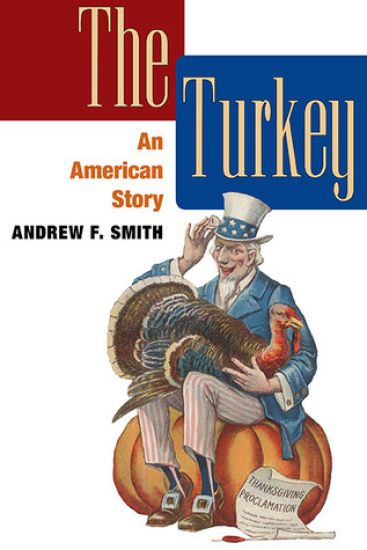
“Talking turkey” about the bird you thought you knewFondly remembered as the centerpiece of family Thanksgiving reunions, the turkey is a cultural symbol as well as a multi-billion dollar industry. As a bird, dinner, commodity, and as a national icon, the turkey has become as American as the bald eagle (with which it actually competed for supremacy on national insignias). Food historian Andrew F. Smith’s sweeping and multifaceted history of Meleagris gallopavo separates fact from fiction, serving as both a solid historical reference and a fascinating general read. With his characteristic wit and insatiable curiosity, Smith presents the turkey in ten courses, beginning with the bird itself (actually several different species of turkey) flying through the wild. The Turkey subsequently includes discussions of practically every aspect of the iconic bird, including the wild turkey in early America, how it came to be called “turkey,” domestication, turkey mating habits, expansion into Europe, stuffing, conditions in modern industrial turkey factories, its surprising commercial history of boom and bust, and its eventual ascension to holiday mainstay. As one of the easiest of foods to cook, the turkey’s culinary possibilities have been widely explored if little noted. The second half of the book collects an amazing array of over one hundred historical and modern turkey recipes from across America and Europe. From sandwiches to salmagundi, you’ll find detailed instructions on nearly every variation on the turkey. Historians will enjoy a look back at the varied appetites of their ancestors and seasoned cooks will have an opportunity to reintroduce a familiar food in forgotten ways.

Where as other Lectionary Commentaries tend to take small numbers of readings and assign them to a large number of people, this commentary will assign each Gospel to one commentator. Each commentator will therefore be able to concentrate on the overall progression of each Gospel, and to indicate how the passages in the lectionary reflect the distinctive emphasis of that Gospel. The introduction and commentary to each Gospel is academically rigorous, drawing fully on modern critical scholarship, intended as preparatory aid for those who will preach.

How the character of war is changing and how militaries can successfully adapt to meet the challenge This book by military strategist Andrew F. Krepinevich, Jr., is the definitive take on the race for military dominance in the twenty-first century. It shows how militaries that successfully pursue disruptive innovation can gain a major advantage over their rivals, while those that fail to do so risk exposing their countries to great danger. The Precision Warfare Revolution introduced by the U.S. military in the First Gulf War found the United States enjoying a near monopoly in this form of warfare for several decades. But now other powers have these capabilities. The U.S. military also confronts an emerging military revolution driven by advances across a wide range of technologies—from artificial intelligence and synthetic biology to quantum computing and additive manufacturing. To stay competitive, the U.S. military must pursue disruptive innovation in a race with other militaries to exploit war’s changing character. Clues exist as to the winner’s identity. They are revealed by militaries that went beyond the bounds of mere innovation to overturn the existing forms of warfare, changing the course of history and the fate of nations. Through exploring their experiences, Krepinevich shows how the U.S. military can win the race to identify and exploit the “next big thing” in warfare.

Howard Fast, one of the most prolific American writers of the 20th century, has enjoyed wide popularity for his writing and suffered from great notoriety for his politics, but has never been given full credit for his contribution to the essential tales of American culture, the American Revolution, and immigrant acculturation. Although his novels have sold close to eighty million copies, this is the first book-length critical study of his work. In addition to an overview of his fiction, it offers close, critical readings of his historical novels of the American Revolution, Citizen Tom Paine, April Morning, and his most recent, Seven Days in June, his novels about slavery, Freedom Road and Spartacus, and his popular series about the American experience, The Immigrants. A biographical chapter is partly based on an extensive interview granted by Fast exclusively for this book. A comprehensive bibliography completes the work.This critical study begins with a biographical chapter that links life and works, showing how Fast transmuted his experience into fiction. Macdonald asserts that for all Fast's notoriety as a Communist in the 1940s and 1950s, his works show him to be deeply committed to the principles that inspired the American Revolution. A chapter on literary background discusses all of Fast's major works and most of his minor ones, placing the historical novels into literary context and the other works into their genre traditions. The remaining six chapters focus on his most important individual novels. Each novel is analyzed for plot structure, characterization, and thematic elements. In addition, Macdonald defines and applies alternative critical perspectives from which to read each novel. A genealogy table for The Immigrants series, and a complete, up-to-date bibliography of all of Fast's nearly one hundred published works, as well as selected reviews and background reading, make this study invaluable for research and critical understanding. This study of Fast's classic works of historical fiction will aid the student and support the interdisciplinary American history/literature curriculum.