Kirjojen hintavertailu. Mukana 11 244 527 kirjaa ja 12 kauppaa.

Kirjahaku

Etsi kirjoja tekijän nimen, kirjan nimen tai ISBN:n perusteella.

1000 tulosta hakusanalla Andrew Robinson

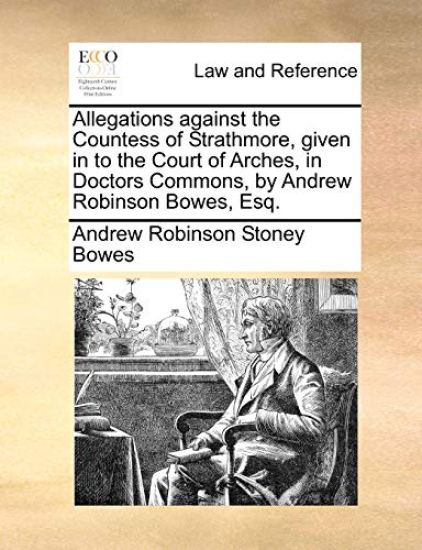
Allegations Against the Countess of Strathmore, Given in to the Court of Arches, in Doctors Commons, by Andrew Robinson Bowes, Esq
The 18th century was a wealth of knowledge, exploration and rapidly growing technology and expanding record-keeping made possible by advances in the printing press. In its determination to preserve the century of revolution, Gale initiated a revolution of its own: digitization of epic proportions to preserve these invaluable works in the largest archive of its kind. Now for the first time these high-quality digital copies of original 18th century manuscripts are available in print, making them highly accessible to libraries, undergraduate students, and independent scholars.This collection reveals the history of English common law and Empire law in a vastly changing world of British expansion. Dominating the legal field is the Commentaries of the Law of England by Sir William Blackstone, which first appeared in 1765. Reference works such as almanacs and catalogues continue to educate us by revealing the day-to-day workings of society.++++The below data was compiled from various identification fields in the bibliographic record of this title. This data is provided as an additional tool in helping to insure edition identification: ++++British LibraryT153836Drop-head title. Part two of 'The trial of Andrew Robinson Bowes'. This work was advertised on the verso of the final leaf of part 1. London, 1789]. 1],6-44p., plate; 8
The Trial of Andrew Robinson Bowes, Esq. for Adultery and Cruelty; First Heard in the Arches Court of Doctors Commons; and, in Consequence of an Appeal, Determined in a Court of Delegates ... When ... the Countess of Strathmore Obtained a Divorce
The 18th century was a wealth of knowledge, exploration and rapidly growing technology and expanding record-keeping made possible by advances in the printing press. In its determination to preserve the century of revolution, Gale initiated a revolution of its own: digitization of epic proportions to preserve these invaluable works in the largest archive of its kind. Now for the first time these high-quality digital copies of original 18th century manuscripts are available in print, making them highly accessible to libraries, undergraduate students, and independent scholars.This collection reveals the history of English common law and Empire law in a vastly changing world of British expansion. Dominating the legal field is the Commentaries of the Law of England by Sir William Blackstone, which first appeared in 1765. Reference works such as almanacs and catalogues continue to educate us by revealing the day-to-day workings of society.++++The below data was compiled from various identification fields in the bibliographic record of this title. This data is provided as an additional tool in helping to insure edition identification: ++++British LibraryT051685Part 1 only; the second part is advertised on the verso of p. 103 and was published without a titlepage; drop-head title: 'Allegations against the Countess of Strathmore, By Andrew Robinson Bowes'.London: printed for R. Randall, 1789. 6],103, 1]p., plate; 8
The Stoniad. Addressed to Andrew Robinson, Esq
The 18th century was a wealth of knowledge, exploration and rapidly growing technology and expanding record-keeping made possible by advances in the printing press. In its determination to preserve the century of revolution, Gale initiated a revolution of its own: digitization of epic proportions to preserve these invaluable works in the largest archive of its kind. Now for the first time these high-quality digital copies of original 18th century manuscripts are available in print, making them highly accessible to libraries, undergraduate students, and independent scholars.Delve into what it was like to live during the eighteenth century by reading the first-hand accounts of everyday people, including city dwellers and farmers, businessmen and bankers, artisans and merchants, artists and their patrons, politicians and their constituents. Original texts make the American, French, and Industrial revolutions vividly contemporary.++++The below data was compiled from various identification fields in the bibliographic record of this title. This data is provided as an additional tool in helping to insure edition identification: ++++British LibraryT118118Andrew Robinson = Andrew Robinson Stoney Bowes. With a half-title.Newcastle: printed in the year, 1777. 4],20p.; 4
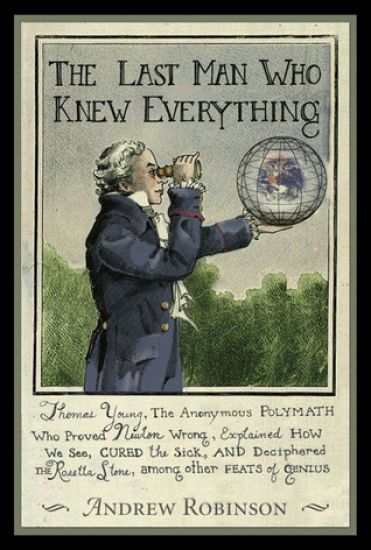
The Last Man Who Knew Everything
"The biography of an individual who simply was the last man who knew everything.Open any physics textbook and you will find the name of Thomas Young (1773-1829), the experimenter who first demonstrated the interference of light and proved that light is a wave, not a stream of corpuscles as maintained by Newton. Open any book on the eye and vision, and Young appears as the celebrated London physician who proposed how the eye focuses and the three-colour theory of vision, experimentally confirmed only in 1959. Open any book on ancient Egypt, and Young is credited for his crucial detective work in deciphering the Rosetta Stone and the hieroglyphic and demotic scripts. And this describes only the basics of his knowledge.An exhibition of Young at London's Science Museum on his birth bicentenary stated that: ""He probably had a wider range of creative learning than any other Englishman in history"". When invited to contribute to a new edition of the Encyclopedia Brittanica, Young offered the following subjects: Alphabet, Annuities, Attraction, Capillary Action, Cohesion, Colour, Dew, Egypt, Eye, Focusm Friction, Halo, Hieroglyphic, Hydraulics, Motion, Resistance, Ship, Sound, Strength, Tides, Waves and ""anything of a medical nature"". But he asked that his contributions be kept anonymous, to avoid harming his medical practice.While not yet thirty he gave a course of lectures at the Royal Institution covering virtually all of known science. But polymathy made him unpopular in the academy. An early attack on his wave theory of light was so scathing that English physicists buried it for nearly two decades until it was rediscovered in France. But slowly, after his death, great scientists began to recognize his genius. Readers who enjoy David Sobel's crisp historical biography and the intellectual curiosity of Patrick O'Brians Stephen Maturin will love Andrew Robinson's colourful portrayal of the last man who knew everything. "
Writing and Script

Writing and Script

Andrew Robinson

Oxford University Press
2009
nidottu
Without writing, there would be no records, no history, no books, and no emails. Writing is an integral and essential part of our lives; but when did it start? Why do we all write differently and how did writing develop into what we use today? All of these questions are answered in this Very Short Introduction. Starting with the origins of writing five thousand years ago, with cuneiform and Egyptian hieroglyphs, Andrew Robinson explains how these early forms of writing developed into hundreds of scripts including the Roman alphabet and the Chinese characters. He reveals how the modern writing symbols and abbreviations we take for granted today - including airport signage and text messaging - resemble ancient ones much more closely than we might think. ABOUT THE SERIES: The Very Short Introductions series from Oxford University Press contains hundreds of titles in almost every subject area. These pocket-sized books are the perfect way to get ahead in a new subject quickly. Our expert authors combine facts, analysis, perspective, new ideas, and enthusiasm to make interesting and challenging topics highly readable.
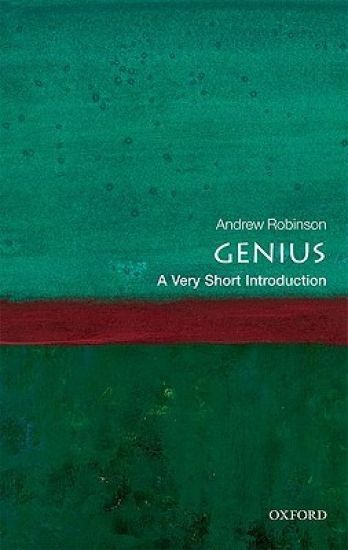
Genius

Genius

Andrew Robinson

Oxford University Press
2011
nidottu
Homer, Leonardo da Vinci, Mozart, Shakespeare, and Tolstoy; Curie, Darwin, Einstein, Galileo, and Newton. What do these world-famous artists and scientists have in common?- apart from the fact that their achievements predate our own time by a century or more. Most of us would probably answer: all ten possessed something we call genius, which in each instance permanently changed the way that humanity perceived the world. But pressed to be more precise, we find it remarkably hard to define genius. Genius is highly individual and unique, of course, yet it shares a compelling, inevitable quality for professionals and the general public alike. Darwin's ideas are still required reading for every working biologist; they continue to generate fresh thinking and experiments around the world. So do Einstein's theories among physicists. Shakespeare's plays and Mozart's melodies and harmonies continue to move people in languages and cultures far removed from their native England and Austria. Contemporary 'geniuses' may come and go, but the idea of genius will not let go of us. Genius is the name we give to a quality of work that transcends fashion, celebrity, fame, and reputation: the opposite of a period piece. Somehow, genius abolishes both the time and the place of its origin. This Very Short Introduction uses the life and work of familiar geniuses-and some less familiar-to illuminate both the individual and the general aspects of genius. In particular: the roles of talent, heredity, parenting, education, training, hard work, intelligence, personality, mental illness, inspiration, eureka moments, and luck, in the making of genius. ABOUT THE SERIES: The Very Short Introductions series from Oxford University Press contains hundreds of titles in almost every subject area. These pocket-sized books are the perfect way to get ahead in a new subject quickly. Our expert authors combine facts, analysis, perspective, new ideas, and enthusiasm to make interesting and challenging topics highly readable.
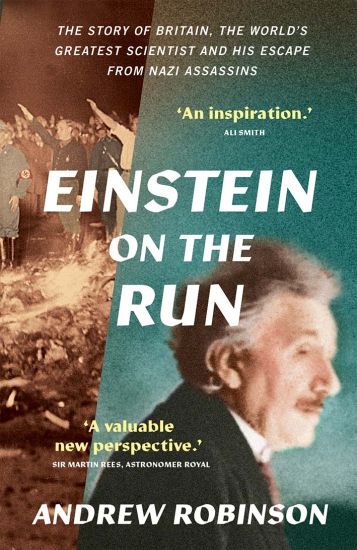
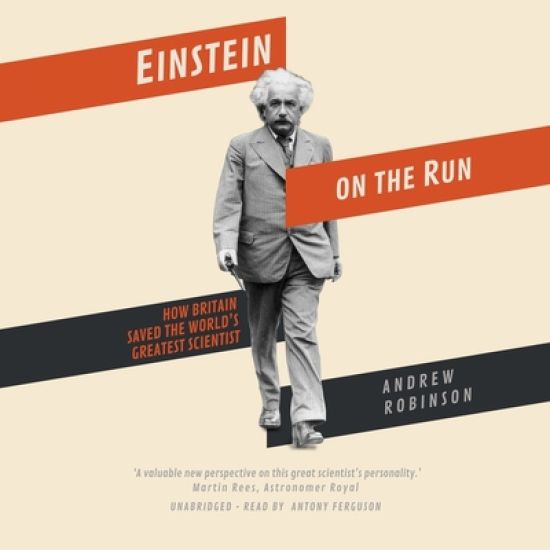
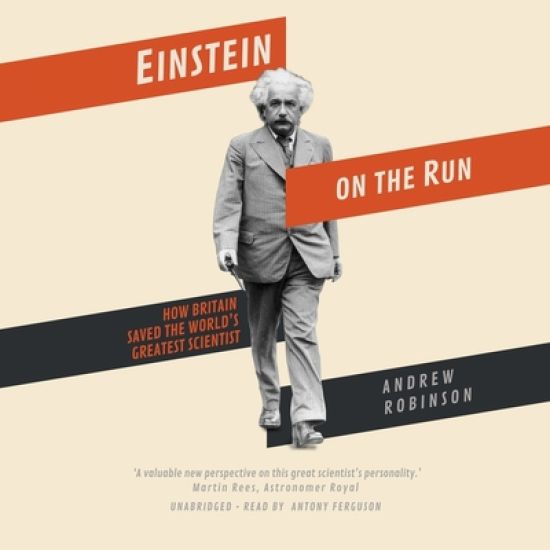
Einstein on the Run

Einstein on the Run

Andrew Robinson

Yale University Press
2021
pokkari
A "highly readable" (Wall Street Journal) account of the role Britain played in Einstein's life—first by inspiring his teenage passion for physics, then by providing refuge from the Nazis“A vivid look at how the U.K. affected the German-born physicist’s life and thinking.” —Publishers Weekly“Robinson has that rare knack for presenting a near-encyclopedic volume of historical information, anecdotes and contemporaneous accounts in a thoroughly delightful fashion.”—Ian Randall, Physics World In autumn 1933, Albert Einstein found himself living alone in an isolated holiday hut in rural England. There, he toiled peacefully at mathematics while occasionally stepping out for walks or to play his violin. But how had Einstein come to abandon his Berlin home and go ‘"on the run"? In this lively account, Andrew Robinson tells the story of the world’s greatest scientist and Britain for the first time, showing why Britain was the perfect refuge for Einstein from rumored assassination by Nazi agents. Young Einstein’s passion for British physics, epitomized by Newton, had sparked his scientific development around 1900. British astronomers had confirmed his general theory of relativity, making him internationally famous in 1919. Welcomed by the British people, who helped him campaign against Nazi anti-Semitism, he even intended to become a British citizen. So why did Einstein then leave Britain, never to return to Europe?
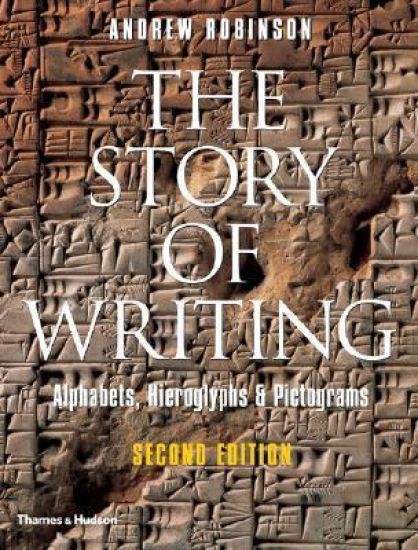
The Story of Writing

The Story of Writing

Andrew Robinson

Thames Hudson Ltd
2007
nidottu
Writing is one of humanity’s greatest inventions.Without it there would be no history and no civilization as we know it. But how, when and where did writing evolve? In a succinct, absorbing and well-illustrated text, Andrew Robinson discusses the history of decipherment and then each of the major writing systems in turn, from cuneiform and Egyptian and Mayan hieroglyphs to alphabets and the scripts of China and Japan. An invaluable guide to the world’s major writing systems, The Story of Writing is a book to read for both pleasure and enlightenment.
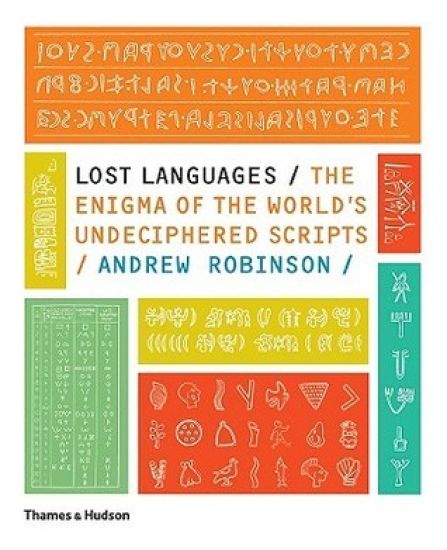
Lost Languages

Lost Languages

Andrew Robinson

Thames Hudson Ltd
2009
nidottu
Beginning with the stories of three great decipherments – Egyptian hieroglyphs, Minoan Linear B and Mayan glyphs – Lost Languages moves on to dissect the most well-known and enigmatic undeciphered scripts from around the world. These include the Etruscan alphabet of Italy, the Indus Valley seal script, Rongorongo from remote Easter Island, the Zapotec script of Mexico (probably the first writing system in the Americas), and the unique Phaistos disc of Crete. Lost Languages reports from the front lines of scholarship where obsessions, genius, occasional delusion and sometimes bitter rivalry are de rigueur among those currently competing for the rare honour of cracking these ancient codes – and giving voice to forgotten worlds.
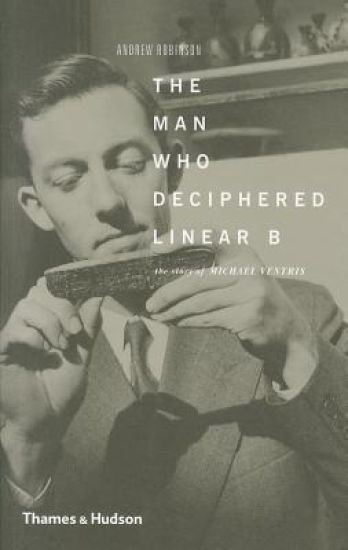
The Man Who Deciphered Linear B

The Man Who Deciphered Linear B

Andrew Robinson

Thames Hudson Ltd
2012
nidottu
Linear B is Europe’s oldest readable writing, dating from the middle of the second millennium BC. This book, newly available in paperback, tells the life story of Michael Ventris, interlaced with that of his decipherment of Linear B. First discovered in 1900, on clay tablets among the ruins of the Palace of Minos at Knossos, Crete, it remained a mystery for over fifty years until 1952, when Michael Ventris discovered that its signs did not represent an unknown language as previously believed, but an archaic dialect of Greek, more than 500 years older than the Greek of Homer. Dubbed the `Everest of archaeology’, the decipherment was all the more remarkable because Ventris was not a trained classical scholar but an architect by profession, who had first heard of Linear B as a schoolboy. An initial fascination became a lifelong obsession for this intriguing and contradictory man, a gifted linguist but a divided soul. `Excellent: well researched and clearly presented … compelling reading’ – The Times Literary Supplement `Excellent … Robinson understands how to make the complexities of pictograms clear to the non-expert. The book gives many examples, and would appeal to anyone interested in crosswords, codes and cyphers, but it also tells a fascinating human story’ – The Independent `A wonderfully swift and clear biography, written for the nonspecialist’ – The Economist `A superb biography of Michael Ventris, combining a warm account of his life with just enough technical details to satisfy those who have knowledge of linguistics or indeed of the classics. It is a splendid read, and a fine memorial to the split personality that enabled Ventris to decipher Minoan Linear B so triumphantly’ – Current World Archaeology
India

India

Andrew Robinson

THAMES HUDSON LTD
2025
nidottu
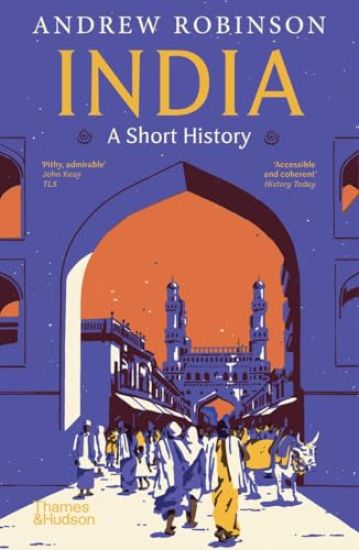
‘Pithy, admirable ... a most refreshing resumé’ The Times Literary Supplement India has had many histories. To pilgrims from ancient China, India was the birthplace of the Buddha; to Alexander the Great it was a land of clever naked philosophers and indomitable, elephantine armies. At the height of the Mughal empire, India boasted nearly a quarter of the world economy, and even under colonial rule it was the jewel in the crown of the British Empire. Today it is the resurgent home to one sixth of the global population. Andrew Robinson incisively distils India’s many incarnations, from the remarkably advanced cities of the early Indus Valley to the world’s largest democracy. Anyone curious about its past, present or future will find this a fascinating introduction.