This work has been selected by scholars as being culturally important and is part of the knowledge base of civilization as we know it.This work is in the public domain in the United States of America, and possibly other nations. Within the United States, you may freely copy and distribute this work, as no entity (individual or corporate) has a copyright on the body of the work.Scholars believe, and we concur, that this work is important enough to be preserved, reproduced, and made generally available to the public. To ensure a quality reading experience, this work has been proofread and republished using a format that seamlessly blends the original graphical elements with text in an easy-to-read typeface.We appreciate your support of the preservation process, and thank you for being an important part of keeping this knowledge alive and relevant.
This work has been selected by scholars as being culturally important and is part of the knowledge base of civilization as we know it.This work is in the public domain in the United States of America, and possibly other nations. Within the United States, you may freely copy and distribute this work, as no entity (individual or corporate) has a copyright on the body of the work.Scholars believe, and we concur, that this work is important enough to be preserved, reproduced, and made generally available to the public. To ensure a quality reading experience, this work has been proofread and republished using a format that seamlessly blends the original graphical elements with text in an easy-to-read typeface.We appreciate your support of the preservation process, and thank you for being an important part of keeping this knowledge alive and relevant.
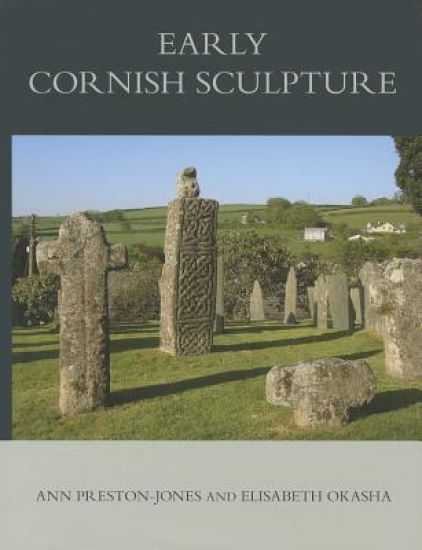
This book is part of a major series published by the British Academy. Volume 11 surveys the county of Cornwall and provides an analytical catalogue of its early sculpture, highlighting the particular distinctiveness of Cornish sculpture compared to other regions. Readers may well be astonished at the range and scale of the Cornish monuments. Introductory chapters set the material within its topographical, historical and archaeological context, considering it especially in relation to its development as Cornwall, at one time an independent Celtic kingdom, became part of the Anglo-Saxon realm. To fully illuminate the material, the volume includes specialist contributions on the geology of the monuments, the historical background, and the sculpture which continued the tradition of monumental carving in Cornwall after the Norman Conquest. There is a full photographic record of each monument, taken for the most part by the authors, which highlights the fact that Cornwall, unlike some regions, has many impressive and complete monuments still surviving. A large number of these were illustrated by A. G. Langdon over a century ago in his seminal Old Cornish Crosses; however the present volume includes many stones not illustrated by Langdon and offers new interpretations and detailed photographs of others. The monuments with early sculpture include substantial free-standing crosses, altar stones, and some recumbent coped stones.The dating and context of a number of potentially early fonts and some simple cross-incised stones is also discussed. The relationship of the Cornish sculpture to monuments in Wales, Ireland and Western Britain is of particular interest given Cornwall's position as a peninsula jutting into the western seaways. In this context, the potential role of Scandinavian influence is considered against the absence of evidence for Scandinavian settlement in Cornwall.
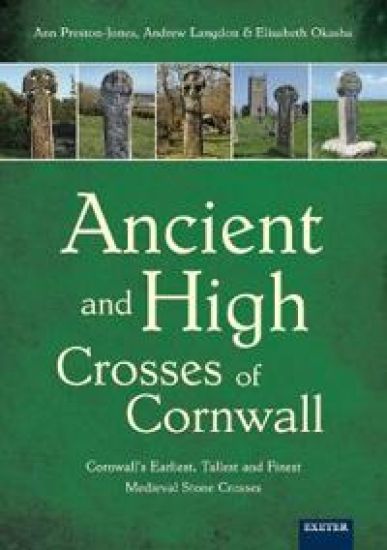
Winner of the Holyer an Gof Award 2022 (Leisure and Lifestyle) An illustrated guide to one hundred of the finest early Cornish stone crosses, dating from around AD 900 to 1300. These characteristic features of the Cornish landscape are splendid examples of their type, exhibiting a wide geographical spread and a certain weather-beaten beauty. The medieval stone crosses of Cornwall have long been objects of curiosity both for residents and visitors. This is the first ever accessible volume on the subject, combining detailed description and discussion of the crosses with information on access, colour images and suggestions for further reading. An approachable but academically rigorous work, it includes analysis of the decorative designs and sculptural techniques, accompanied by high-quality photographs which illustrate the subtleties of each cross, often hard to discern in situ. Ancient and High Crosses of Cornwall offers an ideal introduction for the general reader but will also prove essential to local historians, landscape historians, archaeologists and anyone working in the area of Cornish studies or connected with the Cornish diaspora. DOI: https://doi.org/10.47788/NKIP4746
This volume is the second in the series of final reports on the work of the Kavousi Project and the first volume on the cleaning (1982-1984) and excavations (1987-1992) at the mountain sites located above the modern village of Kavousi in eastern Crete. These sites, Vronda and the Kastro, shed light on the Early Iron Age, the transitional period in Cretan history known popularly as the Dark Ages, thereby elucidating the way of life of the people who lived in the area of Kavousi during that period and how their culture changed over time. Kavousi IIA is devoted to the excavation of material from the Late Minoan IIIC settlement at Vronda, particulary the houses on the summit of the Vronda ridge (Buildings A-B, C-D, J-K, and Q), along with earlier (Building P) and later (Building R) structures around them.
She has a deathly beauty that intrigues me. Her eyes, still intense, see nothing, and I am envious of the quiet inside of her. I want to go to sleep and dream soft dreams, but I can't go to bed with Mama dead in the tub. What would Daddy say?