This book provides the first detailed account of Gramsci's work in the context of current critical and socio-cultural debates. Renate Holub argues that Gramsci was ahead of his time in offering a theory of art, politics and cultural production. Gramsci's achievement is discussed particularly in relation to the Frankfurt School (Adorno, Horkheimer, Benjamin, Bloch, Habermas), to Brecht's theoretical writings and to thinkers in the phenomenological tradition especially Merleau-Ponty. She argues for Gramsci's continuing relevance at a time of retreat from Marxist positions on the postmodern left.Antonio Gramsci is distinguished by its range of philosophical grasp, its depth of specialized historical scholarship, and its keen sense of Gramsci's position as a crucial figure in the politics of contemporary cultural theory.
From the sociology of modern capitalism to state theory and cultural and media studies, Gramsci's ideas have become a central component of mainstream social and political thought since the publication of his writings, in English, in the 1960s. In particular, his concept of 'hegemony', denoting the struggle for ideological dominance by social classes, has been fundamental to the understanding of power in modern states. Over the past thirty years, Gramsci's ideas have been influential in the following areas: * Marxist Political Theory * The Sociology of Culture and Ideology * Political Analysis and State Theory * Cultural Studies * Critical International Relations * Post-structuralist Political Thought With both a general introduction and individual volume introductions and including articles translated from Italian for the first time, this is the only collection of its kind and the first systematic collection of over thirty years worth of critical commentary on this influential figure.
For readers encountering Gramsci for the first time, Steve Jones covers key elements of his thought through detailed discussion and studies the historical context of the theorist's thought, offers examples of putting Gramsci's ideas into practice in the analysis of contemporary culture and evaluates responses to his work.Including British, European and American examples, key topics covered here include:* culture* hegemony* intellectuals* crisis* Americanization.Gramsci's work invites people to think beyond simplistic oppositions by recasting ideological domination as hegemony: the ability of a ruling power's values to live in the minds and lives of its subalterns as a spontaneous expression of their own interestsIs power simply a matter of domination and resistance? Can a ruling power be vulnerable? Can subordinates find their resitance neutralized? and What is the role of culture in this? These questions, and many more are tackled here in this invaluable introduction to Gramsci.
For readers encountering Gramsci for the first time, Steve Jones covers key elements of his thought through detailed discussion and studies the historical context of the theorist's thought, offers examples of putting Gramsci's ideas into practice in the analysis of contemporary culture and evaluates responses to his work.Including British, European and American examples, key topics covered here include:* culture* hegemony* intellectuals* crisis* Americanization.Gramsci's work invites people to think beyond simplistic oppositions by recasting ideological domination as hegemony: the ability of a ruling power's values to live in the minds and lives of its subalterns as a spontaneous expression of their own interestsIs power simply a matter of domination and resistance? Can a ruling power be vulnerable? Can subordinates find their resitance neutralized? and What is the role of culture in this? These questions, and many more are tackled here in this invaluable introduction to Gramsci.
This book provides the first detailed account of Gramsci's work in the context of current critical and socio-cultural debates. Renate Holub argues that Gramsci was ahead of his time in offering a theory of art, politics and cultural production. Gramsci's achievement is discussed particularly in relation to the Frankfurt School (Adorno, Horkheimer, Benjamin, Bloch, Habermas), to Brecht's theoretical writings and to thinkers in the phenomenological tradition especially Merleau-Ponty. She argues for Gramsci's continuing relevance at a time of retreat from Marxist positions on the postmodern left.Antonio Gramsci is distinguished by its range of philosophical grasp, its depth of specialized historical scholarship, and its keen sense of Gramsci's position as a crucial figure in the politics of contemporary cultural theory.
Dante Germino's biography of the Italian communist and political theorist Antonio Gramsci offers a major reassessment of this important twentieth-century thinker. Germino analyses Gramsci's remarkable life as well as his extensive oeuvre, from the early Turin articles to the meditative Prison Notebooks.Gramsci saw society as composed of a small but powerful political center and a large body of emarginati, marginalized people at the periphery of society who are denied access to traditional positions of power. That vision led Gramsci to concentrate on the significance of the ""common man"" as he developed his theory of the political organisation of society. The persistent theme in Gramsci's work is how the ordinary man thinks, feels, and endures, and how the course of political institutions is shaped by the efforts of the marginalized to erode the boundaries of the center. Gramsci's approach is perhaps best expressed as a reunion of philosophy and experience and a revaluation of the quotidian.Gramsci's new politics of inclusion anticipated by well over a half-century the recent epoch-making developments in the USSR and in Eastern Europe. His antiauthoritarian leadership style as secretary of the Italian Communist party in the 1920s prefigured Gorbachev's policies of perestroika and glasnost. Gramsci's insistence on the international Communist movement's openness to new social formations at the grass roots is supremely relevant to developments in Romania, Czechoslovakia, East Germany, and Poland, where forces hitherto kept at the margins of political life by ossified Communist-party structures have burst on the scene with unprecedented vitality.Gramsci refused to revere Marx as a ""shepherd with a crook."" Equating history with the ""rhythm of liberty,"" he emerges as a prophetic voice in the desert of a bureaucratic and dogmatic communism. The dramatic recent changes in the Italian Communist party under Achille Ochetto also owe their ultimate inspiration to this diminutive, hunchbacked theorist-practitioner from Italy's periphery.Germino's compelling study of Gramsci's personal life and intellectual development offers fresh insights into Gramsci's work that will be of interest to all students of cultural and political theory. Of particular interest is his extensive consideration of the preprison writings both in their own right and for the light they cast on the Prison Notebooks.
Brings together Gramsci's writings on religion, education, science, philosophy and economic theory. The theme that links these writings is the investigation of ideology at its different levels, and the structures which embody and reproduce it.
Antonio Gramsci was born in Sardinia in 1891, became the leader of the Italian Communist Party in his early thirties, was arrested by Mussolini's police in 1927, and remained imprisoned until shortly before his death ten years later. The posthumous publication of his Prison Notebooks established him as a major thinker whose influence continues to increase.Fiori's biography enlarges upon the facts of Gramsci's life through personal accounts, and through Gramsci's own writings to relatives and friends. In relating Gramsci's growth as a political leader and theorist to his private experience, it offers acute insights into his involvement in the factory councils movement. It examines his relationship with political opponents, including Mussolini, and with his comrades within the Communist Party before and during Gramsci's imprisonment. It is an approach which seeks to explicate, as well as underscore, the substantial achievement of one of the most important figures in western Marxism.
The thought of Antonio Gramsci continues to enjoy widespread appeal in contemporary political and social theory. This book draws together some of the world's leading scholars on Gramsci to critically explore key ideas, debates and themes in his work in an accessible manner, relating them to contemporary politics and society.
Antonio Gramsci is a giant of Marxian thought and one of the world's greatest cultural critics. Antonio A. Santucci is perhaps the world's preeminent Gramsci scholar. Monthly Review Press is proud to publish, for the first time in English, Santucci's masterful intellectual biography of the great Sardinian scholar and revolutionary. Gramscian terms such as "civil society" and "hegemony" are much used in everyday political discourse. Santucci warns us, however, that these words have been appropriated by both radicals and conservatives for contemporary and often self-serving ends that often have nothing to do with Gramsci's purposes in developing them. Rather what we must do, and what Santucci illustrates time and again in his dissection of Gramsci's writings, is absorb Gramsci's methods. These can be summed up as the suspicion of grand explanatory schemes, the unity of theory and practice, and a focus on the details of everyday life. With respect to the last of these, Joseph Buttigieg says in his foreword: Gramsci did not set out to explain historical reality armed with some full-fledged concept, such as hegemony; rather, he examined the minutiae of concrete social, economic, cultural, and political relations as they are lived by individuals in their specific historical circumstances and, gradually, he acquired an increasingly complex understanding of how hegemony operates in many diverse ways and under many aspects within the capillaries of society. The rigor of Santucci's examination of Gramsci's life and work matches that of the seminal thought of the master himself.
"What the future fortunes of [Gramsci's] writings will be, we cannot know. However, his permanence is already sufficiently sure, and justifies the historical study of his international reception. The present collection of studies is an indispensable foundation for this." --Eric Hobsbawm, from the prefaceAntonio Gramsci is a giant of Marxian thought and one of the world's greatest cultural critics. Antonio A. Santucci is perhaps the world's preeminent Gramsci scholar. Monthly Review Press is proud to publish, for the first time in English, Santucci's masterful intellectual biography of the great Sardinian scholar and revolutionary.Gramscian terms such as "civil society" and "hegemony" are much used in everyday political discourse. Santucci warns us, however, that these words have been appropriated by both radicals and conservatives for contemporary and often self-serving ends that often have nothing to do with Gramsci's purposes in developing them. Rather what we must do, and what Santucci illustrates time and again in his dissection of Gramsci's writings, is absorb Gramsci's methods. These can be summed up as the suspicion of "grand explanatory schemes," the unity of theory and practice, and a focus on the details of everyday life. With respect to the last of these, Joseph Buttigieg says in his Nota "Gramsci did not set out to explain historical reality armed with some full-fledged concept, such as hegemony; rather, he examined the minutiae of concrete social, economic, cultural, and political relations as they are lived in by individuals in their specific historical circumstances and, gradually, he acquired an increasingly complex understanding of how hegemony operates in many diverse ways and under many aspects within the capillaries of society."The rigor of Santucci's examination of Gramsci's life and work matches that of the seminal thought of the master himself. Readers will be enlightened and inspired by every page.
Few revolutionaries have a heritage so contested by rival groups as Antonio Gramsci. Many use his writings as sacred texts' for their own policies, and while others stress any differences with Lenin in order to prove Gramsci a rebel.' In this stirring biography, Davidson cuts through these sterile debates and instead focuses on Gramsci's own political and philosophical ideas.
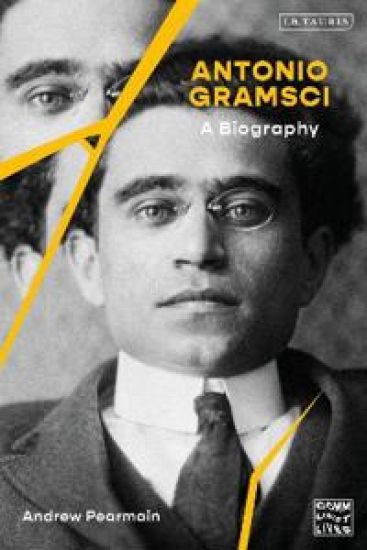
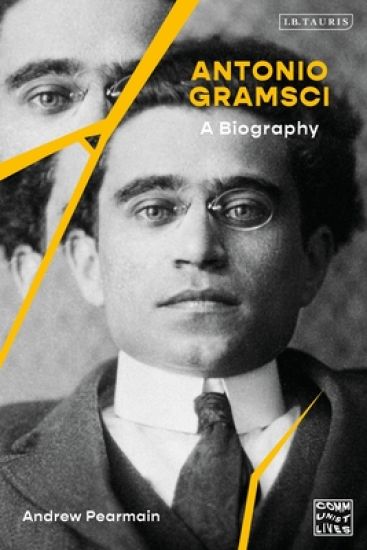
A historical biography of the Italian philosopher/politician Antonio Gramsci (1891-1973), considered one of the most important Marxist philosophers of the twentieth-century. As part of the Communist Lives series, Andrew Pearmain explores the life of Gramsci from his childhood, to his role in the newly formed Communist Party of Italy, and to his imprisonment and death in Turi di Bari, using recent archival research including material released by the Gramsci and Schucht family.
A historical biography of the Italian philosopher/politician Antonio Gramsci (1891-1973), considered one of the most important Marxist philosophers of the twentieth-century. As part of the Communist Lives series, Andrew Pearmain explores the life of Gramsci from his childhood, to his role in the newly formed Communist Party of Italy, and to his imprisonment and death in Turi di Bari, using recent archival research including material released by the Gramsci and Schucht family.
Offers a new look at the life and work of the Italian political activist and theorist who was imprisoned by the fascists for much of his adult life and wrote brilliantly on a broad range of subjects.
This intellectual biography provides an organic framework for understanding Antonio Gramsci’s process of intellectual development, paying close attention to the historical and intellectual contexts out of which his views emerged. The Gramsci in Notebooks cannot fully account for the young director of L’Ordine Nuovo, or for the communist leader. Gramsci’s development did not occur under conditions of intellectual inflexibility, of absence of evolution. However, there is a strong thread connecting the “political Gramsci” with Gramsci as a “cultivated man.” The Sardinian intellectual’s life is marked by the drama of World War I, the first mass conflict in which the great scientific discoveries of the previous decades were applied on a large scale and in which millions of peasants and workers were slaughtered. In all of his theoretical formulations, this dual relation, which epitomizes the instrumental use of “simpletons” by ruling classes, goes beyond the military context of the trenches and becomes full-fledged in the fundamental relations of modern capitalist society. In contrast with this notion of social hierarchy, which is deemed natural and unchangeable, Gramsci constantly affirmed the need to overcome the historically determined rupture between intellectual and manual functions, due to which the existence of a priesthood or of a separate caste of specialists in politics and in knowledge is made necessary. It is not the specific professional activity (whether material or immaterial) that determines the essence of human nature: to Gramsci, “all men are philosophers.” In this passage from Notebooks, we find the condensed form of his idea of “human emancipation,” which is the historical need for an “intellectual and moral reform”: the subversion of traditional relations between rulers and ruled and the end of exploitation of man by man.
Antonio Gramsci ist wegen seiner unerm dlichen politischen Arbeit bekannt, er schrieb die "Gef ngnis-Hefte". W hrend seiner Zeit in Mussolinis Gef ngnis schrieb er unerm dlich und entwickelte eine Theorie der politischen Hegemonie. Gramsci berlebte die Haft nur um wenige Tage.
Filosofen og politikeren Antonio Gramsci (1891-1937) var leder av det italienske kommunistpartiet og ble fengslet under det fascistiske regimet i Italia. Som journalist under første verdenskrig og frem til fengslingen i 1926, kommenterte han en rekke av datidens store og dramatiske begivenheter, som den russiske revolusjon og fremveksten av fascismen i Italia, i tillegg til fremveksten av den angloamerikanske, globaliserte kapitalismen. Disse tekstene gir oss et unikt innblikk i denne dramatiske perioden, slik Gramsci, som selv var direkte involvert i mange av hendelsene, opplevde den. Gramsci avviste enhver form for deterministisk lesning av marxismen, og presenterte egne politiske teorier som førte til at han kom på kollisjonskurs med sitt eget parti. Han representerte en marxisme som ikke var økonomistisk, der kulturen hadde en selvstendig verdi og der det nasjonalt-folkelige og populærkulturen spilte en viktig rolle. Gramsci er ofte sitert, men tekstene hans er sjelden lest. Denne antologien gir leseren mulighet til å bli bedre kjent med filosofen og politikeren Gramsci, en av 1900-tallets viktigste politiske tenkere. Utvalg, innledning og oversettelse ved Geir Lima.