Kirjojen hintavertailu. Mukana 11 244 527 kirjaa ja 12 kauppaa.

Kirjahaku

Etsi kirjoja tekijän nimen, kirjan nimen tai ISBN:n perusteella.

1000 tulosta hakusanalla Arno Schmidt

Arno Schmidt

Arno Schmidt

M.A. Orthofer

Lulu.com
2014
nidottu
Arno Schmidt (1914-1979) was one of the most remarkable writers of the twentieth century. Despite much of his work being available in English, his centenary passed nearly unremarked in the United States and England - to the disappointment of those who frequent the mythical Literary Saloon. In his honor and memory, the evening of 18 January - Schmidt's birthday - was devoted to conversation introducing the author and his work - a fictional centennial colloquy entirely in the spirit of the great man himself. Biography, an account of his translations and his famous 'Radio Dialogs', his early fiction, and then the towering Zettel's Traum ('Bottom's Dream') and his great final works, as well as his legacy: everything is covered in these pages. Arno Schmidt: a centennial colloquy is the perfect introduction to this giant of German letters, and his amazing work.
Arno Schmidt: A Critical Study of his Prose

Arno Schmidt: A Critical Study of his Prose

M. R. Minden

Cambridge University Press
2012
pokkari
This book, originally published in 1982, was the first monograph in English to offer a critical study of an important twentieth-century German novelist, Arno Schmidt. Schmidt, who died in 1979, was a controversial figure on the German literary scene. His early work, which began appearing immediately after the Second World War, attracted attention by virtue of its stylistic eccentricity and aggressive stand against all forms of organized authority. As an experimenter with language, much influenced by Joyce and Freud, Schmidt aroused large-scale public interest with the publication of a gigantic prose work, Zettel's Traum, in 1970. He developed a cult following which survived his death. This book will be of value to anyone with an interest in Schmidt, and the broader development of post-war German literature in general.
Arno Schmidt's Zettel's Traum

Arno Schmidt's Zettel's Traum

Volker Max Langbehn

Camden House Inc
2016
pokkari
The first comprehensive study in English of Schmidt's famous and controversial novel. Arno Schmidt (1914-1979) is considered one of the most daring and influential writers of postwar Germany; the Germanist Jeremy Adler has called him a "giant of postwar German literature." Schmidt was awarded the Fontane Prize in 1964 and the Goethe Prize in 1973, and his early fiction has been translated into English to high critical acclaim, but he is not a well-known figure in the English-speaking world, where his complex work remains at the margins of critical inquiry. Volker Langbehn's book introduces Schmidt to the English-speaking audience, with primary emphasis on his most famous novel, Zettel's Traum. One reviewer called the book an "elephantine monster" because of its unconventional size (folio format), length (1334 pages and over 10 million characters), and unique presentation of text in the form of notes, typewritten pages, parallel columns, and collages. The novel narrates the life of themain characters, Daniel Pagenstecher, Paul Jacobi and his wife Wilma, and their teenage daughter Franziska. In discussing the life and works of Edgar Allan Poe, the four engage in the problems connected with a translation of Poe.Langbehn's study investigates how literary language can mediate or account for the world of experiences and for concepts. Schmidt's use of unconventional presentation formats challenges us to analyze how we think about reading and writing literary texts. Instead of viewing such texts as a representation of reality, Schmidt's novel destabilizes this unquestioned mode of representation, posing a radical challenge to what contemporary literary criticism defines as literature. No comprehensive study of Zettel's Traum exists in English. Volker Langbehn is professor of German at San Francisco State University.
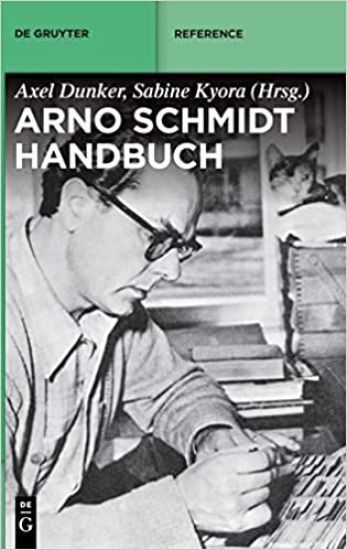
Arno-Schmidt-Handbuch
Arno Schmidt ist vielleicht der größte Außenseiter der deutschen Nachkriegsliteratur. Das Handbuch will sein Werk zugänglich machen, die Lust an der Lektüre wecken und Schmidt auch in der Literaturgeschichte den Platz geben, der ihm gebührt. Es bietet sowohl Informationen für eine erste Begegnung mit den Texten Schmidts als auch einen Überblick zum Forschungsstand für Leser/-innen, die bereits mit seinem Werk vertraut sind.
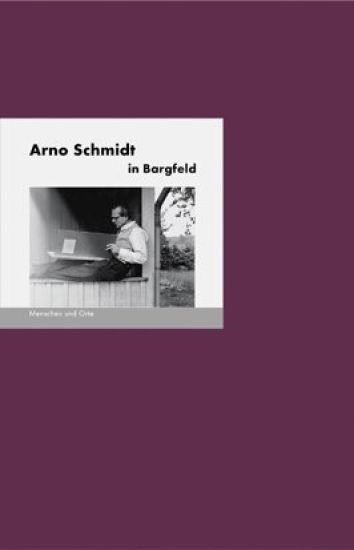
Arno Schmidt in Bargfeld

Arno Schmidt in Bargfeld

Bernd Erhard Fischer

Edition A.B.Fischer
2011
lehtivihko, moniste
Der Schriftsteller Arno Schmidt (1914?1979) erwarb im September 1958 ein kleines Siedlungshaus in Bargfeld bei Celle. Gemeinsam mit seiner Frau Alice lebte er dort völlig isoliert und einzig interessiert an seiner Arbeit, die sich immer mehr zu einem literarischen Weltentwurf entwickelte. In seiner unverwechselbaren Diktion, die sich gegen alle Regeln der Schulgrammatik sträubte, entstand dort das Mammutwerk ?Zettels Traum?. Als der ?Meister der VerschreibKunst? 1979 starb, übernahm eine Stiftung den Nachlaß und konnte sowohl die umfangreiche Bibliothek als auch das winzige Refugium des Autors im Originalzustand erhalten. Es ist, als sei er eben erst fortgegangen?
Arno Schmidts "Leviathan" - Mythologie und Weltanschauung
Studienarbeit aus dem Jahr 2006 im Fachbereich Germanistik - Neuere Deutsche Literatur, Note: 1,5, Otto-Friedrich-Universit t Bamberg, 13 Quellen im Literaturverzeichnis, Sprache: Deutsch, Abstract: Der Begriff "Leviathan" tr gt mehrere Bedeutungen, auf die in dieser Arbeit in der notwendigen Ausf hrlichkeit eingegangen werden soll. Die Betrachtung reicht vom ersten Auftreten des Wortes ber seine religi se Bedeutung bis zu der nach ihm benannten politischen Theorie. Der Leviathan hat seine Urspr nge in der altorientalischen Mythologie. Im Alten Testament f gen sich Leviathan und Drache, Satan und Antichrist zu einer polaren Gegenkraft Gottes. Im monotheistischen Glauben kann es aber keine autonome Position neben Gott geben. Deshalb muss er dessen Gesch pf, also gezielt in den Sch pfungsplan eingesetzt sein. Der Leviathan ist daher auch als dunkle Seite Gottes verstanden worden. Wesentlich wurde der Begriff des Leviathans auch durch Hobbes Staatsphilosophie gepr gt, laut welcher der Absolutismus die einzige Staatsform sei, in der die Menschen in Frieden leben k nnten. Arno Schmidt stimmt mit Hobbes in der pessimistischen Weltsicht, der Mensch sei von Natur aus b se und befinde sich in einem nat rlichen Kampf mit seinen Mitmenschen, berein. Daraus folgert er jedoch keine politische Notwendigkeit, denn aufgrund des Machtmissbrauchs der Nationalsozialisten ist Schmidt gegen eine Staatsgewalt, die Mittel zur Unterdr ckung innehat. Allerdings pl diert er damit nicht f r die Demokratie oder eine andere Staatsform, sondern lehnt den Staat allgemein ab. Andererseits kann der nationalsozialistische Staat als Verk rperung des Leviathan gesehen werden. Unter dem Eindruck des Zweiten Weltkrieges und dem Untergang des Dritten Reiches w re es nahe liegend, dass Schmidt den Leviathan als Gleichnis auf den nationalsozialistischen Staat gesehen hat. Der Autor hat seinem ihm eigenen Weltbild den Namen Leviathan gegeben. Da dies grundlegend f r sein Gesamtwerk ist, bedarf es einer