Tally Ho Yankee in a Spitfire is the action-packed account of American fighter pilot Art Donahue's time flying with Great Britain's R.A.F. during the early days of World War II. Donahue describes combat patrols over the English Channel, skirmishes with Messerschmitts, dogfights galore and his ultimate crowning achievement of fighting for the British during the Battle of Britain in the summer and fall of 1940. Tally Ho is a must-read for aviation enthusiasts, military buffs and students of World War II.
Tally Ho Yankee in a Spitfire is the action-packed account of American fighter pilot Art Donahue's time flying with Great Britain's R.A.F. during the early days of World War II. Donahue describes combat patrols over the English Channel, skirmishes with Messerschmitts, dogfights galore and his ultimate crowning achievement of fighting for the British during the Battle of Britain in the summer and fall of 1940. Tally Ho is a must-read for aviation enthusiasts, military buffs and students of World War II.
This work has been selected by scholars as being culturally important and is part of the knowledge base of civilization as we know it.This work is in the public domain in the United States of America, and possibly other nations. Within the United States, you may freely copy and distribute this work, as no entity (individual or corporate) has a copyright on the body of the work.Scholars believe, and we concur, that this work is important enough to be preserved, reproduced, and made generally available to the public. To ensure a quality reading experience, this work has been proofread and republished using a format that seamlessly blends the original graphical elements with text in an easy-to-read typeface.We appreciate your support of the preservation process, and thank you for being an important part of keeping this knowledge alive and relevant.
This work has been selected by scholars as being culturally important and is part of the knowledge base of civilization as we know it.This work is in the public domain in the United States of America, and possibly other nations. Within the United States, you may freely copy and distribute this work, as no entity (individual or corporate) has a copyright on the body of the work.Scholars believe, and we concur, that this work is important enough to be preserved, reproduced, and made generally available to the public. To ensure a quality reading experience, this work has been proofread and republished using a format that seamlessly blends the original graphical elements with text in an easy-to-read typeface.We appreciate your support of the preservation process, and thank you for being an important part of keeping this knowledge alive and relevant.
Does Santa Claus ride a Harley? Is it okay to post nude pictures of your friends all over town if you tell them it's for a good cause? And just what is a placenta anyway?These are the hard questions Gerald Arthur McGuinness faces growing up in the small, confused town of Isely, Colorado. He barely gets the chance to enjoy being born before he's suddenly causing controversy at his own baptism, starring on the cover of Time magazine, and saving Christmas, all by the time he's six. But when he enters high school and joins "The League of Secret Heroes" he realizes the questions and complications of his life are only beginning. Like plunging into the whitewater of the Arkansas River without a raft, Gerald discovers how strange and wonderful life can be on the path to becoming the ultimate legend...
Invitation borrowed from Henry David Thoreau So we go about indefatigably, chanting our stanza of the lay, and awaiting the response of a kindred soul out of the distance. Limitation from Ishikawa Takiboku A poem should be a strict report of events taking place in one's emotional life - a straightforward diary. This means it has to be fragmentary. Description by Walt Whitman: I saw in Louisiana a live-oak growing, All alone stood it, and the moss hung down from the branches ...] But I wonder'd how it could utter joyous leaves standing alone there . . . Postscript by Simone Weil: The Recognition of God and Man. Electra encounters a young man in the cemetery where her father, the king, is buried after his asassination. It is her brother, the son of the king although she does not recognize him. If these verses are read without thinking of the story of Electra and Orestes, the mystical reso-nance is obvious (hear it from no other voice - never again to part). If after that the story as it appears in Sophocles is thought of, the evidence becomes greater. It is a matter of recognition, a frequent theme in folklore. One believes to have before oneself a stranger and it is the most beloved. This is what took place between Mary Magdalene and a certain gardener. Electra is the daughter of a powerful king, but re-duced to the most miserable state of slavery on the orders of those who have betrayed her father. She is hungry. She is in rags. Affliction not only op-presses her but degrades and embitters her. But she does not give in. She hates these enemies of her father who have complete power over her. Only her brother who is far away could save her. She is consumed by the waiting. Finally he comes but she is unaware of it. She believes she is seeing a stranger who announces his death and carries his ashes. She falls into a boundless despair, she wants to die. But even though she no longer hopes for anything, not for one instant does she dream of giving up. She only hates her enemies the more intensely. While she is holding the urn, weeping, Orestes, who had taken her for a slave, recognizes her by her tears. He tells her that the urn is empty. He reveals himself to her. There is a double recognition. God recognizes the soul by her tears and then he allows himself to be recognized. It is when the exhausted soul has ceased to expect God, when outer affliction or inner aridity makes her believe that God is not a reality; if, in spite of that, she continues to love him, if she has a horror of the good things here below that would replace him: it is then that God, after a while, comes to her, shows himself, speaks to her, touches her. This is what Saint John of the Cross calls the dark night . . . Sophocles is the Greek poet in whom the Christian quality of inspiration is the most obvious and per-haps the most pure. (To the best of my knowledge, he is far more Christian than any other tragic poet of the last twenty centuries.)
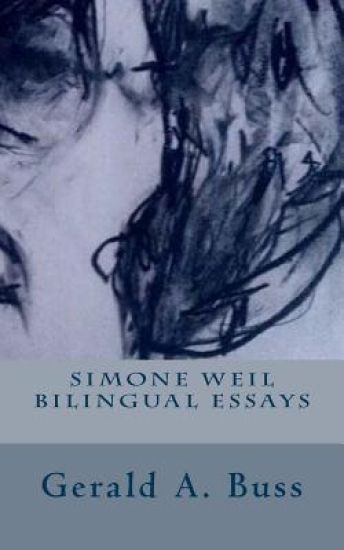
Contents of Simone Weil: Bilingual Essays: Translator's Note The Greek Pater (Lord's Prayer) & Simone Weil's French Version Love, by George Herbert & A French Translation Profession de Foi Profession of Faith Autobiographie spirituelle Spiritual Autobiography R flexions sur le bon usage des tudes scolaires en vue de l'amour de Dieu Reflections on the Good Use of School Studies as a Way to Come to a Love for God Cette Guerre est une guerre de religion This War is a Religious War R flexions sans ordre sur l'amour de Dieu Various Reflections on the Love of God Bibliography Postscript On the thirteenth of April 1942] Simone Weil wrote to Jo Bousquet . . . "I was very moved . . . to see that you had paid real attention to some pages I had shown you . . . Attention is the rarest and purest form of generosity. It is given to very few minds to notice that things and beings exist. Since my childhood I have not wanted anything else but to receive the complete revelation of this before dying." (In Simone P trement, Simone Weil: A Life, tr. Raymond Rosenthal, p. 462) On Simone Weil Diogenes Allen, Professor Emeritus of Philosophy, Princeton University: She was a spokesperson on behalf of striking workers, a volunteer teacher in night schools for railroad workers, and an active trade unionist. By working in factories and on farms she sought to understand how the oppression of work could be alleviated and the social hierarchy dismantled. She once gave shelter to Trotsky (and is said to have argued him into the ground over the nature of social oppression), was a soldier at the front in the Spanish Civil War, sought dangerous service in World War II and served with the Free French in London. If personal heroism is a recommendation . . . Weil's credentials are impeccable. ("Liberation from Illusion," www.religion-online.org) Albert Camus, Nobel Prize in Literature 1957: I am still convinced that Simone Weil is the only great mind of our times . . . For my part, I would be satisfied if I could say that, with the humble means at my disposal, I helped to make known, to disseminate, her work, whose full impact we have yet to measure. (www.hermenaut.com) T. S. Eliot, Nobel Prize in Literature 1948: In trying to understand her, we must not be distracted - as is only too likely to happen on first reading - by considering how far, and at what points, we agree or disagree. We must simply expose ourselves to the personality of a woman of genius, of a kind of genius akin to that of the saints. (Preface, The Need for Roots, p. vi) Gustave Thibon, French Catholic lay theologian: People have found it possible to speak of a 'pathological predisposition to suffering' in connection with Simone Weil. That does not amount to very much: purely psychological explanations, when applied to anyone of such dimensions, suggest a garment that is absurdly tight and splits in all directions . . . She sailed for New York in May 1942. Shortly before our separation, I saw her again in Marseilles . . . To recall the details of this last conversation and to make of it just a memory among others seems to me a profanation today; things which pass beyond time cannot be confined to the memory. I will only say that I had the impression of being in the presence of an absolutely transparent soul which was ready to be reabsorbed into original light. I can still hear Simone Weil's voice in the deserted streets of Marseilles as she took me back to my hotel in the early hours of the morning; she was speaking of the Gospel; her mouth uttered thoughts as a tree gives its fruit, her words did not express reality, they poured it into me in its naked totality; I felt myself to be transported beyond space and time and literally fed with light. (Simone Weil as We Knew Her, tr. Emma Craufurd, pp. 122-123)
Gerald Arthur Winter's narratives thrive at the fringe, where the heart of darkness is offered as a delicacy to pique your appetite for more.Though you can never be sure of the direction Gerald Arthur Winter's tales will take, all are woven from the same cloth. In skilled hands at every turn, you can be certain to return from your narrated journey somehow changed for the better, and equipped with sharp insight into the fragile human condition.Winter's collection is a potpourri of mixed genres, each story containing a resolution of resounding change with a twist.We're caught in Winter's net, from a killer mermaid in "The Catch," through a maze of lost children in "River Rats," to "The Last Gulag," where he opens our eyes to the worst possibilities of American political intrigue.His sharp narrative can even knock us unconscious through a purple haze of American folklore, as found with unexpected delight, in his mixed genre tale, "Fractured Frontier."Crafted on a foundation of Alfred Hitchcock-like surprises, Winter spins his tales on the fringe of Rod Serlingesque entrapment with a punch in the gut that will leave readers shaken, not stirred.Gerald Arthur Winter has a BA in Journalism from Rutgers University and an MFA in Creative Writing from University of Tampa. His short stories have been published by The Connotation Press, The Creativity Webzine, 2 Elizabeths, Gremlin Creative, Hardboiled, Writer Fairies, and NY Literary Magazine which published his story, "A Free Sampling," with a 5 Star Award for Meaningful Fiction in September 2016. He has published over 70 literary stories since 2014.