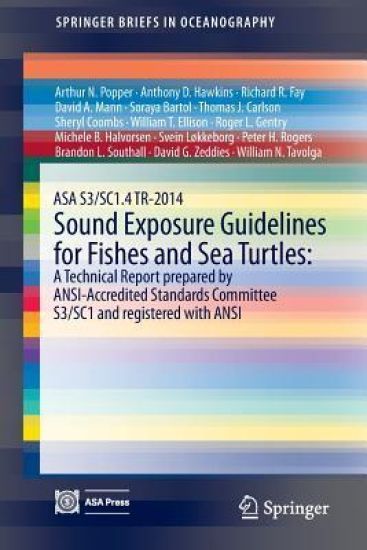
Arthur N. Popper; Anthony D. Hawkins; Richard R. Fay; David A. Mann; Soraya Bartol; Thomas J. Carlson; Sheryl Coombs; William T. Ellison; Roger L. Gentry; Michele B. Halvorsen; Svein Løkkeborg; Peter H. Rogers; Brandon L. Southall; David G. Zeddies; William N. Tavolga
This Technical Report presents the outcome of a Working Group that was established to determine broadly applicable sound exposure guidelines for fishes and sea turtles. After consideration of the diversity of fish and sea turtles, guidelines were developed for broad groups of animals, defined by the way they detect sound. Different sound sources were considered in terms of their acoustic characteristics and appropriate metrics defined for measurement of the received levels. The resultant sound exposure guidelines are presented in a set of tables. In some cases numerical guidelines are provided, expressed in appropriate metrics. When there were insufficient data to support numerical values, the relative likelihood of effects occurring was evaluated, although the actual likelihood of effects depends on the received level. These sound exposure guidelines, which are based on the best scientific information at the time of writing, should be treated as interim. The expectation is that with more research the guidelines can be refined and more cells in the tables completed. Recommendations are put forward defining the research requirements of highest priority for extending these interim exposure guidelines.
Quiller-Couch was born in the town of Bodmin, Cornwall, by the union of two ancient local families, the Quiller family and the Couch family, and was the third in a line of intellectuals from the Couch family. His younger sisters Florence Mabel and Lilian M. were also writers and folklorists. His father, Dr. Thomas Quiller Couch (d. 1884), was a noted physician, folklorist and historian. He married Mary Ford and lived at 63, Fore Street, Bodmin, until his death in 1884. His grandfather, Jonathan Couch, was an eminent naturalist, also a physician, historian, classicist, apothecary, and illustrator (particularly of fish). His son, Bevil Brian Quiller-Couch, was a war hero and poet, whose romantic letters to his fianc e, the poet May Wedderburn Cannan, were published in Tears of War. He also had a daughter, Foy Felicia, to whom Kenneth Grahame inscribed a first edition of his The Wind in the Willows attributing Quiller-Couch as the inspiration for the character Ratty
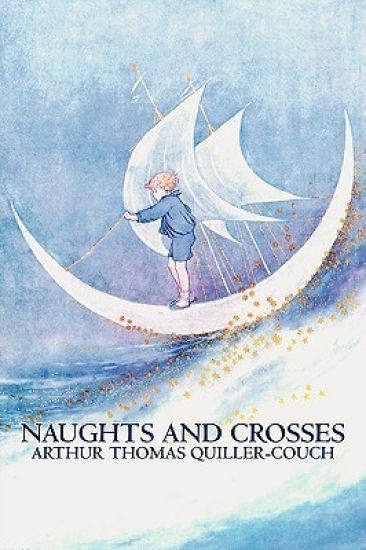
One day, when she and her boy were out playing, the boy stopped for a moment. He stood and smiled at her with the sun at his back -- and his shadow lay upon the whitened steps. But the silhouette was not that of a little breeched boy at all, but of a little girl in petticoats -- with long curls, where the charwoman's son was close-cropped "The Magic Shadow" is one of the dozen-plus stories of everyday life -- and of not-so-everyday delight and wonder -- in Naughts and Crosses, by the author of The Splendid Spur.
One day, when she and her boy were out playing, the boy stopped for a moment. He stood and smiled at her with the sun at his back -- and his shadow lay upon the whitened steps. But the silhouette was not that of a little breeched boy at all, but of a little girl in petticoats -- with long curls, where the charwoman's son was close-cropped "The Magic Shadow" is one of the dozen-plus stories of everyday life -- and of not-so-everyday delight and wonder -- in Naughts and Crosses, by the author of The Splendid Spur.
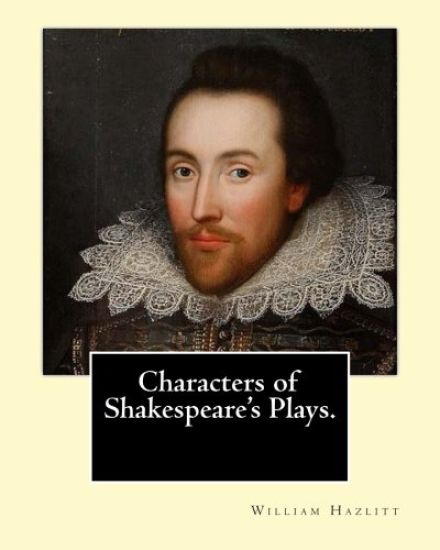
William Hazlitt (10 April 1778 - 18 September 1830) was an English writer, drama and literary critic, painter, social commentator, and philosopher. He is now considered one of the greatest critics and essayists in the history of the English language, placed in the company of Samuel Johnson and George Orwell.He is also acknowledged as the finest art critic of his age. Despite his high standing among historians of literature and art, his work is currently little read and mostly out of print. During his lifetime he befriended many people who are now part of the 19th-century literary canon, including Charles and Mary Lamb, Stendhal, Samuel Taylor Coleridge, William Wordsworth, and John Keats....... Sir Arthur Thomas Quiller-Couch ( 21 November 1863 - 12 May 1944) was a Cornish writer who published using the pseudonym Q. Although a prolific novelist, he is remembered mainly for the monumental publication The Oxford Book Of English Verse 1250-1900 (later extended to 1918) and for his literary criticism. He influenced many who never met him, including American writer Helene Hanff, author of 84, Charing Cross Road and its sequel, Q's Legacy. His Oxford Book of English Verse was a favourite of John Mortimer's fictional character Horace Rumpole....... William Shakespeare ( 26 April 1564 (baptised) - 23 April 1616) nb 1] was an English poet, playwright, and actor, widely regarded as the greatest writer in the English language and the world's pre-eminent dramatist. 154 sonnets, two long narrative poems, and a few other verses, some of uncertain authorship. His plays have been translated into every major living language and are performed more often than those of any other playwright. Shakespeare was born and brought up in Stratford-upon-Avon, Warwickshire. At the age of 18, he married Anne Hathaway, with whom he had three children: Susanna, and twins Hamnet and Judith. Sometime between 1585 and 1592, he began a successful career in London as an actor, writer, and part-owner of a playing company called the Lord Chamberlain's Men, later known as the King's Men. He appears to have retired to Stratford around 1613, at age 49, where he died three years later. Few records of Shakespeare's private life survive, which has stimulated considerable speculation about such matters as his physical appearance, sexuality, and religious beliefs and whether the works attributed to him were written by others. Shakespeare produced most of his known work between 1589 and 1613. His early plays were primarily comedies and histories, which are regarded as some of the best work ever produced in these genres. He then wrote mainly tragedies until about 1608, including Hamlet, Othello, King Lear, and Macbeth, considered some of the finest works in the English language.In his last phase, he wrote tragicomedies, also known as romances, and collaborated with other playwrights. Many of his plays were published in editions of varying quality and accuracy during his lifetime. In 1623, however, John Heminges and Henry Condell, two friends and fellow actors of Shakespeare, published a more definitive text known as the First Folio, a posthumous collected edition of his dramatic works that included all but two of the plays now recognised as Shakespeare's.It was prefaced with a poem by Ben Jonson, in which Shakespeare is hailed, presciently, as "not of an age, but for all time". In the 20th and 21st centuries, his works have been repeatedly adapted and rediscovered by new movements in scholarship and performance. His plays remain highly popular and are constantly studied, performed, and reinterpreted in diverse cultural and political contexts throughout the world.





![Poems and Ballads by 'q.' [I.E. Arthur Thomas Quiller-Couch.]](/covers/9781241052706.jpg)