Kirjojen hintavertailu. Mukana 11 244 527 kirjaa ja 12 kauppaa.

Kirjahaku

Etsi kirjoja tekijän nimen, kirjan nimen tai ISBN:n perusteella.

93 tulosta hakusanalla Asko Parpola

The Roots of Hinduism

The Roots of Hinduism

Asko Parpola

Oxford University Press Inc
2015
nidottu
Hinduism has two major roots. The more familiar is the religion brought to South Asia in the second millennium BCE by speakers of Aryan or Indo-Iranian languages, a branch of the Indo-European language family. Another, more enigmatic, root is the Indus civilization of the third millennium BCE, which left behind thousands of short inscriptions in a forgotten pictographic script. Discovered in the valley of the Indus River in the early 1920s, the Indus civilization had a population estimated at one million people, in more than 1000 settlements, several of which were cities of some 50,000 inhabitants. With an area of nearly a million square kilometers, the Indus civilization was more extensive than the other key urban cultures of the time, in Mesopotamia and Egypt. Yet, after almost a century of excavation and research the Indus civilization remains little understood. What language did the Indus people speak? How might we decipher the exquisitely carved Indus inscriptions? What deities did they worship? Are the roots of contemporary Hinduism to be found in the religion of the Indus civilization as well as in the Vedic religion? Since the rise of Hindu nationalist politics in the 1980s, these questions have been debated with increasing animosity, colored by the history of modern colonialism in India. This is especially true of the enigmatic Indus script, which is at the hub of the debates, and a particular focus of this book. Asko Parpola has spent fifty years researching the roots of Hinduism to answer these fundamental questions. In this pioneering book, he traces the Indo-Iranian speakers from the Aryan homeland north of the Black Sea through the Eurasian steppes to Central, West, and South Asia. Among many other things, he discusses the profound impact of the invention of the horse-drawn chariot on Indo-Aryan religion, and presents new ideas on the origin and formation of the Vedic literature and rites, and the great Hindu epics.
Deciphering the Indus Script

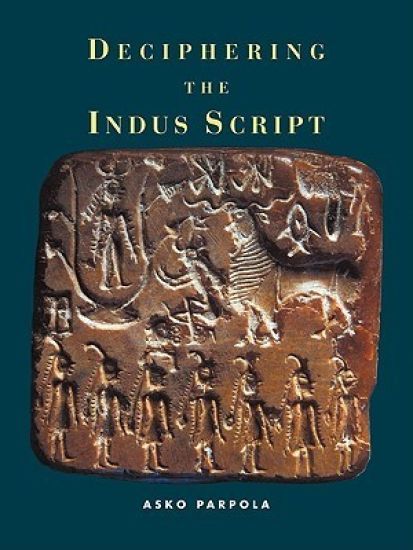
Deciphering the Indus Script

Asko Parpola

Cambridge University Press
2009
pokkari
Of the writing systems of the ancient world which still await deciphering, the Indus script is the most important. It developed in the Indus or Harappan Civilization, which flourished c. 2500–1900 BC in and around modern Pakistan, collapsing before the earliest historical records of South Asia were composed. Nearly 4,000 samples of the writing survive, mainly on stamp seals and amulets, but no translations. Professor Parpola is the chief editor of the Corpus of Indus Seals and Inscriptions. His ideas about the script, the linguistic affinity of the Harappan language, and the nature of the Indus religion are informed by a remarkable command of Aryan, Dravidian, and Mesopotamian sources, archaeological materials, and linguistic methodology. His fascinating study confirms that the Indus script was logo-syllabic, and that the Indus language belonged to the Dravidian family.
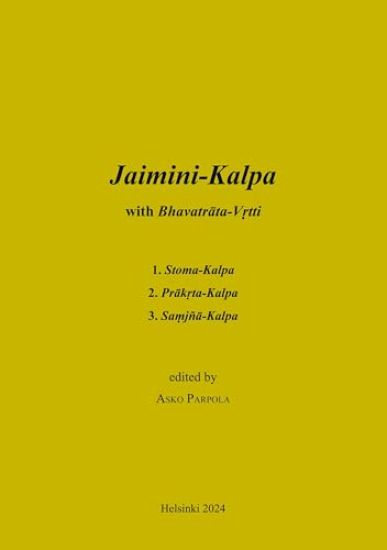
Jaimini-Kalpa with Bhavatrata-Vrtti

Jaimini-Kalpa with Bhavatrata-Vrtti

Asko Parpola

BoD - Books on Demand
2024
pokkari
This book publishes primary sources on ancient South Asia. The Jaimini-Kalpa (JK) is a previouly unpublished Sama-Vedic text composed in Sanskrit around the sixth century BCE. It was discovered by Asko Parpola in 1966 in a unique miscatalogued manuscript in the Tanjore Maharaja Serfoji's Sarasvati Mahal Library in Thanjavur, Tamil Nadu, South India. A rather exhaustive decades-long hunt for manuscripts of Jaiminiya texts in South India and elsewhere did not produce any further manuscripts of this text; but another unique manuscript from the Thanjavur library, Candrasekhara's Prayoga-Vrtti, a Medieval work, contains many quotations from it. The Jaimini-Kalpa is the Jaiminiya counterpart of the Arseya-Kalpa of the Kauthuma school of Sama-Veda. These texts have as their purpose to give the kalpa or klpti 'arrangement' of the Sama-Vedic liturgy in all Soma sacrifices: which samans ('songs') are to be sung on which text verses and in which order and with what repetition of the stotra verses at the different services of pressing the Soma juice in a given rite. The JK has been commented in Sanskrit by Bhavatrata and his student and son-in-law Jayanta, who lived in the South Indian state of Kerala around 700 CE. Their commentary, which cites the commented passages of the bJK only by their first two and last two syllables, was first published, with many errors, in 1966 by Premnidhi Sastri on the basis of a single faulty manuscript. The present edition is based on the best existing manuscripts, all from Kerala. With the coomentaries and Candrasekhara's applications (prayoga), the JK is so voluminous that it has to be printed in two volumes. The latter volume has an appendix, AP's index to the Jaiminiya-Uha-Gana and Jaiminiya-Uhya-Gana, the two song books of the Jaiminiya-Samhita giving the samans in their modified form and in their ritual order, that is, the order of the Soma sacrifices in which they are sung. Also published in the latter volume is Jayanta's c
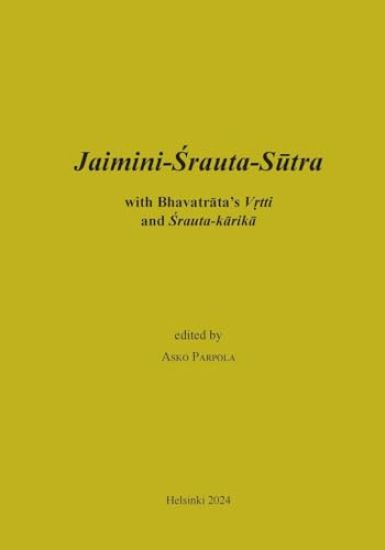
Jaimini-Srauta-Sutra with Bhavatrata-Vrtti and Srautakarika
This book makes a primary source on ancient South Asia available to research. The Jaimini-Srauta-Sutra is a Sanskrit text composed around the 6th century BCE. The important new contribution of this book is the excellent Sanskrit commentary of Bhavatrata, who lived in the South Indian state of Kerala around 700 CE. The Srauta-Sutras codify the duties of the priests performing the elaborate sacrifices of the Vedic religion, as prescribed less systematically in the earlier Brahmana texts considered to be divine revelation. There are four groups of priests representing the four Vedas: the singer priests chant songs from the collection of songs of the Sama-Veda,
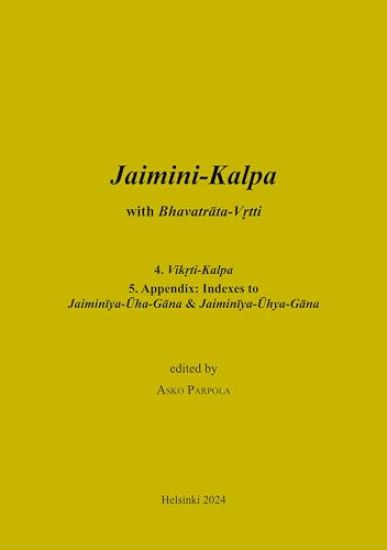
Jaimini-Kalpa with Bhavatrata-Vrtti

Jaimini-Kalpa with Bhavatrata-Vrtti

Asko Parpola

BoD - Books on Demand
2024
pokkari
This book publishes primary sources on ancient South Asia. The Jaimini-Kalpa (JK) is a previouly unpublished Sama-Vedic text composed in Sanskrit around the sixth century BCE. It was discovered by Asko Parpola in 1966 in a unique miscatalogued manuscript in the Tanjore Maharaja Serfoji's Sarasvati Mahal Library in Thanjavur, Tamil Nadu, South India. A rather exhaustive decades-long hunt for manuscripts of Jaiminiya texts in South India and elsewhere did not produce any further manuscripts of this text; but another unique manuscript from the Thanjavur library, Candrasekhara's Prayoga-Vrtti, a Medieval work, contains many quotations from it. The Jaimini-Kalpa is the Jaiminiya counterpart of the Arseya-Kalpa of the Kauthuma school of Sama-Veda. These texts have as their purpose to give the kalpa or klpti 'arrangement' of the Sama-Vedic liturgy in all Soma sacrifices: which samans ('songs') are to be sung on which text verses and in which order and with what repetition of the stotra verses at the different services of pressing the Soma juice in a given rite. The JK has been commented in Sanskrit by Bhavatrata and his student and son-in-law Jayanta, who lived in the South Indian state of Kerala around 700 CE. Their commentary, which cites the commented passages of the bJK only by their first two and last two syllables, was first published, with many errors, in 1966 by Premnidhi Sastri on the basis of a single faulty manuscript. The present edition is based on the best existing manuscripts, all from Kerala. With the coomentaries and Candrasekhara's applications (prayoga), the JK is so voluminous that it has to be printed in two volumes. The latter volume has an appendix, AP's index to the Jaiminiya-Uha-Gana and Jaiminiya-Uhya-Gana, the two song books of the Jaiminiya-Samhita giving the samans in their modified form and in their ritual order, that is, the order of the Soma sacrifices in which they are sung. Also published in the latter volume is Jayanta's c
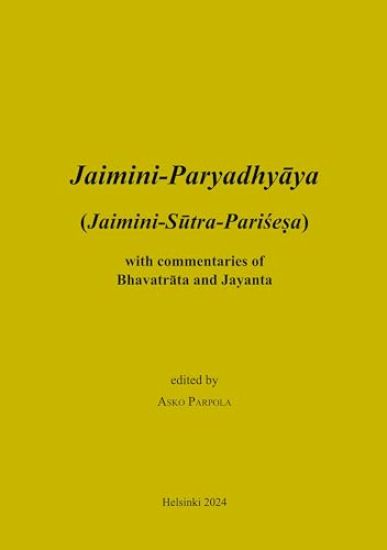
Jaimini-Paryadhyaya (Jaimini-Sutra-Parisesa) with commentaries of Bhavatrata and Jayanta
This book publishes primary sources on ancient South Asia. The Jaimini-Paryadhyaya (JPA) alias Jaimini-Sutra-Parisesa is a Samavedic text composed in Sanskrit around the sixth century BCE. It was known to have once existed from a few quotations from it in commentarial literature. It was discovered by Asko Parpola in 1966 in a unique miscatalogued manuscript in the Tanjore Maharaja Serfoji's Sarasvati Mahal Library in Thanjavur, Tamil Nadu, South India. A rather exhaustive decades-long hunt for manuscripts of Jaiminiya texts in South India and elsewhere did not produce any further manuscripts of this text; but another unique manuscript from the Thanjavur library, Candrasekhara's Prayoga-Vrtti, a Medieval work, contains many quotations from it. Jaimini-Paryadhyaya is a previously unknown Vedic text. It complements the Jaimini-Srauta-Sutra of the Jaiminiya school of Samaveda, which is much shorter than the parallel texts of the Kauthuma and Ranayaniya schools, the Latyayana-Srauta-Sutra and the Drahyayana-Srauta-Sutra. The JPA has been commented in Sanskrit by Bhavatrata and his student and son-in-law Jayanta, who lived in the South Indian state of Kerala around 700 CE. Their commentary, which cites the commented passages of the JPA only by their first two and last two syllables, was first published, with many errors, in 1966 by Premnidhi Sastri on the basis of a single faulty manuscript. The present edition is based on the best existing manuscripts, all from Kerala.
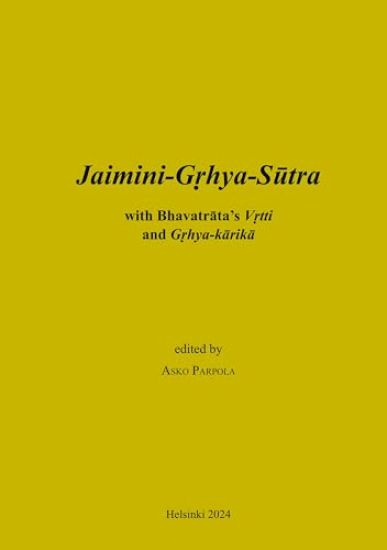
Jaimini-Grhya-Sutra with Bhavatrata's Vrtti and Grhya-karika
This book publishes primary sources on ancient South Asia. The Jaimini-Grhya-Sutra (JGS) is a Sanskrit text dating from about 400 BCE. It gives the rules for the domestic rites of passage for the Samavedic Brahmins of the Jaiminiya school, while its Kauthuma school counterpart is the Gobhila-Grhya-Sutra. The JGS has been edited (with extracts from Srinivasa's commentary) and translated into English by Willem Caland in 1922. Here the text is explained by Bhavatrata, a Keralan Brahmin who lived about 700 CE. Bhavatrata's excellent commentary is published here for the first time, based on manuscripts from Kerala.
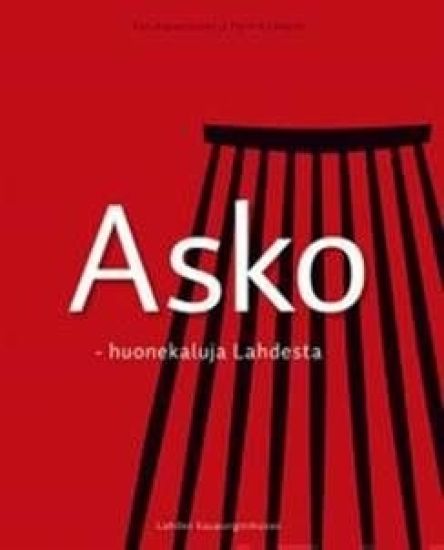
Asko -huonekaluja Lahdesta

Asko -huonekaluja Lahdesta

Sari Kainulainen; Päivi Vickholm

Lahden museot
2016
sidottu
Asko - huonekaluja Lahdesta SisustusnostalgiaaVuonna 1918 Lahteen perustettiin Lahden Puuseppätehdas, sittemmin Askona tunnettu huonekalutehdas. Pienenä verstaana aloittanut yritys kasvoi Lahden suurimmaksi työllistäjäksi ja lopulta Pohjoismaiden suurimmaksi huonekalutehtaaksi, joka kalusti lukuisat suomalaiset kodit ja konttorit. Tehtaan toiminta kesti 80 vuotta.Lahden kaupunginmuseo julkaisi uutuusteoksen Askon huonekalutehtaan tuotteista. Asko-huonekaluja Lahdesta on laaja kuvateos, joka perustuu museon Asko-kokoelman valokuva- ja arkistoaineistoon. Kyseessä on perusteellinen katsaus suomalaisen kodinsisustuksen historiaan. Kirja on paitsi kertomus eräästä lahtelaisesta yrityksestä myös hakuteos omien perintöhuonekalujensa taustoista kiinnostuneille. Teoksen ovat kirjoittaneet museon kokoelmapäällikkö Sari Kainulainen ja tutkija Päivi Vickholm.
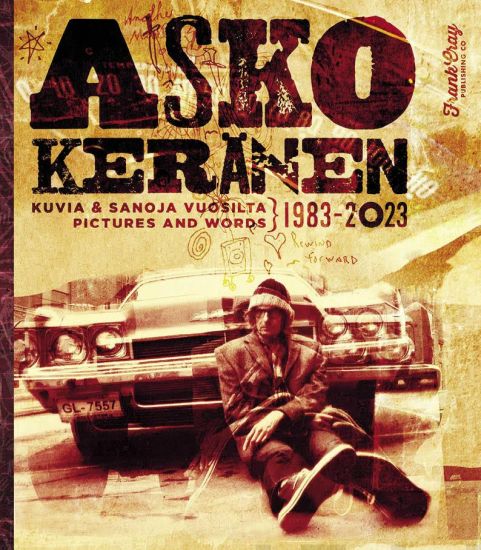
Asko Keränen. Kuvia ja sanoja vuosilta 1983-2023
Tunnetun suomalaisen yhtyeen 22-Pistepirkkojen kosketinsoittaja Asko Keränen on yhtyeen perustajajäsen veljensä PK:n kanssa. Hän on monitaiteellinen persoona, joka on soittanut ja soittaa edelleen 22-Pistepirkoissa kosketinsoittimia. Yhtye treenaa ja esiintyy jälleen kerran yhdessä pitkäaikaisen tauon jälkeen. Tämä kirja näyttää Askosta toisen hiukan vähemmän tunnetun puolen. Kirja esittelee Askon vuosien 1983-2023 aikana keikkojen tauoilla ja hotellihuoneissa piirtämiä kuvituksia ja sanoja omasta elämästään. Mukana on myös ennen julkaisematonta kuvamateriaalia Askon omista kuva-arkistoista. Kyseessä on kulttuuri- ja taidehistoriallisesti ainutlaatuinen hypähdys picassomaiseen sielunmaisemaan.
Integrated Life Cycle Design of Structures
Traditionally the process of design has concentrated on the construction phase itself, with the primary objective being to optimise efficiency and minimise costs during development and construction. With the move towards a more sustainable development comes the need for this short-term approach to be expanded to encompass the entire service life of the structure. This book describes how to optimise the service life of structures, through an optimum integrated life cycle design process. Sustainability and material performance issues are detailed. Integrated Life Cycle Design of Structures provides a comprehensive account of this rapidly emerging field. It is essential reading for civil and structural engineers, designers, architects, contractors, and clients.
The Romantic Idea of the Golden Age in Friedrich Schlegel's Philosophy of History
The nineteenth-century Romantic understanding of history is often confused with the longing for the past Golden Age. In this book, the Romantic idea of Golden Age is seen from a new angle by discussing it in the context of Friedrich Schlegel’s works. Interestingly, Schlegel argued that the concept of a past Golden Age in the beginning of history was itself a product of antiquity, imagined without any historical ground.The Golden Age was not bygone for Schlegel, but to be produced in the future. His utopian vision of the Kingdom of God was related to the millenarian expectations of perpetual peace aroused by the revolutionary wars. Schlegel understood current era through the kairos concept, which emphasized the present possibilities for public agency. Thus history could not be reduced to any kind of pre-established pattern of redemption, for the future was determined only by the opportunities manifested in the present time.
Integrated Life Cycle Design of Structures
Traditionally the process of design has concentrated on the construction phase itself, with the primary objective being to optimise efficiency and minimise costs during development and construction. With the move towards a more sustainable development comes the need for this short-term approach to be expanded to encompass the entire service life of the structure. This book describes how to optimise the service life of structures, through an optimum integrated life cycle design process. Sustainability and material performance issues are detailed. Integrated Life Cycle Design of Structures provides a comprehensive account of this rapidly emerging field. It is essential reading for civil and structural engineers, designers, architects, contractors, and clients.
Brothers

Brothers

Asko Sahlberg

Peirene Press Ltd
2012
pokkari
Finland, 1809. Henrik and Erik are brothers who fought on opposite sides in the war between Sweden and Russia. With peace declared, they both return to their snowed-in farm. But who is the master? Sexual tensions, old grudges, family secrets: all come to a head in this dark and gripping saga.
The Romantic Idea of the Golden Age in Friedrich Schlegel's Philosophy of History
The nineteenth-century Romantic understanding of history is often confused with the longing for the past Golden Age. In this book, the Romantic idea of Golden Age is seen from a new angle by discussing it in the context of Friedrich Schlegel’s works. Interestingly, Schlegel argued that the concept of a past Golden Age in the beginning of history was itself a product of antiquity, imagined without any historical ground.The Golden Age was not bygone for Schlegel, but to be produced in the future. His utopian vision of the Kingdom of God was related to the millenarian expectations of perpetual peace aroused by the revolutionary wars. Schlegel understood current era through the kairos concept, which emphasized the present possibilities for public agency. Thus history could not be reduced to any kind of pre-established pattern of redemption, for the future was determined only by the opportunities manifested in the present time.
Tätä mieltä 1: lehtikirjoituksia

Tätä mieltä 1: lehtikirjoituksia

Asko Korpela; Pekka Pihlanto

Createspace Independent Publishing Platform
2014
nidottu
Pekka Pihlannon kirjoitukset kattavat vaihtelevan aihepiirin. K sitell n robotteja, huumeongelmaa ja nuorten syrj ytymist . Turvallisuuspolitiikan yhteydess nousevat esiin Karjalan palautushaaveet, jalkav kimiinat ja Suomen Nato-j senyys. My s yliopistojen ongelmia valotetaan, huipennuksena uusi yliopistolaki. Kriittiseen valoon joutuvat yritysjohdon palkitsemisj rjestelmien ylily nnit sek uusliberalismin hedelm t, finanssikriisi ja talouskriisi. Politiikasta riitt keskustelua vaalirahoituksesta alkaen. Euroopan unionin velkakriisi ja tukipaketit ovat kestoaiheita t ss kokoelmassa.
Valon juhla

Valon juhla

Asko Jaakonaho

Otava
2017
sidottu
Romaani Katri Valan ja Olavi Paavolaisen vaiheista sotakeväänä 1942 on haikeuden täyttämä kuvaus nuoruudesta ja unelmista.Katria vaivaa parantumaton keuhkotauti, samoin huoli perheestä ja sodan uhreista. Pommejakin enemmän helsinkiläiset pelkäävät puhua. Katrin lähipiiri ryhtyy uhkarohkeasti vastarintaan rauhan puolesta.Kameleonttimainen Olavi pakenee sodan ristiriitoja omiin muistoihinsa. Hän haluaa vielä kerran tavata nuoruudenystävänsä Katrin ja pelastaa tämän viimeiset runot.20-luvulla Katri ja Olavi elivät valon juhlaa, mutta nälkätalvena 1942 suursodan synkkä varjo pimentää koko Euroopan.