

Kirjahaku
Etsi kirjoja tekijän nimen, kirjan nimen tai ISBN:n perusteella.
1000 tulosta hakusanalla Aurelio Jose Costa






Going Around Dili By Microlet - Hale'u Dili Ho Mikrolet
Aurelio Jose Costa
Library for All
2021
pokkari



The Evolution of Political Ideology
Steven Charles Hertler; Aurelio José Figueredo; Mateo Peñaherrera-Aguirre
Springer International Publishing AG
2025
sidottu
This book applies multilevel selection theory to an examination of both the natural history of ideology, and how that natural history has unfolded through the course of civil history in the Western world. Its authors bring together research from across the fields of history, political science, genetics, neurobiology and social science to offer an unprecedented synthesis.Addressing natural history, Part I evolutionarily explains why political ideology is substantially genetic, correlates with personality traits, and is represented in brain regions associated with risk and emotional processing. Addressing civil history, Part II traces the evolution of political ideology across anthropological transitions from non-human primates to small-scale societies, and across historical transitions from autocratic states through to democratic societies with political parties peaceably transferring power and tolerating opposition. In this way, its authors aim to demonstrate that temperamental antecedents to political ideology that are biologically derived, evolutionarily explicable, and historically palpable.This book presents timely insights into issues the evolutionary history of hyper-partisanship that will be of interest to scholars across the fields of political science, political psychology, evolutionary psychology and history.
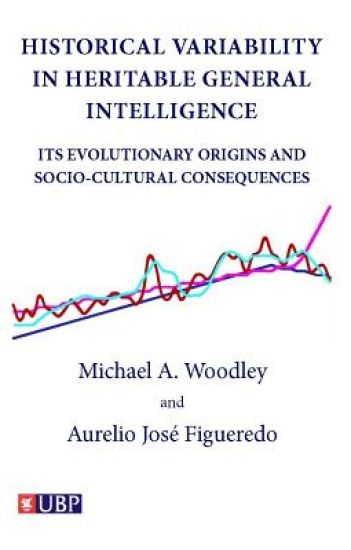
Historical Variability In Heritable General Intelligence
Michael A. Woodley; Aurelio Jose Figueredo
The University of Buckingham Press
2013
nidottu
It is easy for us to believe that as a society we are getting smarter, at least as measured by IQ tests. This supposed improvement, the Flynn Effect, suggests that each generation is brighter than the last. If this improvement in intelligence is real we should all be much, much brighter than the Victorians. However, the researchers of this ground-breaking study find the reverse to be true- the Victorians were cleverer than us! IQ tests may be effective at picking out the brightest, but they are not reliable benchmarks of performance over more than a century.Historical Variance records the exploration of the Flyyn effect hypothesis, which included the use of high-quality instruments to measure simple reaction times (a recognised predictor of intelligence) in a meta-analytic study.The conclusions are very sobering: far from speeding up, we are slowing down. A decline in general intelligence (a loss equivalent to about 14 IQ points) since Victorian times may have resulted from the presence of dysgenic fertility. These findings, as detailed in Historical Variance, strongly indicate that the Victorians were substantially cleverer than we are today...

Life History Evolution
Steven C. Hertler; Aurelio José Figueredo; Mateo Peñaherrera-Aguirre; Heitor B. F. Fernandes; Michael A. Woodley of Menie
Springer Nature Switzerland AG
2019
nidottu
The social sciences share a mission to shed light on human nature and society. However, there is no widely accepted meta-theory; no foundation from which variables can be linked, causally sequenced, or ultimately explained. This book advances “life history evolution” as the missing meta-theory for the social sciences. Originally a biological theory for the variation between species, research on life history evolution now encompasses psychological and sociological variation within the human species that has long been the stock and trade of social scientific study. The eighteen chapters of this book review six disciplines, eighteen authors, and eighty-two volumes published between 1734 and 2015—re-reading the texts in the light of life history evolution.

Multilevel Selection
Steven C. Hertler; Aurelio José Figueredo; Mateo Peñaherrera-Aguirre
Springer Nature Switzerland AG
2020
sidottu
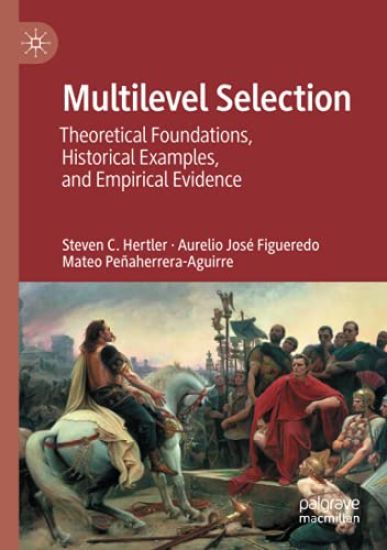
This book embeds a novel evolutionary analysis of human group selection within a comprehensive overview of multilevel selection theory, a theory wherein evolution proceeds at the level of individual organisms and collectives, such as human families, tribes, states, and empires. Where previous works on the topic have variously supported multilevel selection with logic, theory, experimental data, or via review of the zoological literature; in this book the authors uniquely establish the validity of human group selection as a historical evolutionary process within a multilevel selection framework.Select portions of the historical record are examined from a multilevel selectionist perspective, such that clashing civilizations, decline and fall, law, custom, war, genocide, ostracism, banishment, and the like are viewed with the end of understanding their implications for internal cohesion, external defense, and population demography. In doing so, its authors advance the potential for further interdisciplinary study in fostering, for instance, the convergence of history and biology. This work will provide fresh insights not only for evolutionists but also for researchers working across the social sciences and humanities.
Multilevel Selection
Steven C. Hertler; Aurelio José Figueredo; Mateo Peñaherrera-Aguirre
Springer Nature Switzerland AG
2021
nidottu
This book embeds a novel evolutionary analysis of human group selection within a comprehensive overview of multilevel selection theory, a theory wherein evolution proceeds at the level of individual organisms and collectives, such as human families, tribes, states, and empires. Where previous works on the topic have variously supported multilevel selection with logic, theory, experimental data, or via review of the zoological literature; in this book the authors uniquely establish the validity of human group selection as a historical evolutionary process within a multilevel selection framework.Select portions of the historical record are examined from a multilevel selectionist perspective, such that clashing civilizations, decline and fall, law, custom, war, genocide, ostracism, banishment, and the like are viewed with the end of understanding their implications for internal cohesion, external defense, and population demography. In doing so, its authors advance the potential for further interdisciplinary study in fostering, for instance, the convergence of history and biology. This work will provide fresh insights not only for evolutionists but also for researchers working across the social sciences and humanities.
Presidential Age
Steven C. Hertler; Aurelio Jose Figueredo; Mateo Penaherrera-Aguirre
Springer International Publishing AG
2025
sidottu
This book on presidential age is not about Alzheimer's Disease and associated pathologies of the aging brain. It is instead about the normally aging brain. Brains don’t simply develop and maintain their functionality into older adulthood unless otherwise impaired by neurocognitive disease. Were this the case, this book might be about leveraging prodromal biomarkers of neurodegenerative diseases to screen prospective presidential candidates. Instead, the normal decline age brings to all human brains begs a different type of book—and a broader and more blanketed warning about electing increasingly older presidents.

Life History Evolution
Steven C. Hertler; Aurelio José Figueredo; Mateo Peñaherrera-Aguirre; Heitor B. F. Fernandes; Michael A. Woodley of Menie
Springer International Publishing AG
2018
sidottu
The social sciences share a mission to shed light on human nature and society. However, there is no widely accepted meta-theory; no foundation from which variables can be linked, causally sequenced, or ultimately explained. This book advances “life history evolution” as the missing meta-theory for the social sciences. Originally a biological theory for the variation between species, research on life history evolution now encompasses psychological and sociological variation within the human species that has long been the stock and trade of social scientific study. The eighteen chapters of this book review six disciplines, eighteen authors, and eighty-two volumes published between 1734 and 2015—re-reading the texts in the light of life history evolution.
Missing Data
Patrick E. McKnight; Katherine M. McKnight; Souraya Sidani; Aurelio Jose Figueredo
Guilford Publications
2007
nidottu
While most books on missing data focus on applying sophisticated statistical techniques to deal with the problem after it has occurred, this volume provides a methodology for the control and prevention of missing data. In clear, nontechnical language, the authors help the reader understand the different types of missing data and their implications for the reliability, validity, and generalizability of a study’s conclusions. They provide practical recommendations for designing studies that decrease the likelihood of missing data, and for addressing this important issue when reporting study results. When statistical remedies are needed--such as deletion procedures, augmentation methods, and single imputation and multiple imputation procedures--the book also explains how to make sound decisions about their use. Patrick E. McKnight's website offers a periodically updated annotated bibliography on missing data and links to other Web resources that address missing data.