While there have been controversial attempts to link conclusions from sociobiological studies of animal populations to humans, few behavioural scientists or anthropologists have made serious progress. This book presents a theoretical approach to human social behaviour that is rooted in evolutionary biology and sociobiology. Hughes applies the principles of kin selection theory - which states that natural selection can favour social acts that increase the fitness of both individuals and their close relatives - to anthropological data, using mathematical and statistical techniques.
This work has been selected by scholars as being culturally important and is part of the knowledge base of civilization as we know it.This work is in the public domain in the United States of America, and possibly other nations. Within the United States, you may freely copy and distribute this work, as no entity (individual or corporate) has a copyright on the body of the work.Scholars believe, and we concur, that this work is important enough to be preserved, reproduced, and made generally available to the public. To ensure a quality reading experience, this work has been proofread and republished using a format that seamlessly blends the original graphical elements with text in an easy-to-read typeface.We appreciate your support of the preservation process, and thank you for being an important part of keeping this knowledge alive and relevant.
Along Unfamiliar Paths is a therapeutic conversation about our perilous journey through life and all its uncertainties, with Christ as the healing agent. This book is for the imperfect people of the world, those who have deficits. It is for the parents who abandoned their children, the children who suffer from that abandonment, the husband and wife who do not love each other, the family that is divided, and the friends who have hurt and betrayed each other. Each poem is emulative of the conversations I have with my father--unhurried, non-judgmental, and refreshing in their blunt honesty, as coming from someone who genuinely cares. Overall, my hope is that the work nourishes your thoughts so you can heal your wounded heart.
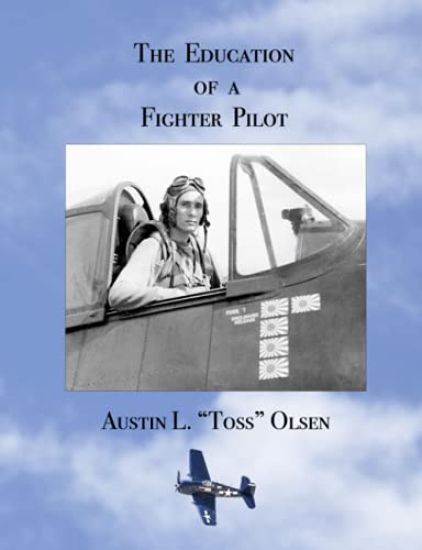
"The Education of a Fighter Pilot" is a personal biography written by Austin L. "Toss" Olsen that covers nearly four years of his life, ages 17 to 20, during which he trained to be a fighter pilot in World War II - and shot down five Japanese airplanes. Olsen was on a team of five fliers - replacement pilots sent out to the Pacific. The five saw combat; two perished, one was shot down and became a prisoner of war, and Toss and a fellow pilot completed their service as the war ended. To write the book, he relied on 144 letters, postcards and telegrams that he had sent to his parents while he trained for some two years in six states and then finally served aboard the aircraft carrier Belleau Wood in 1945. This book tells the details of his training, of his flights in combat, and of his friendships, some of which were shattered when his comrades died during the war. The day he shot down four planes, he had been fired on earlier - by a fellow pilot. The bullet holes that were evidence of the friendly fire were just inches from his cockpit. His first inclination was to use the correspondence to write a work of fiction; he was already the author of two novels: "Corcho Bliss," published in 1972 by Simon & Schuster, and "Apache Ambush," published in 2000 by Kensington. But Olsen chose to use the letters and add his recollections to tell the real story of what he went through to become a pilot for the Navy, and how he was able to pay for his "education" by shooting down five airplanes, including a kamikaze that was headed low on the water against a U.S. destroyer with a complement of more than 200 sailors on board. As he explained, the letters did not contain everything that happened: "Regulations prohibited revealing the details of where I was, or what I had done - and I myself was not always candid."
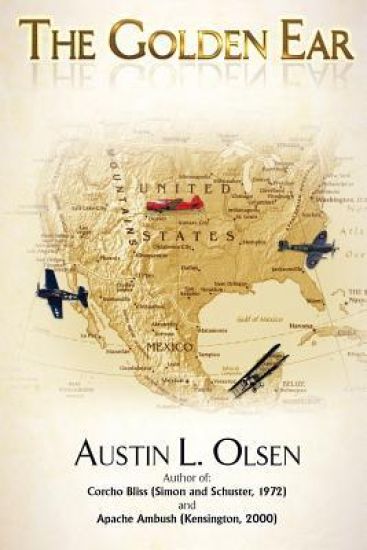
This novel has elements of a modern Western, historical fiction, and a family saga, and many moments of action, romance, heroism, and machismo.It is fiction, but its starting point is based on the reported kidnapping of an American Consul in Puebla, Mexico, in 1920 during the turbulent times of the Mexican Revolution. A ransom was paid. Shortly thereafter the consul resigned his post, bought a sugar mill, and later he started the nation's largest bank and controlled the movie industry. His name was William Jenkins. The character of Willard Riley is loosely based on the kidnapping incident.The novel features the young fighter pilot, Tell Cooper, who flew with the Lafayette Escadrille in France in World War I; his newfound friend, Willard Riley, the amoral consul; his first love, the exotic To a; the loathsome Jorge Rubio whom he calls "Toad"; the charismatic Johnny valos, who might have been president of Mexico had it not been for one perceived flaw in his character; and Helen Anderson, the newspaperwoman who would marry Cooper and write a history of the Riley empire. Her manuscript was titled "Riley's Golden Ear."The Golden Ear takes place mostly in Mexico, but there are parts that concern Cooper's son flying Spitfires in the Battle of Britain during World War II, as well as the exploits of To a's son, a U.S. naval carrier-based fighter pilot in the same war. The fighter pilot fabric in the novel is authentic: At the tender age of 20, the author shot down five Japanese aircraft just before the end of the war.Austin Olsen (1924-2007) had two other novels published: Corcho Bliss, Simon and Schuster, 1972, and Apache Ambush, Kensington, 2000.
Hocus Pocus Here We Go is a short collection of poetry that takes you on a metaphysical journey navigating you through the human psyche and experiences of Austin Dumas. It will aspire you to question the fundamental nature of reality, mind, consciousness and self-identity. These philosophical views and mystical babble may leave you asking, what's going on? You may find your own personal answer in this book.