Kirjahaku
Etsi kirjoja tekijän nimen, kirjan nimen tai ISBN:n perusteella.
1000 tulosta hakusanalla B Keith Franklin

Paxinos and Franklin's the Mouse Brain in Stereotaxic Coordinates, Compact
Keith B.J. Franklin; George Paxinos
Academic Press Inc
2019
kierre
Paxinos and Franklin's The Mouse Brain in Stereotaxic Coordinates, Compact Fifth Edition, is the compact version of the most widely used and cited atlas of the mouse brain in print. It emulates in design and accuracy Paxinos and Watson’s The Rat Brain in Stereotaxic Coordinates, the most cited publication in neuroscience. The compact edition provides the coronal plates and diagrams of the full mouse atlas in a smaller, more convenient spiral format and at a student friendly price. High resolution digital photographs of the coronal plane of section from the full 5th edition complement the coronal drawings. Unique to the compact, it includes an introduction to the use of the atlas in stereotaxic surgery.

Paxinos and Franklin's the Mouse Brain in Stereotaxic Coordinates
George Paxinos; Keith B.J. Franklin
Academic Press Inc
2019
sidottu
Paxinos and Franklin’s The Mouse Brain in Stereotaxic Coordinates, Fifth Edition, emulates in design and accuracy Paxinos and Watson’s The Rat Brain in Stereotaxic Coordinates, the most cited publication in neuroscience.

Benjamin Franklin Keeth: A Family History
James B. Keeth
Createspace Independent Publishing Platform
2014
nidottu


Ishmael and The Enchanted Baseball Cap is the new book from B. Keith Davidson in what will become a new series of juvenile fiction books. In this book we meet Ishmael, a new kid with hipster parents. Ishmael comes across a baseball that can talk, formerly a boy named Jack. Jack tells Ishmael the story of the Evil Enchantress who has been stealing souls throughout history including some well known historical figures. Jack managed to trap the Evil Enchantress in the same book she was using to collect souls years ago. But, in doing so he was trapped himself. But now the disappearances are starting again. And, the museum where it all started is about to be re-opened with his father as the curator. Will Jack and Ishmael be able to stop the Evil Enchantress again or will Ishmael be her next victim?

The church is called to provide clergy for the military. Seminaries educate and prepare students. But there are complexities, controversies, and criticisms. Many seminary and college professors have no experience in the military. Understanding these dilemmas, Paul Linzey and Keith Travis created a much-needed resource. They both have mentored hundreds of chaplains, pastors, and ministerial students. The result is a comprehensive book about serving as a military chaplain in the twenty-first century. Drawing from their experience as chaplain, professor, endorsing agent, and chief of Army chaplain recruiting, they provide a professional resource for anyone interested in ministry to people in the military. Their records, qualifications, and expertise combine to provide a comprehensive, passionate, and authoritative look at serving as a chaplain in today's military. The book is well-researched, true to real life, and up-to-date. It is unparalleled in scope.


This text reviews the capability and future strategic use of the advanced B-2 bomber and analyses how it must meet changing national and international security situations.


Missile Defense In The 21st Century: Protection Against Limited Threats
Keith B. Payne
Routledge
2019
sidottu
This book examines the implications of emerging security environment for missile defense. It identifies the lessons concerning the questions provided by the Gulf War, focusing on the redirection of the Strategic Defense Initiative towards a capability for global protection against limited strikes.

This book critically examines U.S. attempts to establish a nuclear deterrent against the Soviet Union and offers new approaches to dealing with the changing strategic environment. Dr. Payne maintains that the most influential theories of nuclear deterrence--Assured Vulnerability and Flexible Targeting—are unrealistic, given Soviet foreign policy and attitudes toward nuclear war, and no longer adequately meet the requirements of U.S. national security. Identifying an approach compatible with U.S. security commitments, he argues that future U.S. policy should focus on defeating the "Soviet theory of victory"--on threatening Soviet military forces and domestic and external political control assets, while also defending the U.S. against nuclear attack. The discussion covers recent developments, among them the "new nuclear strategy" of the Carter administration and President Reagan's new weapons program.

Keith B. Bickel challenges a host of military and strategic theories that treat particular bureaucratic structures, large organizations, and elites as the progenitors of doctrine. This timely study of how the military draws lessons from interventions focuses on the overlooked role that mid-level combat officers play in creating military doctrine. Mars Learning closely evaluates Marine civil and military pacification operations in Haiti, the Dominican Republic, and Nicaragua, and illuminates the debates surrounding the development of Marine Corps' small wars doctrine between 1915 and 1940. The result is compelling evidence of how field experience obtained before 1940 played a role in shaping the Marine Corps' Small Wars Manual and elements of doctrine that exist today. How the Marines organized lessons at that time provides important insights into how doctrine is likely to be generated today in response to post-Cold War interventions around the globe.

Missile Defense In The 21st Century: Protection Against Limited Threats
Keith B. Payne
Routledge
2020
nidottu
This book examines the implications of emerging security environment for missile defense. It identifies the lessons concerning the questions provided by the Gulf War, focusing on the redirection of the Strategic Defense Initiative towards a capability for global protection against limited strikes.

This book examines U.S. attempts to establish a nuclear deterrent against the Soviet Union and offers new approaches to dealing with the changing strategic environment. It is designed as a contribution to the quality of strategic thought.

The National Institute for Public Policy’s new book, Minimum Deterrence: Examining the Evidence, is the first of its kind. Dr. Keith Payne, the late former Secretary of Defense James Schlesinger and an unparalleled bipartisan group of senior civilian and military experts critically examined eight basic assumptions of Minimum Deterrence against available evidence. In general, Minimum Deterrence does not fare well under the careful scrutiny.Proponents of a "Minimum Deterrent" US nuclear force posture believe that anywhere from a handful to a few hundred nuclear weapons are adequate to deter reliably and predictably any enemy from attacking the United States now and in the future. Because nuclear weapons are so destructive, their thinking goes, no foreign leader would dare challenge US capabilities. The benefits, advocates claim, of reducing US nuclear weapons to the "minimum" level needed are: better relations with Russia and China, reinforcement of the arms control and Nonproliferation Treaty, billions of defense dollars in savings, and greater international stability on the way to "nuclear zero."As political pressure builds to pursue this vision of minimum US deterrence, Minimum Deterrence: Examining the Evidence stands as the seminal study to address the many claims of great benefit against available empirical evidence.This book was published as a National Institute Press monograph, Keith B. Payne and James Schlesinger, Minimum Deterrence: Examining the Evidence (Fairfax, VA: National Institute Press, 2013) and as a special issue of Comparative Strategy.
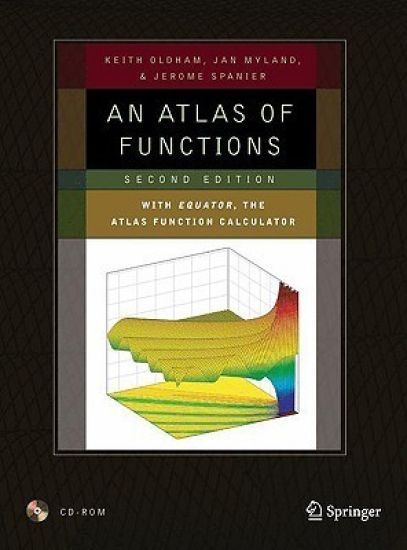
An Atlas of Functions
Keith B. Oldham; Jan Myland; Jerome Spanier
Springer-Verlag New York Inc.
2008
sidottu
[email protected],[email protected]@uci.edu.AnErrataofknownerrorsandrevisionswillbefound on the publisher's website; please access www.springer.com/978-0-387-48806-6 and follow the links. This will be updated as and if new errors are detected or clarifications are found to be needed. Use of the Atlas of Functions or Equator, the Atlas function calculator is at your own risk. The authors and the publisher disclaim liability for any direct or consequential damage resulting from use of the Atlas or Equator. It is a pleasure to express our gratitude to Michelle Johnston, Sten Engblom, and Trevor Mace-Brickman for theirhelpinthecreationoftheAtlasandEquator. Thefrankcommentsofseveralreviewerswhoinspectedanearly versionofthemanuscripthavealsobeenofgreatvalue. WegivesincerethankstoSpringer,andparticularlytoAnn KostantandOonaSchmid,fortheircommitmenttothelengthytaskofcarryingtheconceptofAnAtlasofFunctions through to reality with thoroughness, enthusiasm, skill, and even some humor. Their forbearance in dealing with the authors is particularly appreciated. WehopeyouwillenjoyusingAnAtlasofFunctionsandEquator,andthattheywillprovehelpfulinyourwork or studies. January 2008 Keith B. Oldham Jan C. Myland Jerome Spanier Every chapter has sections devoted to: notation, behavior, definitions, special cases, intrarelationships, expansions, particular values, numerical values, limits and approximations, operations of the calculus, complex argument, generalizations, and cognate functions. In addition, each chapter has the special features itemized below its title. PREFACE v GENERAL CONSIDERATIONS 1 What functions are. Organization of the Atlas. Notational conventions. Rules of the calculus. THE CONSTANT FUNCTION c 13 Mathematical constants. Complex numbers. Pulse functions. Series of powers of natural numbers. THE FACTORIAL FUNCTION n!21 Double and triple factorial functions. Combinatorics. Stirling numbers of the second kind. THE ZETA NUMBERS AND RELATED FUNCTIONS 29 Special values. Apery's constant. The Debye functions of classical physics.

An Atlas of Functions
Keith B. Oldham; Jan Myland; Jerome Spanier
Springer-Verlag New York Inc.
2008
muu
This book comprehensively covers several hundred functions or function families. In chapters that progress by degree of complexity, it starts with simple, integer-valued functions then moves on to polynomials, Bessel, hypergeometric and hundreds more.

Phosphorus: The Carbon Copy
Keith B. Dillon; François Mathey; John F. Nixon
John Wiley Sons Inc
1998
sidottu
Phosphorus: The Carbon Copy examines the extraordinary similarity between low coordinate phosphorus compounds and unsaturated carbon compounds. Written by three of the leading researchers in the field of modern phosphorus chemistry, Phosphorus: The Carbon Copy focuses on the interface between phosphorus and the transition metal elements and deals with the most recent aspects of unsaturated organophosphorus compounds and their coordination chemistry. Aimed at graduate students as well as academic and industrial researchers, this concise volume publicisies the extraordinary potential of these new phosphorus compounds for applications in catalysis, molecular materials and biochemistry.