Kirjojen hintavertailu. Mukana 11 372 768 kirjaa ja 12 kauppaa.

Kirjahaku

Etsi kirjoja tekijän nimen, kirjan nimen tai ISBN:n perusteella.

1000 tulosta hakusanalla Barbara J Aehlert

RAPID ACLS - Revised Reprint

RAPID ACLS - Revised Reprint

Barbara J Aehlert

Mosby/JEMS
2011
nidottu
Designed to offer essential information on-the-spot, where it's needed most! RAPID ACLS, 2nd Edition, Revised Reprint is now updated to reflect the 2010 emergency cardiovascular care guidelines. It contains a broad range of topics pertaining to advanced cardiac life support including information on airway management, pharmacology, vascular access, ECGs, electrical therapy, acute coronary syndromes, and special resuscitation situations. Loaded with tables, mnemonics, and algorithms throughout, RAPID ACLS, 2nd Edition, Revised Reprint is ideal for use in clinical practice or during an ACLS course. Compact 3 x 5 ½-inch size presents essential information in a quick-reference format. Fluid-resistant paper is durable for rugged clinical use. Full-color illustrations show clear, vivid presentations of essential concepts and common cardiac rhythms for clear and easy interpretation. Concise, accessible bullet points and numbered lists make key information easy to find, read, and understand. Convenient format uses spiral binding and color tabs as section dividers allow you to quickly locate important information in an emergency. Over 70 tables throughout the text including dysrhythmias and cardiac medications provide the basics of dysrhythmias and medications at a glance. Commonly used but rarely memorized information broken down into tables, algorithms, and acronyms help in locating essential information. Reflects the 2010 emergency cardiovascular care guidelines.
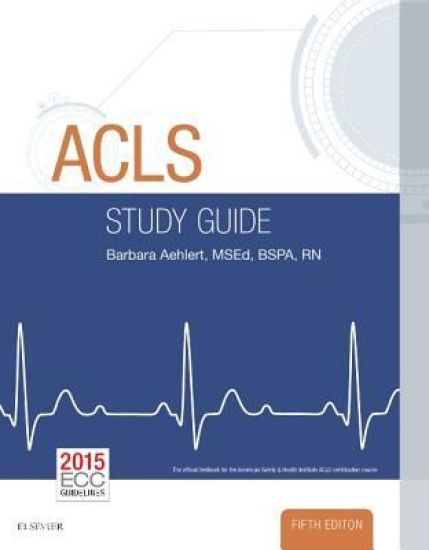
ACLS Study Guide

ACLS Study Guide

Barbara J Aehlert

Mosby
2016
nidottu
Provide the best possible emergency cardiovascular care - using the newest ECC guidelines! ACLS Study Guide, 5th Edition offers a complete, full-color overview of advanced cardiovascular life support. An easy-to-read approach covers everything from airway management to cardiac arrest rhythms and their management, electrical therapy, acute coronary syndromes, and acute stroke. In addition to the latest ACLS treatment algorithms, this edition includes case studies and hundreds of full-color photos and illustrations. Case studies present common, realistic clinical situations, helping you learn and apply skills in cardiac rhythm interpretation, medication administration, and other essential interventions. ACLS Pearls boxes offer brief explanations of complex topics and useful tips for clinical practice. End-of-chapter quizzes include answers and rationales, helping you learn and remember the most important information. Easy-to-understand approach simplifies your study of advanced cardiac life support, thanks to Barbara Aehlert's unique, conversational writing style. NEW! UPDATED content centers on evidence-based practice recommendations, including the 2015 American Heart Association Guidelines for Cardiopulmonary Resuscitation and Emergency Cardiovascular Care and the 2015 International Consensus on Cardiopulmonary Resuscitation and Emergency Cardiovascular Care Science With Treatment Recommendations. NEW! Improved format integrates all case studies into the appropriate chapters, so that you can apply concepts immediately to real-world situations.
ACLS Study Guide

ACLS Study Guide

Barbara J Aehlert

Mosby
2021
nidottu
Build the knowledge and skills you need to provide emergency cardiovascular care! ACLS Study Guide, 6th Edition provides a comprehensive, easy-to-understand overview of advanced cardiovascular life support. With case studies and hundreds of full-color photos and illustrations, this guide covers everything from airway management to cardiac arrest rhythms and electrophysiology, tachycardias and bradycardias, acute coronary syndromes, and acute ischemic stroke. Discussions of the newest ECC guidelines and ACLS treatment algorithms help you manage common cardiac conditions. Written by noted EMS educator Barbara Aehlert, ACLS Study Guide is ideal for use with the American Safety & Health Institute ACLS certification course. Easy-to-understand approach simplifies your study of advanced cardiac life support, thanks to Barbara Aehlert's unique, conversational writing style. Case studies describe real-world examples of common clinical situations, helping you master skills in cardiac rhythm interpretation, medication administration, and other essential interventions. Evidence-based practice recommendations are provided for emergency medical treatment. ACLS Pearl boxes offer brief explanations of complex topics and useful tips for clinical practice. Keeping It Simple boxes provide clear and concise summaries of key points along with memory aids. End-of-chapter quizzes include answers and rationales, helping you remember the most important information. NEW! Updated content includes the latest guidelines from the American Heart Association Guidelines for Cardiopulmonary Resuscitation and Emergency Cardiovascular Care and the International Consensus on Cardiopulmonary Resuscitation and Emergency Cardiovascular Care Science with Treatment Recommendations. NEW! 20 new illustrations are added to the book's hundreds of illustrations.
ECGs Made Easy

ECGs Made Easy

Barbara J Aehlert

Elsevier - Health Sciences Division
2022
nidottu
Learning ECG interpretation has never been easier! A practical guide to heart rhythm recognition, ECGs Made Easy, 7th Edition offers a more visual, less intimidating way to identify and interpret basic heart dysrhythmias. Each ECG rhythm includes a clear description, a sample ECG rhythm strip, possible signs and symptoms related to each rhythm, and recommended treatment. For more practice, additional rhythm strips and review exercises are provided at the end of each chapter. Written by noted EMS educator Barbara Aehlert, this guide has everything you need to master skills in ECG interpretation. Easy-to-read style and conversational tone help you to recall and apply ECG information. Brief description of each dysrhythmia is accompanied by a summary of rhythm characteristics and a sample ECG rhythm strip. Clear ECG discussions highlight what you need to know about dysrhythmia recognition, such as: How Do I Recognize It? What Causes It? What Do I Do About It? Introduction to the 12-Lead ECG chapter provides the basics for this advanced skill, including determining electrical axis, and recognizing ECG changes associated with myocardial ischemia and infarction, bundle branch block, and other conditions. ECG Pearl boxes cover ECG principles, practical applications, indications, and techniques, and offer useful hints for interpreting ECGs. Drug Pearls highlight select medications used to treat dysrhythmias. Key terms open each chapter by introducing and defining essential terminology. Summary tables review the key characteristics of dysrhythmias discussed in the chapter. Stop & Review exercises at the end of each chapter allow you to assess your understanding. Comprehensive posttest with answers at the end of the book allows you to check your understanding. NEW! Content updates reflect current science and clinical practice guidelines, including the American Heart Association's 2020 ECC resuscitation guidelines where applicable. NEW! Updates to selected rhythm strips allow for additional practice.
Pocket Guide for ECGs Made Easy

Pocket Guide for ECGs Made Easy

Barbara J Aehlert

Elsevier - Health Sciences Division
2022
nidottu
Put essential ECG information at your fingertips! Based on Barbara Aehlert's popular ECGs Made Easy, 7th Edition, this full-color pocket guide makes it quick and easy to identify and interpret basic heart rhythms. Each dysrhythmia includes a sample rhythm strip, a brief description, a discussion of possible patient symptoms, and general treatment guidelines. Ideal for use in classroom and practice settings, this handy, compact reference makes heart dysrhythmia information easy to find and easy to understand. Easy-to-read style and conversational tone make understanding ECG information quick and easy. Brief description of each dysrhythmia is accompanied by a concise summary of rhythm characteristics and a sample ECG rhythm strip. More than 70 full-color illustrations plus numerous tables and boxes highlight and summarize key information. NEW! Content updates mirror the changes to Aehlert's core text, ECGs Made Easy, 7th Edition. NEW! Current science and clinical practice guidelines are reflected, including the American Heart Association's 2020 ECC resuscitation guidelines where applicable.
Pocket Guide for ECGs Made Easy: First South Asia Edition
Get quick access to essential ECG information with the Pocket Guide for ECGs Made Easy, First South Asia Edition. Reflecting the American Heart Association's 2015 ECC resuscitation guidelines, this full-color guide contains key points and selected ECG rhythm strips to help you correctly identify ECG rhythms whether you're in the classroom or in the field. Each rhythm covered in the guide includes a brief description, a summary of heart rhythm characteristics, and a sample ECG rhythm strip. And with its numerous illustrations, call-out boxes, full-color layout, and easy-to-read, conversational style, this portable reference makes essential information not only easy to find, but also easy to understand.Easy-to-read, conversational tone makes understanding the information quick and easy.Brief description of each dysrhythmia is accompanied by a summary of heart rhythm characteristics and a sample ECG rhythm strip.Numerous tables, boxes, and full-color illustrations highlight and summarize key information. ECG Pearl boxes offer useful hints for interpreting ECGs, such as the importance of the escape pacemaker.
The 12-Lead ECG in Acute Coronary Syndromes

The 12-Lead ECG in Acute Coronary Syndromes

Barbara J Aehlert; Tim Phalen

Elsevier Health Sciences
2025
nidottu
Learn to accurately interpret 12-lead ECGs with this easy-to-understand guide! The 12-Lead ECG in Acute Coronary Syndromes, 5th Edition describes how to accurately interpret 12-lead ECGs for effective recognition and treatment of patients experiencing ACS. The book's streamlined format uses hundreds of illustrations, summary tables, and ECG examples to help you quickly master the material. You'll learn to identify ST-elevation myocardial infarction (STEMI), non-ST-elevation myocardial infarction (NSTEMI), and other causes of ST elevation. Designed for use as a clinical reference or in a continuing education class, this book reflects current science related to emergency cardiovascular care. More than 300 colorful illustrations depict concepts and skills. Landscape view presents 12-lead ECGs in their actual size for more realistic 12-lead ECG Interpretation. More than 100 practice ECGs help you apply your knowledge and master 12-lead ECG interpretation. Case studies promote recognition and treatment of patient complaints. Consider This boxes highlight important tips, and Quick Review questions with answers and rationales reinforce key content. Learning objectives in each chapter emphasize the knowledge you should gain, and key terms are bolded upon first mention for easier learning. Spiral binding makes it easier to lay the book flat for study or for use while on the job. NEW! Updated ECGs make it easier to comprehend and apply the material. NEW! Each chapter is updated to reflect current science, with references provided.
Ecgs Made Easy - Elsevier eBook on Vitalsource (Retail Access Card)
Learning ECG interpretation has never been easier A practical guide to heart rhythm recognition, ECGs Made Easy, 7th Edition offers a more visual, less intimidating way to identify and interpret basic heart dysrhythmias. Each ECG rhythm includes a clear description, a sample ECG rhythm strip, possible signs and symptoms related to each rhythm, and recommended treatment. For more practice, additional rhythm strips and review exercises are provided at the end of each chapter. Written by noted EMS educator Barbara Aehlert, this guide has everything you need to master skills in ECG interpretation. Easy-to-read style and conversational tone help you to recall and apply ECG information. Brief description of each dysrhythmia is accompanied by a summary of rhythm characteristics and a sample ECG rhythm strip. Clear ECG discussions highlight what you need to know about dysrhythmia recognition, such as: How Do I Recognize It? What Causes It? What Do I Do About It? Introduction to the 12-Lead ECG chapter provides the basics for this advanced skill, including determining electrical axis, and recognizing ECG changes associated with myocardial ischemia and infarction, bundle branch block, and other conditions. ECG Pearl boxes cover ECG principles, practical applications, indications, and techniques, and offer useful hints for interpreting ECGs. Drug Pearls highlight select medications used to treat dysrhythmias. Key terms open each chapter by introducing and defining essential terminology. Summary tables review the key characteristics of dysrhythmias discussed in the chapter. Stop & Review exercises at the end of each chapter allow you to assess your understanding. Comprehensive posttest with answers at the end of the book allows you to check your understanding. NEW Content updates reflect current science and clinical practice guidelines, including the American Heart Association's 2020 ECC resuscitation guidelines where applicable. NEW Updates to selected rhythm strips allow for additional practice.
Winning Widows: "A Study in the Book of Ruth" with Barbara J. White
"We all can relate to Ruth's story, because most everyone at one time or another, has lost something. In this book, Barbara shares insightful truths about a God who cares. A faithful God that specializes in: taking nothing and making something, healing the brokenhearted, and restoring lives when all may seem lost."Uplifting and encouraging from cover to cover."
Messages from the Throne

Messages from the Throne

Barbara J

Trilogy Christian Publishing
2021
pokkari
Would you really like to have a fulfilled and blessed life in Christ? This book will show you how. It is a treasure for your soul and a pathway to a sound relationship with Christ.This book is well worth the time spent reading it. Should you put into practice what you read in this book, your walk with Christ will change immensely. This book is a teaching tool as well as a spiritual guide. Your relationship with God will take on new meaning after you embrace the thought-provoking essence of this book, and you will be a much happier person.
English Aristocratic Women, 1450-1550

English Aristocratic Women, 1450-1550

Barbara J. Harris

Oxford University Press Inc
2002
sidottu
English Aristocratic Women combines a collective portrait of aristocratic women with an analysis of the particular, class-specific form of patriarchy and gender relations that flourished among the upper classes in Yorkist and early Tudor England. The first book on the subject based on extensive archival research, it examines the apparent contradiction between the patriarchal institutions that shaped women's lives and the wide range of their activities, control of resources, and power over themselves and members of their families. It demonstrates that the roles of aristocratic wives, mothers, and wideows constituted careers for women that had as much public and political significance and were as crucial for the survival and prosperity of their families and class as the careers of their husbands. They managed their families' property and households; arranged the marriages and careers of their children; created, sustained, and exploited the client-patron relationships that were an essential element in politics at the regional and national levels and in the power of individual families; and, finally, managed the transmission and distribution of property from one generation to another, since most wives outlive their husbands. For women from the inner circle of court families, careers at court expanded and supported these roles. As in all careers, aristocratic women gained prestige, authority, power, and financial rewards for their activities. Recognising the full significance of aristocratic women's careers revises our understanding of Yorkist and early Tudor politics. In addition, the centrality of their roles means that reconstructing their activities creates a vivid picture of every aspect of aristocratic domestic, familial, economic, and political life.
Community Treatment for Youth

Community Treatment for Youth

Barbara J. Burns; Kimberly Hoagwood

Oxford University Press Inc
2002
nidottu
Burns and Hoagwood bring together original articles by some of the country's leading experts on children's mental health services to create an outstanding text exploring innovative community interventions for youth with serious emotional disorders. These community-based interventions include home-based services, intensive case management, crisis care, therapeutic foster care, therapeutic group homes and community mentors. Part of the series on Innovations in Practice and Service Delivery with Vulnerable Populations, this book will be a needed reference for mental health workers and researchers in children's mental health, and an outstanding text for courses in community mental health and the mental health of children and adolescents.
English Aristocratic Women, 1450-1550

English Aristocratic Women, 1450-1550

Barbara J. Harris

Oxford University Press Inc
2002
nidottu
Portraits of aristocratic women from the Yorkist and Tudor periods reveal elaborately clothed and bejeweled nobility, exemplars of their families' wealth. Unlike their male counterparts, their sitters have not been judged for their professional accomplishments. In this groundbreaking study, Barbara J. Harris argues that the roles of aristocratic wives, mothers, and widows constituted careers for women that had as much public and political significance and were as crucial for the survival and prosperity of their families and class as their husband's careers. Women, Harris demonstrates, were trained from an early age to manage their families' property and households; arrange the marriages and careers of their children; create, sustain, and exploit the client-patron relationships that were an essential element in politics at the regional and national levels; and, finally, manage the transmission and distribution of property from one generation to another, since most wives outlived their husbands. English Aristocratic Women unveils the lives of noblewomen whose historical influence has previously been dismissed, as well as those who became favourites at the court of Henry VIII. Through extensive archival research of documents belonging to more than twelve hundred families, Harris paints a collective portrait of upper-class women of this period. By recognising the full significance of the aristocratic women's careers, this book reinterprets the politics and gender relations of early modern England. Barbara J. Harris is Professor of History and Women's Studies at the University of North Carolina at Chapel Hill. Her previous works include Edward Stafford, Third Duke of Buckingham, 1478-1521.
The Oxford Handbook of Southwest Archaeology

The Oxford Handbook of Southwest Archaeology

Barbara J. Mills; Severin Fowles

OXFORD UNIVERSITY PRESS INC
2022
nidottu
The American Southwest is one of the most important archaeological regions in the world, with many of the best-studied examples of hunter-gatherer and village-based societies. Research has been carried out in the region for well over a century, and during this time the Southwest has repeatedly stood at the forefront of the development of new archaeological methods and theories. Moreover, research in the Southwest has long been a key site of collaboration between archaeologists, ethnographers, historians, linguists, biological anthropologists, and indigenous intellectuals. This volume marks the most ambitious effort to take stock of the empirical evidence, theoretical orientations, and historical reconstructions of the American Southwest. Over seventy top scholars have joined forces to produce an unparalleled survey of state of archaeological knowledge in the region. Themed chapters on particular methods and theories are accompanied by comprehensive overviews of the culture histories of particular archaeological sequences, from the initial Paleoindian occupation, to the rise of a major ritual center in Chaco Canyon, to the onset of the Spanish and American imperial projects. The result is an essential volume for any researcher working in the region as well as any archaeologist looking to take the pulse of contemporary trends in this key research tradition.
Sex, Lies, and Brain Scans

Sex, Lies, and Brain Scans

Barbara J. Sahakian; Julia Gottwald

Oxford University Press
2017
sidottu
The recent explosion of neuroscience techniques has been game-changing in terms of understanding the healthy brain, and in the development of neuropsychiatric treatments. One of the key techniques is functional magnetic resonance imaging (fMRI), which allows us to examine the human brain non-invasively, and observe brain activity in real time. Through fMRI, we are beginning to build a deeper understanding of our thoughts, motivations, and behaviours. Already fMRI has been used to detect conscious activity in some patients who had all indications of being in a vegetative state, and even enabled us to communicate with some of them. This is just one of the many striking areas in which fMRI can be used to 'read minds'. As neuroscientists unravel the brain networks of self-control and morality, we might find abnormalities in criminal offenders. Could we predict crimes before they are committed? fMRI has also been used to detect racial bias in some people who regarded themselves as fair-minded. Meanwhile, the reliability of fMRI as a lie detector in murder cases or as a tool for marketing is being debated. Sex, Lies, and Brain Scans takes readers beyond the media headlines. Barbara Sahakian and Julia Gottwald consider what the technique of fMRI entails, and what information it can give us, showing which applications are possible today, and which ones are science fiction. They also consider the important ethical questions these techniques raise. Should brain scans be allowed at airports to screen for terrorists? Should they be used to vet future judges and teachers? How far will we allow neuroscience to go? It is time to make up our minds.
Sex, Lies, and Brain Scans

Sex, Lies, and Brain Scans

Barbara J. Sahakian; Julia Gottwald

Oxford University Press
2019
nidottu
The recent explosion of neuroscience techniques has proved to be game changing in terms of understanding the healthy brain, and in the development of neuropsychiatric treatments. One of the key techniques available to us is functional magnetic resonance imaging (fMRI), which allows us to examine the human brain non-invasively, and observe brain activity in real time. Through fMRI, we are beginning to build a deeper understanding of our thoughts, motivations, and behaviours. Recent reports that some patients who have all indications of being in a persistent vegetative state actually show conscious awareness, and were able to communicate with researchers, demonstrate perhaps the most remarkable and dramatic use of fMRI. But this is just the most striking of a number of areas in which fMRI is being used to 'read minds', albeit in a very limited way. As neuroscientists unravel the regions of the brain involved in reward and motivation, and in romantic love, we are likely to develop the capacity to influence responses such as love using drugs. fMRI studies have also been used to indicate that many people who would not regard themselves as racist show a racial bias in their emotional responses to faces of another racial group. Meanwhile, the reliability of fMRI as a lie detector in murder cases is being debated - what if the individual simply believes, falsely, that he or she committed a murder? Sex, Lies, and Brain Scans takes readers beyond the media headlines. Barbara J. Sahakian and Julia Gottwald consider what the technique of fMRI entails, and what information it can give us, showing which applications are possible today, and which ones are science fiction. They also consider the important ethical questions these techniques raise. Should individuals applying for jobs as teachers or judges be screened for unconscious racial bias? What if the manipulation of love using 'love potions' was misused for economic or military ends? How far will we allow neuroscience to go? It is time to make up our minds.