Kirjojen hintavertailu. Mukana 11 244 527 kirjaa ja 12 kauppaa.

Kirjahaku

Etsi kirjoja tekijän nimen, kirjan nimen tai ISBN:n perusteella.

157 tulosta hakusanalla Behrooz Mirafzal

Power Electronics in Energy Conversion Systems

Power Electronics in Energy Conversion Systems

Behrooz Mirafzal

McGraw-Hill Education
2021
nidottu
Learn fundamental concepts of power electronics for conventional and modern energy conversion systemsThis textbook offers comprehensive coverage of power electronics for the dynamic and steady-state analysis of conventional and modern energy conversion systems. The book includes detailed discussions of power converters for energy conversion techniques in renewable energy systems, grid-interactive inverters, and motor-drives. Written by a seasoned educator, Power Electronics in Energy Conversion Systems contains exclusive topics and features hundreds of helpful illustrations. Readers will gain clear understandings of the concepts through many examples and simulations.Coverage includes:An introduction to power electronics and energy conversionFundamental concepts in electric and magnetic circuitsPrinciples of electromechanical systemsSteady-state analysis of DC-DC convertersDynamics of DC-DC convertersSteady-state analysis of invertersSteady-state analysis and control of rectifiersControl and dynamics of grid-interactive invertersDynamic models of AC machinesControl of inverters in motor-drive systemsInverters and high-frequency transients
Computer Architecture

Computer Architecture

Behrooz Parhami

Oxford University Press Inc
2005
sidottu
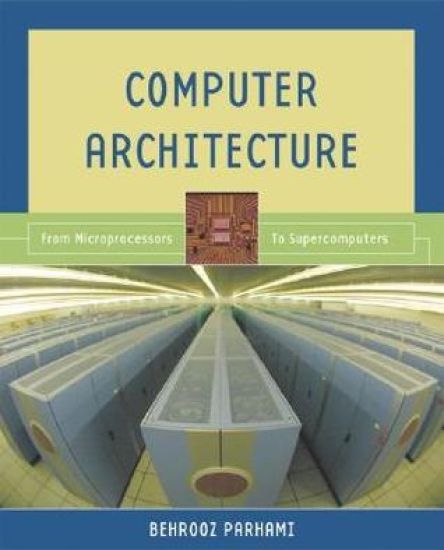
PART I: sets the stage, provides context, reviews some of the prerequisite topics and gives a taste of what is to come in the rest of the book. Included are two refresher-type chapters on digital circuits and components, a discussion of types of computer systems, an overview of digital computer technology, and a detailed perspective on computer system 3erformance. PART II:lays out the user's interface to computer hardware known as the instruction-set architechture (ISA). For better understanding, the instruction set of MiniMIPS (a simplified, yet very realistic, machine for which open reference material and simulation tools exist) is described. Included is a chapter on variations in ISA (e.g. RISC vs CISC) and associated cost performace tradeoffs. The next two parts cover the central processing unit (CPU). PART III: describes the structure of arithmetic/logic units (ALUs) in some detail. Included are discussions of fixed- and floating-point number representations, design of high-speed adders, shift and logical operations, and hardware multipliers/dividers. Implementation aspects and pitfalls of floating-point arthimetic are also discussed. PART IV: is devoted to data path and control circuits comprising the CPU. Beginning with instruction execution steps, the needed components and control mechanisms are derived. These are followed by an exposition of control design strategies, use of a pipelined data path for performance enhancement, and various limitations of pipelining due to data and control dependencies. PART V: concerned with the memory system. The technologies in use for primary and secondary memories are described, along with their strengths and limitations. It is shown how the use of cache memories effectively bridges the speed gap between CPU and main memory. Similarly, the use of virtual memory to provide the illusion of a vast main memory is explained. PART VI: deals with input/output and interfacing topics. A discussion of I/O device technologies is followed by methods of I/O programming and the roles of buses and links (including standards) in I/O communication and interfacing. Elements of processes and context switching, for exception handling or multireaded computation, are also covered. PART VII: introduces advanced architectures. An overview of performance enhancement strategies, beyond simple pipelining, is presented and examples of applications requiring higher performance are cited. These are followed by design strategies and example architectures based on vector or array proccessing, multiprocessing, and multicomputing.
Computer Arithmetic

Computer Arithmetic

Behrooz Parhami

Oxford University Press Inc
2009
sidottu
Ideal for graduate and senior undergraduate courses in computer arithmetic and advanced digital design, Computer Arithmetic: Algorithms and Hardware Designs, Second Edition, provides a balanced, comprehensive treatment of computer arithmetic. It covers topics in arithmetic unit design and circuit implementation that complement the architectural and algorithmic speedup techniques used in high-performance computer architecture and parallel processing. Using a unified and consistent framework, the text begins with number representation and proceeds through basic arithmetic operations, floating-point arithmetic, and function evaluation methods. Later chapters cover broad design and implementation topics-including techniques for high-throughput, low-power, fault-tolerant, and reconfigurable arithmetic. An appendix provides a historical view of the field and speculates on its future. An indispensable resource for instruction, professional development, and research, Computer Arithmetic: Algorithms and Hardware Designs, Second Edition, combines broad coverage of the underlying theories of computer arithmetic with numerous examples of practical designs, worked-out examples, and a large collection of meaningful problems. This second edition includes a new chapter on reconfigurable arithmetic, in order to address the fact that arithmetic functions are increasingly being implemented on field-programmable gate arrays (FPGAs) and FPGA-like configurable devices. Updated and thoroughly revised, the book offers new and expanded coverage of saturating adders and multipliers, truncated multipliers, fused multiply-add units, overlapped quotient digit selection, bipartite and multipartite tables, reversible logic, dot notation, modular arithmetic, Montgomery modular reduction, division by constants, IEEE floating-point standard formats, and interval arithmetic. Features: * Divided into 28 lecture-size chapters * Emphasizes both the underlying theories of computer arithmetic and actual hardware designs * Carefully links computer arithmetic to other subfields of computer engineering * Includes 717 end-of-chapter problems ranging in complexity from simple exercises to mini-projects * Incorporates many examples of practical designs * Uses consistent standardized notation throughout * Instructor's manual includes solutions to text problems * An author-maintained website http://www.ece.ucsb.edu/~parhami/text comp arit.htm contains instructor resources, including complete lecture slides
Computer Arithmetic

Computer Arithmetic

Behrooz Parhami

Oxford University Press Inc
2011
nidottu
Ideal for graduate and senior undergraduate courses in computer arithmetic and advanced digital design, Computer Arithmetic: Algorithms and Hardware Designs, Second Edition, provides a balanced, comprehensive treatment of computer arithmetic. It covers topics in arithmetic unit design and circuit implementation that complement the architectural and algorithmic speedup techniques used in high-performance computer architecture and parallel processing. Using a unified and consistent framework, the text begins with number representation and proceeds through basic arithmetic operations, floating-point arithmetic, and function evaluation methods. Later chapters cover broad design and implementation topics-including techniques for high-throughput, low-power, fault-tolerant, and reconfigurable arithmetic. An appendix provides a historical view of the field and speculates on its future. An indispensable resource for instruction, professional development, and research, Computer Arithmetic: Algorithms and Hardware Designs, Second Edition, combines broad coverage of the underlying theories of computer arithmetic with numerous examples of practical designs, worked-out examples, and a large collection of meaningful problems. This second edition includes a new chapter on reconfigurable arithmetic, in order to address the fact that arithmetic functions are increasingly being implemented on field-programmable gate arrays (FPGAs) and FPGA-like configurable devices. Updated and thoroughly revised, the book offers new and expanded coverage of saturating adders and multipliers, truncated multipliers, fused multiply-add units, overlapped quotient digit selection, bipartite and multipartite tables, reversible logic, dot notation, modular arithmetic, Montgomery modular reduction, division by constants, IEEE floating-point standard formats, and interval arithmetic.
Introduction to Parallel Processing

Introduction to Parallel Processing

Behrooz Parhami

Kluwer Academic/Plenum Publishers
1999
sidottu
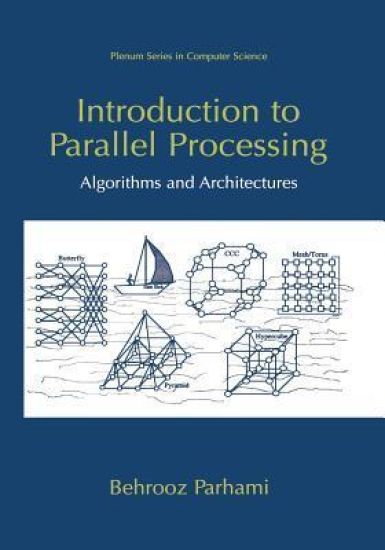
THE CONTEXT OF PARALLEL PROCESSING The field of digital computer architecture has grown explosively in the past two decades. Through a steady stream of experimental research, tool-building efforts, and theoretical studies, the design of an instruction-set architecture, once considered an art, has been transformed into one of the most quantitative branches of computer technology. At the same time, better understanding of various forms of concurrency, from standard pipelining to massive parallelism, and invention of architectural structures to support a reasonably efficient and user-friendly programming model for such systems, has allowed hardware performance to continue its exponential growth. This trend is expected to continue in the near future. This explosive growth, linked with the expectation that performance will continue its exponential rise with each new generation of hardware and that (in stark contrast to software) computer hardware will function correctly as soon as it comes off the assembly line, has its down side. It has led to unprecedented hardware complexity and almost intolerable dev- opment costs. The challenge facing current and future computer designers is to institute simplicity where we now have complexity; to use fundamental theories being developed in this area to gain performance and ease-of-use benefits from simpler circuits; to understand the interplay between technological capabilities and limitations, on the one hand, and design decisions based on user and application requirements on the other.
Biographical Dictionary of Public Administration

Biographical Dictionary of Public Administration

Behrooz Kalantari; Patricia M. Wigfall

Greenwood Press
2000
sidottu
Complementing texts that introduce students to the major theories of public administration, this biographical dictionary introduces the reader to the individuals who originated or had a significant impact on those theories. Including subjects from a spectrum of disciplines and from such diverse areas as organizational theory, personnel, and budgeting, the book covers the original pioneers and their contemporaries. A distinct crystallization covering the subject's personal, social, educational, and philosophical dimensions, each entry includes a short personal history followed by the subject's major contribution to the discipline and a bibliography of his or her works on the subject.By providing information on the individuals who developed the major theories in the field, this book will introduce readers to ideas from a variety of disciplines and thus enable students to consider public administration theories in context. This compact reference fills a serious gap in the field.
Foucault in Iran

Foucault in Iran

Behrooz Ghamari-Tabrizi

University of Minnesota Press
2016
sidottu
Were the thirteen essays Michel Foucault wrote in 1978–1979 endorsing the Iranian Revolution an aberration of his earlier work or an inevitable pitfall of his stance on Enlightenment rationality, as critics have long alleged? Behrooz Ghamari-Tabrizi argues that the critics are wrong. He declares that Foucault recognized that Iranians were at a threshold and were considering if it were possible to think of dignity, justice, and liberty outside the cognitive maps and principles of the European Enlightenment. Foucault in Iran centers not only on the significance of the great thinker’s writings on the revolution but also on the profound mark the event left on his later lectures on ethics, spirituality, and fearless speech. Contemporary events since 9/11, the War on Terror, and the Arab Uprisings have made Foucault’s essays on the Iranian Revolution more relevant than ever. Ghamari-Tabrizi illustrates how Foucault saw in the revolution an instance of his antiteleological philosophy: here was an event that did not fit into the normative progressive discourses of history. What attracted him to the Iranian Revolution was precisely its ambiguity.Theoretically sophisticated and empirically rich, this interdisciplinary work will spark a lively debate in its insistence that what informed Foucault’s writing was not an effort to understand Islamism but, rather, his conviction that Enlightenment rationality has not closed the gate of unknown possibilities for human societies.
Foucault in Iran

Foucault in Iran

Behrooz Ghamari-Tabrizi

University of Minnesota Press
2016
nidottu
Were the thirteen essays Michel Foucault wrote in 1978 1979 endorsing the Iranian Revolution an aberration of his earlier work or an inevitable pitfall of his stance on Enlightenment rationality, as critics have long alleged? Behrooz Ghamari-Tabrizi argues that the critics are wrong. He declares that Foucault recognized that Iranians were at a threshold and were considering if it were possible to think of dignity, justice, and liberty outside the cognitive maps and principles of the European Enlightenment. Foucault in Iran centers not only on the significance of the great thinkers writings on the revolution but also on the profound mark the event left on his later lectures on ethics, spirituality, and fearless speech. Contemporary events since 9/11, the War on Terror, and the Arab Uprisings have made Foucaults essays on the Iranian Revolution more relevant than ever. Ghamari-Tabrizi illustrates how Foucault saw in the revolution an instance of his antiteleological philosophy: here was an event that did not fit into the normative progressive discourses of history. What attracted him to the Iranian Revolution was precisely its ambiguity. Theoretically sophisticated and empirically rich, this interdisciplinary work will spark a lively debate in its insistence that what informed Foucaults writing was not an effort to understand Islamism but, rather, his conviction that Enlightenment rationality has not closed the gate of unknown possibilities for human societies.
Evidentiality in Sa'di's Poetry and Prose

Evidentiality in Sa'di's Poetry and Prose

Behrooz Mahmoodi-Bakhtiari; Masoumeh Mehrabi

TAYLOR FRANCIS LTD
2023
sidottu
This study is the first to introduce evidentiality to the stylistic analysis of literary works, specifically that of the great Persian writer Sa'di, focusing on how he used linguistic means to illustrate a real or ideational world.The authors begin by introducing the concept of evidentiality; its definition, its coding in Persian, the rationale behind evidentiality analysis, and semantic-pragmatic functions of evidentiality. The book highlights how evidentiality can be accounted for as a stylistic device to reveal the validity of a narration, as well as the author’s commitment and contribution to it. Three of Sa'di’s major works are analyzed – Bustan, Golestan and Sonnets – using Krippendoff's frequency approach. It is argued that Sa'di deployed an array of evidentials in his work, from direct visual evidentials in Golestan and Sonnets to heard and quoted evidentials in Bustan. To illustrate this, the book includes translations of Sa'di’s poetry and prose. In addition, the authors consider historical and contemporary manifestations of the Persian narrative style, as well as exploring the cultural concerns of the Persian speech community. The book will appeal to general linguists, practitioners of pragmatics and stylistics, literary critics, and those interested in contrastive analysis of literature and cultural studies.
Evidentiality in Sa'di's Poetry and Prose

Evidentiality in Sa'di's Poetry and Prose

Behrooz Mahmoodi-Bakhtiari; Masoumeh Mehrabi

TAYLOR FRANCIS LTD
2024
nidottu
This study is the first to introduce evidentiality to the stylistic analysis of literary works, specifically that of the great Persian writer Sa'di, focusing on how he used linguistic means to illustrate a real or ideational world.The authors begin by introducing the concept of evidentiality; its definition, its coding in Persian, the rationale behind evidentiality analysis, and semantic-pragmatic functions of evidentiality. The book highlights how evidentiality can be accounted for as a stylistic device to reveal the validity of a narration, as well as the author’s commitment and contribution to it. Three of Sa'di’s major works are analyzed – Bustan, Golestan and Sonnets – using Krippendoff's frequency approach. It is argued that Sa'di deployed an array of evidentials in his work, from direct visual evidentials in Golestan and Sonnets to heard and quoted evidentials in Bustan. To illustrate this, the book includes translations of Sa'di’s poetry and prose. In addition, the authors consider historical and contemporary manifestations of the Persian narrative style, as well as exploring the cultural concerns of the Persian speech community. The book will appeal to general linguists, practitioners of pragmatics and stylistics, literary critics, and those interested in contrastive analysis of literature and cultural studies.
Social Justice and Development

Social Justice and Development

Behrooz Morvaridi

Palgrave Macmillan
2008
nidottu
Explores why articulating social justice in both development discourse and practice provides the potential for a fresh understanding of global poverty, and one that rises above the current 'impasse'. Suggests how principles of global social justice could be used to shift the development paradigm away from a consensus that hinges on Washington.
Social Justice and Development

Social Justice and Development

Behrooz Morvaridi

Palgrave Macmillan
2008
sidottu
Explores why articulating social justice in both development discourse and practice provides the potential for a fresh understanding of global poverty, and one that rises above the current 'impasse'. Suggests how principles of global social justice could be used to shift the development paradigm away from a consensus that hinges on Washington.
Homogenization and Structural Topology Optimization

Homogenization and Structural Topology Optimization

Behrooz Hassani; Ernest Hinton

Springer London Ltd
2011
nidottu
Structural topology optimization is a fast growing field that is finding numerous applications in automotive, aerospace and mechanical design processes. Homogenization is a mathematical theory with applications in several engineering problems that are governed by partial differential equations with rapidly oscillating coefficients Homogenization and Structural Topology Optimization brings the two concepts together and successfully bridges the previously overlooked gap between the mathematical theory and the practical implementation of the homogenization method. The book is presented in a unique self-teaching style that includes numerous illustrative examples, figures and detailed explanations of concepts. The text is divided into three parts which maintains the book's reader-friendly appeal.
Introduction to Parallel Processing

Introduction to Parallel Processing

Behrooz Parhami

Springer-Verlag New York Inc.
2013
nidottu
THE CONTEXT OF PARALLEL PROCESSING The field of digital computer architecture has grown explosively in the past two decades. Through a steady stream of experimental research, tool-building efforts, and theoretical studies, the design of an instruction-set architecture, once considered an art, has been transformed into one of the most quantitative branches of computer technology. At the same time, better understanding of various forms of concurrency, from standard pipelining to massive parallelism, and invention of architectural structures to support a reasonably efficient and user-friendly programming model for such systems, has allowed hardware performance to continue its exponential growth. This trend is expected to continue in the near future. This explosive growth, linked with the expectation that performance will continue its exponential rise with each new generation of hardware and that (in stark contrast to software) computer hardware will function correctly as soon as it comes off the assembly line, has its down side. It has led to unprecedented hardware complexity and almost intolerable dev- opment costs. The challenge facing current and future computer designers is to institute simplicity where we now have complexity; to use fundamental theories being developed in this area to gain performance and ease-of-use benefits from simpler circuits; to understand the interplay between technological capabilities and limitations, on the one hand, and design decisions based on user and application requirements on the other.
New Events and Old Questions

New Events and Old Questions

Behrooz Ghamari

OR Books
2025
pokkari
The U.S. and Iran have been locked in a decades-long standoff, driven by missteps, misunderstandings, and conflicting ambitions. This collection of essays delves into the complex dynamics behind this ongoing conflict, shedding light on why American policies have repeatedly failed to understand the true nature of Iran’s transformations and its role in the Middle East. Drawing on two decades of political analysis, the essays explore the history of U.S. intervention in the region, focusing on the enduring sanctions imposed on Iran and the persistent perception of the Islamic Republic as a major obstacle to American power. Despite the repressive policies of the state, Iran has remained a vibrant society with active intellectual, cultural, and social justice movements. The book examines these internal changes and shifts in Iranian politics, offering crucial insights into why American policies have often been blind to these developments. By challenging the conventional image of Iran as a totalitarian regime, this collection urges readers to appreciate the country’s diverse society and complex political landscape. It calls for a re-evaluation of how the U.S. engages with Iran, advocating for a more informed, nuanced approach to Middle East diplomacy. At a critical moment when U.S. policy is being reshaped, these essays serve as a timely reminder: without acknowledging Iran’s transformations, both nations will continue to face new events—and the same old questions.
Motadan Omid: Addicts of Hope

Motadan Omid: Addicts of Hope

Behrooz Ghorbanian

Createspace Independent Publishing Platform
2018
nidottu
This poetical work in Persian language by Behrooz Ghorbanian, is a critical dialogue with the Iranian culture caught on the cross roads of modernity and tradition. A culture that is nostalgically romanticizing its past glories in literature, politics, and religion. All the while, technologically advancing to challenge the West's centuries old domination of the Middle East. The poems dwell and find their content in the pathological space of the resulting schizophrenia thus imposed both from within and from without. Aware of its own problematic immigrant status, the work is highly critical of romantic escapism of the culture to the traditional forms of representations, and its lazy slumber in a deadly nostalgia. The poems are equally suspicious of the Iranian communities outside of Iran, as they exhibit the same dispositions. The work is also derisive of the West's interventions that have been undermining the economic and political developments of the nation for decades.
Quality Confirmation Tests for Power Transformer Insulation Systems

Quality Confirmation Tests for Power Transformer Insulation Systems

Behrooz Vahidi; Ashkan Teymouri

Springer Nature Switzerland AG
2019
sidottu
This book focuses on oil-paper insulation included in power transformers, especially for EHV and UHV transformers. The importance on insulation ever increased due to a growing voltage rating of transformers. Within the last decades, although research on the transformer insulation and diagnosis methods has advanced a lot, the insulation of HV transformers remained more or less unchanged. The book is divided into five chapters; the first and second chapters explain the basics of oil insulation, while the third chapter focuses on paper insulation. The final two chapters deal with the methods and outcome of testing both techniques. The primary target audience for this book is graduate students and power system engineers.
Quality Confirmation Tests for Power Transformer Insulation Systems

Quality Confirmation Tests for Power Transformer Insulation Systems

Behrooz Vahidi; Ashkan Teymouri

Springer Nature Switzerland AG
2020
nidottu
This book focuses on oil-paper insulation included in power transformers, especially for EHV and UHV transformers. The importance on insulation ever increased due to a growing voltage rating of transformers. Within the last decades, although research on the transformer insulation and diagnosis methods has advanced a lot, the insulation of HV transformers remained more or less unchanged. The book is divided into five chapters; the first and second chapters explain the basics of oil insulation, while the third chapter focuses on paper insulation. The final two chapters deal with the methods and outcome of testing both techniques. The primary target audience for this book is graduate students and power system engineers.