Kirjojen hintavertailu. Mukana 11 244 527 kirjaa ja 12 kauppaa.

Kirjahaku

Etsi kirjoja tekijän nimen, kirjan nimen tai ISBN:n perusteella.

1000 tulosta hakusanalla Benjamin J. Bruxvoort Lipscomb

The Women Are Up to Something

The Women Are Up to Something

Benjamin J. Bruxvoort Lipscomb

OXFORD UNIVERSITY PRESS INC
2024
nidottu
The story of four remarkable women who shaped the intellectual history of the 20th century: Elizabeth Anscombe, Philippa Foot, Mary Midgley, and Iris Murdoch. On the cusp of the Second World War, four women went to Oxford to begin their studies: a fiercely brilliant Catholic convert; a daughter of privilege longing to escape her stifling upbringing; an ardent Communist and aspiring novelist with a list of would-be lovers as long as her arm; and a quiet, messy lover of newts and mice who would become a great public intellectual of our time. They became lifelong friends. At the time, only a handful of women had ever made lives in philosophy. But when Oxford's men were drafted in the war, everything changed. As Elizabeth Anscombe, Philippa Foot, Mary Midgley, and Iris Murdoch labored to make a place for themselves in a male-dominated world, as they made friendships and families, and as they drifted toward and away from each other, they never stopped insisting that some lives are better than others. They argued that courage and discernment and justice--and love--are the heart of a good life. This book presents the first sustained engagement with these women's contributions: with the critique and the alternative they framed. Drawing on a cluster of recently opened archives and extensive correspondence and interviews with those who knew them best, Benjamin Lipscomb traces the lives and ideas of four friends who gave us a better way to think about ethics, and ourselves.
Socially Responsible Investment Law

Socially Responsible Investment Law

Benjamin J Richardson

Oxford University Press Inc
2008
sidottu
Socially Responsible Investment Law shows how to improve the environmental behavior of corporate financiers, such as banks, pension plans, and mutual funds. Normally, we associate environmental harm with the front-line companies that extract, consume, and pollute, but not the financiers that sponsor and profit from these activities. Corporate financiers are the economy's "unseen polluters," and they should adopt policies and practices to avoid environmental harm that may result from their loans and capital financing investments. Benjamin Richardson proposes governance reforms to encourage Socially Responsible Investment. These include: redefining the fiduciary responsibilities of institutional investors to include the environment (specifically the precautionary principle); enhancing the strategic role of national pension funds in sustainable finance; building new forms of international cooperation for transnational financial markets; democratizing and strengthening local financing through credit unions; and, for all financiers, providing a better mix of economic incentives and informational resources for SRI.
Instrument of the State

Instrument of the State

Benjamin J. Harbert

OXFORD UNIVERSITY PRESS INC
2023
sidottu
Louisiana State Penitentiary is one of the largest and most brutal maximum-security prisons in the United States. Built on the grounds of a former plantation, the prison is commonly referred to as "Angola" apropos of the country of origin for many of the enslaved people who inhabited the land. Despite notoriously inhumane conditions within the prison, people incarcerated at Angola have sustained a rich and dynamic musical legacy since the late nineteenth century, attracting folklorists such as John and Alan Lomax and Harry Oster. Well-known musicians including Huddie William "Lead Belly" Ledbetter, Charles Neville, and James Booker played a part in this history, in addition to a litany of others who proved vital to the prison's musical culture but for various reasons were unable to establish their careers upon release. In Instrument of the State, author Benjamin J. Harbert interweaves oral history and archival research to show how incarcerated musicians find small but essential freedoms by performing jazz, R&B, country, gospel, rock, and fusion throughout the Twentieth Century. In doing so, he expands folkloric definitions of "prison music." considering the ways in which music manifests among the incarcerated and the prison's administration as a lens to better understand state power and the fragments of hope and joy that remain in its wake. Instrument of the State acts as an indictment of the carceral state, highlighting the many ways in which the US penal system disproportionately affects African American people through desperate profiteering of a deliberately underfunded state agency.
Instrument of the State

Instrument of the State

Benjamin J. Harbert

OXFORD UNIVERSITY PRESS INC
2023
nidottu
Louisiana State Penitentiary is one of the largest and most brutal maximum-security prisons in the United States. Built on the grounds of a former plantation, the prison is commonly referred to as "Angola" apropos of the country of origin for many of the enslaved people who inhabited the land. Despite notoriously inhumane conditions within the prison, people incarcerated at Angola have sustained a rich and dynamic musical legacy since the late nineteenth century, attracting folklorists such as John and Alan Lomax and Harry Oster. Well-known musicians including Huddie William "Lead Belly" Ledbetter, Charles Neville, and James Booker played a part in this history, in addition to a litany of others who proved vital to the prison's musical culture but for various reasons were unable to establish their careers upon release. In Instrument of the State, author Benjamin J. Harbert interweaves oral history and archival research to show how incarcerated musicians find small but essential freedoms by performing jazz, R&B, country, gospel, rock, and fusion throughout the Twentieth Century. In doing so, he expands folkloric definitions of "prison music." considering the ways in which music manifests among the incarcerated and the prison's administration as a lens to better understand state power and the fragments of hope and joy that remain in its wake. Instrument of the State acts as an indictment of the carceral state, highlighting the many ways in which the US penal system disproportionately affects African American people through desperate profiteering of a deliberately underfunded state agency.
The Women Are Up to Something

The Women Are Up to Something

Benjamin J.B. Lipscomb

Oxford University Press Inc
2021
sidottu
The story of four remarkable women who shaped the intellectual history of the 20th century: Elizabeth Anscombe, Philippa Foot, Mary Midgley, and Iris Murdoch. On the cusp of the Second World War, four women went to Oxford to begin their studies: a fiercely brilliant Catholic convert; a daughter of privilege longing to escape her stifling upbringing; an ardent Communist and aspiring novelist with a list of would-be lovers as long as her arm; and a quiet, messy lover of newts and mice who would become a great public intellectual of our time. They became lifelong friends. At the time, only a handful of women had ever made lives in philosophy. But when Oxford's men were drafted in the war, everything changed. As Elizabeth Anscombe, Philippa Foot, Mary Midgley, and Iris Murdoch labored to make a place for themselves in a male-dominated world, as they made friendships and families, and as they drifted toward and away from each other, they never stopped insisting that some lives are better than others. They argued that courage and discernment and justice--and love--are the heart of a good life. This book presents the first sustained engagement with these women's contributions: with the critique and the alternative they framed. Drawing on a cluster of recently opened archives and extensive correspondence and interviews with those who knew them best, Benjamin Lipscomb traces the lives and ideas of four friends who gave us a better way to think about ethics, and ourselves.

Dream States

Dream States

Benjamin J. Cohen

OXFORD UNIVERSITY PRESS INC
2025
sidottu
Around the world, numerous communities seek the protections of sovereignty--a "dream state" of their own--to preserve their traditional way of life. However, these secessionist movements create risk of prolonged conflict in countries of every size and location, from tiny statelets in the Caribbean or Pacific to large and fragile multiethnic federations like Russia, India, and even the United States. Dream States asks and answers two questions: How serious is the danger of separatist conflict? And what can be done about it? Using diverse examples from recent history, Benjamin J. Cohen guides readers through types of dream states, some harmless and others more threatening. Cohen argues that abandoning the traditional dichotomous conceptualization of statehood, which insists that communities are either fully sovereign or else completely subordinate, presents the best way to reduce the threat of violent conflict. Given the increasing emphasis on territorial and ethnic identity in political movements throughout the world, this book is essential reading for anyone interested in separatism and why it poses a threat to peace and international order.
Dream States

Dream States

Benjamin J. Cohen

OXFORD UNIVERSITY PRESS INC
2025
nidottu
Around the world, numerous communities seek the protections of sovereignty--a "dream state" of their own--to preserve their traditional way of life. However, these secessionist movements create risk of prolonged conflict in countries of every size and location, from tiny statelets in the Caribbean or Pacific to large and fragile multiethnic federations like Russia, India, and even the United States. Dream States asks and answers two questions: How serious is the danger of separatist conflict? And what can be done about it? Using diverse examples from recent history, Benjamin J. Cohen guides readers through types of dream states, some harmless and others more threatening. Cohen argues that abandoning the traditional dichotomous conceptualization of statehood, which insists that communities are either fully sovereign or else completely subordinate, presents the best way to reduce the threat of violent conflict. Given the increasing emphasis on territorial and ethnic identity in political movements throughout the world, this book is essential reading for anyone interested in separatism and why it poses a threat to peace and international order.
Calvinists and Libertines

Calvinists and Libertines

Benjamin J. Kaplan

Clarendon Press
1995
sidottu
After the Reformation, the Dutch Republic emerged as the most religiously tolerant country in seventeenth-century Europe. Benjamin Kaplan examines the reasons behind this phenomenon, focusing on the struggle of Calvinist reformers to realize their theocratic aspirations in the Netherlands, and the fierce opposition offered to them by a large, amorphous group of people known as `Libertines'. Nowhere was this struggle more intense than in Utrecht, a city at the heart of the Dutch Reformation. The author illuminates the nature of this conflict through a study of the city and people of Utrecht, examing social relations, popular piety, civic culture, and state formation. This urban case-study shows how Dutch religious developments fitted into the wider European framework. Offering a fascinating microcosm of religious tensions in Europe around 1600, Kaplan shows how the Calvinist-Libertine conflict in the Netherlands was in fact a local manifestation of a broader European phenomenon: the struggle between champions and opponents of `confessionalism'. He thus combines a new interpretation of the Dutch Reformation with a presentation that makes this largely unknown phenomenon accessible to students of other countries. As the first case-study in English of the Dutch Reformation, Calvinists and Libertines fills an important gap in our knowledge of Dutch history and in our understanding of the European Reformation as a whole.
The Oxford Movement and the People of God

The Oxford Movement and the People of God

Benjamin J. King

Oxford University Press
2025
sidottu
Seeing the Church in danger from the government in 1833, the clergyman John Henry Newman wanted to 'look to the people' for help. The people of God were vital to the Tractarian (or Oxford) Movement which Newman, John Keble, and Edward Pusey led, and which hundreds of thousands of Anglican laypeople followed during the nineteenth century. The faithful were central to the movement's theological vision. Spiritually disciplined, the faithful would ensure that the Church's work in the world was ongoing. Properly educated, in schools for the middle classes and for the poor, at home and across the British Empire, the faithful would preserve the Church's teaching. Yet to opponents in the nineteenth century, and most scholars since, the movement seemed to magnify the role of the clergy of the Church of England at the expense of the people. This is to neglect not only Tractarian theology, but also lay Tractarians themselves, whether the few who were important figures in the British nation and Empire, or the many who took part in shaping society. The Oxford Movement and the People of God covers topics which are not usually encountered in studies of the Tractarians-enslavement, Empire, and English engagement in the American Civil War-as well as showing how their theology of the laity sheds new light on old topics-the Church of England's privileged place in the State, the Ritualist movement, and opposition to democracy. In none of these topics was the movement on what is called, with hindsight, 'the right side of history'. But the theological reasons, such as they were, why Tractarians took the positions they did are explored in chapters concerning providence, ecclesiology, consensus fidelium, episcopacy, and lay spirituality.
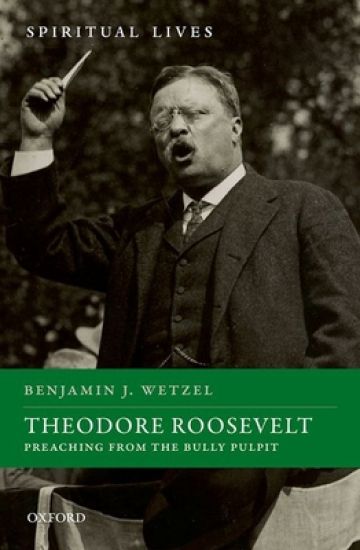
Theodore Roosevelt

Theodore Roosevelt

Benjamin J. Wetzel

Oxford University Press
2021
sidottu
Theodore Roosevelt is well-known as a rancher, hunter, naturalist, soldier, historian, explorer, and statesman. His visage is etched on Mount Rushmore--alongside George Washington, Thomas Jefferson, and Abraham Lincoln--as a symbol of his vast and consequential legacy. While Roosevelt's life has been written about from many angles, no modern book probes deeply into his engagement with religious beliefs, practices, and controversies despite his lifelong church attendance and commentary on religious issues. Theodore Roosevelt: Preaching from the Bully Pulpit traces Roosevelt's personal religious odyssey from youthful faith and pious devotion to a sincere but more detached adult faith. Benjamin J. Wetzel presents the president as a champion of the separation of church and state, a defender of religious ecumenism, and a "preacher" who used his "bully pulpit" to preach morality using the language of the King James Bible. Contextualizing Roosevelt in the American religious world of the late nineteenth and early twentieth centuries, Wetzel shows how religious groups interpreted the famous Rough Rider and how he catered to, rebuked, and interacted with various religious constituencies. Based in large part on personal correspondence and unpublished archival materials, this book offers a new interpretation of an extremely significant historical figure.
CCTV and Policing

CCTV and Policing

Benjamin J. Goold

Oxford University Press
2004
sidottu
CCTV and Policing is the first major published work to present a comprehensive assessment of the impact of CCTV on the police in Britain. Drawing extensively upon empirical research, the volume examines how the police in Britain first became involved in public area surveillance, and how they have since attempted to use CCTV technology to prevent, respond to, and investigate crime. In addition, the volume also provides a detailed analysis of the legality of CCTV surveillance in light of recent changes to the Data Protection Act and the incorporation of the European Convention on Human Rights. Challenging many existing accounts of the relationship between the police and new surveillance technologies, CCTV and Policing breaks new ground in policing and surveillance theory, and argues that it is time for a major reassessment of both our understanding of how the police respond to technological change, and of the role played by such technologies in our society.
Newman and the Alexandrian Fathers

Newman and the Alexandrian Fathers

Benjamin J. King

Oxford University Press
2009
sidottu
John Henry (later Cardinal) Newman is generally known to have been devoted to reading the Church Fathers. In this volume, Benjamin King draws on archive as well as published material to explore how Newman interpreted specific Fathers at different periods of his life. King draws connections between the Alexandrian Fathers Newman was reading and the development of his thought. This analysis shows that it was events in Newman's life that changed his interpretation of the Fathers, not the interpretation of the Fathers that caused Newman to change his life. King argues that Newman tailored his reading, 'trying on' the ideas of different Fathers to fit his own needs. An innovative comparison of Newman's two translations of Athanasius of Alexandria, from 1842-44 and 1881, demonstrates that by 1881 the Cardinal was swayed by the theology favored by Pope Leo XIII. King reveals that although Newman was a controversial figure in his own day, eventually his view of the Fathers and their doctrines came to be accepted by many scholars. This new exploration of his work, however, shows that the Cardinal's interpretation of the Fathers should still be controversial today.
Currency Statecraft

Currency Statecraft

Benjamin J. Cohen

University of Chicago Press
2018
sidottu
At any given time, a limited number of national currencies are used as instruments of international commerce, to settle foreign trade transactions or store value for investors and central banks. How countries whose currencies gain international appeal choose to use this status forms their strategy of currency statecraft. In different circumstances, issuing governments may welcome and promote the internationalization of their currency, tolerate it, or actively oppose it. Benjamin J. Cohen offers a provocative explanation of the strategic policy choices at play. In a comprehensive review that ranges from World War II to the present, Cohen convincingly argues that one goal stands out as the primary motivation for currency statecraft: the extent of a country’s geopolitical ambition, or how driven it is to build or sustain a prominent place in the international community. When a currency becomes internationalized, it generally increases the power of the nation that produces it. In the persistent contestation that characterizes global politics, that extra edge can matter greatly, making monetary rivalry an integral component of geopolitics. Today, the major example of monetary rivalry is the emerging confrontation between the US dollar and the Chinese renminbi. Cohen describes how China has vigorously promoted the international standing of its currency in recent years, even at the risk of exacerbating relations with the United States, and explains how the outcome could play a major role in shaping the broader geopolitical engagement between the two superpowers.
Currency Statecraft

Currency Statecraft

Benjamin J. Cohen

University of Chicago Press
2018
nidottu
At any given time, a limited number of national currencies are used as instruments of international commerce, to settle foreign trade transactions or store value for investors and central banks. How countries whose currencies gain international appeal choose to use this status forms their strategy of currency statecraft. In different circumstances, issuing governments may welcome and promote the internationalization of their currency, tolerate it, or actively oppose it. Benjamin J. Cohen offers a provocative explanation of the strategic policy choices at play. In a comprehensive review that ranges from World War II to the present, Cohen convincingly argues that one goal stands out as the primary motivation for currency statecraft: the extent of a country’s geopolitical ambition, or how driven it is to build or sustain a prominent place in the international community. When a currency becomes internationalized, it generally increases the power of the nation that produces it. In the persistent contestation that characterizes global politics, that extra edge can matter greatly, making monetary rivalry an integral component of geopolitics. Today, the major example of monetary rivalry is the emerging confrontation between the US dollar and the Chinese renminbi. Cohen describes how China has vigorously promoted the international standing of its currency in recent years, even at the risk of exacerbating relations with the United States, and explains how the outcome could play a major role in shaping the broader geopolitical engagement between the two superpowers.
Experiments in Democracy

Experiments in Democracy

Benjamin J. Hurlbut

Columbia University Press
2017
sidottu
Human embryo research touches upon strongly felt moral convictions, and it raises such deep questions about the promise and perils of scientific progress that debate over its development has become a moral and political imperative. From in vitro fertilization to embryonic stem cell research, cloning, and gene editing, Americans have repeatedly struggled with how to define the moral status of the human embryo, whether to limit its experimental uses, and how to contend with sharply divided public moral perspectives on governing science. Experiments in Democracy presents a history of American debates over human embryo research from the late 1960s to the present, exploring their crucial role in shaping norms, practices, and institutions of deliberation governing the ethical challenges of modern bioscience. J. Benjamin Hurlbut details how scientists, bioethicists, policymakers, and other public figures have attempted to answer a question of great consequence: how should the public reason about aspects of science and technology that effect fundamental dimensions of human life? Through a study of one of the most significant science policy controversies in the history of the United States, Experiments in Democracy paints a portrait of the complex relationship between science and democracy, and of U.S. society's evolving approaches to evaluating and governing science's most challenging breakthroughs.
Experiments in Democracy

Experiments in Democracy

Benjamin J. Hurlbut

Columbia University Press
2022
pokkari
Human embryo research touches upon strongly felt moral convictions, and it raises such deep questions about the promise and perils of scientific progress that debate over its development has become a moral and political imperative. From in vitro fertilization to embryonic stem cell research, cloning, and gene editing, Americans have repeatedly struggled with how to define the moral status of the human embryo, whether to limit its experimental uses, and how to contend with sharply divided public moral perspectives on governing science.Experiments in Democracy presents a history of American debates over human embryo research from the late 1960s to the present, exploring their crucial role in shaping norms, practices, and institutions of deliberation governing the ethical challenges of modern bioscience. J. Benjamin Hurlbut details how scientists, bioethicists, policymakers, and other public figures have attempted to answer a question of great consequence: how should the public reason about aspects of science and technology that effect fundamental dimensions of human life? Through a study of one of the most significant science policy controversies in the history of the United States, Experiments in Democracy paints a portrait of the complex relationship between science and democracy, and of U.S. society's evolving approaches to evaluating and governing science's most challenging breakthroughs.
Flint Fights Back

Flint Fights Back

Benjamin J. Pauli

MIT Press
2019
pokkari
An account of the Flint water crisis shows that Flint's struggle for safe and affordable water is part of a broader struggle for democracy.When Flint, Michigan, changed its source of municipal water from Lake Huron to the Flint River, Flint residents were repeatedly assured that the water was of the highest quality. At the switchover ceremony, the mayor and other officials performed a celebratory toast, declaring "Here's to Flint!" and downing glasses of freshly treated water. But as we now know, the water coming out of residents' taps harbored a variety of contaminants, including high levels of lead. In Flint Fights Back, Benjamin Pauli examines the water crisis and the political activism that it inspired, arguing that Flint's struggle for safe and affordable water was part of a broader struggle for democracy. Pauli connects Flint's water activism with the ongoing movement protesting the state of Michigan's policy of replacing elected officials in financially troubled cities like Flint and Detroit with appointed "emergency managers."Pauli distinguishes the political narrative of the water crisis from the historical and technical narratives, showing that Flint activists' emphasis on democracy helped them to overcome some of the limitations of standard environmental justice frameworks. He discusses the pro-democracy (anti-emergency manager) movement and traces the rise of the "water warriors"; describes the uncompromising activist culture that developed out of the experience of being dismissed and disparaged by officials; and examines the interplay of activism and scientific expertise. Finally, he explores efforts by activists to expand the struggle for water justice and to organize newly mobilized residents into a movement for a radically democratic Flint.
Cunegonde's Kidnapping

Cunegonde's Kidnapping

Benjamin J. Kaplan

Yale University Press
2015
sidottu
How a popular religious war erupted on the Dutch-German border, despite the ideals of religious tolerance proclaimed by the Enlightenment In a remote village on the Dutch-German border, a young Catholic woman named Cunegonde tries to kidnap a baby to prevent it from being baptized in a Protestant church. When she is arrested, fellow Catholics stage an armed raid to free her from detention. These dramatic events of 1762 triggered a cycle of violence, starting a kind of religious war in the village and its surrounding region. Contradicting our current understanding, this war erupted at the height of the Age of Enlightenment, famous for its religious toleration. Cunegonde’s Kidnapping tells in vivid detail the story of this hitherto unknown conflict. Drawing characters, scenes, and dialogue straight from a body of exceptional primary sources, it is the first microhistorical study of religious conflict and toleration in early modern Europe. In it, award-winning historian Benjamin J. Kaplan explores the dilemmas of interfaith marriage and the special character of religious life in a borderland, where religious dissenters enjoy unique freedoms. He also challenges assumptions about the impact of Enlightenment thought and suggests that, on a popular level, some parts of eighteenth-century Europe may not have witnessed a “rise of toleration.”
Advances in the Study of Biblical Hebrew and Aramaic

Advances in the Study of Biblical Hebrew and Aramaic

Benjamin J. Noonan; Hélène Dallaire

Zondervan
2020
nidottu
Advances in the Study of Biblical Hebrew and Aramaic by Benjamin J. Noonan is an introduction to issues of interest in the current world of Biblical Hebrew and Aramaic scholarship. A growing knowledge of the Semitic languages and the field of linguistics continues to enhance understanding of biblical Hebrew and Aramaic. Comprehension of these items directly affects the way we read the Hebrew Bible and is therefore invaluable for those interested in the Old Testament. This book fills a gap in the field of Biblical Hebrew and Aramaic linguistics and provides an accessible, comprehensive, up-to-date, and linguistically-informed investigation of the language.Topics addressed include:Linguistic theoriesLexical semantics and lexicographyVerbal stemsTense, mood, and aspect in the verbal systemRegister, dialect, and code-switchingDating of Biblical Hebrew and Aramaic textsDiscourse analysisTeaching and learning Biblical Hebrew and AramaicAdvances in the Study of Biblical Hebrew and Aramaic provides an accessible introduction for students, pastors, professors, and commentators to understand these important issues.