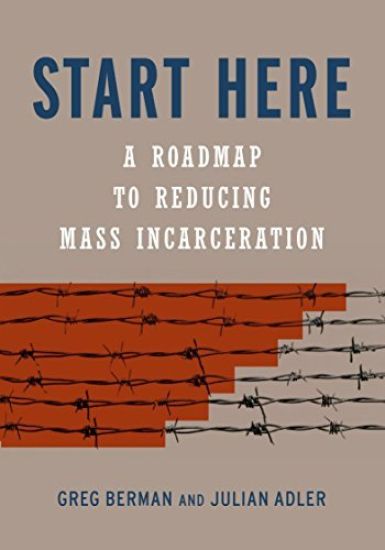
We are living at the beginning of the end of mass incarceration in America. Notwithstanding the posturing at the federal level, states have begun to take real steps to keep their citizens out of prisons. And yet the two million teenagers who report that they've used an illegal drug in the last month still remain at risk of arrest, and many will face the trauma of being cuffed and fingerprinted. The good news is that it's easy to change their lives for the better, right now: we just need to change our policies. This is but one example of the pragmatic case that Greg Berman and Julian Adler build in Start Here, which moves from abstract critique of the justice system to concrete action. Berman and Adler present three overarching, revolutionary ideas, each supported with a litany of practical solutions and battle-tested programs that could be implemented nationwide: to engage the public in preventing crime, to treat all defendants with dignity and respect, and to link people to effect
A call to tone down our political rhetoric and embrace a common-sense approach to change. Many experts believe that we are at a fulcrum moment in history, a time that demands radical shifts in thinking and policymaking. Calls for bold change are everywhere these days, particularly on social media, but is this actually the best way to make the world a better place? In Gradual, Greg Berman and Aubrey Fox argue that, contrary to the aspirations of activists on both the right and the left, incremental reform is the best path forward. They begin by emphasizing that the very structure of American government explicitly and implicitly favors incrementalism. Particularly in a time of intense polarization, any effort to advance radical change will inevitably engender significant backlash. As Berman and Fox make clear, polling shows little public support for bold change. The public is, however, willing to endorse a broad range of incremental reforms that, if implemented, would reduce suffering and improve fairness. To illustrate how incremental changes can add up to significant change over time, Berman and Fox provide portraits of "heroic incrementalists" who have produced meaningful reforms in a variety of areas, from the expansion of Social Security to more recent efforts to reduce crime and incarceration. Gradual is a bracing call for a "radical realism" that prioritizes honesty, humility, nuance, and respect in an effort to transcend political polarization and reduce the conflict produced by social media.
A bracing look at what's gone wrong in American nonprofits--and how it might be fixed. We rely on nonprofits every day to feed the hungry, care for the sick, and perform a host of other essential work, but American nonprofits have been under siege in recent years. Attacked by the left (for being part of the "nonprofit industrial complex") and the right (for advancing a "woke" agenda), nonprofits have also faced a serious threat from within: a rising generation of staffers who expect their employers to share their social justice convictions. In The Nonprofit Crisis, Greg Berman takes an in-depth look at the challenges faced by American nonprofits in the years since Donald Trump's first election. It highlights the very real problems that have plagued the nonprofit sector and shows how some organizations have lost their way during the culture wars. Berman, an award-winning nonprofit executive, argues that if nonprofit leaders cannot figure out a way to handle the challenges of racial justice, the generational divide, and political polarization effectively, we are doomed to a future of declining public trust in some of our most important American institutions. The Nonprofit Crisis offers nonprofits, and those that care about them, a way forward in trying times.
A bracing look at what's gone wrong in American nonprofits--and how it might be fixed. We rely on nonprofits every day to feed the hungry, care for the sick, and perform a host of other essential work, but American nonprofits have been under siege in recent years. Attacked by the left (for being part of the "nonprofit industrial complex") and the right (for advancing a "woke" agenda), nonprofits have also faced a serious threat from within: a rising generation of staffers who expect their employers to share their social justice convictions. In The Nonprofit Crisis, Greg Berman takes an in-depth look at the challenges faced by American nonprofits in the years since Donald Trump's first election. It highlights the very real problems that have plagued the nonprofit sector and shows how some organizations have lost their way during the culture wars. Berman, an award-winning nonprofit executive, argues that if nonprofit leaders cannot figure out a way to handle the challenges of racial justice, the generational divide, and political polarization effectively, we are doomed to a future of declining public trust in some of our most important American institutions. The Nonprofit Crisis offers nonprofits, and those that care about them, a way forward in trying times.
A call to tone down our political rhetoric and embrace a common-sense approach to change. Many experts believe that we are at a fulcrum moment in history, a time that demands radical shifts in thinking and policymaking. Calls for bold change are everywhere these days, particularly on social media, but is this actually the best way to make the world a better place? In Gradual, Greg Berman and Aubrey Fox argue that, contrary to the aspirations of activists on both the right and the left, incremental reform is the best path forward. They begin by emphasizing that the very structure of American government explicitly and implicitly favors incrementalism. Particularly in a time of intense polarization, any effort to advance radical change will inevitably engender significant backlash. As Berman and Fox make clear, polling shows little public support for bold change. The public is, however, willing to endorse a broad range of incremental reforms that, if implemented, would reduce suffering and improve fairness. To illustrate how incremental changes can add up to significant change over time, Berman and Fox provide portraits of "heroic incrementalists" who have produced meaningful reforms in a variety of areas, from the expansion of Social Security to more recent efforts to reduce crime and incarceration. Gradual is a bracing call for a "radical realism" that prioritizes honesty, humility, nuance, and respect in an effort to transcend political polarization and reduce the conflict produced by social media.
In this revised edition of their concise, readable, yet wide-ranging book, Greg Berman and Aubrey Fox tackle a question students and scholars of law, criminology, and political science constantly face: what mistakes have led to the problems that pervade the criminal justice system in the United States? The reluctance of criminal justice policymakers to talk openly about failure, the authors argue, has stunted the public conversation about crime in this country and stifled new ideas. It has also contributed to our inability to address such problems as chronic offending in low-income neighborhoods, an overreliance on incarceration, the misuse of pretrial detention, and the high rates of recidivism among parolees. Berman and Fox offer students and policymakers an escape from this fate by writing about failure in the criminal justice system. Their goal is to encourage a more forthright dialogue about criminal justice, one that acknowledges that many new initiatives fail and that no one knows for certain how to reduce crime. For the authors, this is not a source of pessimism, but a call to action. This revised edition is updated with a new foreword by Cyrus R. Vance, Jr., and afterword by Greg Berman.
In this revised edition of their concise, readable, yet wide-ranging book, Greg Berman and Aubrey Fox tackle a question students and scholars of law, criminology, and political science constantly face: what mistakes have led to the problems that pervade the criminal justice system in the United States? The reluctance of criminal justice policymakers to talk openly about failure, the authors argue, has stunted the public conversation about crime in this country and stifled new ideas. It has also contributed to our inability to address such problems as chronic offending in low-income neighborhoods, an overreliance on incarceration, the misuse of pretrial detention, and the high rates of recidivism among parolees. Berman and Fox offer students and policymakers an escape from this fate by writing about failure in the criminal justice system. Their goal is to encourage a more forthright dialogue about criminal justice, one that acknowledges that many new initiatives fail and that no one knows for certain how to reduce crime. For the authors, this is not a source of pessimism, but a call to action. This revised edition is updated with a new foreword by Cyrus R. Vance, Jr., and afterword by Greg Berman.
Public confidence in American criminal courts is at an all-time low. Victims, communities, and even offenders view courts as unable to respond adequately to complex social and legal problems including drugs, prostitution, domestic violence, and quality-of-life crime. Even many judges and attorneys think that the courts produce assembly-line justice. Increasingly embraced by even the most hard-on-crime jurists, problem-solving courts offer an effective alternative. As documented by Greg Berman and John Feinblatt—both of whom were instrumental in setting up New York’s Midtown Community Court and Red Hook Community Justice Center, two of the nation’s premier models for problem-solving justice—these alternative courts reengineer the way everyday crime is addressed by focusing on the underlying problems that bring people into the criminal justice system to begin with. The first book to describe this cutting-edge movement in detail, Good Courts features, in addition to the Midtown and Red Hook models, an in-depth look at Oregon’s Portland Community Court and reviews the growing body of evidence that the problem-solving approach to justice is indeed producing positive results around the country.
In this landmark, character-driven history, Greg Behrman tells the story of the Marshall Plan, the unprecedented and audacious policy through which America helped rebuild World War II-ravaged Western Europe. With nuanced, vivid prose, Greg Behrman recreates the story of a unique American enterprise that was at once strategic, altruistic and stunningly effective, and of a time when America stood as a beacon of generosity and moral leadership. The Marshall Plan was a four-year, $13 billion (more than $100 billion in today's dollars) plan to provide assistance for Europe's economic recovery at the end of World War II. More than an aid program, it sought to modernize Western Europe's economies and launch them on a path to prosperity and integration; to restore Western Europe's faith in democracy and capitalism; to enmesh the region firmly in a Western economic association and eventually a military alliance. It was the linchpin of America's strategy to meet the Soviet threat. It helped to trigger the Cold War and, eventually, to win it. Through detailed and exhaustive research, Behrman brings this vital and dramatic epoch to life and animates the personalities that shaped it. More than a humanitarian endeavor, the Marshall Plan was one of the most effective foreign policies in all of American history, in large part because, as Behrman writes, it was born and executed in a time when American "foreign policy was defined by its national interests and the very best of ideals."
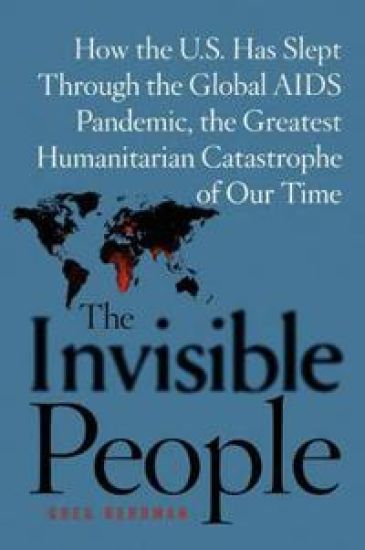
"The Invisible People" is a revealing and at times shocking look inside the United States's response to one of the greatest catastrophes the world has ever known -- the global AIDS crisis. A true story of politics, bureaucracy, disease, internecine warfare, and negligence, it illustrates that while the pandemic constitutes a profound threat to U.S. economic and security interests, at every turn the United States has failed to act in the face of this pernicious menace. During the past twenty years, more than 65 million people across the globe have become infected with HIV. Already 25 million around the world have died -- more than all of the battle deaths in the twentieth century combined. By decade's end there will be an estimated 25 million AIDS orphans. If trends continue, by 2025, 250 million global HIV-AIDS cases are a distinct possibility. Beyond the ineffable human toll, the pandemic is reshaping the social, economic, and geopolitical dimensions of our world. Eviscerating national economies, creating an entire generation of orphans, and destroying military capacity, the disease is generating pressures that will lead to instability and possibly even state failure and collapse in sub-Saharan Africa. Poised to explode in Eastern Europe, Russia, India, and China, AIDS will have devastating and destabilizing effects of untold proportions that will reverberate throughout the global economy and the international political order. In this gripping account that draws on more than two hundred interviews with key political insiders, policy makers, and thinkers, Greg Behrman chronicles the red tape, colossal blunders, monumental egos, power plays, and human pain and suffering that comprise America's woeful response to the AIDS crisis. Behrman's unprecedented access takes you inside the halls of power from seminal White House meetings to tumultuous turf battles at World Health Organization headquarters in Geneva, heated debates in the United Nations, and chilling discoveries at the Centers for Disease Control. Behrman also brings us into the field to meet the people who live in the midst of AIDS devastation in places like a school yard in Namibia, the red-light district in Bombay, and an orphanage in South Africa. Intensely researched and vividly detailed, "The Invisible People" is a groundbreaking and compellingly readable account of the appalling destruction caused by more than two decades of American abdication in the face of the defining humanitarian catastrophe of our time.
Berman's Pediatric Decision Making uses an algorithmic, structured approach to lead you to the right diagnosis and treatment every time. Drs. Lalit Baja, Simon Hambidge, Ann-Christine Nyquist, and Gwendolyn Kerby use evidence-based research and flow charts for each presenting complaint or specific disorder to provide quick access to the information you need for effective decision making. With updated drug tables, revised algorithms, and full-text online access at www.expertconsult.com, this streamlined new edition makes it even easier for you to diagnose and manage common clinical problems from infancy through adolescence. Rapidly access guidance on diagnosis and management from algorithms for each clinical disorder. Treat the full range of diseases and disorders with comprehensive coverage of diagnosis, assessment of severity, and clinical management. Choose the best treatment for each case thanks to indications for surgical interventions as well as expensive diagnostic procedures Access the fully searchable contents online at www.expertconsult.com. Stay current on recent developments and make effective decisions for movement disorders, physical abuse in children, sexual abuse in children, eating disorders, ADHD, and other hot topics. Find answers quickly and easily with a new table of contents organized into two sections-Presenting Complaints and Specific Disorders-that reduces the need to flip between chapters. Tap into the diverse perspectives of expert authors from all over the country. Get only the information you need in the streamlined new edition with shorter, more user-friendly flow diagrams and fewer specialized chapters.
The Theatre of Sabina Berman: The Agony of Ecstasy and Other Plays introduces and makes accessible to an English-speaking audience the work of the contemporary Mexican playwright Sabina Berman. The book contains translations of the four plays that established Berman's career: The Agony of Ecstasy, Yankee, Puzzle, and Heresy. An introduction by Adam Versenyi provides a critical assessment of each play, a discussion of the specific problems of translation involved, and placement of Berman's work in the large Mexican and Latin American context. It is evident that Sabina Berman's theatrical acumen matches the depth of her dramatic design whether it is the sheer variety of techniques from song to staged tableau that appear in The Agony of Ecstasy; the physicalization of what it means to be interrogated and to interrogate in Yankee; the final enigmatic image of a soldier alone on stage, silently aiming his firearm at an undefined threat that potentially emanates from the audience in Puzzle; or the manner in which the family narrates its own ""heretical"" actions in Heresy. It is the combination of theatrical technique with universal themes of self-definition that cuts across cultures and ultimately makes these plays translatable.
When a scientist runs an experiment on three separate college campuses that goes horribly wrong, several hundred students find their lives altered forever. They must learn to adapt to their new lives as Werewolves. Immediately after the incident a government program was put in place to keep track of these unwitting subjects. After a year the program falls apart as those in charge argue on how to proceed. Without the programmers constantly looking over their shoulders the werewolves have now started to organize themselves. Creating their own hierarchy and alliances.Jack is the Alpha of Pacific Northwest University's pack F. He thought the government had finally taken a step back and let him and the other Alphas run their packs. Recently, however, he has been hearing rumblings about the programmers wanting to reinstate the program. He thought they were just rumors until he finds out one of his pack is being threatened by several of the lab assistants that took part in the original experiment. Now Jack must scramble to find allies and hunt down those threatening his pack. The more he goes looking the bigger the plot becomes.
Poison courses through Lyra's veins and the only hope in sight comes from anonymous letters.The suppressant cobbled together from incomplete notes is working less and less as time goes on. Lyra's family and pack can do nothing but stand by and watch as she deteriorates. With nerves wearing thin, other problems become harder to bear.Word has gotten out in the born werewolf community about the made wolves and the other families are not happy with the swelling numbers recently added to the family in western Washington. Now they have formed a tribunal to judge the threat these increased numbers can bring. This leaves the family scrambling to protect themselves.Meanwhile, the made wolves are struggling with what little information they have about the current whereabouts of Dr. Berman. They know now he is nearby and experimenting on others, but they do not have all the information they need to move forward. But they are being stalked and anonymous letters were sent to each of them. These letters say someone out there knows not only who, but what they are and there may be nowhere left to hide.
2018 National Jewish Book Award FinalistMaira Kalman, the author of the bestsellers The Principles of Uncertainty and The Elements of Style, and Alex Kalman, the designer, curator, writer, and founder of Mmuseumm, combine their talents in this captivating family memoir, a creative blend of narrative and striking visuals that is a paean to an exceptional woman and a celebration of individuality, personal expression, and the art of living authentically.In the early 1950s, Jewish émigré Sara Berman arrived in the Bronx with her husband and two young daughters When the children were grown, she and her husband returned to Israel, but Sara did not stay for long. In the late 1960s, at age sixty, she left her husband after thirty-eight years of marriage. One night, she packed a single suitcase and returned alone to New York City, moving intoa studio apartment in Greenwich Village near her family. In her new home, Sara began discovering new things and establishing new rituals, from watching Jeopardy each night at 7:00 to eating pizza at the Museum of Modern Art’s cafeteria every Wednesday. She also began discarding the unnecessary, according to the Kalmans: "in a burst of personal expression, she decided to wear only white." Sara kept her belongings in an extraordinarily clean and organized closet. Filled with elegant, minimalist, heavily starched, impeccably pressed and folded all-white clothing, including socks and undergarments, as well as carefully selected objects—from a potato grater to her signature perfume, Chanel No.19—the space was sublime. Upon her death in 2004, her family decided to preserve its pristine contents, hoping to find a way to exhibit them one day.In 2015, the Mmuseumm, a new type of museum located in a series of unexpected locations founded and curated by Sara’s grandson, Alex Kalman, recreated the space in a popular exhibit—Sara Berman's Closet—in Tribeca. The installation eventually moved to the Metropolitan Museum of Art. The show will run at the Skirball Center in Los Angeles from December 4, 2018 to March 10, 2019; it will open again about a month later at the National Museum of American Jewish History from April 5, 2019 to September 1, 2019.Inspired by the exhibit, this spectacular illustrated memoir, packed with family photographs, exclusive images, and Maira Kalman's distinctive paintings, is an ode to Sara’s life, freedom, and re-invention. Sara Berman’s Closet is an indelible portrait of the human experience—overcoming hardship, taking risks, experiencing joy, enduring loss. It is also a reminder of the significance of the seemingly insignificant moments in our lives—the moments we take for granted that may turn out to be the sweetest. Filled with a daughter and grandson’s wry and touching observations conveyed in Maira’s signature script, Sara Berman’s Closest is a beautiful, loving tribute to one woman’s indomitable spirit.
The Theatre of Sabina Berman: The Agony of Ecstasy and Other Plays introduces and makes accessible to an English-speaking audience the work of the contemporary Mexican playwright Sabina Berman. The book contains translations of the four plays that established Berman's career: The Agony of Ecstasy, Yankee, Puzzle, and Heresy. An introduction by Adam Versenyi provides a critical assessment of each play, a discussion of the specific problems of translation involved, and placement of Berman's work in the large Mexican and Latin American context. It is evident that Sabina Berman's theatrical acumen matches the depth of her dramatic design whether it is the sheer variety of techniques from song to staged tableau that appear in The Agony of Ecstasy; the physicalization of what it means to be interrogated and to interrogate in Yankee; the final enigmatic image of a soldier alone on stage, silently aiming his firearm at an undefined threat that potentially emanates from the audience in Puzzle; or the manner in which the family narrates its own ""heretical"" actions in Heresy. It is the combination of theatrical technique with universal themes of self-definition that cuts across cultures and ultimately makes these plays translatable.