Kirjojen hintavertailu. Mukana 11 342 296 kirjaa ja 12 kauppaa.

Kirjahaku

Etsi kirjoja tekijän nimen, kirjan nimen tai ISBN:n perusteella.

1000 tulosta hakusanalla Bernard O'Connor

Bletchley Park and the Belgian Pigeon Service
During the Second World War, the British Royal Air Force's Special Duties Squadrons parachuted thousands of pigeons into Belgium. Bletchley Park, the nerve centre of the British Intelligence Service, had its own pigeon loft from where birds were sent on intelligence gathering missions. A secret organisation, MI14(d), was created to organise a pigeon service to occupied Europe. Those who found the pigeons were expected to supply military, economic and political intelligence for the Allies. This book includes the messages sent back from Belgium. In particular, it investigates the roles played by Josef Raskin and Jean Ceysens, the British Intelligence Services, the RAF and the brave individuals who, despite the possibility of imprisonment, sent messages to Britain in the hope it would help liberate their country.
Operation EBENSBURG

Operation EBENSBURG

Bernard O'Connor

Lulu.com
2018
pokkari
Some captured German and Austrian personnel were brought to Britain as prisoners of war. Those who were identified as anti-Nazi were 'turned' and, codenamed 'Bonzos', were trained in paramilitary and clandestine warfare to be sent back into occupied Europe on top secret missions. The British Special Operations Executive arranged the infiltration of four Austrians, Albrecht Gaiswinkler, Joseph Grafl, Karl Standhartinger and Karl Lzicar, into the Salzkammergut area of northwestern Austria. This book tells the story of Operation EBENSBURG, their mission to kidnap or assassinate Joseph Goebbels, the Reich's Minister of Propaganda, to organise resistance groups before the arrival of American forces and to protect the looted works of art hidden in the Altaussee salt mine.
Blowing Up Iberia: British, German and Italian Sabotage in Spain and Portugal
During the Second World War, the British military and intelligence agencies had plans in case Germany invaded Spain and Portugal. This involved training British and Spanish agents to be secretly infiltrated to undertake sabotage operations on important lines of communication and liaising with pro-British locals. At the same time the Abwehr, Germany's military intelligence agency, paid young Spanish and Portuguese collaborators to undertake sabotage missions against Allied military and economic targets in Iberia but they had limited success. Italian saboteurs from the Decima Flotigglia MAS were more successful using underwater divers to attack Allied shipping. Using declassified files from Britain's National Archives, autobiographies, biographies and newspaper articles, this documentary history sheds new light on an unusual aspect of Iberian history telling a human story of international diplomacy, political intrigue, secret agents, clandestine warfare, military strategy, nationalism, and deception.
Bletchley Park and the Pigeon Spies

Bletchley Park and the Pigeon Spies

Bernard O'Connor

Lulu.com
2018
pokkari
Over 15,000 pigeons were dropped into occupied Europe during WW2. Some were used by secret agents to send messages back to headquarters. Others were dropped by parachute into France, Belgium, Holland and Denmark in the hope that people would complete the attached questionnaire and provided military, political, economic or other intelligence of value for the Allies. Photographic negatives could be sent. Bletchley Park had its own loft for its pigeon spies. This book investigates the work of MI14, known as the Colomba Service, and for the first time sheds light on conditions in Occupied Europe described by extremely brave men and women who risked execution if found in possession of a pigeon. MI14 staff, decoded or translated messages and forwarded copies to SOE, SIS, MI19, RAF, RN, Ministry of Economic Warfare, BBC, Churchill, de Gaulle and President Benes of Czechoslovakia.
The BBC and the Pigeon Spies

The BBC and the Pigeon Spies

Bernard O'Connor

Lulu.com
2019
nidottu
Over 16,000 pigeons were dropped into occupied Europe during the Second World War. Some were used by secret agents to send messages back to headquarters. Others were dropped into selected areas of France, Belgium, Holland and Denmark in the hope that people would complete the attached questionnaire and provided military, political, economic or other intelligence of value for the Allies. There were also requests for information on the reception and content of the BBC Overseas Service news. Many messages sent back requests that the BBC acknowledge receipt of the message. This book investigates the work of MI14, known as the Colomba Service, and for the first time sheds light on conditions in Occupied Europe described by extremely brave men and women who risked execution if found in possession of a pigeon. MI14 staff, decoded or translated messages and forwarded copies to the SOE, SIS, MI19, the War Office, RAF, Royal Navy, Ministry of Economic Warfare, Churchill, de Gaulle and the BBC.
Blowing up the Rock:  German, Italian and Spanish Sabotage attacks on Gibraltar during  the Second World War
During the Second World War, Gibraltar faced the threat of invasion by Italy, Germany, and Spain. The Abwehr, the German Intelligence Service, rather than use their own saboteurs, paid young Spanish men to undertake over sixty sabotage attacks on military installations and shipping with limited success. The Italian Decima Flotilla MAS, a specialist team of underwater frogmen, launched eight attacks which were relatively successful and Spanish Falangists made several unsuccessful attempts. The British Secret Intelligence Service endeavoured to stop or at least limit such attacks. Using contemporary files from the National Archives in Kew, autobiographies, biographies, histories and newspaper articles, this documentary history investigates the successes and failures of these attacks on Gibraltar and the roles played by intelligence officers, agents, double agents in discovering and preventing such acts. The book sheds light on an unusual and largely overlooked aspect of Gibraltar's history.
The Royal Naval Armaments Depot, Ditton Priors, Shropshire
Shortly after the start of the Second World War, the British Admiralty compulsorily purchased land near Ditton Priors, Shropshire, to store armaments. Using the Cleobury Mortimer and Ditton Priors Light Railway, thousands of tons of shells and high explosives were brought by train to be assembled and stored in specially-built magazines protected by 'batter mounds'. Every weekday, up to thirty buses brought in several hundred men and women from surrounding villages and towns and took them back after work. They all signed the Official Secrets Act. To avoid fires, no smoking and no newspapers were allowed on site, Eating sweets was forbidden as the acetic acid was said to be corrosive. There were no electric lights or heating in the magazines and laboratories. Trolleys laden with ammunition were hauled by small tractors from a railway siding. Trucks carried crates of assembled armaments to naval docks around Britain until, twenty years after the end of the war, the Depot became surplus to the Navy's requirement. Employees were transferred to other depots or accepted redundancy. Arrangements to sell the land back to the original owners were cancelled when the British government allowed the American Army to store 22,000 tons of their armaments. Legal disputes followed and questions were raised in parliament. When the Americans moved out in 1967, most of the land was sold to its original owners. In the 1980s there was a scare when it was claimed that the Russians had allocated two nuclear weapons to target Ditton Priors. Today, part of the Depot has become an industrial estate. The rest is hidden by trees and gradually becoming overgrown by vegetation. Bernard O'Connor's documentary history of the Royal Naval Armament Depot in Ditton Priors uses accounts and illustrations found in local history books, newspapers, government and the construction company's correspondence, websites and interviews with local people who remembered working there.
RAF Tempsford

RAF Tempsford

Bernard O'Connor

The History Press Ltd
2010
nidottu
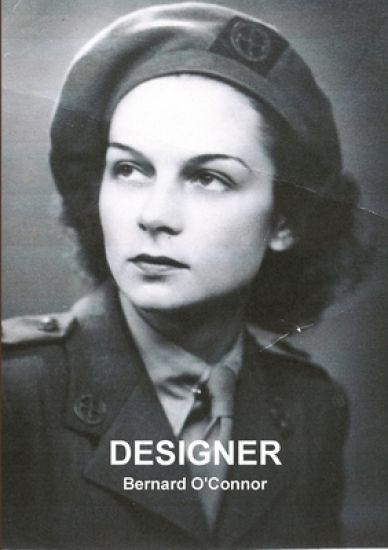
Designed by an illusionist, RAF Tempsford was described by Hitler as a viper's nest. Locals knew it was an airfield but not what went on there. They weren't meant to. This fascinating book reveals many of the top secret SOE missions that 138 and 161 Special Duties Squadrons flew from Tempsford, dropping supplies to the resistance groups across occupied Europe as well as specially trained secret agents. Group Captain 'Mouse' Fielden was in charge and agents like Violette Szabo, Odette Churchill, Peter Churchill and Wing-Commander Yeo-Thomas flew out on secret missions from here. Vital operations like the bombing of Amiens Prison, the destruction of the heavy water plant in Norway and the assassination of Heydrich were all flown from Tempsford. Also looking at daily life at Tempsford both during and after the war, Bernard O'Connor's detailed account sheds light on the men and women based at Britain's secret airfield.
The Royal Naval Armaments Depot, Ditton Priors, Shropshire
Shortly after the start of the Second World War, the British Admiralty compulsorily purchased land near Ditton Priors, Shropshire, to store armaments. Using the Cleobury Mortimer and Ditton Priors Light Railway, thousands of tons of shells and high explosives were brought by train to be assembled and stored in specially-built magazines protected by 'batter mounds'. Every weekday, up to thirty buses brought in several hundred men and women from surrounding villages and towns and took them back after work. They all signed the Official Secrets Act. To avoid fires, no smoking and no newspapers were allowed on site, Eating sweets was forbidden as the acetic acid was said to be corrosive. There were no electric lights or heating in the magazines and laboratories. Trolleys laden with ammunition were hauled by small tractors from a railway siding. Trucks carried crates of assembled armaments to naval docks around Britain until, twenty years after the end of the war, the Depot became surplus to the Navy's requirement. Employees were transferred to other depots or accepted redundancy. Arrangements to sell the land back to the original owners were cancelled when the British government allowed the American Army to store 22,000 tons of their armaments. Legal disputes followed. Questions were raised in parliament. When the Americans moved out in 1967, most of the land was sold to its original owners. In the 1980s there was a scare when it was claimed that the Russians had allocated two nuclear weapons to target Ditton Priors. Today, part of the Depot has become an industrial estate. The rest is hidden by trees and gradually becoming overgrown by vegetation. Bernard O'Connor's documentary history of the Royal Naval Armament Depot in Ditton Priors uses accounts and illustrations found in local history books, newspapers, government and the construction company's correspondence, websites and interviews with local people who remembered working there.
The Peaton Shadow Factory

The Peaton Shadow Factory

Bernard O'Connor

Lulu.com
2021
pokkari
Before the Second World War, the British Air Ministry needed more aircraft . An arrangement was made with motor manufacturers to make aircraft components. The Shadow Factory Scheme was introduced whereby experienced automobile engineers 'shadowed' aircraft engineers to learn their skills. Existing machines were modified and specialised new equipment was installed in the motor works. Hurry Water Heaters of Birmingham had a contract to make the fuel tanks for Short Stirling bombers. The finished products were taken to be fitted in the Austin Motor Company's Works in Bromsgrove. 'When Hurry's factory was bombed, the undamaged machinery and many of their skilled welders and riveters were relocated to an empty cow house in the remote hamlet of Peaton, near Diddlebury, Shropshire. Local men and women were recruited and between 1941 and 1945, fuel tanks were made and transported by lorry to the 'Aero' works where they were fitted into the wings and tail planes of the Stirlings. Bernard O'Connor has researched the history of this shadow factory using accounts found in local history books and magazines and interviews with local people who remembered it.
Operations VIVACIOUS and BRANSTON

Operations VIVACIOUS and BRANSTON

Bernard O'Connor

Lulu.com
2021
pokkari
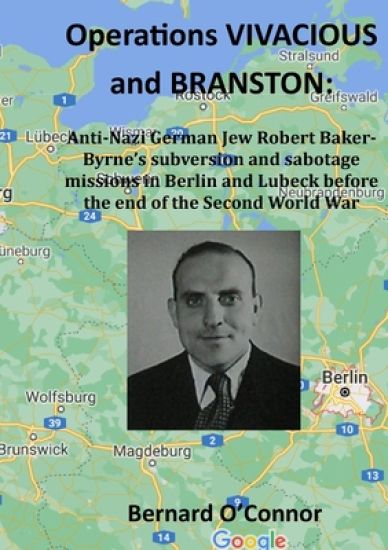
Following D-Day, the Allied invasion of France, plans were made to invade Germany. The British Special Operations Executive (SOE), set up by Winston Churchill in 1940 'to set Europe ablaze by sabotage', liaised with the American Office of Strategic Services (OSS) to recruit anti-Nazi Germans willing to be trained for subversion and sabotage missions in Germany. Rudolph Becker, a German jew, fled persecution and after living in France and Mexico, settled in England. He married, joined the Pioneer Corps and changed his name to Robert Baker-Byrne. Recruited by SOE in 1943, he received paramilitary, parachute and clandestine warfare training and then briefed for a sabotage mission in Berlin. His mission was to destroy an engineering factory making parts for the V rockets. Dropped in Germany in November 1944, he attempted his mission and escaped through Switzerland. Brought back to England, he was debriefed and prepared for a sabotage and subversion mission in Lubeck. He was dropped in March 1945 and was eventually overrun by the Allies. . Using his personnel file and mission papers which were found in the National Archives in Kew, Bernard O'Connor, author of many books on the SOE, has researched Baker-Byrne's story and provides a detailed documentary history of his involvement in secret operations and insight into the day-to-day workings of the British and American intelligence services. He also includes previously unpublished first-hand accounts of conditions in Germany between November 1944 and May 1945.
Jagdeinsatz Italien

Jagdeinsatz Italien

Bernard O'Connor

Lulu.com
2025
pokkari
Bernard O'Connor's Jagdeinsatz Italien is a documentary history based on the information collated by British and American intelligence services in Italy towards the end of the Second World War. It provides a comprehensive overview of Jagd Einsatz Italien, a German military organisation operating in Northern Italy between 1944 and 1945. These texts, including interrogation reports, memoranda, and historical accounts, detail the unit's sabotage, espionage, and anti-partisan activities, particularly focusing on the South Tyrol region. The sources illuminate the structure, training, and missions of Jagdeinsatz Italien and its subordinate Jagdkommandos, as well as their connections to larger German intelligence and paramilitary organisations like the Brandenburg Division and the SS Jagdverb nde. Furthermore, the documents contain biographical information and interrogation summaries of key personnel, such as Hptm. Albert Soelder and Hptm. Hans Gerlach, and also record post-war investigations into buried explosives and alleged war crimes, providing insight into Allied efforts to dismantle German resistance and gather intelligence.
Bedford School's Secret Old Boys

Bedford School's Secret Old Boys

Bernard O'Connor

Lulu.com
2013
pokkari
Six 'Old Bedfordians', ex-Bedford School pupils, served their country in ingenious, brave and daring ways during the Second World War. They were involved with the Special Operations Executive (SOE), a TOP SECRET organisation that helped the resistance movements in occupied Europe. Read the stories of Frank Nelson, the first head of SOE;David Makgill Crighton, sent to Yugoslavia as an aide to King Zog; Frederic Peters, the Commandant of a secret school to train secret agents; John Clarke and his father 'Nobby' who developed limpet bombs and other explosive devices; Mike Andrews who worked in Portugal, Spain and France, helping to return escaped prisoners and other evaders to Britain and Charles Bovill, who developed sophistated wireless communications for RAF planes going on clandestine missions into Europe.
The Coffee Party

The Coffee Party

Bernard O'Connor

Lulu.com
2013
pokkari
In February 1942, four passengers dismbarked in Scotland from one of a convoy of ships from Russia. Known as the COFFEE party, they had been sent to Britain as part of a top secret arrangement between Churchill and Stalin to infiltrate Soviet agents into occupied Europe. Originally from Vienna, they were destined to be parachuted into Austria. This historical faction tells their story, one of political intrigue and international diplomacy.
Do it Well and Do it Now

Do it Well and Do it Now

Bernard O'Connor

Lulu.com
2013
pokkari
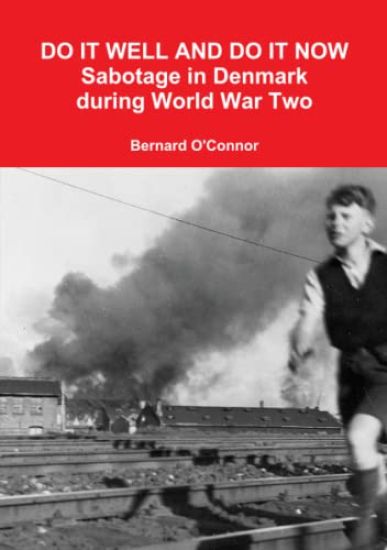
During World War Two over a thousand saboteurs were trained at Brickendonbury, near Hertford, UK. This book tells the stories of the successes and failures of Ole Geisler, Christian Rottb ll, Erik Petersen, Aage Christensen, Paul Brandenborg, Flemming Muus and others who were parachuted into Denmark to help the Resistance before liberation in May 1945. It also details the sabotage work done by brave Danes, including J rgen Kieler, J rgen Schmidt and Bent Faurschou-Hviid.
Sabotage in Norway

Sabotage in Norway

Bernard O'Connor

Lulu Press Inc
2016
nidottu
Norwegians trained in industrial sabotage at Brickendonbury Manor, near Hertford, U.K. were infiltrated by the 'Shetland Bus', fishing boats, motorboats, submarines or parachuted in by planes to attack targets across Norway. They included Karl Aarsaether, Jan Allen, Johannes S. Andersen, Gunnar Berg, Torfinn Bjornas, Svein Blindheim, Peter Deinboll, Andreas Fasting, Kasper Fjell, Gunnar Fougner, Arne Gjestland, Per Getz, Gregers Gram, Sverre Granlund, Torleif Grong, Arne Haegstad, Knut Haukelid, Claus Helberg, Thor Helliessen, Willy Houlder, Kasper Idland, Fredrik Kayser, Arne Kjelstrup, Frithjof Pedersen Kviljo, Ruben Langmo, Alf Lindeberg, Martin Linge, Max Manus, Odd Nilsen, Nils Nordland, Martin Olsen, Erik Gjems-Onstad, Arthur Pevik, Johnny Pevik, Jens Anton Poulsson, Joachim Ronneberg, Einar Skinnarland, Paal Skjaerpe, Gunnar Sonsteby Odd Starheim, Hans Storhaug, Birger Stromsheim, Harald Svindseth, Edvard Tallasken, Gunvald Tomstad, Ragnar Ulstein, Karl Vilnes, Leif Well and Aasmund Wisloff. .
Sabotage in Holland

Sabotage in Holland

Bernard O'Connor

Lulu.com
2013
pokkari
Between 1940 and 1945, over twenty Dutch men attended a course in industrial sabotage at Brickendonbury Manor, near Hertford, UK, before being parachuted into Holland to undertake attacks on targets across the country. This book tells the stories of their successes and failures.
Sabotage in Belgium

Sabotage in Belgium

Bernard O'Connor

Lulu.com
2013
pokkari
Between 1940 and 1944 forty Belgians were trained in industrial sabotage at Brickendonbury Manor, near Hertford, UK. This book tells the stories of their successes and failures when they were dropped into Belgian. They include: Emile Tromme, Robert Jourdain, Armand Campion, Octave Fabri, Jean Scohier, Jean Cassart, Henri Verhaeghen, Andr Wendelen, Achille Hottia, Oscar Catherine, Val re Passelecq, Willy Bernaert, Jean Deflem, L on Kaanen, ? Piquart, Felicien Moreau, Victor Lemmens, Pierre Osterrieth, Pierre Vliex, Frederic Veldekens, Henri Frenay, Jean Woluwe and Jean van Gyseghem, Jean Schools, Leon Engelen, Adhemar Delplace, Francois Mathot, Andr Berten, Alphonse Mabille, Theo Andries, Andr Bayet, Pierre Davreux, L on Joye, Georges Andr , Maurice Bertrand, Robert Duby, Zephir Braibant, Leon Servais, Raymonde Thonon and Andr Guissart.