Kirjojen hintavertailu. Mukana 12 352 497 kirjaa ja 12 kauppaa.

Kirjahaku

Etsi kirjoja tekijän nimen, kirjan nimen tai ISBN:n perusteella.

1000 tulosta hakusanalla Bernhard Riemann

Bernhard Riemann „Über die Hypothesen, welche der Geometrie zu Grunde liegen“

Bernhard Riemann „Über die Hypothesen, welche der Geometrie zu Grunde liegen“

Bernhard Riemann

Springer-Verlag Berlin and Heidelberg GmbH Co. K
2013
nidottu
In diesem Werk wird einer der klassischen Texte der Mathematik umfassend historisch, mathematisch, physikalisch und philosophisch von Jürgen Jost ausführlich kommentiert und die gesamte Entwicklung dieser Disziplinen eingeordnet. Neben dem Urtext wird auch der historisch wichtige Kommentarteil von Hermann Weyl wiedergegeben.
Bernhard Riemann

Bernhard Riemann

Jürgen Jost

Springer Fachmedien Wiesbaden
2025
nidottu
Die Geburtsstunde der modernen Geometrie war am 10.06.1854, als Bernhard Riemann in seinem Habilitationsvortrag differenzierbare Mannigfaltigkeiten, Riemannsche Metriken, Schnittkrümmungen und Normalkoordinaten einführte. Die Riemannsche Geometrie ist nicht nur eines der wichtigsten Forschungsgebiete der heutigen Mathematik, sondern führte auch zu einem völlig neuen Raumverständnis und bildet die Grundlage der modernen Physik, von der Allgemeinen Relativitätstheorie Einsteins bis zur Quantenfeldtheorie. Die Riemannsche Geometrie inspiriert auch wichtige Verfahren des Maschinellen Lernens. Im vorliegenden Werk wird dieser klassische Text der Mathematik umfassend historisch, mathematisch, physikalisch und philosophisch kommentiert und in die gesamte Entwicklung dieser Disziplinen eingeordnet. Bernhard Riemann wurde 1826 geboren und starb 1866 im Alter von 39 Jahren. Während seines kurzen Lebens prägte er die moderne Mathematik wie sonst nur noch Gauß. Sein Konzept der Riemannschen Fläche fasste in genialer Weise die komplexe Analysis und die Theorie der elliptischen Integrale zusammen und war gleichzeitig der Ausgangspunkt für die Entwicklung der Topologie und der modernen algebraischen Geometrie und führte zudem noch neuartige analytische Werkzeuge in die Funktionentheorie ein. Sein Werk lieferte auch wichtige Anregungen für die mathematische Physik. Die Riemannsche Vermutung in der Zahlentheorie gilt auch fast 150 Jahre nach ihrer Formulierung als das schwierigste und tiefste offene Problem der gesamten Mathematik. Jürgen Jost schloss sein 1975 begonnenes Studium der Mathematik, Physik, Volkswirtschaft und Philosophie an der Universität Bonn 1980 mit der Promotion ab. 1984 wurde er als Professor für Mathematik an die Ruhr-Universität Bochum berufen. Seit 1996 ist er als Direktor am Max-Planck-Institut für Mathematik in den Naturwissenschaften in Leipzig tätig. Neben seinen mathematischen Schwerpunkten in der Geometrie und Analysis arbeitet er auch in der mathematischen und theoretischen Physik, Biologie und Neurobiologie und zur Theorie der komplexen Systeme sowie zur Geschichte und Philosophie der Wissenschaften. Er ist Autor von mehr als 20 Monographien und Fachbüchern und mehr als 500 wissenschaftlichen Publikationen. Seine Forschungen wurden mit dem Gottfried-Wilhelm-Leibniz-Preis der DFG (1993) und einem ERC Advanced Grant (2010) ausgezeichnet.
Collected Works of Bernhard Riemann

Collected Works of Bernhard Riemann

Bernhard Riemann; Ramon Martinez

Dover Publications Inc.
2017
nidottu
Printed in the original German, this highly prized, unabridged text of the complete works of the legendary mathematician includes 31 monographs, three complete lecture courses, and 15 miscellaneous papers. Major influences on Einstein, de Sitter, Dirac, and others, they include epoch-making works on Abelian functions, non-Euclidean geometry, and other mathematical topics.
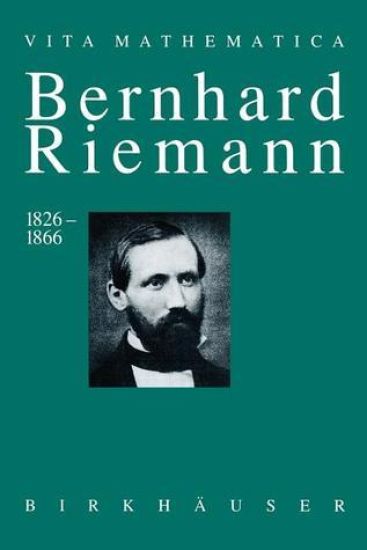
Bernhard Riemann 1826–1866

Bernhard Riemann 1826–1866

Detlef Laugwitz

Birkhauser Boston Inc
2008
nidottu
The name of Bernard Riemann is well known to mathematicians and physicists around the world. His name is indelibly stamped on the literature of mathematics and physics. This remarkable work, rich in insight and scholarship, is addressed to mathematicians, physicists, and philosophers interested in mathematics. It seeks to draw those readers closer to the underlying ideas of Riemann's work and to the development of them in their historical context. This illuminating English-language version of the original German edition will be an important contribution to the literature of the history of mathematics.
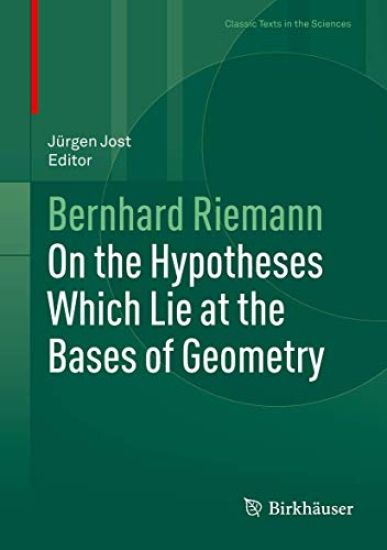
Bernhard Riemann — On the Hypotheses Which Lie at the Bases of Geometry
This book presents William Clifford’s English translation of Bernhard Riemann’s seminal text, accompanied by detailed mathematical, historical, and philosophical commentary. It explores Riemann’s revolutionary ideas on space, placing them within the broader framework developed by later thinkers such as Helmholtz, Ricci, Weyl, and Einstein. A historical introduction situates Riemann’s work in its 19th-century context, while subsequent chapters trace the evolution of the concept of space across philosophy, physics, and mathematics, and examine its enduring influence up to modern research. The second edition includes expanded mathematical commentary, a new section on metric geometry and machine learning, a systematic bibliography, and numerous updates throughout. Appealing to mathematicians, historians, and readers with an interest in physics or philosophy, this book provides a comprehensive perspective on Riemann’s groundbreaking contributions and their lasting impact.
Bernhard Riemann 1826–1866

Bernhard Riemann 1826–1866

Detlef Laugwitz

Springer Basel
2011
nidottu
Das Riemannsche Integral lernen schon die Schüler kennen, die Theorien der reellen und der komplexen Funktionen bauen auf wichtigen Begriffsbildungen und Sätzen Riemanns auf, die Riemannsche Geometrie ist für Einsteins Gravitationstheorie und ihre Erweiterungen unentbehrlich, und in der Zahlentheorie ist die berühmte Riemannsche Vermutung noch immer offen. Riemann und sein um fünf Jahre jüngerer Freund Richard Dedekind sahen sich als Schüler von Gauss und Dirichlet. Um die Mitte des 19. Jahrhunderts leiteten sie den Übergang zur "modernen Mathematik" ein, der eine in Analysis und Geometrie, der andere in der Algebra mit der Hinwendung zu Mengen und Strukturen. Dieses Buch ist der erste Versuch, Riemanns wissenschaftliches Werk unter einem einheitlichen Gesichtspunkt zusammenzufassend darzustellen. Riemann gilt als einer der Philosophen unter den Mathematikern. Er stellte das Denken in Begriffen neben die zuvor vorherrschende algorithmische Auffassung von der Mathematik, welche die Gegenstände der Untersuchung, in Formeln und Figuren, in Termumformungen und regelhaften Konstruktionen als die allein legitimen Methoden sah. David Hilbert hat als Riemanns Grundsatz herausgestellt, die Beweise nicht durch Rechnung, sondern lediglich durch Gedanken zu zwingen. Hermann Weyl sah als das Prinzip Riemanns in Mathematik und Physik, "die Welt als das erkenntnistheoretische Motiv..., die Welt aus ihrem Verhalten im un- endlich kleinen zu verstehen."
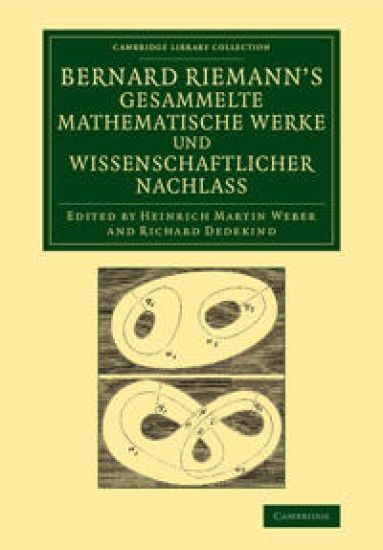
Bernard Riemann's gesammelte mathematische Werke und wissenschaftlicher Nachlass
Great mathematicians write for the future and Georg Friedrich Bernhard Riemann (1826–66) was one of the greatest mathematicians of all time. Edited by Heinrich Martin Weber, with assistance from Richard Dedekind, this edition of his collected works in German first appeared in 1876. Riemann's interests ranged from pure mathematics to mathematical physics. He wrote a short paper on number theory which provided the key to the prime number theorem, and his zeta hypothesis has given mathematicians the most famous of today's unsolved problems. Moreover, his famous 1854 lecture 'On the hypotheses which underlie geometry' set in motion studies which culminated in Einstein's general theory of relativity. Even Riemann's over-optimistic use of the Dirichlet principle to prove the conformal mapping theorem turned out to be immensely fruitful. The alert reader will further profit from finding here the seeds of modern distribution theory, algebraic topology and measure theory.
On the Hypotheses Which Lie at the Bases of Geometry

On the Hypotheses Which Lie at the Bases of Geometry

Bernhard Riemann

Birkhauser Verlag AG
2016
sidottu
This book presents William Clifford’s English translation of Bernhard Riemann’s classic text together with detailed mathematical, historical and philosophical commentary. The basic concepts and ideas, as well as their mathematical background, are provided, putting Riemann’s reasoning into the more general and systematic perspective achieved by later mathematicians and physicists (including Helmholtz, Ricci, Weyl, and Einstein) on the basis of his seminal ideas. Following a historical introduction that positions Riemann’s work in the context of his times, the history of the concept of space in philosophy, physics and mathematics is systematically presented. A subsequent chapter on the reception and influence of the text accompanies the reader from Riemann’s times to contemporary research. Not only mathematicians and historians of the mathematical sciences, but also readers from other disciplines or those with an interest in physics or philosophy will find this work both appealing and insightful.