Kirjojen hintavertailu. Mukana 11 244 527 kirjaa ja 12 kauppaa.

Kirjahaku

Etsi kirjoja tekijän nimen, kirjan nimen tai ISBN:n perusteella.

1000 tulosta hakusanalla Bijan Kumar Bagchi

Partial Differential Equations for Mathematical Physicists
Partial Differential Equations for Mathematical Physicists is intended for graduate students, researchers of theoretical physics and applied mathematics, and professionals who want to take a course in partial differential equations. This book offers the essentials of the subject with the prerequisite being only an elementary knowledge of introductory calculus, ordinary differential equations, and certain aspects of classical mechanics. We have stressed more the methodologies of partial differential equations and how they can be implemented as tools for extracting their solutions rather than dwelling on the foundational aspects. After covering some basic material, the book proceeds to focus mostly on the three main types of second order linear equations, namely those belonging to the elliptic, hyperbolic, and parabolic classes. For such equations a detailed treatment is given of the derivation of Green's functions, and of the roles of characteristics and techniques required in handling the solutions with the expected amount of rigor. In this regard we have discussed at length the method of separation variables, application of Green's function technique, and employment of Fourier and Laplace's transforms. Also collected in the appendices are some useful results from the Dirac delta function, Fourier transform, and Laplace transform meant to be used as supplementary materials to the text. A good number of problems is worked out and an equally large number of exercises has been appended at the end of each chapter keeping in mind the needs of the students. It is expected that this book will provide a systematic and unitary coverage of the basics of partial differential equations.Key FeaturesAn adequate and substantive exposition of the subject. Covers a wide range of important topics.Maintains mathematical rigor throughout.Organizes materials in a self-contained way with each chapter ending with a summary.Contains a large number of worked out problems.
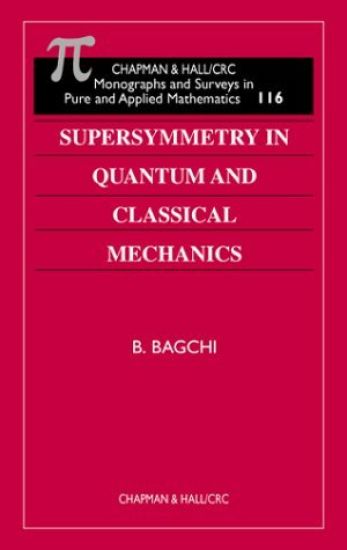
Supersymmetry In Quantum and Classical Mechanics
Following Witten's remarkable discovery of the quantum mechanical scheme in which all the salient features of supersymmetry are embedded, SCQM (supersymmetric classical and quantum mechanics) has become a separate area of research . In recent years, progress in this field has been dramatic and the literature continues to grow. Until now, no book has offered an overview of the subject with enough detail to allow readers to become rapidly familiar with its key ideas and methods. Supersymmetry in Classical and Quantum Mechanics offers that overview and summarizes the major developments of the last 15 years. It provides both an up-to-date review of the literature and a detailed exposition of the underlying SCQM principles. For those just beginning in the field, the author presents step-by-step details of most of the computations. For more experienced readers, the treatment includes systematic analyses of more advanced topics, such as quasi- and conditional solvability and the role of supersymmetry in nonlinear systems.
Supersymmetry In Quantum and Classical Mechanics
Following Witten's remarkable discovery of the quantum mechanical scheme in which all the salient features of supersymmetry are embedded, SCQM (supersymmetric classical and quantum mechanics) has become a separate area of research . In recent years, progress in this field has been dramatic and the literature continues to grow. Until now, no book has offered an overview of the subject with enough detail to allow readers to become rapidly familiar with its key ideas and methods. Supersymmetry in Classical and Quantum Mechanics offers that overview and summarizes the major developments of the last 15 years. It provides both an up-to-date review of the literature and a detailed exposition of the underlying SCQM principles. For those just beginning in the field, the author presents step-by-step details of most of the computations. For more experienced readers, the treatment includes systematic analyses of more advanced topics, such as quasi- and conditional solvability and the role of supersymmetry in nonlinear systems.
Bibliometric Study of Selected Social Science Subjects

Bibliometric Study of Selected Social Science Subjects

Sanjukta Mondal; Bijan Kumar Roy

Lap Lambert Academic Publishing
2021
pokkari
This book deals with the Bibliometric Study of four Social Science Subjects viz. Political Science, Economics, History, and Law. The main objective of this book is to analyze citation patterns of selected Social Science subjects and their sub-subjects. This book analyzes year-wise productivity of theses, different types of literature used, Ranked list of journals, authorship pattern. It also compares four selected subjects against the above-mentioned parameters. This book will be helpful to the research scholars who wish to conduct their research in this domain.
Temple Architecture in India

Temple Architecture in India

Bijay Kumar Das

Lulu.com
2018
pokkari
This reference book on Temple Architecture in India highlights the basic features of Indian Temple. The ceremonial making of temple, its plan, and elevation along with significance of vastu purusha mandala is discussed. Architecturally significant Temples of three styles spread across India is referred in this book. The book will be helpful for initial readers who want to gain a first hand knowledge about temple architecture.
Two Plays

Two Plays

Bijay Kumar Satapathy

BLACK EAGLE BOOKS
2024
pokkari
The Soul of Kansa is of two Acts. Act I highlights the Indian myth, as prescribed in the Mahabharat, of the conflict of vice and virtue. The protagonist, Kansa, stands for evil. This protagonist was of the Dwapar Yuga (Three thousand years earlier was in this Indian peninsula). A tyrannical ruler Kansa oppressed the ordinary people greatly. Kansa is not with us physically; his soul is very much alive in the society. The character Andhak represents the soul of Kansa.The second play, Kokua, revolves around Dhamaguda, a tribal village. Kokua is an imaginary, frightful, and mysterious character of the Mahabharata, one of the great epics of India. The Mahabharata of India has many regional versions in different languages. The Kokua anecdote is well described in Sarala Das's Odia Mahabharata. Kokua comes down, when the degree of doubt, disbelief, terror, murder, and anarchy overpowers the world. Because of the industrial growth and development, the tribes lose their land, rivers, brooks, forests, and simple lifestyles. Their mind gets polluted. The tribes are deprived of their natural rights. The issues of these locals are very beautifully reproduced. Shyamananda is the owner of the Ashram wherein Atanu was a disciple and later becomes the Police Inspector. At the same time, Ajay Marandi was also a disciple and later becomes a Naxal leader or Area Commander. Shyamananda's erstwhile belief was that he would guide rightly the students of this village to follow the path of non-violence. His dream is shattered in due course of time. Shibu (Also known as Sadashiba Rao) is a character supporting the Maoist movement.
Simulation Using ProModel

Simulation Using ProModel

Biman Kumar Ghosh; Royce O. Bowden; Bruce Gladwin

Cognella Academic Publishing
2021
sidottu
Simulation Using ProModel helps students build competence and confidence in the use of simulation through hands-on application. The text features a blend of theory and practice, real-life examples, case studies, and lab exercises using ProModel to help students develop their knowledge and abilities. Part I consists of 14 study chapters. The first four chapters introduce simulation, its application to system design and improvement, and how simulation works. Chapters 5 through 11 cover the practical and theoretical aspects of conducting a simulation project, including applying simulation optimization. Chapters 12 through 14 cover applications of simulation to manufacturing, material handling, and service systems. Part II features 14 labs that correlate with the 14 chapters in Part I. Each lab guides students through the steps of modeling a situation using ProModel and then provides exercises to further develop their skills.
Uno sguardo al contributo del settore forestale al miglioramento dei mezzi di sussistenza
Questo libro fornisce un quadro generale del contributo del settore forestale alla sicurezza alimentare in Nepal. I programmi per il miglioramento dei mezzi di sussistenza sono regolati dai Piani nazionali periodici, dalle politiche del settore forestale e dal quadro giuridico e sono sostenuti da progetti ricchi di risorse. Il metodo della classifica del benessere ampiamente utilizzato per identificare e selezionare le famiglie pi povere tra quelle povere, sia nella silvicoltura comunitaria che in quella in affitto, attraverso un metodo partecipativo. In questo modo si concentrano le famiglie pi povere ed emarginate. Allo stesso modo, l'approccio di gruppo prevalente al fine di fornire beni, servizi e sviluppo delle capacit che sono stati ulteriormente federati a livello superiore, compreso quello nazionale, come FECOFUN nella silvicoltura comunitaria, il consiglio della zona cuscinetto nelle aree protette, l'intergruppo e le cooperative nella silvicoltura in affitto. L'assegnazione di risorse forestali produttive alle famiglie pi povere, con un periodo a lungo termine, un altro approccio alla silvicoltura in leasing, alla silvicoltura comunitaria e allo sviluppo della silvicoltura pubblica. L'allocazione dei fondi pubblici razionalizzata dal quadro normativo, come ad esempio l'allocazione del 35% dei fondi nel reddito delle foreste comunitarie o la condivisione del 30-50% delle entrate.
Aperçu de la contribution du secteur forestier à l'amélioration des moyens de subsistance
Ce livre fournit une image globale de la contribution du secteur forestier la s curit alimentaire au N pal. Les programmes d'am lioration des moyens de subsistance sont rationalis s par les plans p riodiques nationaux, les politiques du secteur forestier et le cadre juridique, et soutenus par des projets ing nieux. La m thode de classement du bien- tre est largement utilis e pour identifier et s lectionner les m nages les plus pauvres dans la foresterie communautaire et la foresterie bail par le biais d'une m thode participative. Ainsi, les m nages pauvres et les plus marginalis s sont cibl s. De m me, l'approche de groupe pr vaut afin de fournir des biens, des services et un d veloppement des capacit s qui ont t f d r s un niveau plus lev , y compris au niveau national, comme le FECOFUN dans la foresterie communautaire, le conseil de la zone tampon dans les zones prot g es, l'intergroupe et les coop ratives dans la foresterie bail. L'attribution de ressources foresti res productives aux m nages les plus pauvres avec une p riode long terme sur le concept de bail est une autre approche de la foresterie bail, de la foresterie communautaire et du d veloppement de la foresterie publique. L'allocation des fonds publics est rationalis e par le cadre juridique, comme l'allocation de 35 % des fonds dans les revenus des for ts communautaires ou le partage des revenus hauteur de 30 50 %.