
Kirjahaku
Etsi kirjoja tekijän nimen, kirjan nimen tai ISBN:n perusteella.
1000 tulosta hakusanalla Billy Jones
When 11 year old Billy Jones discovers his Dad is really a secret spaceman who works on the moon, to avoid a galactic diplomatic incident he becomes the first human child to go to space school. However, not all aliens are friendly. The sinister alien Darkmites hate humanity and secretly plot the Earth's destruction. With his new, strange, friends, can he save the World from being destroyed and not get expelled?
Billy Jones's Father is a true story written in contemporary fiction. The stories written within are testaments to the verbal, emotional and psychological abusive events which Billy Jones endured from his father, Scotty Jones, and people like him. They are validations of what millions of children have suffered for the past eighty years while playing organized sports. They are also reminders as to why so many of today's youth struggle to find peace in their lives.Never able to satisfy his father's expectations as an athlete, Arnold suffered ridicule from coaches, fellow players and the community of Torrid Hills., North Carolina. His downfall is a wakeup call to all who enroll children in organized youth sports.
Billy Jones's Father is a true story written in contemporary fiction. The stories written within are testaments to the verbal, emotional and psychological abusive events which Billy Jones endured from his father, Scotty Jones, and people like him. They are validations of what millions of children have suffered for the past eighty years while playing organized sports. They are also reminders as to why so many of today's youth struggle to find peace in their lives.Never able to satisfy his father's expectations as an athlete, Arnold suffered ridicule from coaches, fellow players and the community of Torrid Hills., North Carolina. His downfall is a wakeup call to all who enroll children in organized youth sports.
For over two million miles and the better part of twenty-five years, I rode around. All those years, I never knew what it was I wanted to do when I grew up, so I didn't. When I was young, big trucks and the call of the open road were all I could hear. It always seemed as if the pot of gold at the end of the rainbow was just beyond the next horizon. I chased many dreams over the years, but none of them were ever to be mine. A dream can never be yours if it isn't really yours to begin with. Eventually I stopped dreaming, and it was then I died. There were several long, hard years that I thought I served no purpose except to take up space. I'm not going to tell you here all the stories about broken hearts and dreams long since lost. We've all experienced heartaches and disillusionment to some degree, and it would serve no purpose to go into detail here. I'll only say that sooner or later we all have to get over it. I started writing in nineteen-ninety-six as a means to work out the pain of a broken heart and hoped to write songs, as music is one of my greatest passions, second only to beautiful women, of course. It didn't take me long to figure out that there are too many angst-filled poets in the world writing more gloom and despair than we'll ever want to read, so I asked God to let me write something funny. He did. I began sharing my songs and poetry with friends who encouraged me to write more. My telephone rang all the time with people wanting to hear my latest musings, so I joyfully complied with their wishes. Soon I was reading in church, at coffee houses and even in bars. Everywhere I went, even at work, people wanted to hear my poetry. It wasn't long before I figured out that while all of this was fun, it was really a waste of time. I needed to write a book, and write a book I did. In the last three years I have finished ten books, am working on ten more, and if you are reading this, then I have published my first book, CARROT ON A STICK. All of this from a guy who had a perfect "D" average in English class and never learned to type. I guess that accounts for the bad grammar and errors in punctuation, but I think you'll get the point anyway. Is something dangling here?
For over two million miles and the better part of twenty-five years, I rode around. All those years, I never knew what it was I wanted to do when I grew up, so I didn't. When I was young, big trucks and the call of the open road were all I could hear. It always seemed as if the pot of gold at the end of the rainbow was just beyond the next horizon. I chased many dreams over the years, but none of them were ever to be mine. A dream can never be yours if it isn't really yours to begin with. Eventually I stopped dreaming, and it was then I died. There were several long, hard years that I thought I served no purpose except to take up space. I'm not going to tell you here all the stories about broken hearts and dreams long since lost. We've all experienced heartaches and disillusionment to some degree, and it would serve no purpose to go into detail here. I'll only say that sooner or later we all have to get over it. I started writing in nineteen-ninety-six as a means to work out the pain of a broken heart and hoped to write songs, as music is one of my greatest passions, second only to beautiful women, of course. It didn't take me long to figure out that there are too many angst-filled poets in the world writing more gloom and despair than we'll ever want to read, so I asked God to let me write something funny. He did. I began sharing my songs and poetry with friends who encouraged me to write more. My telephone rang all the time with people wanting to hear my latest musings, so I joyfully complied with their wishes. Soon I was reading in church, at coffee houses and even in bars. Everywhere I went, even at work, people wanted to hear my poetry. It wasn't long before I figured out that while all of this was fun, it was really a waste of time. I needed to write a book, and write a book I did. In the last three years I have finished ten books, am working on ten more, and if you are reading this, then I have published my first book, CARROT ON A STICK. All of this from a guy who had a perfect "D" average in English class and never learned to type. I guess that accounts for the bad grammar and errors in punctuation, but I think you'll get the point anyway. Is something dangling here?


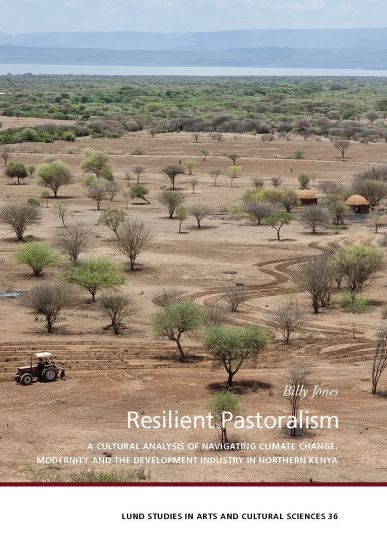
Resilient pastoralism : a cultural analysis of navigating climate change, modernity and the development industry in northern Kenya
Billy Jones
Lunds universitet, Media-Tryck
2025
nidottu
Droughts, Floods, Violence and Poverty. The drylands of Northern Kenya are not an easy place to live. Up here, pastoralism has been the dominant way of life for centuries. But over the past half a century, the grass has all but run out, the ecosystem has fallen apart, and extreme poverty is the norm. And yet, some people have found a new way to get by. A growing number of people are switching from traditional forms of pastoralism to intensively plant grass on private farms. By feeding fodder to their livestock and harvesting the seeds, they are thriving in the face of crippling financial pressures and an increasingly erratic climate. At the same time, millions of dollars of aid money have been poured into the region via projects to improve livelihoods and rehabilitate the environment. Very few have succeeded. Only a handful of locally run projects have managed to make an impact by helping grass farmers build resilient, environmentally friendly livelihoods. This thesis tells the story of pastoralism and Development in Baringo, Northern Kenya. It explores the social, political and ecological processes which have marginalised the economy and investigates how pastoralists are adapting their way of life through grass farming. It also critically examines the International Development Industry’s attempts to bring sustainable development to the region, asking how and why so many have failed. By contrasting these failed attempts with more successful local initiatives, it hopes to trigger a discussion about how we might move towards more localised, collaborative approaches to Development in the world’s most marginalised landscapes.
Who are we? We are hardworking and focused. We are winners or defeaters. We fall in and out of love. Some of us own nice cars while others take the bus. We are immensely rich or exceedingly broke. We're not in tabloids or on covers of magazines. "We're common, "Everyday Folks."" "Everyday Folks: Short Stories on the Common People" takes a glimpse into the lives of people whose life stories would probably go unnoticed. The short stories warm our hearts or challenge our nerves. They chronicle the realities and complexities that many of us face on a day-to-day basis. Set in Miami, Florida, "Everyday Folks gives the rest of the world a chance to see beneath the fleshy surface of people who build their lives around love, pain, and the inevitable. This book is dedicated to you...not to many but a small few...for the things you do in lieu of what you do... For it is derived from the essence of you. It captures the heart with episodes that only the common people will understand.
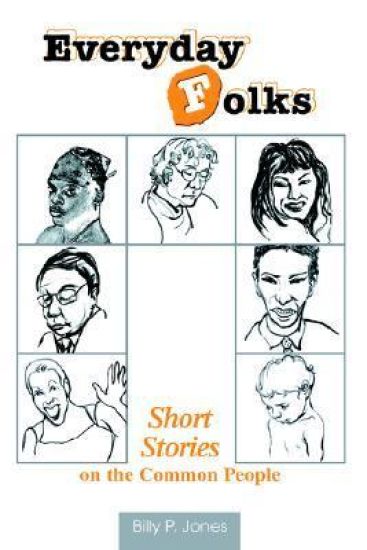
Who are we? We are hardworking and focused. We are winners or defeaters. We fall in and out of love. Some of us own nice cars while others take the bus. We are immensely rich or exceedingly broke. We're not in tabloids or on covers of magazines. "We're common, "Everyday Folks."" "Everyday Folks: Short Stories on the Common People" takes a glimpse into the lives of people whose life stories would probably go unnoticed. The short stories warm our hearts or challenge our nerves. They chronicle the realities and complexities that many of us face on a day-to-day basis. Set in Miami, Florida, "Everyday Folks gives the rest of the world a chance to see beneath the fleshy surface of people who build their lives around love, pain, and the inevitable. This book is dedicated to you...not to many but a small few...for the things you do in lieu of what you do... For it is derived from the essence of you. It captures the heart with episodes that only the common people will understand.

History of Twiggs County, Georgia
J. Lanette Faulk; Billy Walker Jones
Southern Historical Press
2017
nidottu
By: J. Lanette O. Faulk & Billy Walker Jones, Orig. Pub. 1960, Reprinted 2017, 486 pages, soft cover, ISBN #0-89308-009-8.This long awaited reprint of this central Georgia county history book should make many a researcher very happy. This book is a genealogical gem of a book. It is filled with a wide variety of information such as: early history, Indian affairs, roster of soldiers from the Civil War, the Revolutionary War, World War I & II, abstracts of tax Digest for 1818-1826-1853, abstracts of deeds 1809-1900, abstracts of deeds from other Index Books to 1901, abstracts of Wills, Newspaper abstracts, Cemeteries inscriptions for some 45 different cemeteries, Land lottery - Wilkinson County 1805 (now Twiggs). The authors did not stop there. They also added biographical sketches / genealogies of approx. 66 early settlers of this important county.

In 1936 as Texas prepared to celebrate its centennial--100 years after the Battle of San Jacinto--Dallas was chosen as the site of the official exhibition. Plans were under way for a modest Frontier Days Celebration in Fort Worth--until "Star-Telegram" publisher and civic booster Amon G. Carter stepped in. Carter considered the naming of Dallas as the official site a gross miscarriage of justice and was determined to get even by mounting a show that would directly rival the official event--and pull tourist dollars into Fort Worth. To put his celebration together Carter hired flamboyant Broadway producer Billy Rose. The result was Fort Worth's Frontier Centennial, an improbable conglomeration of agricultural exhibits, sideshow nudes, an old-time Wild West show, Rose's musicalized circus Jumbo, and a parade of Broadway and vaudeville talent led by feature artiste, stripper Sally Rand. The centerpiece for this extravaganza was the dinner theater, Casa Manana, with the world's largest revolving stage surrounded by a tank of water on which it seemed to float, over twenty fountains, and geysers of water that shot into the air at strategic intervals. The building featured over thirty Spanish-style arches, was 320 feet in length, and contained the world's longest bar, a fact of which Rose was inordinately proud. But it was the revue on this magnificent stage that truly made theatrical history. On opening night, Paul Whiteman raised his baton and two bands swung into the fanfare. There were interpretations of the St. Louis World's Fair, the Paris Exposition of 1925, and Chicago's 1933 Century of Progress Exposition. Texas "Sweetheart Number One" wore a $5,000 gold-mesh gown, and Sally Rand wore only a huge opaline balloon. On opening night when the orchestra played "The Eyes of Texas," the audience rose to its feet singing, whistling, and cheering. "Texans," wrote one critic, "are not given to polite applause." The Frontier Centennial and its sequel, the Frontier Fiesta, closed after only two brief seasons (1936 and 1937), the second season cut short by controversy and lawsuits. Rose left Fort Worth under a cloud, informed by city fathers that his services were no longer needed. Undaunted, he went on to become a multimillionaire with almost legendary status as a theatrical producer. But Fort Worth was never again the same after the Frontier Centennial . . . and memories of that festival linger today, even though the buildings were long ago razed. Today a permanent theater-in-the-round, appropriately named Casa Manana, is located on the centennial grounds. Popular with Fort Worthians, it can only echo the splendor of the original.
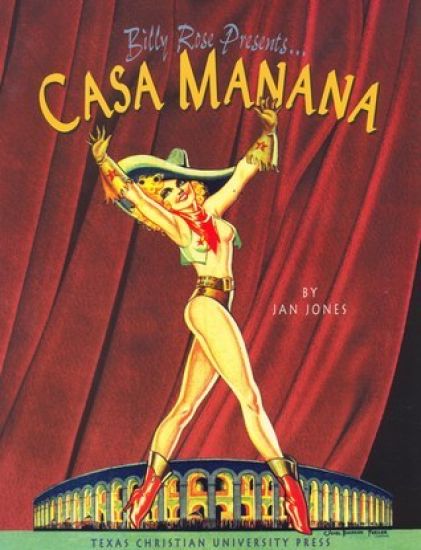
In 1936 as Texas prepared to celebrate its centennial--100 years after the Battle of San Jacinto--Dallas was chosen as the site of the official exhibition. Plans were under way for a modest Frontier Days Celebration in Fort Worth--until Star-Telegram publisher and civic booster Amon G. Carter stepped in. Carter considered the naming of Dallas as the official site a gross miscarriage of justice and was determined to get even by mounting a show that would directly rival the official event--and pull tourist dollars into Fort Worth. To put his celebration together Carter hired flamboyant Broadway producer Billy Rose. The result was Fort Worth's Frontier Centennial, an improbable conglomeration of agricultural exhibits, sideshow nudes, an old-time Wild West show, Rose's musicalized circus Jumbo, and a parade of Broadway and vaudeville talent led by feature artiste, stripper Sally Rand. The centerpiece for this extravaganza was the dinner theater, Casa Manana, with the world's largest revolving stage surrounded by a tank of water on which it seemed to float, over twenty fountains, and geysers of water that shot into the air at strategic intervals. The building featured over thirty Spanish-style arches, was 320 feet in length, and contained the world's longest bar, a fact of which Rose was inordinately proud. But it was the revue on this magnificent stage that truly made theatrical history. On opening night, Paul Whiteman raised his baton and two bands swung into the fanfare. There were interpretations of the St. Louis World's Fair, the Paris Exposition of 1925, and Chicago's 1933 Century of Progress Exposition. Texas "Sweetheart Number One" wore a $5,000 gold-mesh gown, and Sally Rand wore only a huge opaline balloon. On opening night when the orchestra played "The Eyes of Texas," the audience rose to its feet singing, whistling, and cheering. "Texans," wrote one critic, "are not given to polite applause." The Frontier Centennial and its sequel, the Frontier Fiesta, closed after only two brief seasons (1936 and 1937), the second season cut short by controversy and lawsuits. Rose left Fort Worth under a cloud, informed by city fathers that his services were no longer needed. Undaunted, he went on to become a multimillionaire with almost legendary status as a theatrical producer. But Fort Worth was never again the same after the Frontier Centennial . . . and memories of that festival linger today, even though the buildings were long ago razed. Today a permanent theater-in-the-round, appropriately named Casa Manana, is located on the centennial grounds. Popular with Fort Worthians, it can only echo the splendor of the original.

Doughnie Jones, one of the most creative story tellers of this generation, delivers one of his greatest characters into a children's classic. Jones captures the spirit of Billy Bad Boy in all of us. This is a wonderful Christmas Story that all children should grow up with. It is Christmas Eve and Billy Bad Boy decides not to go to bed. He plans on staying up all night until he sees you know who. Billy looses his patience and can't help but get into a little mischief. One thing leads to another and before long Billy is in a heap of trouble. Profits from this book will go to purchase Christmas presents for needy children.