

Kirjahaku
Etsi kirjoja tekijän nimen, kirjan nimen tai ISBN:n perusteella.
1000 tulosta hakusanalla Bishop Dorothy Y N Tee

Dorothy Bishop, The Life and Times of a Civil Rights Activist
Earl Gillespie
Createspace Independent Publishing Platform
2013
nidottu

Test for Reception of Grammar - Version 2 - Complete Kit
Dorothy Bishop; Rod Nicolson
Elsevier Health Sciences
2003
muu

Test for reception of Grammar - Version 2 - Record Form, pack 25
Dorothy Bishop
Elsevier Health Sciences
2003
nidottu

Children's Communication Checklist Second Edition Summary Sheet (25) (CCC-2)
Dorothy Bishop
Psychological Corporation Ltd
2003
nidottu

Expression, Reception and Recall of Narrative Instrument - Complete Kit
Dorothy Bishop
Elsevier Health Sciences
2004
muu

Expression, Reception and Recall of Narrative Instrument (ERRNI) Manual
Dorothy Bishop
Elsevier Health Sciences
2004
nidottu

Communication Checklist Self-Report Manual (CC-SR)
Dorothy Bishop; Andrew Whitehouse
Psychological Corporation Ltd
2009
nidottu

Communication Checklist Self-Report Score Keys in Envelope (CC-SR)
Dorothy Bishop; Andrew Whitehouse
Psychological Corporation Ltd
2008
muu


A great deal has been written on how children learn to speak, but development of language comprehension has been a relatively neglected topic. This book is unique in integrating research in language acquisition, psycholinguistics and neuropsychology to give a comprehensive picture of the process we call "comprehension", right from the reception of an acoustic stimulus at the ear, up to the point where we interpret the message the speaker intended to convey by the utterance. A major theme of the book is that "comprehension" is not a unitary skill: to understand spoken language, one needs the ability to classify incoming speech sounds, to relate them to a "mental lexicon", to interpret the propositions encoded by word order and grammatical inflections, and to use information from the environmental and social context to select, from a wide range of possible interpretations, the one that was intended by the speaker. Furthermore, although neuropsychological and experimental research on adult comprehension can provide useful concepts and methods for assessing comprehension, they should be applied with caution, because a sequential, bottom-up information processing model of comprehension is ill-suited to the developmental context. The emphasis of the book is on children with specific language impairments, but normal development is also given extensive coverage. The focus is on research and theory, rather than practical matters of assessment and intervention. Nevertheless, while this book is not intended as a clinical guide to assessment, it does aim to provide a theoretical framework that can help clinicians develop a clearer understanding of what comprehension involves, and how different types of difficulty may be pinpointed.
Those who work in allied health professions and education aim to make people’s lives better. Often, however, it is hard to know how effective this work has been: would change have occurred if there was no intervention? Is it possible we are doing more harm than good? To answer these questions and develop a body of knowledge about what works, we need to evaluate interventions. Objective intervention research is vital to improve outcomes, but this is a complex area, where it is all too easy to misinterpret evidence. This book uses practical examples to increase awareness of the numerous sources of bias that can lead to mistaken conclusions when evaluating interventions. The focus is on quantitative research methods, and exploration of the reasons why those both receiving and implementing intervention behave in the ways they do. Evaluating What Works: Intuitive Guide to Intervention Research for Practitioners illustrates how different research designs can overcome these issues, and points the reader to sources with more in-depth information. This book is intended for those with little or no background in statistics, to give them the confidence to approach statistics in published literature with a more critical eye, recognise when more specialist advice is needed, and give them the ability to communicate more effectively with statisticians.Key Features:Strong focus on quantitative research methodsComplements more technical introductions to statisticsProvides a good explanation of how quantitative studies are designed, and what biases and pitfalls they can involve
Those who work in allied health professions and education aim to make people’s lives better. Often, however, it is hard to know how effective this work has been: would change have occurred if there was no intervention? Is it possible we are doing more harm than good? To answer these questions and develop a body of knowledge about what works, we need to evaluate interventions. Objective intervention research is vital to improve outcomes, but this is a complex area, where it is all too easy to misinterpret evidence. This book uses practical examples to increase awareness of the numerous sources of bias that can lead to mistaken conclusions when evaluating interventions. The focus is on quantitative research methods, and exploration of the reasons why those both receiving and implementing intervention behave in the ways they do. Evaluating What Works: Intuitive Guide to Intervention Research for Practitioners illustrates how different research designs can overcome these issues, and points the reader to sources with more in-depth information. This book is intended for those with little or no background in statistics, to give them the confidence to approach statistics in published literature with a more critical eye, recognise when more specialist advice is needed, and give them the ability to communicate more effectively with statisticians.Key Features:Strong focus on quantitative research methodsComplements more technical introductions to statisticsProvides a good explanation of how quantitative studies are designed, and what biases and pitfalls they can involve
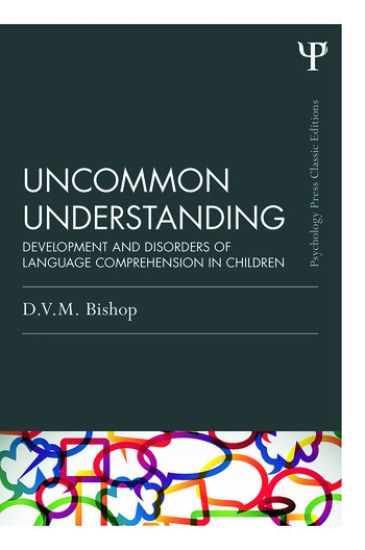
This is a Classic Edition of Dorothy Bishop's award-winning textbook on the development of language comprehension, which has been in print since 1997, and now includes a new introduction from the author. The book won the British Psychological Society book award in 1999, and is now widely seen as a classic in the field of developmental language disorders.Uncommon Understanding provides a comprehensive account of the process of comprehension, from the reception of an acoustic signal, to the interpretation of communicative intentions, and integrates a vast field of research on language acquisition, psycholinguistics and neuropsychology. In the new introduction Dorothy Bishop reflects on the organization of the book, and developments in the field since the book was first published.A major theme in the book is that comprehension should not be viewed as a unitary skill – to understand spoken language one needs the ability to classify incoming speech sounds, to relate them to a "mental lexicon," to interpret the propositions encoded by word order and grammatical inflections, and to use information from the environmental and social context to grasp an intended meaning. Another important theme is that although neuropsychological and experimental research on adult comprehension provides useful concepts and methods for assessing comprehension, it should be applied with caution, because a sequential, bottom-up information processing model of comprehension is ill-suited to the developmental context. Although the main focus of the book is on research and theory, rather than practical matters of assessment and intervention, the theoretical framework presented in the book will continue to help clinicians develop a clearer understanding of what comprehension involves, and how different types of difficulty may be pin-pointed.
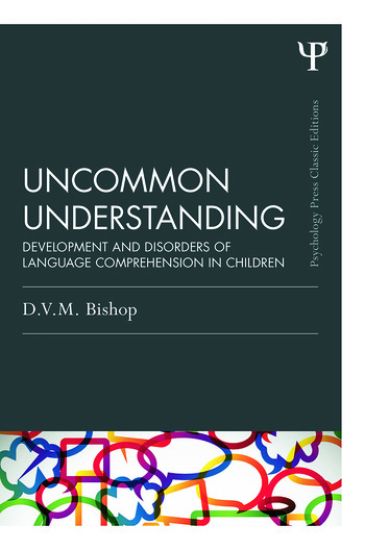
This is a Classic Edition of Dorothy Bishop's award-winning textbook on the development of language comprehension, which has been in print since 1997, and now includes a new introduction from the author. The book won the British Psychological Society book award in 1999, and is now widely seen as a classic in the field of developmental language disorders.Uncommon Understanding provides a comprehensive account of the process of comprehension, from the reception of an acoustic signal, to the interpretation of communicative intentions, and integrates a vast field of research on language acquisition, psycholinguistics and neuropsychology. In the new introduction Dorothy Bishop reflects on the organization of the book, and developments in the field since the book was first published.A major theme in the book is that comprehension should not be viewed as a unitary skill – to understand spoken language one needs the ability to classify incoming speech sounds, to relate them to a "mental lexicon," to interpret the propositions encoded by word order and grammatical inflections, and to use information from the environmental and social context to grasp an intended meaning. Another important theme is that although neuropsychological and experimental research on adult comprehension provides useful concepts and methods for assessing comprehension, it should be applied with caution, because a sequential, bottom-up information processing model of comprehension is ill-suited to the developmental context. Although the main focus of the book is on research and theory, rather than practical matters of assessment and intervention, the theoretical framework presented in the book will continue to help clinicians develop a clearer understanding of what comprehension involves, and how different types of difficulty may be pin-pointed.

McKenzie Bishop is fresh out of the Army after getting wounded overseas. Estranged from his family, he decides to attend college as far away from home as possible; ending up at Buchanan State University, in Crescent Falls, Pennsylvania. He doesn't know a soul there; so, it's the perfect place to begin the next chapter in his life.After two weeks of immense boredom, loneliness, and his own form of alcohol therapy, he decides to pledge a fraternity, something he always wanted to do prior to joining the Army. Enter, Delta Iota Kappa, the animal house of BSU.Bishop is the oldest one in his pledge class and wary about what the pledging process will entail, but like everything else in his life prior, he fully commits. Everything goes smoothly until the night he's arrested at a fraternity party. Faced with jail time or a Veterans Affairs substance abuse program, Bishop chooses the latter, and to his surprise, falls head over heels for his much older female counselor. He finds this elusive woman intriguing and suddenly, his sessions become about much more than learning how to overcome his addiction to alcohol.


As a church leader, it s easy to make the wrong move and find yourself in a bad position. What to teach; How to teach; What to do, were the three questions Wesley employed at his first conferences. In sixty previous books Will Willimon has worked the first two. This book is of the What to do? genre. Many believe the long decline of The United Methodist Church is a crisis of effective leadership. Willimon takes this problem on. As an improbable bishop, for the last eight years he has laid hands on heads, made ordinands promise to go where he sends them, overseen their ministries, and acted as if this were normal. Here is his account of what he has learned and more important what The United Methodist Church must do to have a future as a viable movement of the Holy Spirit. "