

Kirjahaku
Etsi kirjoja tekijän nimen, kirjan nimen tai ISBN:n perusteella.
1000 tulosta hakusanalla Boris V Horvat

This book provides an introduction to the asymptotic theory of random summation, combining a strict exposition of the foundations of this theory and recent results. It also includes a description of its applications to solving practical problems in hardware and software reliability, insurance, finance, and more. The authors show how practice interacts with theory, and how new mathematical formulations of problems appear and develop. Attention is mainly focused on transfer theorems, description of the classes of limit laws, and criteria for convergence of distributions of sums for a random number of random variables. Theoretical background is given for the choice of approximations for the distribution of stock prices or surplus processes. General mathematical theory of reliability growth of modified systems, including software, is presented. Special sections deal with doubling with repair, rarefaction of renewal processes, limit theorems for supercritical Galton-Watson processes, information properties of probability distributions, and asymptotic behavior of doubly stochastic Poisson processes. Random Summation: Limit Theorems and Applications will be of use to specialists and students in probability theory, mathematical statistics, and stochastic processes, as well as to financial mathematicians, actuaries, and to engineers desiring to improve probability models for solving practical problems and for finding new approaches to the construction of mathematical models.

This book is the sixth edition of a classic text that was first published in 1950 in the former Soviet Union. The clear presentation of the subject and extensive applications supported with real data helped establish the book as a standard for the field. To date, it has been published into more that ten languages and has gone through five editions. The sixth edition is a major revision over the fifth. It contains new material and results on the Local Limit Theorem, the Integral Law of Large Numbers, and Characteristic Functions. The new edition retains the feature of developing the subject from intuitive concepts and demonstrating techniques and theory through large numbers of examples. The author has, for the first time, included a brief history of probability and its development. Exercise problems and examples have been revised and new ones added.

Superfluid States of Matter
Boris V. Svistunov; Egor S. Babaev; Nikolay V. Prokof'ev
CRC Press
2021
nidottu
Covers the State of the Art in Superfluidity and SuperconductivitySuperfluid States of Matter addresses the phenomenon of superfluidity/superconductivity through an emergent, topologically protected constant of motion and covers topics developed over the past 20 years. The approach is based on the idea of separating universal classical-field superfluid properties of matter from the underlying system’s “quanta.” The text begins by deriving the general physical principles behind superfluidity/superconductivity within the classical-field framework and provides a deep understanding of all key aspects in terms of the dynamics and statistics of a classical-field system.It proceeds by explaining how this framework emerges in realistic quantum systems, with examples that include liquid helium, high-temperature superconductors, ultra-cold atomic bosons and fermions, and nuclear matter. The book also offers several powerful modern approaches to the subject, such as functional and path integrals.Comprised of 15 chapters, this text: Establishes the fundamental macroscopic properties of superfluids and superconductors within the paradigm of the classical matter fieldDeals with a single-component neutral matter fieldConsiders fundamentals and properties of superconductorsDescribes new physics of superfluidity and superconductivity that arises in multicomponent systemsPresents the quantum-field perspective on the conditions under which classical-field description is relevant in bosonic and fermionic systemsIntroduces the path integral formalismShows how Feynman path integrals can be efficiently simulated with the worm algorithmExplains why nonsuperfluid (insulating) ground states of regular and disordered bosons occur under appropriate conditionsExplores superfluid solids (supersolids)Discusses the rich dynamics of vortices and various aspects of superfluid turbulence at T ?0Provides account of BCS theory for the weakly interacting Fermi gasHighlights and analyzes the most crucial developments that has led to the current understanding of superfluidity and superconductivityReviews the variety of superfluid and superconducting systems available today in nature and the laboratory, as well as the states that experimental realization is currently actively pursuing

Unified Non-Local Theory of Transport Processess, 2nd Edition provides a new theory of transport processes in gases, plasmas and liquids. It is shown that the well-known Boltzmann equation, which is the basis of the classical kinetic theory, is incorrect in the definite sense. Additional terms need to be added leading to a dramatic change in transport theory. The result is a strict theory of turbulence and the possibility to calculate turbulent flows from the first principles of physics.
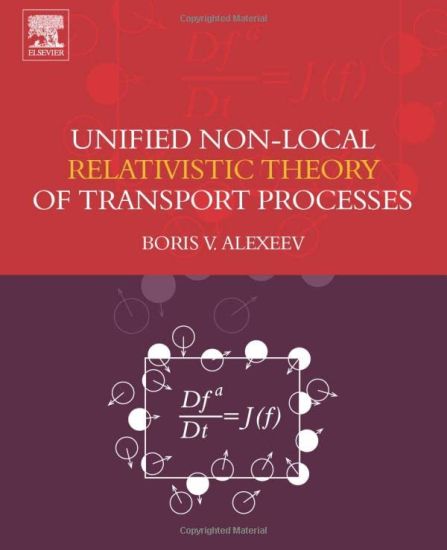
Unified Non-Local Relativistic Theory of Transport Processes
Boris V. Alexeev
Elsevier Science Ltd
2016
nidottu
Unified Non-Local Relativistic Theory of Transport Processes highlights the most significant features of non-local relativistic theory, which is a highly effective tool for solving many physical problems in areas where the classical local theory runs into difficulties. The book provides the fundamental science behind new non-local physics – generalized for relativistic cases and applied in a range of scales – from transport phenomena in massless physical systems to unified theory of dissipative structures. The book complements the author’s previous monograph on Unified Non-Local Theory of Transport Processes (Elsevier, 2015), which is mainly devoted to non-relativistic non-local physics. Nevertheless, the theory as handled in this new work is outlined independently so the book can be studied on its own.

Non-Local Astrophysics: Dark Matter, Dark Energy and Physical Vacuum highlights the most significant features of non-local theory, a highly effective tool for solving many physical problems in areas where classical local theory runs into difficulties. The book provides the fundamental science behind new non-local astrophysics, discussing non-local kinetic and generalized hydrodynamic equations, non-local parameters in several physical systems, dark matter, dark energy, black holes and gravitational waves.
This book provides an introduction to the asymptotic theory of random summation, combining a strict exposition of the foundations of this theory and recent results. It also includes a description of its applications to solving practical problems in hardware and software reliability, insurance, finance, and more. The authors show how practice interacts with theory, and how new mathematical formulations of problems appear and develop. Attention is mainly focused on transfer theorems, description of the classes of limit laws, and criteria for convergence of distributions of sums for a random number of random variables. Theoretical background is given for the choice of approximations for the distribution of stock prices or surplus processes. General mathematical theory of reliability growth of modified systems, including software, is presented. Special sections deal with doubling with repair, rarefaction of renewal processes, limit theorems for supercritical Galton-Watson processes, information properties of probability distributions, and asymptotic behavior of doubly stochastic Poisson processes. Random Summation: Limit Theorems and Applications will be of use to specialists and students in probability theory, mathematical statistics, and stochastic processes, as well as to financial mathematicians, actuaries, and to engineers desiring to improve probability models for solving practical problems and for finding new approaches to the construction of mathematical models.
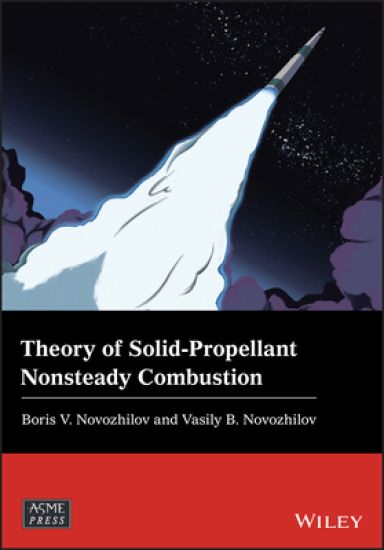
Theory of Solid-Propellant Nonsteady Combustion
Boris V. Novozhilov; Vasily B. Novozhilov
Wiley-Blackwell
2020
sidottu
Despite significant developments and widespread theoretical and practical interest in the area of Solid-Propellant Nonsteady Combustion for the last fifty years, a comprehensive and authoritative text on the subject has not been available. Theory of Solid-Propellant Nonsteady Combustion fills this gap by summarizing theoretical approaches to the problem within the framework of the Zeldovich-Novozhilov (ZN-) theory. This book contains equations governing unsteady combustion and applies them systematically to a wide range of problems of practical interest. Theory conclusions are validated, as much as possible, against available experimental data. Theory of Solid-Propellant Nonsteady Combustion provides an accurate up-to-date account and perspectives on the subject and is also accompanied by a website hosting solutions to problems in the book.

The appearance of this English edition of my book, ?rst published in Russian in mid-2006, is related to the help and support of two prominent scientists: Professor Michael Brown (Rhodes University Grahamstown, South Africa) and Dr. Judit Simon (Budapest University of Technology and Economics, Hungary). The story is as follows. In the winter of 2006, in the process of exchange of views by email with Michael on some problems of decomposition kinetics, I asked him about the possibility of publishing my book in English. He s- gestedthatIshouldcontactJudit,theSeriesEditorof“HotTopicsinThermal Analysis and Calorimetry”. My application was kindly accepted, considered, and approved. As a result, Judit strongly recommended this book to Springer for publication, and Michael kindly agreed to help me with linguistic impro- ments of my hurriedly translated book. In the process of editing, he made some critical comments and questions, which stimulated me to improve and clarify the text, but we did have to agree to put our di?erences of scienti?c opinions aside so as not to delay the process. Without this invaluable help, this book would not be as “readable” as I hope it is now. The author uses this opportunity to express his sincere thanks to Michael and Judit for their signi?cant help and support. Although only about a year has gone after the preparation of the original edition of the book (in Russian), this English version of the manuscript has undergone considerable revision. These changes refer to Sections2. 2, 2.
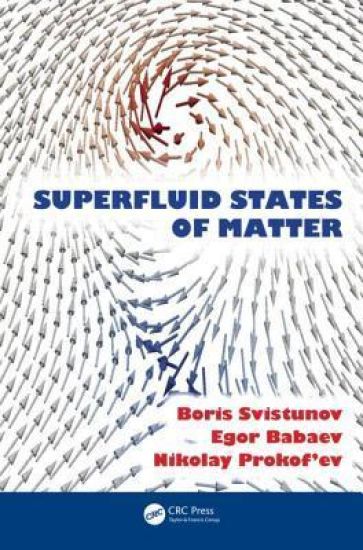
Superfluid States of Matter
Boris V. Svistunov; Egor S. Babaev; Nikolay V. Prokof'ev
CRC Press Inc
2015
sidottu
Covers the State of the Art in Superfluidity and SuperconductivitySuperfluid States of Matter addresses the phenomenon of superfluidity/superconductivity through an emergent, topologically protected constant of motion and covers topics developed over the past 20 years. The approach is based on the idea of separating universal classical-field superfluid properties of matter from the underlying system’s “quanta.” The text begins by deriving the general physical principles behind superfluidity/superconductivity within the classical-field framework and provides a deep understanding of all key aspects in terms of the dynamics and statistics of a classical-field system.It proceeds by explaining how this framework emerges in realistic quantum systems, with examples that include liquid helium, high-temperature superconductors, ultra-cold atomic bosons and fermions, and nuclear matter. The book also offers several powerful modern approaches to the subject, such as functional and path integrals.Comprised of 15 chapters, this text: Establishes the fundamental macroscopic properties of superfluids and superconductors within the paradigm of the classical matter fieldDeals with a single-component neutral matter fieldConsiders fundamentals and properties of superconductorsDescribes new physics of superfluidity and superconductivity that arises in multicomponent systemsPresents the quantum-field perspective on the conditions under which classical-field description is relevant in bosonic and fermionic systemsIntroduces the path integral formalismShows how Feynman path integrals can be efficiently simulated with the worm algorithmExplains why nonsuperfluid (insulating) ground states of regular and disordered bosons occur under appropriate conditionsExplores superfluid solids (supersolids)Discusses the rich dynamics of vortices and various aspects of superfluid turbulence at T ?0Provides account of BCS theory for the weakly interacting Fermi gasHighlights and analyzes the most crucial developments that has led to the current understanding of superfluidity and superconductivityReviews the variety of superfluid and superconducting systems available today in nature and the laboratory, as well as the states that experimental realization is currently actively pursuing
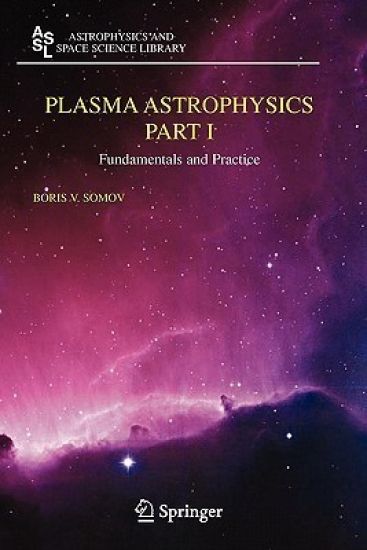
This well-illustrated monograph is devoted to classic fundamentals, current practice, and perspectives of modern plasma astrophysics. The first part of the book is unique in covering all the basic principles and practical tools required for understanding and work in plasma astrophysics. The second part represents the physics of magnetic reconnection and flares of electromagnetic origin in space plasmas in the solar system, single and double stars, relativistic objects, accretion disks, their coronae. The level of the book is designed mainly for professional researchers in astrophysics. The book will also be interesting and useful to graduate students in space sciences, geophysics, as well as to advanced students in applied physics and mathematics seeking a unified view of plasma physics and fluid mechanics.

Magnetic ?elds are easily generated in astrophysical plasma owing to its ?6 high conductivity. Magnetic ?elds, having strengths of order few 10 G, correlated on several kiloparsec scales are seen in spiral galaxies. Their origin could be due to ampli?cation of a small seed ?eld by a turbulent galactic dynamo. In several galaxies, like the famous M51, magnetic ?elds are well correlated (or anti-correlated) with the optical spiral arms. These are the weakest large-scale ?elds observed in cosmic space. The strongest magnets in space are presumably the so-called magnetars, the highly mag- 15 netized (with the strength of the ?eld of about 10 G) young neutron stars formed in the supernova explosions. The energy of magnetic ?elds is accumulated in astrophysical plasma, and the sudden release of this energy – an original electrodynamical ‘burst’ or‘explosion’–takesplaceunderde?nitebutquitegeneralconditions(P- att, 1992; Sturrock, 1994; Kivelson and Russell, 1995; Rose, 1998; Priest and Forbes, 2000; Somov, 2000; Kundt, 2001). Such a ‘?are’ in ast- physical plasma is accompanied by fast directed ejections (jets) of plasma, powerful ?ows of heat and hard electromagnetic radiation as well as by impulsive acceleration of charged particles to high energies.
This two-part book is devoted to classic fundamentals and current practices and perspectives of modern plasma astrophysics. This first part uniquely covers all the basic principles and practical tools required for understanding and work in plasma astrophysics. More than 25% of the text is updated from the first edition, including new figures, equations and entire sections on topics such as magnetic reconnection and the Grad-Shafranov equation. The book is aimed at professional researchers in astrophysics, but it will also be useful to graduate students in space sciences, geophysics, applied physics and mathematics, especially those seeking a unified view of plasma physics and fluid mechanics.
This two-part book is devoted to classic fundamentals and current practices and perspectives of modern plasma astrophysics. This second part discusses the physics of magnetic reconnection and flares of electromagnetic origin in space plasmas in the solar system, single and double stars, relativistic objects, accretion disks and their coronae. More than 25% of the text is updated from the first edition, included the additions of new figures, equations and entire sections on topics such as topological triggers for solar flares and the magnetospheric physics problem. This book is aimed at professional researchers in astrophysics, but it will also be useful to graduate students in space sciences, geophysics, applied physics and mathematics, especially those seeking a unified view of plasma physics and fluid mechanics.
This two-part book is devoted to classic fundamentals and current practices and perspectives of modern plasma astrophysics. This second part discusses the physics of magnetic reconnection and flares of electromagnetic origin in space plasmas in the solar system, single and double stars, relativistic objects, accretion disks and their coronae. More than 25% of the text is updated from the first edition, included the additions of new figures, equations and entire sections on topics such as topological triggers for solar flares and the magnetospheric physics problem. This book is aimed at professional researchers in astrophysics, but it will also be useful to graduate students in space sciences, geophysics, applied physics and mathematics, especially those seeking a unified view of plasma physics and fluid mechanics.
This two-part book is devoted to classic fundamentals and current practices and perspectives of modern plasma astrophysics. This first part uniquely covers all the basic principles and practical tools required for understanding and work in plasma astrophysics. More than 25% of the text is updated from the first edition, including new figures, equations and entire sections on topics such as magnetic reconnection and the Grad-Shafranov equation. The book is aimed at professional researchers in astrophysics, but it will also be useful to graduate students in space sciences, geophysics, applied physics and mathematics, especially those seeking a unified view of plasma physics and fluid mechanics.

Theory of Probability
Boris V. (Chair of the Probability Department Gnedenko
GORDON AND BREACH
1996
sidottu
The appearance of this English edition of my book, ?rst published in Russian in mid-2006, is related to the help and support of two prominent scientists: Professor Michael Brown (Rhodes University Grahamstown, South Africa) and Dr. Judit Simon (Budapest University of Technology and Economics, Hungary). The story is as follows. In the winter of 2006, in the process of exchange of views by email with Michael on some problems of decomposition kinetics, I asked him about the possibility of publishing my book in English. He s- gestedthatIshouldcontactJudit,theSeriesEditorof“HotTopicsinThermal Analysis and Calorimetry”. My application was kindly accepted, considered, and approved. As a result, Judit strongly recommended this book to Springer for publication, and Michael kindly agreed to help me with linguistic impro- ments of my hurriedly translated book. In the process of editing, he made some critical comments and questions, which stimulated me to improve and clarify the text, but we did have to agree to put our di?erences of scienti?c opinions aside so as not to delay the process. Without this invaluable help, this book would not be as “readable” as I hope it is now. The author uses this opportunity to express his sincere thanks to Michael and Judit for their signi?cant help and support. Although only about a year has gone after the preparation of the original edition of the book (in Russian), this English version of the manuscript has undergone considerable revision. These changes refer to Sections2. 2, 2.
This book is the sixth edition of a classic text that was first published in 1950 in the former Soviet Union. The clear presentation of the subject and extensive applications supported with real data helped establish the book as a standard for the field. To date, it has been published into more that ten languages and has gone through five editions. The sixth edition is a major revision over the fifth. It contains new material and results on the Local Limit Theorem, the Integral Law of Large Numbers, and Characteristic Functions. The new edition retains the feature of developing the subject from intuitive concepts and demonstrating techniques and theory through large numbers of examples. The author has, for the first time, included a brief history of probability and its development. Exercise problems and examples have been revised and new ones added.