Kirjojen hintavertailu. Mukana 11 244 527 kirjaa ja 12 kauppaa.

Kirjahaku

Etsi kirjoja tekijän nimen, kirjan nimen tai ISBN:n perusteella.

1000 tulosta hakusanalla Brad Inwood

Seneca: Selected Philosophical Letters

Seneca: Selected Philosophical Letters

Brad Inwood

Clarendon Press
2007
sidottu
Seneca's Letters to Lucilius are a rich source of information about ancient Stoicism, an influential work for early modern philosophers, and a fascinating philosophical document in their own right. This selection of the letters aims to include those which are of greatest philosophical interest, especially those which highlight the debates between Stoics and Platonists or Aristotelians in the first century AD, and the issue, still important today, of how technical philosophical enquiry is related to the various purposes for which philosophy is practised. In addition to examining the philosophical content of each letter, Brad Inwood's commentary discusses the literary and historical background of the letters and to their relationship with other prose works by Seneca. Seneca is the earliest Stoic author for whom we have access to a large number of complete works, and these works were highly influential in later centuries. He was also a politically influential advisor to the Roman emperor Nero and a celebrated author of prose and verse. His philosophical acuity and independence of mind make his works exciting and challenging for the modern reader. CLARENDON LATER ANCIENT PHILOSOPHERS General Editors: Jonathan Barnes and A. A. Long This series is designed to encourage philosophers and students of philosophy to explore the fertile terrain of later ancient philosophy. The texts range in date from the first century BC to the fifth century AD, and will cover all the parts and all the schools of philosophy. Each volume contains a substantial introduction, an English translation, and a critical commentary on the philosophical claims and arguments of the text. The translations aim primarily at accuracy and fidelity; but they are also readable and accompanied by notes on textual problems that affect the philosophical interpretation. No knowledge of Greek or Latin is assumed.
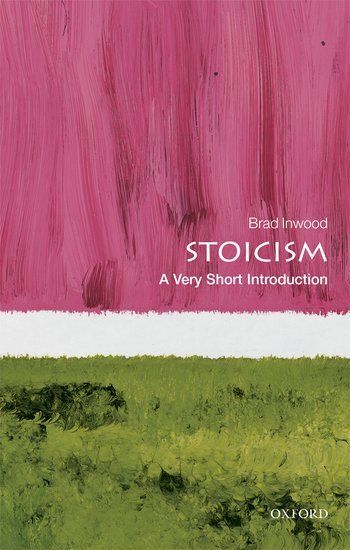
Stoicism

Stoicism

Brad Inwood

Oxford University Press
2018
nidottu
Stoicism is two things: a long past philosophical school of ancient Greece and Rome, and an enduring philosophical movement that still inspires people in the twenty-first century to re-think and re-organize their lives in order to achieve personal satisfaction. What is the connection between them? This Very Short Introduction provides an introductory account of Stoic philosophy, and tells the story of how ancient Stoicism survived and evolved into the movement we see today. Exploring the roots of the school in the philosophy of fourth century BCE Greece, Brad Inwood examines its basic history and doctrines and its relationship to the thought of Plato, Aristotle and his successors, and the Epicureans. Sketching the history of the school's reception in the western tradition, he argues that, despite the differences between ancient and contemporary Stoics, there is a common core of philosophical insight that unites the modern version not just to Seneca, Epictetus, and Marcus Aurelius but also to the school's original founders, Zeno, Cleanthes, and Chrysippus. Inwood concludes by considering the place of Stoicism in modern life. ABOUT THE SERIES: The Very Short Introductions series from Oxford University Press contains hundreds of titles in almost every subject area. These pocket-sized books are the perfect way to get ahead in a new subject quickly. Our expert authors combine facts, analysis, perspective, new ideas, and enthusiasm to make interesting and challenging topics highly readable.
Reading Seneca

Reading Seneca

Brad Inwood

Clarendon Press
2005
sidottu
Brad Inwood presents a selection of his most influential essays on the philosophy of Seneca, the Roman Stoic thinker, statesman, and tragedian of the first century AD. Including two brand-new pieces, and a helpful introduction to orient the reader, this volume will be an essential guide for anyone seeking to understand Seneca's fertile, wide-ranging thought and its impact on subsequent generations. In each of these essays Seneca is considered as a philosopher, but with as much account as possible taken of his life, his education, his intellectual and literary background, his career, and his self-presentation as an author. Seneca emerges as a discerning and well-read Stoic, with a strong inclination to think for himself in the context of an intellectual climate teeming with influences from other schools. Seneca's intellectual engagement with Platonism, Aristotelianism, and even with Epicureanism involved a wide range of substantial philosophical interests and concerns. His philosophy was indeed shaped by the fact that he was a Roman, but he was a true philosopher shaped by his culture rather than a Roman writer trying his hand at philosophical themes. The highly rhetorical character of his writing must be accounted for when reading his works, and when one does so the underlying philosophical themes stand out more clearly. While it is hard to generalize about an overall intellectual agenda or systematic philosophical method, key themes and strategies are evident. Inwood shows how Seneca's philosophical ingenium worked itself out in a fundamentally particularistic way as he pursued those aspects of Stoicism that engaged him most forcefully over his career.
Reading Seneca

Reading Seneca

Brad Inwood

Oxford University Press
2008
nidottu
Brad Inwood presents a selection of his most influential essays on the philosophy of Seneca, the Roman Stoic thinker, statesman, and tragedian of the first century AD. Including two brand-new pieces, and a helpful introduction to orient the reader, this volume will be an essential guide for anyone seeking to understand Seneca's fertile, wide-ranging thought and its impact on subsequent generations. In each of these essays Seneca is considered as a philosopher, but with as much account as possible taken of his life, his education, his intellectual and literary background, his career, and his self-presentation as an author. Seneca emerges as a discerning and well-read Stoic, with a strong inclination to think for himself in the context of an intellectual climate teeming with influences from other schools. Seneca's intellectual engagement with Platonism, Aristotelianism, and even with Epicureanism involved a wide range of substantial philosophical interests and concerns. His philosophy was indeed shaped by the fact that he was a Roman, but he was a true philosopher shaped by his culture rather than a Roman writer trying his hand at philosophical themes. The highly rhetorical character of his writing must be accounted for when reading his works, and when one does so the underlying philosophical themes stand out more clearly. While it is hard to generalize about an overall intellectual agenda or systematic philosophical method, key themes and strategies are evident. Inwood shows how Seneca's philosophical ingenium worked itself out in a fundamentally particularistic way as he pursued those aspects of Stoicism that engaged him most forcefully over his career.
Seneca: Selected Philosophical Letters

Seneca: Selected Philosophical Letters

Brad Inwood

Oxford University Press
2010
nidottu
Seneca's Letters to Lucilius are a rich source of information about ancient Stoicism, an influential work for early modern philosophers, and a fascinating philosophical document in their own right. This selection of the letters aims to include those which are of greatest philosophical interest, especially those which highlight the debates between Stoics and Platonists or Aristotelians in the first century AD, and the issue, still important today, of how technical philosophical enquiry is related to the various purposes for which philosophy is practised. In addition to examining the philosophical content of each letter, Brad Inwood's commentary discusses the literary and historical background of the letters and their relationship with other prose works by Seneca. Seneca is the earliest Stoic author for whom we have access to a large number of complete works, and these works were highly influential in later centuries. He was also a politically influential advisor to the Roman emperor Nero and a celebrated author of prose and verse. His philosophical acuity and independence of mind make his works exciting and challenging for the modern reader. CLARENDON LATER ANCIENT PHILOSOPHERS General Editors: Jonathan Barnes and A. A. Long This series is designed to encourage philosophers and students of philosophy to explore the fertile terrain of later ancient philosophy. The texts range in date from the first century BC to the fifth century AD, and will cover all the parts and all the schools of philosophy. Each volume contains a substantial introduction, an English translation, and a critical commentary on the philosophical claims and arguments of the text. The translations aim primarily at accuracy and fidelity; but they are also readable and accompanied by notes on textual problems that affect the philosophical interpretation. No knowledge of Greek or Latin is assumed.
Plato's Crito

Plato's Crito

Brad Inwood

Cambridge University Press
2026
sidottu
Many people read the Crito primarily as a companion piece to the Apology and as one of Plato's statements on the nature of politics and the citizen's relationship to the state. This book challenges both of those assumptions and shows, by close analysis of the characters, the argument and the dramatic features of the dialogue, that it is best read as an exploration of the nature and significance of Socratic moral reasoning. It shows that there is a single argument throughout the dialogue and that the 'Laws of Athens' are best understood as supporting Socrates' attempt to convince Crito that a commitment to the currently best rational argument justifies his submission to the death penalty, despite the injustice of his sentence. The importance of the Crito for later political and legal theory is great, but the reception of the dialogue should not blind us to its original intention and significance.
Ethics After Aristotle

Ethics After Aristotle

Brad Inwood

Harvard University Press
2014
sidottu
From the earliest times, philosophers and others have thought deeply about ethical questions. But it was Aristotle who founded ethics as a discipline with clear principles and well-defined boundaries. Ethics After Aristotle focuses on the reception of Aristotelian ethical thought in the Hellenistic and Roman worlds, underscoring the thinker’s enduring influence on the philosophers who followed in his footsteps from 300 BCE to 200 CE.Beginning with Aristotle’s student and collaborator Theophrastus, Brad Inwood traces the development of Aristotelian ethics up to the third-century Athenian philosopher Alexander of Aphrodisias. He shows that there was no monolithic tradition in the school, but a rich variety of moral theory. The philosophers of the Peripatetic school produced surprisingly varied theories in dialogue with other philosophical traditions, generating rich insight into human virtue and happiness. What unifies the different strands of thought—what makes them distinctively Aristotelian—is a form of ethical naturalism: that our knowledge of the good and virtuous life depends first on understanding our place in the natural world, and second on the exercise of our natural dispositions in distinctively human activities. What is now referred to as “virtue ethics,” Inwood argues, is a less important part of Aristotle’s legacy than the naturalistic approach Aristotle articulated and his philosophical descendants developed further.Offering a wide range of ways of thinking about ethics from an ancient perspective, Ethics After Aristotle is a penetrating study of how philosophy evolves in the wake of an unusually powerful and original thinker.
Stoics Reader

Stoics Reader

Brad Inwood

Hackett Publishing Co, Inc
2008
pokkari
Offers translations of a selection of the writings of the Stoics, along with relevant selections from the works of the Sceptics, an introduction, bibliography, glossary, and index.
The Stoics Reader

The Stoics Reader

Brad Inwood

Hackett Publishing Co, Inc
2008
sidottu
This volume gathers together the most important evidence about Stoic thought surviving from the ancient world. It is an expanded version of the section on Stoicism in Inwood and Gerson's Hellenistic Philosophy, consolidating related texts into larger, more continuous selections, adding material on the skeptical attack on Stoicism, and a short section that introduces the reader to some of the more interesting texts on Stoic ethics from the Roman imperial period.Inwood and Gerson provide lucid, accurate translations, an Introduction that sets the works included in historical and philosophical context, a glossary of terms, a glossary of philosophers and philosophical sources, an index of passages translated, and a subject index.
Plato's Crito

Plato's Crito

Brad Inwood

Cambridge University Press
2026
nidottu
Many people read the Crito primarily as a companion piece to the Apology and as one of Plato's statements on the nature of politics and the citizen's relationship to the state. This book challenges both of those assumptions and shows, by close analysis of the characters, the argument and the dramatic features of the dialogue, that it is best read as an exploration of the nature and significance of Socratic moral reasoning. It shows that there is a single argument throughout the dialogue and that the 'Laws of Athens' are best understood as supporting Socrates' attempt to convince Crito that a commitment to the currently best rational argument justifies his submission to the death penalty, despite the injustice of his sentence. The importance of the Crito for later political and legal theory is great, but the reception of the dialogue should not blind us to its original intention and significance.
Later Stoicism 155 BC to AD 200

Later Stoicism 155 BC to AD 200

Brad Inwood

Cambridge University Press
2022
sidottu
Most modern readers of the Stoics think first of later authors such as Seneca, Epictetus and Marcus Aurelius. Existing works like Long and Sedley's The Hellenistic Philosophers concentrate on the Stoics of the early school. This book focusses on the more influential later school, including key figures like Panaetius and Posidonius, and provides well-chosen selections from the full range of Stoic thinkers. It emphasizes their important work in logic, physics and cosmology as well as in ethics. Fresh translations and incisive commentary present a picture of Stoic thought informed by up-to-date historical research and philosophical analysis. The book will be essential for scholars and students of ancient philosophy and of Hellenistic and Roman culture.
Brad

Brad

Pepper North

Independently Published
2017
pokkari
Could two guard dogs play matchmaker between an older man and a young male nurse?Walking home from the hospital past the ornate gates of the Burmingham estate, ICU nurse Brad always stopped to talk to the ferocious guard dogs. He'd been trying to make friends with the German shepherds for months. Thorston Burmingham doesn't know what to make of the young man in scrubs. Drawn to the caring nurse, the wealthy reclusive man soon pursues Brad with single-minded determination. When Thorston forces Brad to admit his interest in living as a Little, Brad quickly learns that the strict man could be the Daddy that he has dreamed of for years.
Brad's Birthday Cake

Brad's Birthday Cake

Annette Smith; Jenny Giles; Beverley Randell

Cengage Learning Australia
2005
nidottu
Ella has been invited to her friend Brad's birthday party and she wants to bake him a cake for a present, but Brad is blind and won't be able to see the candles. What should Ella do?
Brad Thinks I'm NUTS!

Brad Thinks I'm NUTS!

Steven Ware Smith

Steven W Smith
2020
pokkari
Brad Thinks I'm NUTS Because I learned to use my PSYCHIC abilitiesLearn the truth about psychic experiences in an easy 10-minute experiment with a few friends. What if a simple change to your mindset showed you that you were subconsciously sharing information mentally with your friends? Imagine that your entire outlook on life is altered for the better when you see clear evidence that subconscious communications are real and you can do it.Author, Steven Ware Smith, is a science guy through and through. He has a Bachelor of Science degree in Aerospace Engineering from the United States Naval Academy. He flew fighter jets in the Navy and then worked as a radar engineer. He later went to law school and became a patent attorney. He obtained hundreds of patents for his clients in the field of high-tech telecommunications. He's even named as an inventor on 15 U.S. patents himself. Not only that, he grew up never having a single psychic or spiritual experience. So he became a die-hard skeptic until a friend convinced him to participate in a simple telepathy experiment that proved beyond a doubt that he and two friends communicated mentally. His world view was shattered, so for the next 24 years, he studied dozens of spirituality books and took courses in meditation, expanded consciousness, and remote viewing. He now wants to share with you the amazing things he discovered and show you how to discover them yourself.Brad Thinks I'm NUTS is designed for the curious person who has never had a psychic or spiritual experience. Don't worry-it does not cover far-out psychic topics like psychic healing, aura viewing, yoga wisdom, crystal gazing, astrology, channeling, destiny, or karma, which are difficult for most beginners to believe in. Instead, it sticks to the basic goal of showing you how to have your first psychic experience. The straightforward experiments in this book are designed to crack open the door for you the way Smith's telepathy experiment cracked open the door for him 24 years ago.In this book, you will learn about: - Details of the simple telepathy experiment that convinced the skeptical author that subconscious communications are real- Why it's reasonable to believe in subconscious communications - How to identify and clear limiting beliefs that may hold you back- The importance of creating a positive mindset before attempting any experiments- How to conduct basic experiments to demonstrate different types of psychic functioning- Scientific theories on how subconscious communication works- The wondrous universe that was opened up to the author and can be opened for you- Recommended next steps to explore expanded consciousness and develop spiritual powers beyond your wildest dreams- BONUS: A downloadable checklist for performing your own experiments Scientific studies have shown that everyone has psychic abilities. They are just a part of being human. Most people don't realize they have these abilities and don't know how to use them, but many have been trained to use them to create happier, healthier, and wealthier lives.With practice, you'll be able to recognize information coming from your subconscious mind. For many of us, this information is so subtle and so fleeting, we don't consciously perceive it. Yet it holds immense value for enabling us to live up to our full potential.You can learn the truth about the subconscious powers you never knew you had.