
Kirjahaku
Etsi kirjoja tekijän nimen, kirjan nimen tai ISBN:n perusteella.
1000 tulosta hakusanalla Brandon Joseph Park
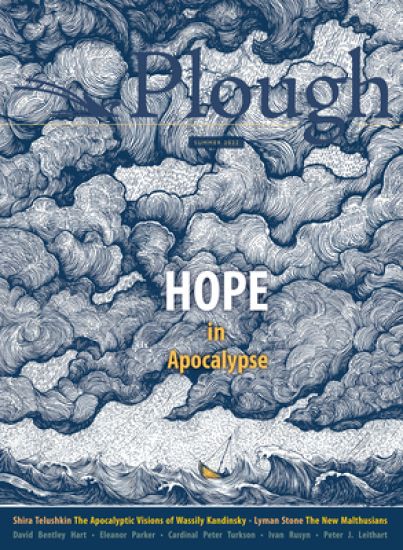
Plough Quarterly No. 32 – Hope in Apocalypse
David Bentley Hart; Mindy Belz; Peter J. Leithart; Shira Telushkin; Joseph Julián González; Peter Turkson; Eleanor Parker; Lyman Stone; Anika T. Prather; Brandon McGinley; Joel Clarkson
PLOUGH PUBLISHING HOUSE
2022
pokkari
In times that feel apocalyptic, where do we place our hope? It's an apocalyptic moment. The grim effects of climate change have left many people in despair. Young people often cite climate fears as a reason they are not having children. Then there’s the threat of nuclear war, again in the cards, which could make climate worries a moot point. The paradoxical answer ancient Judaism gave to such despair was a promise: the promise of doomsday, the “Day of the Lord” when God will visit his people and establish lasting justice and peace. Judgment, according to the Hebrew prophets, will be followed by renewal – for the faithful, and perhaps even for the entire cosmos. Over the centuries since, this hopeful vision of apocalypse has carried many others through moments of crisis and catastrophe. Might it do the same for us?On this theme: creation is transformed and made new.That’s what the “end of the age” meant to Jesus and his early - Peter J. Leithart says when old worlds die, we need something sturdier than the myth of progress. - Brandon McGinley says you can’t protect your kids from tragedy. - Cardinal Peter Turkson points to the spiritual roots of the climate crisis. - David Bentley Hart says disruption, not dogma, is Christianity’s grounds for hope. - Hanna-Barbara Gerl-Falkovitz reminds us that the Book of Revelation ends well. - Lyman Stone argues that those who claim that having children threatens the environment are wrong. - Eleanor Parker recounts how, amid Viking terror, one Anglo-Saxon bishop held a kingdom together. - Shira Telushkin describes how artist Wassily Kandinsky forged a path from the material to the spiritual. - Anika T. Prather learned to let her children grieve during the pandemic.Also in the issue: - Ukrainian pastor Ivan Rusyn describes ministering in wartime Bucha and Kyiv. - Mindy Belz reports on farmers who held out in Syria despite ISIS. - New poems by winners of the 2022 Rhina Espaillat Poetry Award - A profile of newly sainted Charles de Foucauld - Reviews of Elena Ferrante’s In the Margins, Abigail Favale’s The Genesis of Gender, and Emily St. John Mandel’s Sea of Tranquility - Readers’ forum, comics, and morePlough Quarterly features stories, ideas, and culture for people eager to apply their faith to the challenges we face. Each issue includes in-depth articles, interviews, poetry, book reviews, and art.

100 Year Tribute to First Baptist Church Brandon, Florida
Rear Admiral Joseph H Miller
WestBow Press
2016
pokkari

Some Thoughts on Judaism. Two Lectures Delivered May, 1879, Before the Y. M. H. A., San Francisco
Joseph R. Brandon
Outlook Verlag
2024
nidottu
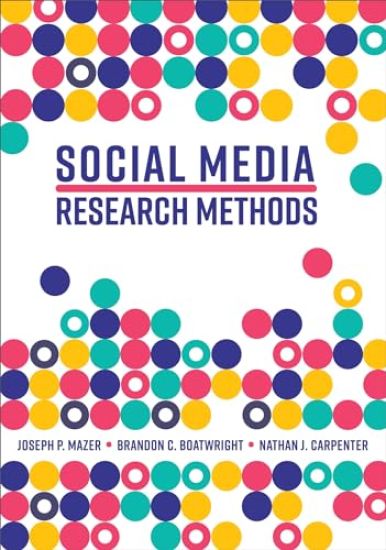
Social Media Research Methods
Joseph P. Mazer; Brandon C. Boatwright; Nathan J. Carpenter
Cognella, Inc
2023
pokkari
Filling a gap in the literature and featuring an emphasis on using new media in communication research, Social Media Research Methods introduces students to a variety of social media research methods and data analysis strategies. The text recognizes the richness of the data available within social media platforms and underscores the importance of employing effective research methods to make meaning of that data.By integrating applied concepts, theories, and practical advice for working with and presenting social media data, the textbook arms students with the latest research and social media tools. It begins by introducing students to scholarly and industry applications of social media research methods before outlining the complete process of developing social media research questions and data collection procedures. The book then transitions to devoting individual chapters to a social media analysis tool. The final chapter outlines the process of writing and presenting social media research for scholarly and industry audiences. Each chapter features interactive, applied examples and exercises, as well as review questions, to bring the material to life and reinforce key learnings.A comprehensive resource designed to help students use cutting-edge, timely research methods within the discipline, Social Media Research Methods is an exemplary textbook for courses in communication research methods.
Social Media Research Methods
Joseph P Mazer; Nathan J Carpenter; Brandon C Boatwright
Cognella Academic Publishing
2023
sidottu
Filling a gap in the literature and featuring an emphasis on using new media in communication research, Social Media Research Methods introduces students to a variety of social media research methods and data analysis strategies. The text recognizes the richness of the data available within social media platforms and underscores the importance of employing effective research methods to make meaning of that data. By integrating applied concepts, theories, and practical advice for working with and presenting social media data, the textbook arms students with the latest research and social media tools. It begins by introducing students to scholarly and industry applications of social media research methods before outlining the complete process of developing social media research questions and data collection procedures. The book then transitions to devoting individual chapters to a social media analysis tool. The final chapter outlines the process of writing and presenting social media research for scholarly and industry audiences. Each chapter features interactive, applied examples and exercises, as well as review questions, to bring the material to life and reinforce key learnings. A comprehensive resource designed to help students use cutting-edge, timely research methods within the discipline, Social Media Research Methods is an exemplary textbook for courses in communication research methods.
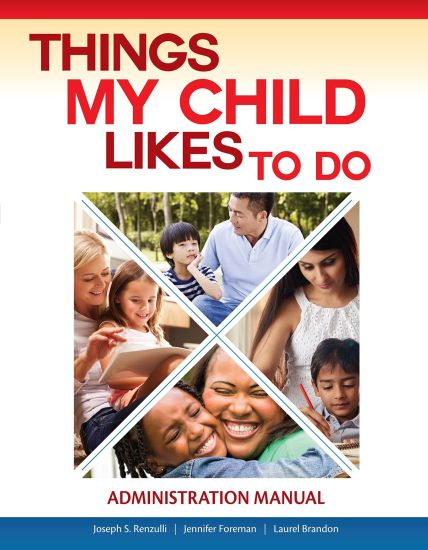
Things My Child Likes to Do Administration Manual
Joseph Renzulli; Jennifer Foreman; Laurel Brandon
TAYLOR FRANCIS INC
2017
nidottu
Things My Child Likes to Do enables educational decision-makers to collect information on children's social, emotional, motivational, and creative abilities from the perspective of those who know them best: their parents or guardians. These scales can be used as one component of a multiple measures identification system for gifted, talented, or enrichment programming or to collect information on students' readiness, interests, and learning profiles. The scales have been subjected to content and construct validation to provide clear, accurate, and informative data regarding student characteristics. The Administration Manual provides information on the new rating scale's validity and advice on administering the scale.
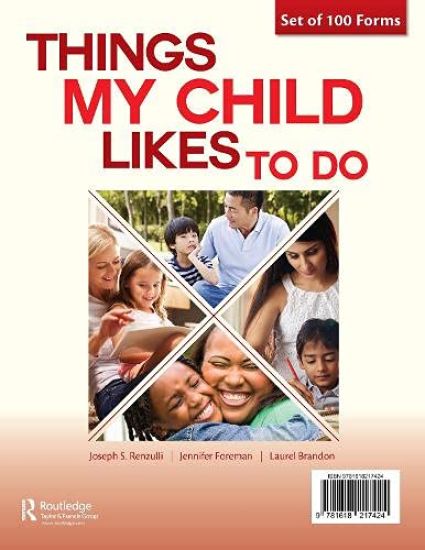
Things My Child Likes to Do Forms
Joseph Renzulli; Jennifer Foreman; Laurel Brandon
TAYLOR FRANCIS INC
2017
irtolehti
Things My Child Likes to Do enables educational decision-makers to collect information on children's social, emotional, motivational, and creative abilities from the perspective of those who know them best: their parents or guardians. These scales can be used as one component of a multiple measures identification system for gifted, talented, or enrichment programming or to collect information on students' readiness, interests, and learning profiles. The scales have been subjected to content and construct validation to provide clear, accurate, and informative data regarding student characteristics. Includes 100 sets of 4-page booklets containing the Things My Child Likes to Do scale for administration purposes.
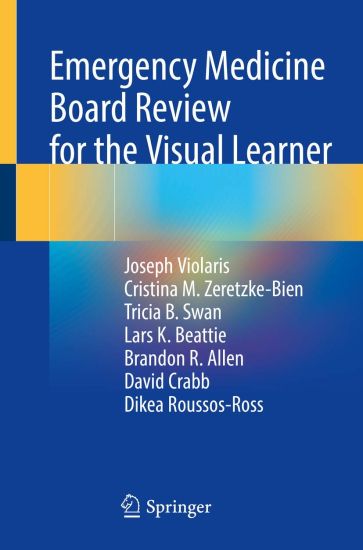
Emergency Medicine Board Review for the Visual Learner
Joseph J. Violaris; Cristina M. Zeretzke-Bien; Tricia B. Swan; Lars K. Beattie; Brandon R. Allen; David Crabb; Dikea Roussos-Ross
Springer Nature Switzerland AG
2021
nidottu
This state-of-the-art book provides a concise and up-to-date review of key emergency medicine topics in a predominantly visual format along with extensive practice questions to assist in preparing for the emergency medicine board exams. It is comprised of numerous illustrations, created by Dr. Joseph Violaris, which are specifically tailored toward the visual learner studying and preparing for board exams in emergency medicine. The book is organized by organ system, with chapters on ophthalmology, cardiology, pulmonology, gastroenterology, nephrology, orthopedics, immunology, and more. Special chapters that conclude the book are dedicated to trauma, pediatrics, toxicology, environmental disorders, and epidemiology. Each chapter contains a visual learning guide followed by board practice questions at the end to reinforce topics addressed in the illustrations. Emergency Medicine Board Review for the Visual Learner is an essential guide for medicalstudents, residents, and fellows in emergency and internal medicine studying for board exams as well as EM physicians and related professionals preparing for recertification.
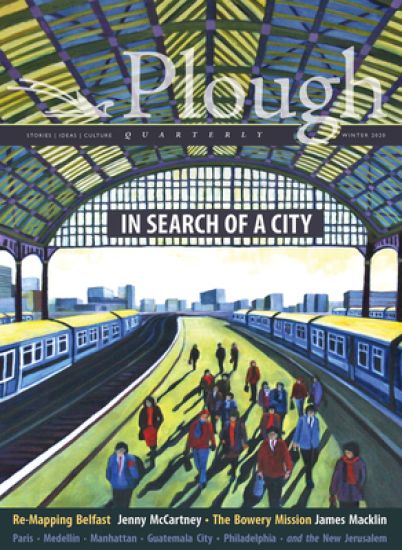
Plough Quarterly No. 23 - In Search of a City
Jenny McCartney; Adriano Cirino; Clare Coffey; Joseph Bottum; Brandon McGinley; N.T. Wright; José Corpas; John Thornton; Jane Jacobs; Julian Peters; Eberhard Arnold
Plough Publishing House
2019
pokkari
The future of humanity is urban. It might seem a bad move for a magazine named after a farm tool to bring out an issue on cities. Especially if that magazine is published by an Anabaptist community that originated in a back-to-the-land movement and still has the whiff of hayfield and woodlot to it. Why not stick to what you’re good at? Why jump lanes? Because the future of humanity, pretty clearly, is urban. Urbanization is arguably the biggest change of habitat our species has ever undergone. For anyone who cares about the common good of humanity, then, cities need to matter. The modern city is an electrifying concentration of creativity, energy, and cultural dynamism. It’s also still the “cauldron of unholy loves” that Saint Augustine discovered in Carthage one and a half millennia ago. It’s the place where the cruelties of mammon, the hubris of power, and the perversions of lust manifest themselves most crassly. But cities have also given birth to culture and community and to remarkable movements of revival and renewal. In this issue, visit: - Belfast with Jenny McCartney - New York City with James Macklin - Medellín with Adriano Cirino - Pittsburgh with Brandon McGinley - Guatemala City with José Corpas - Philadelphia with Clare Coffey - Chicago with John Thornton Jr. - Paris with Jason Landsel You’ll also find: - Insights on cities from Jane Jacobs, Eberhard Arnold, Augustine, and Philip Britts - reviews of books by Jonathan Foiles, Bethany McKinney Fox, J. Malcolm Garcia, Tatiana Schlossberg, Tim Gautreaux, Philip Bess, and Frederic Morton - art by Gail Brodholt, Michelangelo Buonarroti, Ben Ibebe, Brian Peterson, Chota, Raphael, Gertrude Hermes, Valentino Belloni, Tony Taj, and Aristarkh Lentulov Plough Quarterly features stories, ideas, and culture for people eager to put their faith into action. Each issue brings you in-depth articles, interviews, poetry, book reviews, and art to help you put Jesus’ message into practice and find common cause with others.

Assessing the Association Between Airmen Participation in Force Support Squadron Programs and Unit Cohesion
Stephanie Brooks Holliday; Sarah O Meadows; Stephani L Wrabel; Laura Werber; Christopher Joseph Doss; Wing Yi Chan; Lu Dong; Brandon Crosby
RAND Corporation
2022
pokkari
The UNITE Initiative aims to promote readiness and resilience in the Air Force through events that focus on unit cohesion. The authors describe the results of their evaluation of UNITE and the program's association with unit cohesion, drawing on interviews with UNITE representatives and post-event surveys completed by airmen participants.
Experimentations provides a detailed historical and theoretical analysis of the first three decades of experimental composer John Cage’s aesthetic production (ca. 1940-1972). Paying particular attention to Cage’s inter- and cross-disciplinary engagements with the visual arts and architecture during this period, the book sheds new light on some of Cage’s most controversial and influential innovations, such as the use of noise, chance techniques, indeterminacy, electronic technologies, and computerization, as well as upon lesser known but important ideas and strategies such as transparency, multiplicity, virtuality, and actualization. Ultimately, it traces the development of Cage’s avant-garde aesthetic and political project as it transformed from the emulation of historical avant-garde precedents such as futurism and the Bauhaus, to the development of important precedents for the post-World War II movements of happenings and Fluxus, to its ultimate abandonment in the aftermath of problems encountered in the vast, multimedia composition HPSCHD (1967-69).
Experimentations provides a detailed historical and theoretical analysis of the first three decades of experimental composer John Cage’s aesthetic production (ca. 1940-1972). Paying particular attention to Cage’s inter- and cross-disciplinary engagements with the visual arts and architecture during this period, the book sheds new light on some of Cage’s most controversial and influential innovations, such as the use of noise, chance techniques, indeterminacy, electronic technologies, and computerization, as well as upon lesser known but important ideas and strategies such as transparency, multiplicity, virtuality, and actualization. Ultimately, it traces the development of Cage’s avant-garde aesthetic and political project as it transformed from the emulation of historical avant-garde precedents such as futurism and the Bauhaus, to the development of important precedents for the post-World War II movements of happenings and Fluxus, to its ultimate abandonment in the aftermath of problems encountered in the vast, multimedia composition HPSCHD (1967-69).

The world economy today is at an historical inflection point. The neoclassical (industrial) model of economics is self-destructing while a new life-mimicking model, based on radically different assumptions, is emerging. Although rarely acknowledged in economic journals, Nordic countries, which pioneered the life-mimicking model, have become world leaders in prosperity and productivity while those operating on the older neoclassical/industrial model are trapped in downward spirals. By approaching economies as sub-systems of life rather than super-systems that transcend life, we gain transformative insights. Such thinking led to the first circular economy experiments in Kalundborg (Denmark) during the 1970s, then quickly spread to the rest of the Nordic world. By placing a higher value on living assets (people and Nature) than on non-living capital assets, this approach generates harmony rather than exploitation and conflict. Because Nordic people feel vested in the system and responsible for its success, they are extraordinarily innovative and productive. That is why Nordic companies are regularly rated among the world’s most sustainable and profitable in their fields – even though their region holds less than half of one percent of the world’s population.Written in an accessible way for non-economists, the book is ideal for readers interested in the benefits of biomimicry and methods of guiding democratic countries along a proven path of self-renewal. Economies That Mimic Life will also provide useful background for corporate leaders in scenario planning and strategic thinking. Knowing which way the political-economic wind is blowing will become increasingly important to corporate survival.

The world economy today is at an historical inflection point. The neoclassical (industrial) model of economics is self-destructing while a new life-mimicking model, based on radically different assumptions, is emerging. Although rarely acknowledged in economic journals, Nordic countries, which pioneered the life-mimicking model, have become world leaders in prosperity and productivity while those operating on the older neoclassical/industrial model are trapped in downward spirals. By approaching economies as sub-systems of life rather than super-systems that transcend life, we gain transformative insights. Such thinking led to the first circular economy experiments in Kalundborg (Denmark) during the 1970s, then quickly spread to the rest of the Nordic world. By placing a higher value on living assets (people and Nature) than on non-living capital assets, this approach generates harmony rather than exploitation and conflict. Because Nordic people feel vested in the system and responsible for its success, they are extraordinarily innovative and productive. That is why Nordic companies are regularly rated among the world’s most sustainable and profitable in their fields – even though their region holds less than half of one percent of the world’s population.Written in an accessible way for non-economists, the book is ideal for readers interested in the benefits of biomimicry and methods of guiding democratic countries along a proven path of self-renewal. Economies That Mimic Life will also provide useful background for corporate leaders in scenario planning and strategic thinking. Knowing which way the political-economic wind is blowing will become increasingly important to corporate survival.