Kirjojen hintavertailu. Mukana 12 390 323 kirjaa ja 12 kauppaa.

Kirjahaku

Etsi kirjoja tekijän nimen, kirjan nimen tai ISBN:n perusteella.

1000 tulosta hakusanalla Brooke-Rose Christine

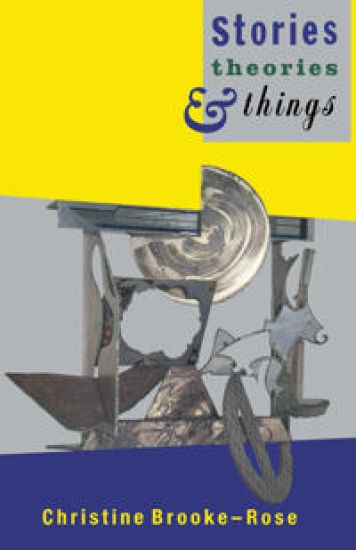
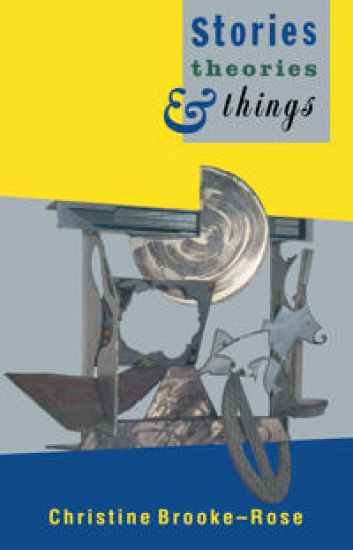
Stories, Theories and Things

Stories, Theories and Things

Brooke-Rose Christine

Cambridge University Press
2009
pokkari
The novelist and critic Christine Brooke-Rose reflects on her own fictional craft and turns her well-developed analytic abilities on other writers fictional and critical, from Hawthorne to Pound to Bloom and Derrida, in an attempt to investigate those difficult border zones between the 'invented' and the 'real'. The result is an extended meditation in a highly personal idiom, on the creative act and its relation to modern theoretical writing and thinking. Like her fiction, Professor Brooke-Rose's criticism is self-consciously experimental, trying out and discarding ideas, adopting others. Her linguistic prowess, her uncommon role as a recognised writer of fiction and theory and the relevance of her work to the feminist and other other movements, all contribute to the interest of this unusual sequence of essays.
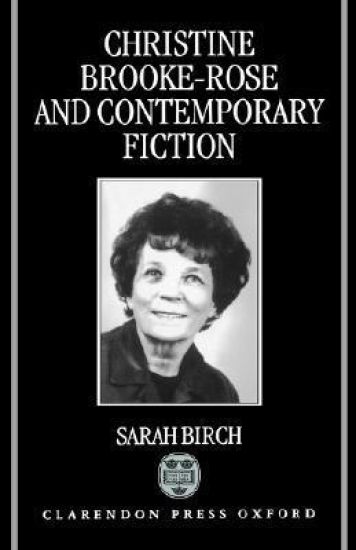
Christine Brooke-Rose and Contemporary Fiction
This is the first full-length study of the fiction of Christine Brooke-Rose, one of the most innovative and yet critically neglected of contemporary British writers. Setting her work firmly in the context of English and French writing and literary and feminist theory, Sarah Birch examines the full range of Brooke-Rose's fiction: the early realist novels published between 1957-1961; the strongly anti-realist period beginning with Out (1964), when Brooke-Rose's work was seen to be heavily influenced by French experimental fiction; and the third phase of her development which began with Xorandor (1986) and which marks a questioning return to the traditional techniques of the novel. Sarah Brich asks why a novelist who has been so highly praised by critics is nevertheless excluded from the contemporary canon, and argues that Brooke-Rose's position on the borders of European and British cultures raises key questions concenring the notion of a `national' tradition and of literary post-modernism. For Birch, Brooke-Rose's work is best understood as a poetic and playful questioning of categories in general, be they discursive or cultural. Drawing on a detailed knowledge of literary theory, this is a major study of an important but critically neglected novelist and a perceptive analysis of the position of contemporary experimental writers.
Christine Brooke-Rose and Post-War Literature

Christine Brooke-Rose and Post-War Literature

Joseph Darlington

Springer Nature Switzerland AG
2021
sidottu
This book utilizes archive research, interviews and historical analysis to present a comprehensive overview of the works of Christine Brooke-Rose. A writer well-known for her idiosyncratic and experimental approaches to the novel form; this work traces her development from her early years as a social satirist, through her space-aged experimentalism in the 1960s, to her later poststructuralism and interest in digital computing and genetics. The book gives an overview of her writing and intellectual career with new archival research that places Brooke-Rose’s work in the context of the historically important events in which she was a participant: Bletchley Park codebreaking in the Second World War, the events in Paris during May 1968, the dawning of the internet and the rise of poststructuralism. Joseph Darlington begins with Brooke-Rose’s first novels written in the late 1950s of social satire, studies her experimental phase of writing and finally illuminates her unique approach to autobiography, arguing for reevaluating this interdisciplinary author and her contribution to poststructuralism, life writing and post-war literature.
Christine Brooke-Rose and Post-War Literature

Christine Brooke-Rose and Post-War Literature

Joseph Darlington

Springer Nature Switzerland AG
2022
nidottu
This book utilizes archive research, interviews and historical analysis to present a comprehensive overview of the works of Christine Brooke-Rose. A writer well-known for her idiosyncratic and experimental approaches to the novel form; this work traces her development from her early years as a social satirist, through her space-aged experimentalism in the 1960s, to her later poststructuralism and interest in digital computing and genetics. The book gives an overview of her writing and intellectual career with new archival research that places Brooke-Rose’s work in the context of the historically important events in which she was a participant: Bletchley Park codebreaking in the Second World War, the events in Paris during May 1968, the dawning of the internet and the rise of poststructuralism. Joseph Darlington begins with Brooke-Rose’s first novels written in the late 1950s of social satire, studies her experimental phase of writing and finally illuminates her unique approach to autobiography, arguing for reevaluating this interdisciplinary author and her contribution to poststructuralism, life writing and post-war literature.
Brooke-Rose Omnibus

Brooke-Rose Omnibus

Christine Brooke-Rose

Carcanet Press Ltd
2006
nidottu
"The Brooke-Rose Omnibus" brings together four unexpected novels: "Out", a science-fiction vision of a world surviving catastrophe; "Such", in which a three-minute heart massage is developed into a poetic and funny narrative; "Between", a glittering experience of the multiplicity of language; and "Thru", a novel in which text and typography assume a life of their own. Linking them all is wit, inventiveness and the sharply focused intelligence of Christine Brooke-Rose, a great European humanist writer.
A Rhetoric of the Unreal

A Rhetoric of the Unreal

Christine Brooke-Rose

Cambridge University Press
1983
pokkari
This 1981 book is a study of wide range of fiction, from short stories to tales of horror, from fairy-tales and romances to science fiction, to which the rather loose term 'fantastic' has been applied. Cutting across this wide field, Professor Brooke-Rose examines in a clear and precise way the essential differences between these types of narrative against the background of realistic fiction. In doing so, she employs many of the methods of modern literary theory from Russian formalism to structuralism, while at the same time bringing to these approaches a sharp critical intuition and sound common sense of her own. The range of texts considered is broad: from Poe and James to Tolkien; from Flann O'Brien to the American postmodernism. This book should prove a source of stimulation to all teachers and students of modern literary theory and genre, as well as those interested in 'fantastic' literature.
Stories, Theories and Things

Stories, Theories and Things

Christine Brooke-Rose

Cambridge University Press
1991
sidottu
The novelist and critic Christine Brooke-Rose reflects on her own fictional craft and turns her well-developed analytic abilities on other writers fictional and critical, from Hawthorne to Pound to Bloom and Derrida, in an attempt to investigate those difficult border zones between the 'invented' and the 'real'. The result is an extended meditation in a highly personal idiom, on the creative act and its relation to modern theoretical writing and thinking. Like her fiction, Professor Brooke-Rose's criticism is self-consciously experimental, trying out and discarding ideas, adopting others. Her linguistic prowess, her uncommon role as a recognised writer of fiction and theory and the relevance of her work to the feminist and other other movements, all contribute to the interest of this unusual sequence of essays.
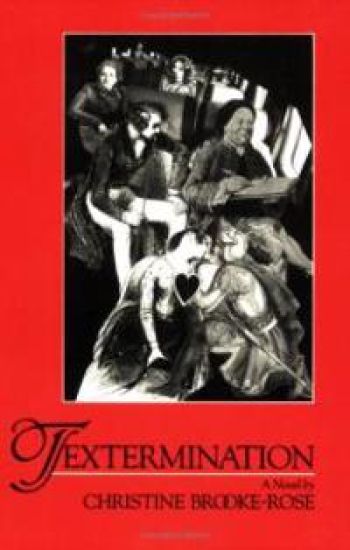
Textermination

Textermination

Christine Brooke-Rose

NEW DIRECTIONS PUBLISHING CORPORATION
1992
nidottu
In Textermination, the eminent British novelist/critic Christine Brooke-Rose pulls a wide array of characters out of the great works of literature and drops them into the middle of the San Francisco Hilton. Emma Bovary, Emma Woodhouse, Captain Ahab, Odysseus, Huck Finn... all are gathered to meet, to discuss, to pray for their continued existence in the mind of the modern reader. But what begins as a grand enterprise erupts into total pandemonium: with characters from different times, places, and genres all battling for respect and asserting their own hard-won fame and reputations. Dealing with such topical literary issues as deconstruction, multiculturalism, and the Salman Rushdie affair, this wild and humorous satire pokes fun at the academy and ultimately brings into question the value of determining a literary canon at all.
Textermination

Textermination

Christine Brooke-Rose

NEW DIRECTIONS PUBLISHING CORPORATION
1992
sidottu
In Textermination, the eminent British novelist/critic Christine Brooke-Rose pulls a wide array of characters out of the great works of literature and drops them into the middle of the San Francisco Hilton. Emma Bovary, Emma Woodhouse, Captain Ahab, Odysseus, Huck Finn... all are gathered to meet, to discuss, to pray for their continued existence in the mind of the modern reader. But what begins as a grand enterprise erupts into total pandemonium: with characters from different times, places, and genres all battling for respect and asserting their own hard-won fame and reputations. Dealing with such topical literary issues as deconstruction, multiculturalism, and the Salman Rushdie affair, this wild and humorous satire pokes fun at the academy and ultimately brings into question the value of determining a literary canon at all.
Life, End of

Life, End of

Christine Brooke-Rose

Carcanet Press Ltd
2006
nidottu
She is eighty. Facing death, she becomes 'a cruising mind', lost in sequences of unabstract comic detail, in - as the title implies - a kind of index, rigid, arbitrary, pointing backwards into the lived text. The head top leans against the bathroom mirror so that the looking glass becomes a feeling glass. She is getting worse day by day, and yet she goes on, deeper into meaning, into non-meaning, with a kind of wry eagerness. She is not disappointed with her life. In order to distract herself, to place herself, she attends to what the media say about the world as if what they say was actually the world. She reflects on her own career, on her experiments with narrative, and on the narrative she is writing here: therapy, fun, but anything else, anything more? What is its purpose, and what the purpose of the life that lives it in the writing? She discovers how, as in fiction, as in any form of experiment, the difficulty for the handicapped is less the handicap than other people, and they too have their lives and handicaps. She becomes like them, she becomes one of them, an other person.Reasserting herself, at the centre of the book, in a mock-technical lecture from a character to an author who is not interested, she comes to accept that her experiments in narrative are like pain-killers, and that they no longer matter, like life.