

Kirjahaku
Etsi kirjoja tekijän nimen, kirjan nimen tai ISBN:n perusteella.
1000 tulosta hakusanalla Bruce C Thornton

Analytic And Combinatorial Number Theory: The Legacy Of Ramanujan - Contributions In Honor Of Bruce C. Berndt
WORLD SCIENTIFIC PUBLISHING CO PTE LTD
2024
sidottu
This volume reflects the contributions stemming from the conference Analytic and Combinatorial Number Theory: The Legacy of Ramanujan which took place at the University of Illinois at Urbana-Champaign on June 6-9, 2019. The conference included 26 plenary talks, 71 contributed talks, and 170 participants. As was the case for the conference, this book is in honor of Bruce C Berndt and in celebration of his mathematics and his 80th birthday.Along with a number of papers previously appearing in Special Issues of the International Journal of Number Theory, the book collects together a few more papers, a biography of Bruce by Atul Dixit and Ae Ja Yee, a preface by George Andrews, a gallery of photos from the conference, a number of speeches from the conference banquet, the conference poster, a list of Bruce's publications at the time this volume was created, and a list of the talks from the conference.
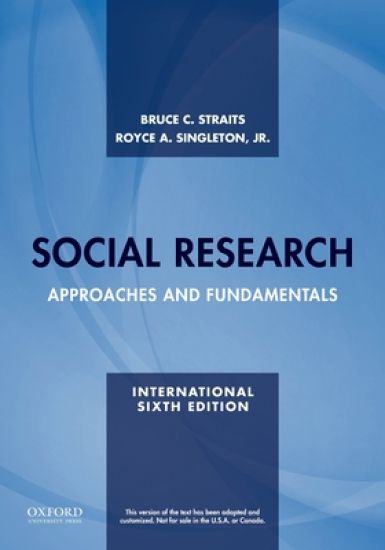
Revised and updated in its sixth edition, Social Research: Approachs and Fundamentals is a rigorous yet clear and engaging introduction to research methods. Covering all of the fundamentals in a straightforward, student-friendly manner, it is ideal for undergraduate- and graduate-level courses across the social sciences and also serves as an indispensable guide for researchers. Striking a balance between specific techniques and the underlying logic of scientific inquiry, this book provides a lucid treatment of the four major approaches to research: experimentation, survey research, field research, and the use of available data. Richly developed examples of empirical research and an emphasis on the research process enable students to better understand the real-world application of research methods. The authors also offer a unique chapter (13) advocating a multiple-methods strategy.

The Aqueous Chemistry of Oxides
Bruce C. Bunker; William H. Casey
Oxford University Press Inc
2016
sidottu
The Aqueous Chemistry of Oxides is a single-volume text that encapsulates all of the critical issues associated with how oxide materials interact with aqueous solutions. It serves as a central reference for academics working with oxides in the contexts of geology, various types of inorganic chemistry, and materials science. The text also has utility for professionals working with industrial applications in which oxides are either prepared or must perform in aqueous environments. The volume is organized into five key sections. Part One features two introductory chapters, intended to introduce the mutual interests of engineers, chemists, geologists, and industrial scientists in the physical and chemical properties of oxide materials. Part Two provides the essential and fundamental principles that are critical to understanding most of the major reactions between water and oxides. Part Three deals with the synthesis of oxide materials in aqueous media. Part Four deals with oxide-water reactions and their environmental and technological impacts, and Part Five is devoted to other types of relevant reactions. The Aqueous Chemistry of Oxides is the first book that provides a comprehensive summary of all of the critical reactions between oxides and water in a single volume. As such, it ties together a wide range of existing books and literature into a central location that provides a key reference for understanding and accessing a broad range of more specialized topics. The book contain over 300 figures and tables.

What was it like to experience World War II in small-town America? Here is the story of the war at home as it unfolded in one small town, New Castle, Indiana. We see through the eyes of the residents of Plum Street as families search for information about the progress of the war and the fate of loved ones in the censored accounts in local newspapers. We overhear everyday conversation up and down the street, in which the dominant subject is the news from overseas. The war finds its way into letters and diaries, which also record private fears and hopes, rumors and town gossip, and the wonderfully mundane events of everyday life.

'It is rare for a book to be both erudite and amusing at the same time, and this book has succeeded. It has changed the common but unacceptable image of the Puritans as dull, solemn, melancholy misanthropes' - Horton Davies, author of The Worship of the American Puritans For over four centuries, 'puritan' has been a synonym for dour, joyless, and repressed. In Puritans at Play, Bruce Daniels reappraises the accuracy of this grim portrait by examining leisure and recreation in colonial and revolutionary New England. Chapters on music, dinner parties, dancing, sex, alcohol, taverns, and sports are presented in a lively style making this book as entertaining as it is illuminating.
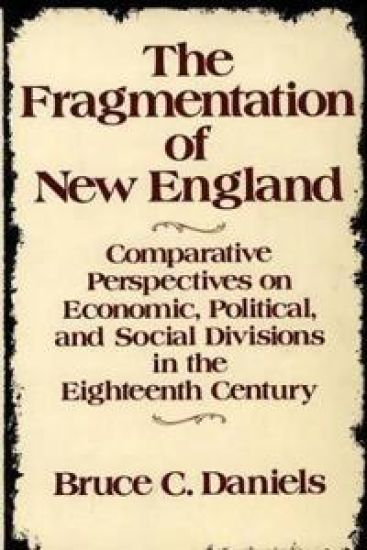
A readable and wide-ranging contribution to the social history of New England, this volume treats subjects as diverse as economic growth, wealth distribution, poor relief, local government, office-holding, leadership, urban development, and historiography. Each essay takes a comparative approach to its subject, identifying general patterns within New England society as well as significant regional, typological, and idiosyncratic variations and changes that occurred over the course of the eighteenth century. Collectively, the work creates a picture of an increasingly heterogeneous society fragmenting into competing economic, political, and social groups.Although largely quantitative in approach, the book is written to be accessible both to undergraduates just beginning their study of social history and experienced researchers who seek a deeper understanding of particular aspects of New England's history. As such, it will be an ideal supplemental text for courses on American history, colonial history, and social, community, or New England history.
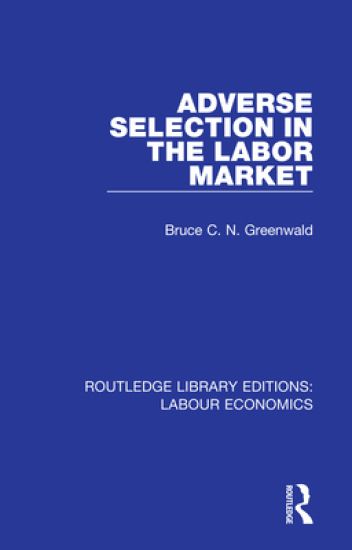
First published in 1979. This thesis describes the theoretical impact on labour markets of a process of adverse selection similar to that described in outline by George Arthur Akerlof. It concerns the information conveyed to potential employers by the fact that any new worker, except for one just entering the labour force, has either left or is prepared to leave his latest Job. If an employer is able to identify his good workers more accurately than the market at large and is generally successful in retaining them, then the group of workers leaving him will contain a disproportionately small number of good ones. For similar reasons this pool should also contain an unusually large number of bad workers who have been either flied or induced to quit. Thus, workers who change jobs should on average be less able ones. Since the market failures that result have potentially significant consequences in the labour market, this study is devoted to examining their influence on the structure of wages and job tenure, and on the operation and efficiency of labour markets. This title will be of great interest to students of economics and business studies.
First published in 1979. This thesis describes the theoretical impact on labour markets of a process of adverse selection similar to that described in outline by George Arthur Akerlof. It concerns the information conveyed to potential employers by the fact that any new worker, except for one just entering the labour force, has either left or is prepared to leave his latest Job. If an employer is able to identify his good workers more accurately than the market at large and is generally successful in retaining them, then the group of workers leaving him will contain a disproportionately small number of good ones. For similar reasons this pool should also contain an unusually large number of bad workers who have been either flied or induced to quit. Thus, workers who change jobs should on average be less able ones. Since the market failures that result have potentially significant consequences in the labour market, this study is devoted to examining their influence on the structure of wages and job tenure, and on the operation and efficiency of labour markets. This title will be of great interest to students of economics and business studies.
During the years 1903-1914, Ramanujan worked in almost complete isolation in India. During this time, he recorded most of his mathematical discoveries without proofs in notebooks. Although many of his results were already found in the literature, most were not. Almost a decade after Ramanujan's death in 1920, G.N. Watson and B.M. Wilson began to edit Ramanujan's notebooks, but they never completed the task. A photostat edition, with no editing, was published by the Tata Institute of Fundamental Research in Bombay in 1957. This book is the fourth of five volumes devoted to the editing of Ramanujan's notebooks. Parts I, II, and III, published in 1985, 1989, and 1991, contain accounts of Chapters 1-21 in Ramanujan's second notebook as well as a description of his quarterly reports. This is the first of two volumes devoted to proving the results found in the unorganized portions of the second notebook and in the third notebook. The author also proves those results in the first notebook that are not found in the second or third notebooks. For those results that are known, references in the literature are provided. Otherwise, complete proofs are given. Over 1/2 of the results in the notebooks are new. Many of them are so startling and different that there are no results akin to them in the literature.
During the years 1903-1914, Ramanujan recorded most of his mathematical dis coveries without proofs in notebooks. Although many of his results had already been published by others, most had not. Almost a decade after Ramanujan's death in 1920, G. N. Watson and B. M. Wilson began to edit Ramanujan's notebooks, but, despite devoting over ten years to this project, they never completed their task. An unedited photostat edition of the notebooks was published by the Tata Institute of Fundamental Research in Bombay in 1957. This book is the fifth and final volume devoted to the editing of Ramanujan's notebooks. Parts I-III, published, respectively, in 1985, 1989, and 1991, contain accounts of Chapters 1-21 in the second notebook, a revised enlarged edition of the first. Part IV, published in 1994, contains results from the 100 unorganized pages in the second notebook and the 33 unorganized pages comprising the third notebook. Also examined in Part IV are the 16 organized chapters in the first notebook, which contain very little that is not found in the second notebook. In this fifth volume, we examine the remaining contents from the 133 unorganized pages in the second and third notebooks, and the claims in the 198 unorganized pages of the first notebook that cannot be found in the succeeding notebooks.
Srinivasa Ramanujan is, arguably, the greatest mathematician that India has produced. His story is quite unusual: although he had no formal education inmathematics, he taught himself, and managed to produce many important new results. With the support of the English number theorist G. H. Hardy, Ramanujan received a scholarship to go to England and study mathematics. He died very young, at the age of 32, leaving behind three notebooks containing almost 3000 theorems, virtually all without proof. G. H. Hardy and others strongly urged that notebooks be edited and published, and the result is this series of books. This volume dealswith Chapters 1-9 of Book II; each theorem is either proved, or a reference to a proof is given.
During the years 1903-1914, Ramanujan recorded many of his mathematical discoveries in notebooks without providing proofs. Although many of his results were already in the literature, more were not. Almost a decade after Ramanujan's death in 1920, G.N. Watson and B.M. Wilson began to edit his notebooks but never completed the task. A photostat edition, with no editing, was published by the Tata Institute of Fundamental Research in Bombay in 1957. This book is the second of four volumes devoted to the editing of Ramanujan's Notebooks. Part I, published in 1985, contains an account of Chapters 1-9 in the second notebook as well as a description of Ramanujan's quarterly reports. In this volume, we examine Chapters 10-15 in Ramanujan's second notebook. If a result is known, we provide references in the literature where proofs may be found; if a result is not known, we attempt to prove it. Not only are the results fascinating, but, for the most part, Ramanujan's methods remaina mystery. Much work still needs to be done. We hope readers will strive to discover Ramanujan's thoughts and further develop his beautiful ideas.
During the time period between 1903 and 1914, Ramanujan worked in almost complete isolation in India. Throughout these years, he recorded his mathematical results without proofs in notebooks. Upon Ramanujan's death in 1920, G.H. Hardy strongly urged that Ramanujan's notebooks be published and edited. The English mathematicians G.N. Watson and B.M. Wilson began this task in 1929, but although they devoted nearly ten years to the project, the work was never completed. In 1957, the Tata Institute of Fundamental Research in Bombay published a photostat edition of the notebooks, but no editing was undertaken. In 1977, Berndt began the tasks of editing Ramanujan's notebooks. Proofs are provided to theorems not yet proven in previous literature, and many results are so startling and different that there are no results akin to them in the literature.

Value Investing
Bruce C. Greenwald; Judd Kahn; Erin Bellissimo; Mark A. Cooper; Tano Santos
John Wiley Sons Inc
2020
sidottu
Explore the modern extension of value investing in this essential text from "the guru to Wall Street’s gurus" The substantially rewritten Second Edition of Value Investing: From Graham to Buffett and Beyond delivers an incisive and refined approach to investing grounded on almost 100 years of history, beginning with Graham and Dodd. Founded on the value investing course taught for almost twenty-five years by co-author Bruce Greenwald at Columbia Business School, the book helps investors consistently land on the profitable side of the trade. Readers will learn how to search for underpriced securities, value them accurately, hone a research strategy, and apply it all in the context of a risk management practice that mitigates the chance of a permanent loss of capital. The new edition includes: Two innovative new chapters discussing the valuation of growth stocks, a perennial problem for investors in the Graham and Dodd traditionNew profiles of successful investors, including Tom Russo, Paul Hilal, and Andrew WeissAn extended discussion of risk management, including modern best practices in an environment where it is often divorced from individual security selection A substantive expansion of an already highly regarded book, Value Investing: From Graham to Buffett and Beyond is the premier text discussing the application of timeless investing principles within a transformed economic environment. It is an essential resource for portfolio managers, retail and institutional investors, and anyone else with a professional or personal interest in securities valuation and investing. Successful value investing practitioners have graced both the course and this book with presentations describing what they really do when they are at work. Find brief descriptions of their practices within, and video presentations available on the web site that accompanies this volume: www.wiley.com/go/greenwald/valueinvesting2e

In Globalization, authors Bruce Greenwald and Judd Kahn cut through the myths surrounding globalization and look more closely at its real impact, presenting a more accurate picture of the present status of globalization and its future consequences. Page by page, they uncover the real facts about globalization and answer the most important questions it raises, including: Will globalization increase or diminish in economic importance? Do higher living standards depend more on global or local conditions– and What are the actual implications of globalization for financial markets?

Gauss and Jacobi Sums
Bruce C. Berndt; Ronald J. Evans; Kenneth S. Williams
John Wiley Sons Inc
1998
sidottu
Devised in the 19th century, Gauss and Jacobi Sums are classical formulas that form the basis for contemporary research in many of today's sciences. This book offers readers a solid grounding on the origin of these abstract, general theories. Though the main focus is on Gauss and Jacobi, the book does explore other relevant formulas, including Cauchy.

Most chemical reactions in industry and biology are catalytic and play a role at some stage of the processing of about 80% of the goods manufactured in the U.S., yet catalysis is a neglected subject in chemical education. The fragmentary treatment accorded the topic until now is integrated. It covers, in a unified way, catalysis in solutions, by enzymes, in synthetic polymers within the molecular scale cages of zeolites and other molecular sieves, and on surfaces of inorganic solids. The central ideas are chemical; principles are illustrated by emphasizing industrial reactions and catalysts.
The Theory and Scholarship of Talcott Parsons to 1951
Bruce C. Wearne
Cambridge University Press
2009
pokkari
The most influential sociologist to have emerged in the United States, Talcott Parsons developed a distinctive theoretical synthesis which drew on Weber, Smobart, Durkheim and Marx. He was the moving spirit behind the interdisciplinary Department of Social Relations at Harvard, and he became a central figure in the development of the social sciences in post-war America. Interest in his theories is now reviving, after a period of neglect, and Bruce C. Wearne's study will help a generation of scholars to reassess his work. Drawing on unpublished papers, Wearne describes Parson's religious background and his education and traces the impact of German and other social theory on his development as a scholar. The book concludes with a thorough and fresh reading of his classic work, The Social System.

Connecting the Old Testament with the modern church, this book relates the testimonies and stories of Israel's faith in the Hebrew canon to the character and conduct of Christians and the Christian community today. By opening up the moral resources available in the Old Testament, this book will spur discussion of both the character of those moral resources and their pertinence to ethical issues in a complex and challenging time.