Kirjojen hintavertailu. Mukana 11 445 806 kirjaa ja 12 kauppaa.

Kirjahaku

Etsi kirjoja tekijän nimen, kirjan nimen tai ISBN:n perusteella.

1000 tulosta hakusanalla Bruno Latour

Bruno Latour

Bruno Latour

Anders Blok; Torben Elgaard Jensen

Routledge
2011
sidottu
French sociologist and philosopher, Bruno Latour, is one of the most significant and creative thinkers of the last decades. Bruno Latour: Hybrid Thoughts in a Hybrid World is the first comprehensive and accessible English-language introduction to this multi-faceted work. The book focuses on core Latourian themes:• contribution to science studies (STS – Science, Technology & Society)• philosophical approach to the rise and fall of modernity• innovative thoughts on politics, nature, and ecology• contribution to the branch of sociology known as ANT – Actor-Network Theory.With ANT, Latour has pioneered an approach to socio-cultural analysis built on the notion that social life arises in complex networks of actants – people, things, ideas, norms, technologies, and so on – influencing each other in dynamic ways. This book explores how Latour helps us make sense of the changing interrelations of science, technology, society, nature, and politics beyond modernity.
Bruno Latour

Bruno Latour

Anders Blok; Torben Elgaard Jensen

Routledge
2012
nidottu
French sociologist and philosopher, Bruno Latour, is one of the most significant and creative thinkers of the last decades. Bruno Latour: Hybrid Thoughts in a Hybrid World is the first comprehensive and accessible English-language introduction to this multi-faceted work. The book focuses on core Latourian themes:• contribution to science studies (STS – Science, Technology & Society)• philosophical approach to the rise and fall of modernity• innovative thoughts on politics, nature, and ecology• contribution to the branch of sociology known as ANT – Actor-Network Theory.With ANT, Latour has pioneered an approach to socio-cultural analysis built on the notion that social life arises in complex networks of actants – people, things, ideas, norms, technologies, and so on – influencing each other in dynamic ways. This book explores how Latour helps us make sense of the changing interrelations of science, technology, society, nature, and politics beyond modernity.
Bruno Latour

Bruno Latour

Kyle McGee

Routledge
2013
sidottu
The first extended study of Bruno Latour’s legal theory, this book presents a critical reconstruction of the whole of Latour’s oeuvre to date, from Laboratory Life to An Inquiry into the Modes of Existence. Based on the powerful insights into normative effects that actor-network theory makes possible, the book advances a new theory of legal normativity and the force of law, rethinking Latour’s work on technology, the image, and referential scientific inscriptions, among others, and placing them within the ambit of legality. The book also captures and deepens the contrast between the modern legal institution and the value of law as a mode of existence, and provides a fulsome theoretical account of legal veridiction. Throughout, Latour’s thought is put into dialogue with important progenitors and adversaries as well as historical and contemporary strands of legal and political philosophy. But the thread of legality is not confined to Latour's reflections on the making of law; rather, it cuts through the whole of his highly diverse body of work. The empire of mononaturalism augured by modern philosophies of science is thoroughly juridical; as such, the actor-network theory that promises to undo that empire by freeing the value of the sciences from its epistemological clutches is unthinkable without the device of the trial and the descriptive semiotics of normativity that sustain ANT. The democratization of the sciences and the vibrancy of ecologized politics that become possible once the bifurcation of nature into essential primary and disposable secondary qualities is disabled, and once the ‘modern Constitution’ is called into doubt, also have important legal dimensions that have gone largely unexamined. Bruno Latour: The Normativity of Networks remedies this and other omissions, evaluating Latour’s thought about law while carrying it in striking new directions. This book introduces legal scholars and students to the thought of the philosopher and sociologist Bruno Latour, whilst also presenting a critical analysis of his work in and around law. This interdisciplinary study will be of interest to those researching in Law, Philosophy, and Sociology.
Bruno Latour

Bruno Latour

Graham Harman

Pluto Press
2014
pokkari
Bruno Latour, the French sociologist, anthropologist and long-established superstar in the social sciences is revisited in this pioneering account of his ever-evolving political philosophy. Breaking from the traditional focus on his metaphysics, most recently seen in Harman's book Prince of Networks, the author instead begins with the Hobbesian and even Machiavellian underpinnings of Latour's early period encountering his shift towards Carl Schmitt then finishing with his final development into the Lippmann / Dewey debate. Harman brings these twists and turns into sharp focus in terms of Latour's personal political thinking. Along with Latour's most important articles on political themes, the book chooses three works as exemplary of the distinct periods in Latour's thinking: The Pasteurization of France, Politics of Nature, and the recently published An Inquiry Into Modes of Existence, as his conception of politics evolves from a global power struggle between individuals, to the fabrication of fragile parliamentary networks, to just one mode of existence among many others.
Bruno Latour

Bruno Latour

Harman Graham

Pluto Press
2014
sidottu
Bruno Latour, the French sociologist, anthropologist and long-established superstar in the social sciences is revisited in this pioneering account of his ever-evolving political philosophy. Breaking from the traditional focus on his metaphysics, most recently seen in Harman's book Prince of Networks, the author instead begins with the Hobbesian and even Machiavellian underpinnings of Latour's early period encountering his shift towards Carl Schmitt then finishing with his final development into the Lippmann / Dewey debate. Harman brings these twists and turns into sharp focus in terms of Latour's personal political thinking. Along with Latour's most important articles on political themes, the book chooses three works as exemplary of the distinct periods in Latour's thinking: The Pasteurization of France, Politics of Nature, and the recently published An Inquiry Into Modes of Existence, as his conception of politics evolves from a global power struggle between individuals, to the fabrication of fragile parliamentary networks, to just one mode of existence among many others.
Bruno Latour

Bruno Latour

Gerard de Vries

Polity Press
2016
sidottu
Bruno Latour is among the most important figures in contemporary philosophy and social science. His ethnographic studies have revolutionized our understanding of areas as diverse as science, law, politics and religion. To facilitate a more realistic understanding of the world, Latour has introduced a radically fresh philosophical terminology and a new approach to social science, ‘Actor-Network Theory’. In seminal works such as Laboratory Life, We Have Never Been Modern and An Inquiry into Modes of Existence, Latour has outlined an alternative to the foundational categories of ‘modern’ western thought Ð particularly its distinction between society and nature Ð that has major consequences for our understanding of the ecological crisis and of the role of science in democratic societies. Latour’s ‘empirical philosophy’ has evolved considerably over the past four decades. In this lucid and compelling book, Gerard de Vries provides one of the first overviews of Latour’s work. He guides readers through Latour’s main publications, from his early ethnographies to his more recent philosophical works, showing with considerable skill how Latour’s ideas have developed. This book will be of great value to students and scholars attempting to come to terms with the immense challenge posed by Latour’s thought. It will be of interest to those studying philosophy, anthropology, sociology, science and technology studies, and almost all other branches of the social sciences and humanities.
Bruno Latour

Bruno Latour

Gerard de Vries

Polity Press
2016
nidottu
Bruno Latour is among the most important figures in contemporary philosophy and social science. His ethnographic studies have revolutionized our understanding of areas as diverse as science, law, politics and religion. To facilitate a more realistic understanding of the world, Latour has introduced a radically fresh philosophical terminology and a new approach to social science, ‘Actor-Network Theory’. In seminal works such as Laboratory Life, We Have Never Been Modern and An Inquiry into Modes of Existence, Latour has outlined an alternative to the foundational categories of ‘modern’ western thought Ð particularly its distinction between society and nature Ð that has major consequences for our understanding of the ecological crisis and of the role of science in democratic societies. Latour’s ‘empirical philosophy’ has evolved considerably over the past four decades. In this lucid and compelling book, Gerard de Vries provides one of the first overviews of Latour’s work. He guides readers through Latour’s main publications, from his early ethnographies to his more recent philosophical works, showing with considerable skill how Latour’s ideas have developed. This book will be of great value to students and scholars attempting to come to terms with the immense challenge posed by Latour’s thought. It will be of interest to those studying philosophy, anthropology, sociology, science and technology studies, and almost all other branches of the social sciences and humanities.
Bruno Latour

Bruno Latour

Kyle McGee

Routledge
2015
nidottu
The first extended study of Bruno Latour’s legal theory, this book presents a critical reconstruction of the whole of Latour’s oeuvre to date, from Laboratory Life to An Inquiry into the Modes of Existence. Based on the powerful insights into normative effects that actor-network theory makes possible, the book advances a new theory of legal normativity and the force of law, rethinking Latour’s work on technology, the image, and referential scientific inscriptions, among others, and placing them within the ambit of legality. The book also captures and deepens the contrast between the modern legal institution and the value of law as a mode of existence, and provides a fulsome theoretical account of legal veridiction. Throughout, Latour’s thought is put into dialogue with important progenitors and adversaries as well as historical and contemporary strands of legal and political philosophy. But the thread of legality is not confined to Latour's reflections on the making of law; rather, it cuts through the whole of his highly diverse body of work. The empire of mononaturalism augured by modern philosophies of science is thoroughly juridical; as such, the actor-network theory that promises to undo that empire by freeing the value of the sciences from its epistemological clutches is unthinkable without the device of the trial and the descriptive semiotics of normativity that sustain ANT. The democratization of the sciences and the vibrancy of ecologized politics that become possible once the bifurcation of nature into essential primary and disposable secondary qualities is disabled, and once the ‘modern Constitution’ is called into doubt, also have important legal dimensions that have gone largely unexamined. Bruno Latour: The Normativity of Networks remedies this and other omissions, evaluating Latour’s thought about law while carrying it in striking new directions. This book introduces legal scholars and students to the thought of the philosopher and sociologist Bruno Latour, whilst also presenting a critical analysis of his work in and around law. This interdisciplinary study will be of interest to those researching in Law, Philosophy, and Sociology.

Bruno Latour

Bruno Latour

Anna Zacharias

Grin Publishing
2009
pokkari
Der Mitbegr nder der Actor-Network-Theory, der franz sische Ethnologe und Wissenschaftsforscher Bruno Latour, stellt in "Die Hoffnung der Pandora" (2000) berlegungen zu der Unterscheidung von Glaube und Wissen an. Dieser Text geht dem von Latour gestalteten Begriff des "Faitiche" auf den Grund. Konstruiert aus den Vorlagen "Fait" (Fakt) und F tiche (Fetisch), soll dieser die Barrieren unter ihnen aufbrechen. Latour postuliert, dass auch das vermeintliche "Wissen" der Wissenschaften Glaubensfragen unterliege, und vermeintliche Glaubensfragen keinesfalls einer dem Glaubenden vom Skeptiker unterstellten mystischer berzeugung unterl gen. Auf welcher theoretischen Grundlage Latour diese Behauptungen anstellt und welche pragmatischen Konsequenzen diese zur logischen Folge haben k nnten, ist Sujet dieser Arbeit. ...]
Bruno Latour

Bruno Latour

Anders Blok; Torben Elgaard Jensen

Gyldendal
2009
sidottu
"velskrevet uden at være forsimplende og pædagogisk uden at give afkald på nuance ... på alle måder en fornøjelse" (Casper Bruun Jensen, Dansk Sociologi) Denne bog er en introduktion til den franske sociolog og filosof Bruno Latour. Bogen er en indføring i Latours forfatterskab og de discipliner, han har beskæftiget sig med og medvirket til at udvikle – f.eks. STS (Science, Technology, Society) og ANT (aktør-netværks-teori). Bogen tager afsæt i en af Latours grundlæggende antagelser, nemlig at det ikke giver mening at betragte natur og kultur som adskilte fænomener – hvilket ikke desto mindre ofte bliver gjort. Denne antagelse har vigtige konsekvenser inden for f.eks. natur- og samfundsvidenskaberne, fordi de objekter, man arbejder med, hverken kan betragtes som helt igennem naturlige eller socialt konstruerede. Tværtimod må vi ifølge Latour anerkende, at fænomener som ”videnskabelige kendsgerninger” og ”samfundsmæssig orden” opstår i et komplekst netværk, hvor naturlige og kulturelle elementer væver sig ind i hinanden. Opgaven bliver her at identificere disse netværk og rekonstruere deres måder at opstå på. Bruno Latour er i dag en af Europas mest nyskabende og indflydelsesrige socialteoretikere, og denne bog er den første danske introduktion til hans forfatterskab og analysemetode. Anders Blok er ph.d.-studerende på Institut for Sociologi, Københavns Universitet. For tiden er han gæsteforsker på Harvard University, USA. Torben Elgaard Jensen er lektor ved Institut for Planlægning, Innovation og Ledelse, DTU.
Bruno Latour in Pieces

Bruno Latour in Pieces

Henning Schmidgen

Fordham University Press
2014
sidottu
Bruno Latour stirs things up. Latour began as a lover of science and technology, co-founder of actor-network theory, and philosopher of a modernity that had "never been modern." In the meantime he is regarded not just as one of the most intelligent—and also popular—exponents of science studies but also as a major innovator of the social sciences, an exemplary wanderer who walks the line between the sciences and the humanities. This book provides the first comprehensive overview of the Latourian oeuvre, from his early anthropological studies in Abidjan (Ivory Coast), to influential books like Laboratory Life and Science in Action, and his most recent reflections on an empirical metaphysics of "modes of existence." In the course of this enquiry it becomes clear that the basic problem to which Latour's work responds is that of social tradition, the transmission of experience and knowledge. What this empirical philosopher constantly grapples with is the complex relationship of knowledge, time, and culture.
Bruno Latour in Pieces

Bruno Latour in Pieces

Henning Schmidgen

Fordham University Press
2014
pokkari
Bruno Latour stirs things up. Latour began as a lover of science and technology, co-founder of actor-network theory, and philosopher of a modernity that had "never been modern." In the meantime he is regarded not just as one of the most intelligent—and also popular—exponents of science studies but also as a major innovator of the social sciences, an exemplary wanderer who walks the line between the sciences and the humanities. This book provides the first comprehensive overview of the Latourian oeuvre, from his early anthropological studies in Abidjan (Ivory Coast), to influential books like Laboratory Life and Science in Action, and his most recent reflections on an empirical metaphysics of "modes of existence." In the course of this enquiry it becomes clear that the basic problem to which Latour's work responds is that of social tradition, the transmission of experience and knowledge. What this empirical philosopher constantly grapples with is the complex relationship of knowledge, time, and culture.
Bruno Latour in the Semiotic Turn

Bruno Latour in the Semiotic Turn

Paolo Peverini

Springer International Publishing AG
2024
nidottu
This open access book highlights the link between Bruno Latour's works and the semiotic perspective on social phenomena analysis. It identifies and relaunches a dialogue that was as heated as it was fruitful, but still little recognized within the social sciences. It asks why the theory of signification has so far been only sporadically acknowledged in literature derived from Latour's work. Starting from these premises, the book explores two interrelated dimensions, the initial one of a "semiotics for Latour", which looks at concepts from semiotics in Latour's study of social phenomena, and extensively for the first time, a symmetrical one of a "Latour for semiotics," accounting for the impact of Latourian inquiry on contemporary semiotic research. The book offers a novel perspective on Bruno Latour's work by addressing a wide readership, including those interested in Latour’s approach, actor-network theory, semiotics, and the social sciences. The English translation of this book from the Italian original manuscript was done with the help of artificial intelligence, then revised technically and linguistically by the author in collaboration with a professional translator.
Zur Aktualität von Bruno Latour

Zur Aktualität von Bruno Latour

Lars Gertenbach; Henning Laux

Springer vs
2018
nidottu
Bruno Latour ist in den letzten Jahren zu einem der meistdiskutierten und einflussreichsten Autoren der Sozial- und Kulturwissenschaften aufgestiegen. Er wird nicht nur rege gelesen und zitiert, mittlerweile schließen auch unzählige Forschungen an seine Schriften an und auch in der Lehre besitzt er bereits einen festen Platz in vielen Grundkursen und Überblicksvorlesungen. Weil zugleich aber kaum zu übersehen ist, dass die Vorbehalte gegenüber Latour immer noch groß sind, zielt die vorliegende Einführung darauf, zunächst die zentralen Motive und Konzepte dieses auf den ersten Blick immens heterogenen Werkes zu erschließen. Sie möchte den Weg in ein Denken bahnen, das dem eigenen Anspruch nach eine grundsätzliche Alternative zu eingespielten Ansätzen der Sozial- und Kulturwissenschaften formuliert. Vor diesem Hintergrund muss man sich Latour – so die These des Buches – als einen überaus systematischen und kohärenten Denker vorstellen. Um dies aufzuzeigen, folgt die Einführung dem Werdegang seines Werkes und versucht die Kernannahmen herauszuarbeiten, die im Anschluss an die noch kaum erschlossenen Schriften aus der Dissertationszeit in den Wissenschafts- und Technikstudien sichtbar werden und die schließlich zur Entwicklung der Akteur-Netzwerk-Theorie und zahlreichen allgemeinen philosophischen und soziologischen Beiträgen führen. Aufbauend hierauf werden schließlich die jüngeren Werke von Latour diskutiert, die sich in gesellschaftstheoretischer Absicht mit den Existenzweisen der Modernen oder wie in Kampf um Gaia mit der ökologischen Krise und den Möglichkeiten einer neuen Politik der Natur befassen.
Natur-Kultur-Verhältnisse bei Bruno Latour

Natur-Kultur-Verhältnisse bei Bruno Latour

André Hinderlich

Springer Fachmedien Wiesbaden
2023
nidottu
Das Verhältnis des Menschen zur Natur beschäftigt die Soziologie seit ihrem Entstehen und ist in Anbetracht der Klimakrise und anderer mit ihr netzwerkartig verbundener Problemlagen ein Thema von besonderer Aktualität. In der Spätmoderne vollzieht sich ein Bruch mit der dualistischen Auffassung von Natur versus Kultur, unter anderem im Denken des französischen Philosophen und Soziologen Bruno Latour, welcher als einer der Hauptvertreter der Science & Technology Studies (STS) gilt. André Hinderlich verfolgt mit der vorliegenden Publikation eine begriffliche Ordnung und theoretische Klärung der mannigfaltigen Ausführungen, Versatzstücke und Konzepte zur prominent gewordenen Akteur-Netzwerk-Theorie (ANT), mit Fokus auf dem Verhältnis der Begriffspaare 'Relation(en)' und 'Differenzierung(en)'. Dies führt notwendigerweise über Latour hinaus, zu ergänzenden naturphilosophischen Reflexionen sowie weiteren Methodologien innerhalb der Umweltsoziologie.
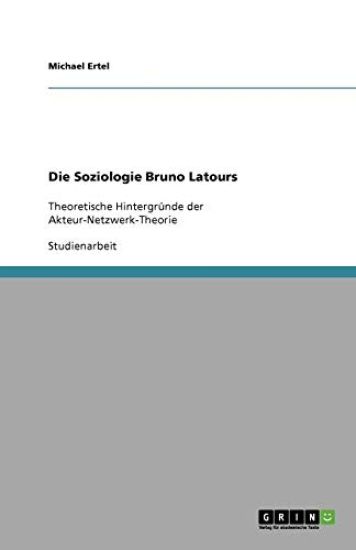
Die Soziologie Bruno Latours

Die Soziologie Bruno Latours

Michael Ertel

Grin Publishing
2009
nidottu
Studienarbeit aus dem Jahr 2009 im Fachbereich Soziologie - Klassiker und Theorierichtungen, Technische Universit t Berlin (Institut f r Soziologie), Sprache: Deutsch, Abstract: Die Vorliegende Hausarbeit entstand im Rahmen des Hauptseminars "Technik und Sozialtheorie" (WS 08/09). Gegenstand dieser Ausarbeitung ist die Vorstellung eines Teilausschnitts des soziologischen Interesses Bruno Latours. Der Schwerpunkt liegt hierbei auf der Erl uterung der gedanklichen Hintergr nde, der in neuerer Zeit, vieldiskutierten Akteur-Netzwerk-Theorie. Die Soziologie Bruno Latours hinterfrag die Grund berzeugungen der Moderne, der Dualismus von Natur und Kultur wird von ihm abgelehnt. Er widerspricht zum Einen, der g ngigen Leitvorstellung, dass es eine vom Menschen unabh ngige, objektive Natur gibt. Zum anderen, der Anma ung der Wissenschaft, bei der Untersuchung der Natur und ihrer Gesetze zu unbestechlichen Wahrheiten zu gelangen. Latour wendet sich damit gegen die, von Durkheim und Weber, beanspruchte Idee der Wertfreiheit der Wissenschaften. Die Latour'sche Soziologie befasst sich also mit dem Verh ltnis von Natur und Gesellschaft. Die Untersuchung dieses Verh ltnisses ist durchaus komplex und bringt eine Menge verschiedener Fragen mit sich. Die folgende Arbeit m chte vor allem aufzeigen, wie Latour das Mikro/Makro-Problem l st, welche Rolle die Technik spielt, und welche Methoden Latour den Soziologen vorschl gt.