Daria Kohler; Daniel Wakelin; Natascha Domeisen; Daniel Haywood; Edward Jones; Micah Mackay; Rosie Maxton; Brian M. Moore; Katie Noble; Felix M. Simon; Daniel Wojahn
This Element explores the idea of publication in media used before, alongside, and after print. It contrasts multiple traditions of unprinted communication in their diversity and particularity. This decentres print as the means for understanding publication; instead, publication is seen as an heuristic term which identifies activities these traditions share, but which also differ in ways not reducible to comparisons with printing. The Element engages with texts written on papyrus, chiselled in stone, and created digitally; sung, proclaimed, and put on stage; banned, hidden and rediscovered. The authors move between Greek inscriptions and Tibetan edicts, early modern manuscripts and AI-assisted composition, monasteries and courts, constantly questioning the term 'publication' and considering the agency of people publishing and the publics they address. The picture that transpires is that of a colourful variety of contexts of production and dissemination, underlining the value of studying 'unprinted' publication in its own right.
The 18th century was a wealth of knowledge, exploration and rapidly growing technology and expanding record-keeping made possible by advances in the printing press. In its determination to preserve the century of revolution, Gale initiated a revolution of its own: digitization of epic proportions to preserve these invaluable works in the largest archive of its kind. Now for the first time these high-quality digital copies of original 18th century manuscripts are available in print, making them highly accessible to libraries, undergraduate students, and independent scholars.Rich in titles on English life and social history, this collection spans the world as it was known to eighteenth-century historians and explorers. Titles include a wealth of travel accounts and diaries, histories of nations from throughout the world, and maps and charts of a world that was still being discovered. Students of the War of American Independence will find fascinating accounts from the British side of conflict. ++++The below data was compiled from various identification fields in the bibliographic record of this title. This data is provided as an additional tool in helping to insure edition identification: ++++British LibraryT136755Dublin: Luke White, 1793. 2v., plate, tables: map; 8
This work has been selected by scholars as being culturally important, and is part of the knowledge base of civilization as we know it. This work was reproduced from the original artifact, and remains as true to the original work as possible. Therefore, you will see the original copyright references, library stamps (as most of these works have been housed in our most important libraries around the world), and other notations in the work.This work is in the public domain in the United States of America, and possibly other nations. Within the United States, you may freely copy and distribute this work, as no entity (individual or corporate) has a copyright on the body of the work.As a reproduction of a historical artifact, this work may contain missing or blurred pages, poor pictures, errant marks, etc. Scholars believe, and we concur, that this work is important enough to be preserved, reproduced, and made generally available to the public. We appreciate your support of the preservation process, and thank you for being an important part of keeping this knowledge alive and relevant.
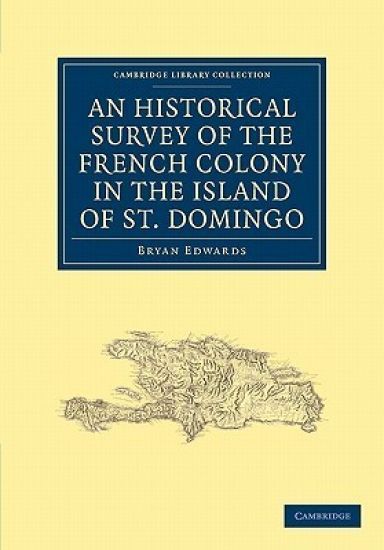
Bryan Edwards (1743–1800) was a wealthy West Indian planter, politician and historian. He vigorously opposed the abolition of the slave trade, since the sugar industry relied heavily on it. An Historical Survey of the French Colony in the Island of St. Domingo was published in 1797. St Domingo (now Haiti) had been one of the most prosperous West Indian economies, producing more sugar and coffee than all the British West Indies combined. The harsh treatment of the slaves under the French code noir led to a widespread revolt in 1791, in part inspired by the French Revolution. An alliance between white planters and the British to take over the island was unsuccessful. Edwards feared that the revolt would spread to other islands, destroying their trade. The rebellion in St Domingo was of major significance, as it led to the colony becoming the first independent black-ruled republic in 1804.
Bryan Edwards (1743–1800) was a wealthy West Indian planter, politician and historian. He vigorously opposed the abolition of the slave trade, since the sugar industry relied heavily on it. His most important work was The History, Civil and Commercial, of the British Colonies in the West Indies, originally published in two volumes in 1793, and subsequently expanded (this fifth edition of 1819 reaching five volumes) with many plates and maps. In this wide-ranging work, he described his aim as 'to describe the manners and dispositions of the present inhabitants, as influenced by climate, situation, and other local causes . . . an account of the African slave trade, some observations on the negro character and genius, and reflections on the system of slavery established in our colonies'. Volume 1 covers the physical geography of the area, its early inhabitants, and the discovery and settlement by Europeans.
Bryan Edwards (1743–1800) was a wealthy West Indian planter, politician and historian. He vigorously opposed the abolition of the slave trade, since the sugar industry relied heavily on it. His most important work was The History, Civil and Commercial, of the British Colonies in the West Indies, originally published in two volumes in 1793, and subsequently expanded (this fifth edition of 1819 reaching five volumes) with many plates and maps. In this wide-ranging work, he described his aim as 'to describe the manners and dispositions of the present inhabitants, as influenced by climate, situation, and other local causes . . . an account of the African slave trade, some observations on the negro character and genius, and reflections on the system of slavery established in our colonies'. Volume 2 includes a description of the present inhabitants of the islands, the practice of slavery, government and commercial activity.
Bryan Edwards (1743–1800) was a wealthy West Indian planter, politician and historian. He vigorously opposed the abolition of the slave trade, since the sugar industry relied heavily on it. His most important work was The History, Civil and Commercial, of the British Colonies in the West Indies, originally published in two volumes in 1793, and subsequently expanded (this fifth edition of 1819 reaching five volumes) with many plates and maps. In this wide-ranging work, he described his aim as 'to describe the manners and dispositions of the present inhabitants, as influenced by climate, situation, and other local causes … an account of the African slave trade, some observations on the negro character and genius, and reflections on the system of slavery established in our colonies'. Volume 3 examines the French colony of St Domingo and the rebellion there, and also discusses Jamaica, Barbados and St Lucia.
Bryan Edwards (1743–1800) was a wealthy West Indian planter, politician and historian. He vigorously opposed the abolition of the slave trade, since the sugar industry relied heavily on it. His most important work was The History, Civil and Commercial, of the British Colonies in the West Indies, originally published in two volumes in 1793, and subsequently expanded (this fifth edition of 1819 reaching five volumes) with many plates and maps. In this wide-ranging work, he described his aim as 'to describe the manners and dispositions of the present inhabitants, as influenced by climate, situation, and other local causes … an account of the African slave trade, some observations on the negro character and genius, and reflections on the system of slavery established in our colonies'. Volume 4 describes the campaigns of the Revolutionary and Napoleonic wars in the West Indies, and provides updated sections on the issue of abolition.
Bryan Edwards (1743–1800) was a wealthy West Indian planter, politician and historian. He vigorously opposed the abolition of the slave trade, since the sugar industry relied heavily on it. His most important work was The History, Civil and Commercial, of the British Colonies in the West Indies, originally published in two volumes in 1793, and subsequently expanded (this fifth edition of 1819 reaching five volumes) with many plates and maps. In this wide-ranging work, he described his aim as 'to describe the manners and dispositions of the present inhabitants, as influenced by climate, situation, and other local causes … an account of the African slave trade, some observations on the negro character and genius, and reflections on the system of slavery established in our colonies'. Volume 5 includes legislative papers dealing with the West Indies, and a supplement to the history of St Domingo.