Kirjojen hintavertailu. Mukana 11 244 527 kirjaa ja 12 kauppaa.

Kirjahaku

Etsi kirjoja tekijän nimen, kirjan nimen tai ISBN:n perusteella.

1000 tulosta hakusanalla Bryan J. Cuevas

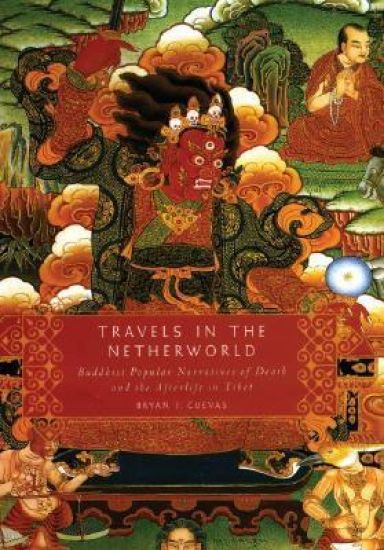
Travels in the Netherworld

Travels in the Netherworld

Bryan J. Cuevas

Oxford University Press Inc
2012
nidottu
In Travels in the Netherworld, Bryan J. Cuevas examines a fascinating but little-known genre of Tibetan narrative literature about the délok, ordinary men and women who claim to have died, traveled through hell, and then returned from the afterlife. These narratives enjoy audiences ranging from the most sophisticated monastic scholars to pious townsfolk, villagers, and nomads. Their accounts emphasize the universal Buddhist principles of impermanence and worldly suffering, the fluctuations of karma, and the feasibility of obtaining a favorable rebirth through virtue and merit. Providing a clear, detailed analysis of four vivid return-from-death tales, including the stories of a Tibetan housewife, a lama, a young noble woman, and a Buddhist monk, Cuevas argues that these narratives express ideas about death and the afterlife that held wide currency among all classes of faithful Buddhists in Tibet. Relying on a diversity of traditional Tibetan sources, Buddhist canonical scriptures, scholastic textbooks, ritual and meditation manuals, and medical treatises, in addition to the délok works themselves, Cuevas surveys a broad range of popular Tibetan Buddhist ideas about death and dying. He explores beliefs about the vulnerability of the soul and its journey beyond death, karmic retribution and the terrors of hell, the nature of demons and demonic possession, ghosts, and reanimated corpses. Cuevas argues that these extraordinary accounts exhibit flexibility between social and religious categories that are conventionally polarized and concludes that, contrary to the accepted wisdom, such rigid divisions as elite and folk, monastic and lay religion are not sufficiently representative of traditional Tibetan Buddhism on the ground. This study offers innovative perspectives on popular religion in Tibet and fills a gap in an important field of Tibetan literature.
The Buddhist Dead (Studies in East Asian Buddhism)

The Buddhist Dead (Studies in East Asian Buddhism)

Bryan J. Cuevas

University of Hawai'i Press
2011
nidottu
In its teachings, practices, and institutions, Buddhism in its varied Asian forms has been--and continues to be--centrally concerned with death and the dead. Yet surprisingly "death in Buddhism" has received little sustained scholarly attention. The Buddhist Dead offers the first comparative investigation of this topic across the major Buddhist cultures of India, Sri Lanka, China, Japan, Tibet, and Burma. Its individual essays, representing a range of methods, shed light on a rich array of traditional Buddhist practices for the dead and dying; the sophisticated but often paradoxical discourses about death and the dead in Buddhist texts; and the varied representations of the dead and the afterlife found in Buddhist funerary art and popular literature. This important collection moves beyond the largely text--and doctrine--centered approaches characterizing an earlier generation of Buddhist scholarship and expands its treatment of death to include ritual, devotional, and material culture.
Travels in the Netherworld

Travels in the Netherworld

Bryan J Cuevas

Oxford University Press Inc
2008
sidottu
In Travels in the Netherworld, Bryan J. Cuevas examines a fascinating but little-known genre of Tibetan narrative literature about the délok, ordinary men and women who claim to have died, traveled through hell, and then returned from the dead. Providing a clear, detailed analysis of four vivid return-from-death tales, including the story of a Tibetan housewife, a lama, a young noble woman, and a Buddhist monk, Cuevas argues that these narratives express ideas about death and the afterlife that held wide currency among all classes of faithful Buddhists in Tibet, from the most sophisticated of scholars in the monasteries and hermits isolated in caves to the pious townsfolk, villagers, and nomads. Relying on a diversity of traditional Tibetan sources, Buddhist canonical scriptures, scholastic textbooks, ritual and meditation manuals, and medical treatises, in addition to the délok works themselves, Cuevas surveys a broad range of popular Tibetan Buddhist ideas about death and dying, including beliefs about the vulnerability of the soul and its journey beyond death, karmic retribution and the terrors of hell, the nature of demons and demonic possession, ghosts and reanimated corpses. This study, moreover, offers innovative perspectives on popular religion in Tibet and fills a gap in an important field of Tibetan literature.
Phase Space Methods for Degenerate Quantum Gases

Phase Space Methods for Degenerate Quantum Gases

Bryan J. Dalton; John Jeffers; Stephen M. Barnett

Oxford University Press
2014
sidottu
Recent experimental progress has enabled cold atomic gases to be studied at nano-kelvin temperatures, creating new states of matter where quantum degeneracy occurs - Bose-Einstein condensates and degenerate Fermi gases. Such quantum states are of macroscopic dimensions. This book presents the phase space theory approach for treating the physics of degenerate quantum gases, an approach already widely used in quantum optics. However, degenerate quantum gases involve massive bosonic and fermionic atoms, not massless photons. The book begins with a review of Fock states for systems of identical atoms, where large numbers of atoms occupy the various single particle states or modes. First, separate modes are considered, and here the quantum density operator is represented by a phase space distribution function of phase space variables which replace mode annihilation, creation operators, the dynamical equation for the density operator determines a Fokker-Planck equation for the distribution function, and measurable quantities such as quantum correlation functions are given as phase space integrals. Finally, the phase space variables are replaced by time dependent stochastic variables satisfying Langevin stochastic equations obtained from the Fokker-Planck equation, with stochastic averages giving the measurable quantities. Second, a quantum field approach is treated, the density operator being represented by a distribution functional of field functions which replace field annihilation, creation operators, the distribution functional satisfying a functional FPE, etc. A novel feature of this book is that the phase space variables for fermions are Grassmann variables, not c-numbers. However, we show that Grassmann distribution functions and functionals still provide equations for obtaining both analytic and numerical solutions. The book includes the necessary mathematics for Grassmann calculus and functional calculus, and detailed derivations of key results are provided.
Benny and the Turtles

Benny and the Turtles

Bryan J Skytte

Tellwell Talent
2023
pokkari
Get ready for an adventure with Benny and the Turtles JoinBenny and his friends as they face a problem that threatens their peaceful homein the lake. With teamwork, determination, and a little bit of ingenuity, theydiscover a solution that saves their community and brings new life to the lake.This heartwarming tale is perfect for young readers who love stories aboutfriendship, problem solving, and making a difference. Don't miss out on thisinspiring story that shows how even the smallest creatures can have a bigimpact.
Spon's Estimating Costs Guide to Plumbing and Heating

Spon's Estimating Costs Guide to Plumbing and Heating

Bryan J. D. Spain; Bryan Spain

Spon Press
2008
nidottu
All the cost data you need to keep your estimating accurate, competitive and profitable.Do you work on jobs between £50 and £50,000? - Then this book is for you.Specially written for contractors and small businesses carrying out small works, Spon's Estimating Cost Guide to Plumbing and Heating contains accurate information on thousands of rates each broken down to labour, material overheads and profit.The first book to include typical project costs for:rainwater goods installationsbathroomsexternal waste systemscentral heating systemshot and cold water systems.
Structures for Architects

Structures for Architects

Bryan J.B. Gauld

Routledge
1994
nidottu
Demand from building control officials for structural calculations - even for very simple projects - means that today's architects must have a thorough understanding of everyday structural concepts.Structures for Architects satisfies the need for a basic introduction to the structural problems encountered by the architect, surveyor and builder. This third edition reflects advances in recent techniques and refers to current Building Regulations and Codes of Practice.Students of architecture, building and surveying at degree, diploma or professional (RIBA, RICS, CIOB) examination level will find this book a valuable course text. Professionals in these fields who must perform structural calculations to satisfy building control authorities will also find it a useful handbook.
The Mark of Criminality

The Mark of Criminality

Bryan J. McCann

The University of Alabama Press
2019
nidottu
Illustrates the ways that the ""war on crime"" became conjoined—aesthetically, politically, and rhetorically—with the emergence of gangsta rap as a lucrative and deeply controversial subgenre of hip-hop.In The Mark of Criminality: Rhetoric, Race, and Gangsta Rap in the War-on-Crime Era, Bryan J. McCann argues that gangsta rap should be viewed as more than a damaging reinforcement of an era's worst racial stereotypes. Rather, he positions the works of key gangsta rap artists, as well as the controversies their work produced, squarely within the law-and-order politics and popular culture of the 1980s and 1990s to reveal a profoundly complex period in American history when the meanings of crime and criminality were incredibly unstable. At the center of this era—when politicians sought to prove their ""tough-on-crime"" credentials—was the mark of criminality, a set of discourses that labeled members of predominantly poor, urban, and minority communities as threats to the social order. Through their use of the mark of criminality, public figures implemented extremely harsh penal polices that have helped make the United States the world's leading jailer of its adult population. At the same time when politicians like Ronald Reagan, George H. W. Bush, and Bill Clinton and television shows such as COPS and America's Most Wanted perpetuated images of gang and drug-filled ghettos, gangsta rap burst out of the hip-hop nation, emanating mainly from the predominantly black neighborhoods of South Central Los Angeles. Groups like NWA and solo artists (including Dr. Dre, Snoop Dogg, and Tupac Shakur) became millionaires by marketing the very discourses political and cultural leaders used to justify their war on crime. For these artists, the mark of criminality was a source of power, credibility, and revenue. By understanding gangsta rap as a potent, if deeply imperfect, enactment of the mark of criminality, we can better understand how crime is always a site of struggle over meaning. Furthermore, by underscoring the nimble rhetorical character of criminality, we can learn lessons that may inform efforts to challenge our nation's failed policies of mass incarceration.