

Kirjahaku
Etsi kirjoja tekijän nimen, kirjan nimen tai ISBN:n perusteella.
1000 tulosta hakusanalla Carl L Gabriel
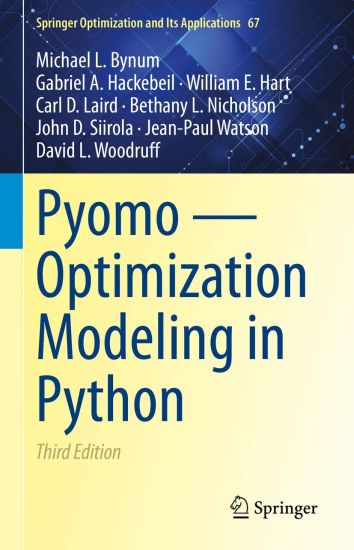
Pyomo — Optimization Modeling in Python
Michael L. Bynum; Gabriel A. Hackebeil; William E. Hart; Carl D. Laird; Bethany L. Nicholson; John D. Siirola; Jean-Paul Watson; David L. Woodruff
Springer Nature Switzerland AG
2021
sidottu
This book provides a complete and comprehensive guide to Pyomo (Python Optimization Modeling Objects) for beginning and advanced modelers, including students at the undergraduate and graduate levels, academic researchers, and practitioners. Using many examples to illustrate the different techniques useful for formulating models, this text beautifully elucidates the breadth of modeling capabilities that are supported by Pyomo and its handling of complex real-world applications. In the third edition, much of the material has been reorganized, new examples have been added, and a new chapter has been added describing how modelers can improve the performance of their models. The authors have also modified their recommended method for importing Pyomo. A big change in this edition is the emphasis of concrete models, which provide fewer restrictions on the specification and use of Pyomo models. Pyomo is an open source software package for formulating and solving large-scale optimization problems. The software extends the modeling approach supported by modern AML (Algebraic Modeling Language) tools. Pyomo is a flexible, extensible, and portable AML that is embedded in Python, a full-featured scripting language. Python is a powerful and dynamic programming language that has a very clear, readable syntax and intuitive object orientation. Pyomo includes Python classes for defining sparse sets, parameters, and variables, which can be used to formulate algebraic expressions that define objectives and constraints. Moreover, Pyomo can be used from a command-line interface and within Python's interactive command environment, which makes it easy to create Pyomo models, apply a variety of optimizers, and examine solutions.
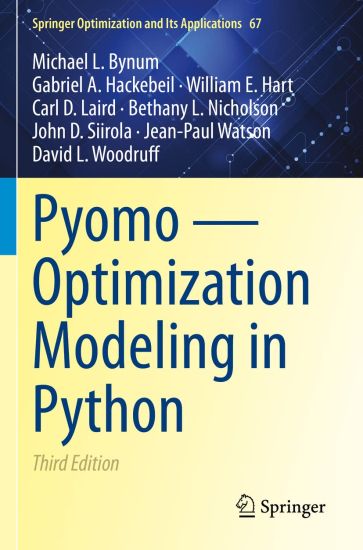
Pyomo — Optimization Modeling in Python
Michael L. Bynum; Gabriel A. Hackebeil; William E. Hart; Carl D. Laird; Bethany L. Nicholson; John D. Siirola; Jean-Paul Watson; David L. Woodruff
Springer Nature Switzerland AG
2022
nidottu
This book provides a complete and comprehensive guide to Pyomo (Python Optimization Modeling Objects) for beginning and advanced modelers, including students at the undergraduate and graduate levels, academic researchers, and practitioners. Using many examples to illustrate the different techniques useful for formulating models, this text beautifully elucidates the breadth of modeling capabilities that are supported by Pyomo and its handling of complex real-world applications. In the third edition, much of the material has been reorganized, new examples have been added, and a new chapter has been added describing how modelers can improve the performance of their models. The authors have also modified their recommended method for importing Pyomo. A big change in this edition is the emphasis of concrete models, which provide fewer restrictions on the specification and use of Pyomo models. Pyomo is an open source software package for formulating and solving large-scale optimization problems. The software extends the modeling approach supported by modern AML (Algebraic Modeling Language) tools. Pyomo is a flexible, extensible, and portable AML that is embedded in Python, a full-featured scripting language. Python is a powerful and dynamic programming language that has a very clear, readable syntax and intuitive object orientation. Pyomo includes Python classes for defining sparse sets, parameters, and variables, which can be used to formulate algebraic expressions that define objectives and constraints. Moreover, Pyomo can be used from a command-line interface and within Python's interactive command environment, which makes it easy to create Pyomo models, apply a variety of optimizers, and examine solutions.
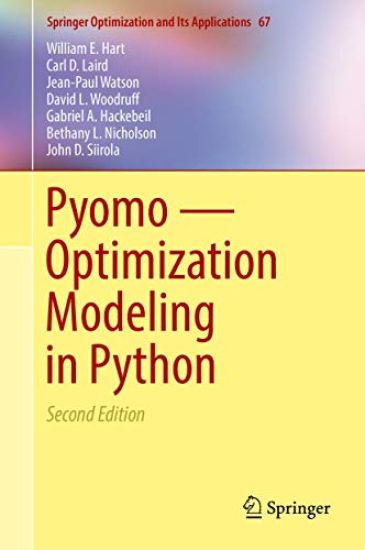
Pyomo — Optimization Modeling in Python
Hart William E.; Carl D. Laird; Watson Jean-Paul; Woodruff David L.; Gabriel A. Hackebeil; Bethany L. Nicholson; Siirola John D.
Springer International Publishing AG
2017
sidottu
?This book provides a complete and comprehensive guide to Pyomo (Python Optimization Modeling Objects) for beginning and advanced modelers, including students at the undergraduate and graduate levels, academic researchers, and practitioners. Using many examples to illustrate the different techniques useful for formulating models, this text beautifully elucidates the breadth of modeling capabilities that are supported by Pyomo and its handling of complex real-world applications. This second edition provides an expanded presentation of Pyomo’s modeling capabilities, providing a broader description of the software that will enable the user to develop and optimize models. Introductory chapters have been revised to extend tutorials; chapters that discuss advanced features now include the new functionalities added to Pyomo since the first edition including generalized disjunctive programming, mathematical programming with equilibrium constraints, and bilevel programming.Pyomo is an open source software package for formulating and solving large-scale optimization problems. The software extends the modeling approach supported by modern AML (Algebraic Modeling Language) tools. Pyomo is a flexible, extensible, and portable AML that is embedded in Python, a full-featured scripting language. Python is a powerful and dynamic programming language that has a very clear, readable syntax and intuitive object orientation. Pyomo includes Python classes for defining sparse sets, parameters, and variables, which can be used to formulate algebraic expressions that define objectives and constraints. Moreover, Pyomo can be used from a command-line interface and within Python's interactive command environment, which makes it easy to create Pyomo models, apply a variety of optimizers, and examine solutions.
Pyomo — Optimization Modeling in Python
William E. Hart; Carl D. Laird; Jean-Paul Watson; David L. Woodruff; Gabriel A. Hackebeil; Bethany L. Nicholson; John D. Siirola
Springer International Publishing AG
2018
nidottu
?This book provides a complete and comprehensive guide to Pyomo (Python Optimization Modeling Objects) for beginning and advanced modelers, including students at the undergraduate and graduate levels, academic researchers, and practitioners. Using many examples to illustrate the different techniques useful for formulating models, this text beautifully elucidates the breadth of modeling capabilities that are supported by Pyomo and its handling of complex real-world applications. This second edition provides an expanded presentation of Pyomo’s modeling capabilities, providing a broader description of the software that will enable the user to develop and optimize models. Introductory chapters have been revised to extend tutorials; chapters that discuss advanced features now include the new functionalities added to Pyomo since the first edition including generalized disjunctive programming, mathematical programming with equilibrium constraints, and bilevel programming.Pyomois an open source software package for formulating and solving large-scale optimization problems. The software extends the modeling approach supported by modern AML (Algebraic Modeling Language) tools. Pyomo is a flexible, extensible, and portable AML that is embedded in Python, a full-featured scripting language. Python is a powerful and dynamic programming language that has a very clear, readable syntax and intuitive object orientation. Pyomo includes Python classes for defining sparse sets, parameters, and variables, which can be used to formulate algebraic expressions that define objectives and constraints. Moreover, Pyomo can be used from a command-line interface and within Python's interactive command environment, which makes it easy to create Pyomo models, apply a variety of optimizers, and examine solutions.
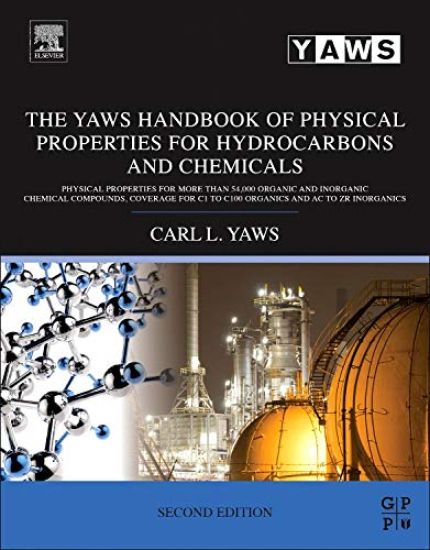
The Yaws Handbook of Physical Properties for Hydrocarbons and Chemicals
Carl L. Yaws
Gulf Professional Publishing
2015
sidottu
Refineries and petrochemical engineers today are accepting more unconventional feedstocks such as heavy oil and shale, causing unique challenges on the processing side of the business. To create more reliable engineering design of process equipment for the petrochemical industry, petroleum engineers and process managers are forced to study the physical properties and compounds of these particular hydrocarbons. Instead of looking up each compound’s information, The Yaws Handbook of Physical Properties for Hydrocarbons and Chemicals, Second Edition presents an easy-to-use format with rapid access to search for the particular compound and understand all the complex calculations in one tabular format. Understanding the composition of hydrocarbons is not easy to calculate quickly or accurately, but this must-have reference leads the engineer to better estimated properties and fractions from easily measured components. Expanded to cover more total compounds and relevant functions, The Yaws Handbook of Physical Properties for Hydrocarbons and Chemicals, Second Edition remains a necessary reference tool for every petrochemical and petroleum engineers’ library.
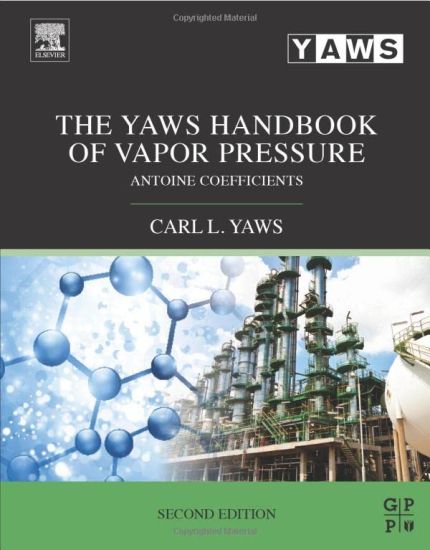
Increased to include over 25,000 organic and inorganic compounds, The Yaws Handbook of Vapor Pressure: Antoine Coefficients, Second Edition delivers the most comprehensive and practical database source for today's petrochemical. Understanding antoine coefficients for vapor pressure leads to numerous critical engineering applications such as pure components in storage vessels, pressure relief valve design, flammability limits at the refinery, as well as environmental emissions from exposed liquids, making data to efficiently calculate these daily challenges a fundamental need. Written by the world’s leading authority on chemical and petrochemical data, The Yaws Handbook of Vapor Pressure simplifies the guesswork for the engineer and reinforces the credibility of the engineer’s calculations with a single trust-worthy source. This data book is a must-have for the engineer’s library bookshelf.
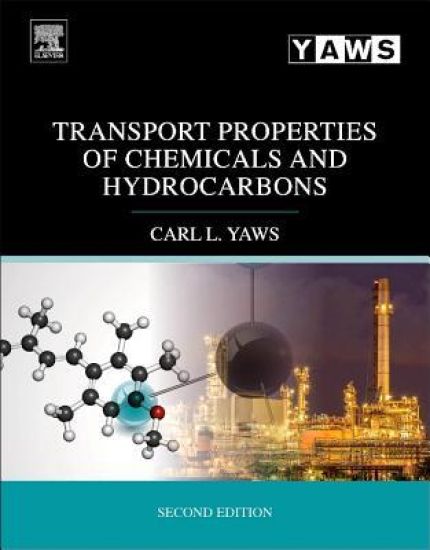
Transport Properties of Chemicals and Hydrocarbons
Carl L. Yaws
Gulf Professional Publishing
2016
nidottu
Covering more than 7,800 organic and inorganic chemicals and hydrocarbons, Transport Properties of Chemical and Hydrocarbons, Second Edition is an essential volume for any chemist or chemical engineer. Spanning gases, liquids, and solids, the book covers all critical properties (including viscosity, thermal conductivity, and diffusion coefficient). From C1 to C100 organics and Ac to Zr inorganics, the data in this handbook is a perfect quick reference for field, lab, or classroom use. By collecting a massive – but relevant – amount of information in one source, the handbook enables engineers to spend more time developing new designs and processes, and less time collecting vital properties data. This is not a theoretical treatise, but an aid to the practicing engineer in the field, on day-to-day operations and long-range projects.
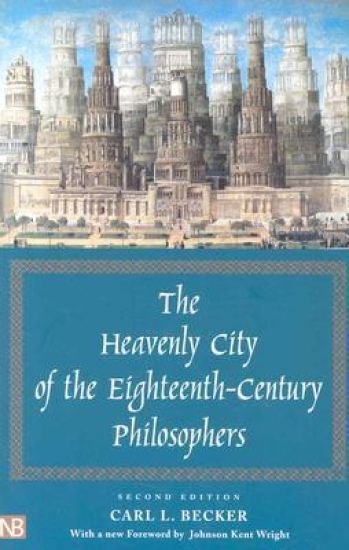
The Heavenly City of the Eighteenth-Century Philosophers
Carl L. Becker
Yale University Press
2003
pokkari
“Will remain a classic—a beautifully finished literary product.”—Charles A. Beard, American Historical Review In this volume, the distinguished American historian Carl L. Becker challenges the belief that the eighteenth century was essentially modern in its temper. He writes, in crystalline prose, that the period commonly described as the Age of Reason was, in fact, very far from that; that Voltaire, Hume, Diderot, and Locke were living in a medieval world; and that these philosophers “demolished the Heavenly City of St. Augustine only to rebuild it with more up-to-date materials.” In a Foreword written for this edition, Johnson Kent Wright looks at the book’s continuing relevance within the context of current discussion about the Enlightenment, noting that Becker’s work is “likely to beguile and provoke readers for a long time to come.”
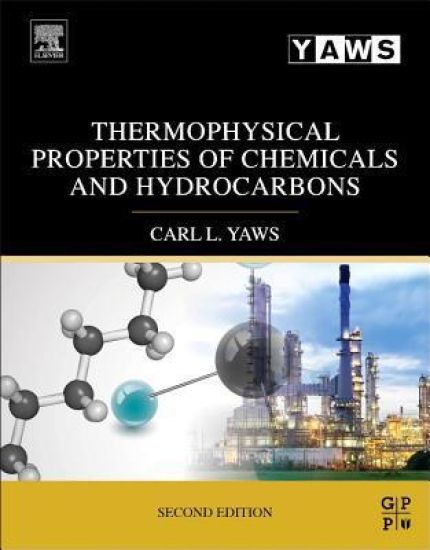
Thermophysical Properties of Chemicals and Hydrocarbons
Carl L. Yaws
Gulf Publishing Company
2014
sidottu
Compiled by an expert in the field, the book provides an engineer with data they can trust. Spanning gases, liquids, and solids, all critical properties (including viscosity, thermal conductivity, and diffusion coefficient) are covered. From C1 to C100 organics and Ac to Zr inorganics, the data in this handbook is a perfect quick reference for field, lab or classroom usage. By collecting a large – but relevant – amount of information in one source, the handbook enables engineers to spend more time developing new designs and processes, and less time collecting vital properties data. This is not a theoretical treatise, but an aid to the practicing engineer in the field, on day-to-day operations and long range projects.

The Declaration of IndependenceCarl L. Becker's important study is an analysis of the concepts expressed in the Declaration. Here is a lucid explanation of what the Declaration really is, what views it sets forth, where those views arose, and how they have been accepted or modified by succeeding generations. A book that every American should read.
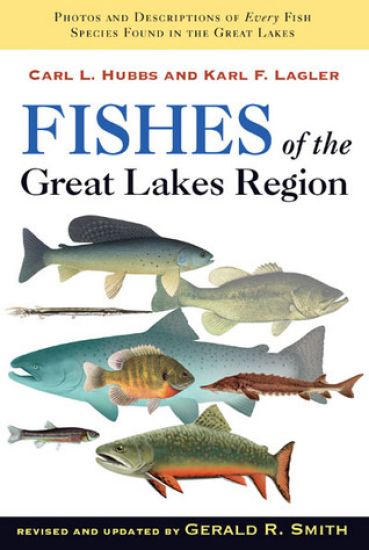
Fishes of the Great Lakes Region, Revised Edition
Carl L. Hubbs; Karl F. Lagler
The University of Michigan Press
2004
nidottu
For everyday anglers, armchair enthusiasts, and serious students, Hubbs and Lagler's text remains the definitive work in the identification and study of the fishes of this important freshwater region. Organized by fish family, with sections on waters of the Great Lakes region, zoogeography, field study and collection, preservation of fishes for study, fish identification, anatomy, terminology, and more, Fishes of the Great Lakes Region is comprehensive in its scope and breadth of information-truly the classic book on Great Lakes fishes.The book also documents a half century of changes in fish population in the region that have resulted from pollution, development, and the introduction of nonnative species. This edition will thus inspire future generations of anglers and students to take a fresh look at one of our most important fauna.


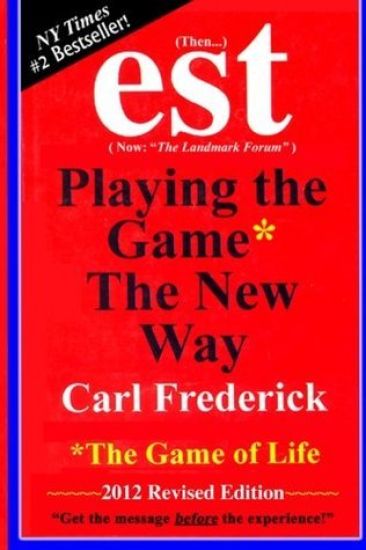
"est: Playing The Game* The New Way *The Game Of Life
Carl L. Frederick
Carlfrederick.Org
2011
nidottu
The only book "EST"/Werner Erhard tried to stop, in US Federal Court. The suit failed, and this title rocketed to the #2 position on the New York Times best-seller list, selling more than a million copies "EST" has now changed its name to "The Landmark Forum" but the message remains the same, and you can get it in this 2012 Revised Edition, at a fraction of the cost for the theatrical experience. Carl Frederick is an "EST" graduate and participated in the "EST Graduate Seminar Leader Program". He is not now affiliated with "EST", Werner Erhard, or "The Landmark Forum", and no endorsement of this book or its message by "EST", Werner Erhard or "The Landmark Forum" is intended or implied.
Mortality and Morbidity in the United States
Carl L Erhardt; Joyce E Berlin
Harvard University Press
1974
sidottu