Kirjahaku
Etsi kirjoja tekijän nimen, kirjan nimen tai ISBN:n perusteella.
1000 tulosta hakusanalla Carl T. Crowl

Essential Reads on Family Offices
Amelia Renkert-Thomas; Antoaneta Proctor; Asher Noor; Carl Sjöström; Carly E Doshi; Carolina Cintra; Caroline Underwood; Charlie Bain; Christian Stewart; David Werdiger; Dennis T Jaffe; Fabrizio Arengi Bentivoglio; Franklin J Parker; Guillermo Barandalla; Jeremy Cheng; Jessica McGawley; Kecia Barkawi; Maya Prabhu; Melissa Cowley Wolf; Michael S Schwartz; Nicola Saccardo; Peter Brock; Philip Marcovici; Philippe J Weil; Raimund Kamp; Rodolfo J Paiz Rodolfo Paiz; Roger King; Russell Cohen; Sue Nickason; Susan R Schoenfeld
Globe Law and Business Ltd
2023
nidottu
Essential Reads on Family Offices is your essential resource featuring insights from the world’s foremost experts on the most pressing topics facing family offices and their advisers today. Containing a collection of authoritative materials dedicated to providing family offices and their advisers with the most informative and thought-provoking contributions on key themes, the content focuses on: • Family office profiles: profiles of leading family offices from around the world, highlighting their unique structures, strategies and values. • Governance: best practices for developing and implementing effective governance structures and processes for family offices. • NextGen planning: expert insights on how to prepare the next generation of family members and manage the family’s wealth and legacy. Family offices have complex and unique needs, and Globe Law and Business is committed to providing family offices and their advisers with the resources they need to thrive. Contributions have been carefully curated from the prestigious archive of The International Family Offices Journal, co-published with STEP, and the Special Report, Family Business and Responsible Wealth Ownership in order to provide you with the core knowledge needed to manage a family’s wealth, relationships and legacy for generations to come.

The choice of structural design and material is essential in preventing the external walls of a vessel from buckling under pressure. In this revised second edition of Pressure vessels, Carl Ross reviews the problem and uses both theoretical and practical examples to show how it can be solved for different structures. The second edition opens with an overview of the types of vessels under external pressure and materials used for construction. Axisymmetric deformation and different types of instability are discussed in the following chapters, with chapters 5 and 6 covering vibration of pressure vessel shells, both in water and out. Chapters 7 and 8 focus on novel pressure hulls, covering design, vibration and collapse, while chapters 9 and 10 concentrate on the design and non-linear analysis of submarine pressure hulls under external hydrostatic pressure. In chapter 11, the design, structure and materials of deep-diving underwater pressure vessels are discussed, focusing on their application in missile defence systems. Finally, chapter 12 analyses the vibration of a thin-walled shell under external water pressure, using ANSYS technology. Drawing on the author’s extensive experience in engineering and design both in an industrial and academic capacity, the second edition of Pressure vessels is an essential reference for stress analysts, designers, consultants and manufacturers of pressure vessels, as well as all those with an academic research interest in the area.
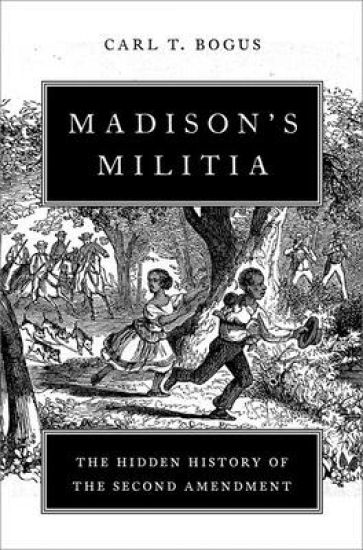
This engaging history overturns the conventional wisdom about the Second Amendment--showing that the right to bear arms was not about protecting liberty but about preserving slavery. In Madison's Militia, Carl Bogus illuminates why James Madison and the First Congress included the right to bear arms in the Bill of Rights. Linking together dramatic accounts of slave uprisings and electric debates over whether the Constitution should be ratified, Bogus shows that--contrary to conventional wisdom--the fitting symbol of the Second Amendment is not the musket in the hands of the minuteman on Lexington Green but the musket wielded by a slave patrol member in the South. Bogus begins with a dramatic rendering of the showdown in Virginia between James Madison and his federalist allies, who were arguing for ratification of the new Constitution, and Patrick Henry and the antifederalists, who were arguing against it. Henry accused Madison of supporting a constitution that empowered Congress to disarm the militia, on which the South relied for slave control. The narrative then proceeds to the First Congress, where Madison had to make good a congressional campaign promise to write a Bill of Rights--and seizing that opportunity to solve the problem Henry had raised. Three other collections of stories--on slave insurrections, Revolutionary War battles, and the English Declaration of Rights--are skillfully woven into the narrative and show how arming ragtag militias was never the primary goal of the amendment. And as the puzzle pieces come together, even initially skeptical readers will be surprised by the completed picture: one that forcefully demonstrates that the Second Amendment was intended in the first instance to protect slaveholders from the people they owned.

"This important book fills a gap in our knowledge. . . . Highly recommended." —Library Journal " . . . highly recommended . . . " —Choice "With admirable clarity and remarkable brevity, Jackson surveys the history of the movement and raises . . . important issues . . . " —The Journal of American History An important history of the Ramakrishna movement, the very first and in many ways the most important Asian religious group to appear in the United States.

Warning readers that America's racial and economic disputes are escalating to warlike proportions, a cautionary study cites such symptoms as corporate downsizing, the growth of armed right-wing militia, repealed welfare and affirmative action, and the O. J. Simpson trial.
Strength of Materials and Structures
Carl T. F. Ross; John Case; A. H. Chilver
Butterworth-Heinemann Ltd
1999
nidottu
Engineers need to be familiar with the fundamental principles and concepts in materials and structures in order to be able to design structurers to resist failures. For 4 decades, this book has provided engineers with these fundamentals. Thoroughly updated, the book has been expanded to cover everything on materials and structures that engineering students are likely to need. Starting with basic mechanics, the book goes on to cover modern numerical techniques such as matrix and finite element methods. There is also additional material on composite materials, thick shells, flat plates and the vibrations of complex structures. Illustrated throughout with worked examples, the book also provides numerous problems for students to attempt.
Presents the introductory theory and applications of Maxwell's equations to electromagnetic field problems. Unlike other texts, Maxwell's equations and the associated vector mathematics are developed early in the work, allowing readers to apply them at the outset. Its unified treatment of coordinate systems saves time in developing the rules for vector manipulations in ways other than the rectangular coordinate system. The following chapters cover static and quasi-static electric and magnetic fields, wave reflection and transmission at plane boundaries, the Poynting power theorem, rectangular waveguide mode theory, transmission lines, and an introduction to the properties of linear antennas and aperture antennas. Includes an expanded set of problems, many of which extend the material developed in the chapters.

A comprehensive look at the fundamental principles of the mechanics of composites. This book includes an extensive array of results demonstrating the wide range of possibilities for mechanical and thermal properties of fibrous composites. It includes an introductory chapter on the properties and advantages of fibrous composites and discusses two-dimensional and three-dimensional constitutive equations, lamination theory, test methods, response of polymer matrix and metal matrix composites, interlaminar stresses, failure and damage, laminated tubes, laminated plates and micromechanics.
Calling Bullshit: The Art of Skepticism in a Data-Driven World
Carl T. Bergstrom; Jevin D. West
Random House Trade
2021
nidottu
Bullshit isn't what it used to be. Now, two science professors give us the tools to dismantle misinformation and think clearly in a world of fake news and bad data. "A modern classic . . . a straight-talking survival guide to the mean streets of a dying democracy and a global pandemic."--WiredMisinformation, disinformation, and fake news abound and it's increasingly difficult to know what's true. Our media environment has become hyperpartisan. Science is conducted by press release. Startup culture elevates bullshit to high art. We are fairly well equipped to spot the sort of old-school bullshit that is based in fancy rhetoric and weasel words, but most of us don't feel qualified to challenge the avalanche of new-school bullshit presented in the language of math, science, or statistics. In Calling Bullshit, Professors Carl Bergstrom and Jevin West give us a set of powerful tools to cut through the most intimidating data. You don't need a lot of technical expertise to call out problems with data. Are the numbers or results too good or too dramatic to be true? Is the claim comparing like with like? Is it confirming your personal bias? Drawing on a deep well of expertise in statistics and computational biology, Bergstrom and West exuberantly unpack examples of selection bias and muddled data visualization, distinguish between correlation and causation, and examine the susceptibility of science to modern bullshit. We have always needed people who call bullshit when necessary, whether within a circle of friends, a community of scholars, or the citizenry of a nation. Now that bullshit has evolved, we need to relearn the art of skepticism.

In 1951, Carl Rowan, a young African American journalist from Minneapolis, journeyed six thousand miles through the South to report on the reality of everyday life for blacks in the region. He sought out the hot spots of racial tension, including Columbia, Tennessee, the scene of a 1946 race riot, and Birmingham, Alabama, which he found to be a brutally racist city, and returned to the setting of his more personal trials: McMinnville, Tennessee, his boyhood home. In this ""balance sheet of American race relations,"" Rowan plots the racial mood of the South and describes simply but vividly the discrimination he encountered daily at hotels, restaurants, and railroad stations, on trains and on buses. Originally published in 1952 and long out of print, South of Freedom is a first-rate account of what it was like to live as a second-class citizen, to experience the segregation, humiliation, danger, stereotypes, economic exploitation, and taboos that were all part of life for African Americans in the 1940s and 1950s. For this edition, Douglas Brinkley provides a new introduction, incorporating recent interviews with Rowan to place the work in the context of its time.An engaging, disturbing look at the opinions of the time on the ""Negro problem,"" Rowan's tales of travel in the South under Jim Crow are especially valuable today as a means of seeing how far we have advanced, and fallen short, in forty-five years.
Argues that lawsuits work far better than commonly understood Judging by the frequency with which it makes an appearance in television news shows and late night stand up routines, the frivolous lawsuit has become part and parcel of our national culture. A woman sues McDonald's because she was scalded when she spilled her coffee. Thousands file lawsuits claiming they were injured by Agent Orange, silicone breast implants, or Bendectin although scientists report these substances do not cause the diseases in question. The United States, conventional wisdom has it, is a hyperlitigious society, propelled by avaricious lawyers, harebrained judges, and runaway juries. Lawsuits waste money and time and, moreover, many are simply groundless. Carl T. Bogus is not so sure. In Why Lawsuits Are Good for America, Bogus argues that common law works far better than commonly understood. Indeed, Bogus contends that while the system can and occasionally does produce "wrong" results, it is very difficult for it to make flatly irrational decisions. Blending history, theory, empirical data, and colorful case studies, Bogus explains why the common law, rather than being outdated, may be more necessary than ever. As Bogus sees it, the common law is an essential adjunct to governmental regulation—essential, in part, because it is not as easily manipulated by big business. Meanwhile, big business has launched an all out war on the common law. "Tort reform"—measures designed to make more difficult for individuals to sue corporations—one of the ten proposals in the Republican Contract With America, and George W. Bush's first major initiative as Governor of Texas. And much of what we have come to believe about the system comes from a coordinated propaganda effort by big business and its allies. Bogus makes a compelling case for the necessity of safeguarding the system from current assaults. Why Lawsuits Are Good for America provides broad historical overviews of the development of American common law, torts, products liability, as well as fresh and provocative arguments about the role of the system of "disciplined democracy" in the twenty-first century.
Argues that lawsuits work far better than commonly understood Judging by the frequency with which it makes an appearance in television news shows and late night stand up routines, the frivolous lawsuit has become part and parcel of our national culture. A woman sues McDonald's because she was scalded when she spilled her coffee. Thousands file lawsuits claiming they were injured by Agent Orange, silicone breast implants, or Bendectin although scientists report these substances do not cause the diseases in question. The United States, conventional wisdom has it, is a hyperlitigious society, propelled by avaricious lawyers, harebrained judges, and runaway juries. Lawsuits waste money and time and, moreover, many are simply groundless. Carl T. Bogus is not so sure. In Why Lawsuits Are Good for America, Bogus argues that common law works far better than commonly understood. Indeed, Bogus contends that while the system can and occasionally does produce "wrong" results, it is very difficult for it to make flatly irrational decisions. Blending history, theory, empirical data, and colorful case studies, Bogus explains why the common law, rather than being outdated, may be more necessary than ever. As Bogus sees it, the common law is an essential adjunct to governmental regulation—essential, in part, because it is not as easily manipulated by big business. Meanwhile, big business has launched an all out war on the common law. "Tort reform"—measures designed to make more difficult for individuals to sue corporations—one of the ten proposals in the Republican Contract With America, and George W. Bush's first major initiative as Governor of Texas. And much of what we have come to believe about the system comes from a coordinated propaganda effort by big business and its allies. Bogus makes a compelling case for the necessity of safeguarding the system from current assaults. Why Lawsuits Are Good for America provides broad historical overviews of the development of American common law, torts, products liability, as well as fresh and provocative arguments about the role of the system of "disciplined democracy" in the twenty-first century.
Die kosmogonischen Ansichten der Inder und Hebräer
Carl T Johannsen
Hutson Street Press
2025
sidottu

Die kosmogonischen Ansichten der Inder und Hebräer
Carl T Johannsen
Hutson Street Press
2025
pokkari

Home Painting, Wallpapering and Decorating: Materials, Tools and Techniques for All Kinds of Painting, Finishing and Decorating
Carl T. Sigman; William J. Ward Jr
Literary Licensing, LLC
2012
sidottu
Home Painting, Wallpapering And Decorating is a comprehensive guidebook that provides detailed information on various materials, tools, and techniques for all kinds of painting, finishing, and decorating. The book is authored by William Wise And Company, a renowned name in the field of home improvement and decoration.The book covers a wide range of topics related to home painting, including the different types of paints and finishes available, their properties, and their suitability for different surfaces. It also discusses the various tools and equipment required for painting, such as brushes, rollers, sprayers, and masking tapes, and provides tips on their proper use.In addition to painting, the book also covers wallpapering and other decorating techniques, such as stenciling, faux painting, and murals. It provides step-by-step instructions for each technique, along with helpful tips and tricks to achieve professional-looking results.The book is written in a clear and concise language, making it easy for beginners and experienced DIY enthusiasts alike to understand and follow. It is also accompanied by numerous illustrations and photographs that further aid in understanding the concepts and techniques discussed.Overall, Home Painting, Wallpapering And Decorating is an essential guidebook for anyone looking to spruce up their home with a fresh coat of paint or add some decorative touches to their walls. It is a valuable resource that provides all the information and guidance needed to achieve beautiful and long-lasting results.Additional Illustrators Are Jane Vincil, Elaine White, Walter Karl, And Many Others.This scarce antiquarian book is a facsimile reprint of the old original and may contain some imperfections such as library marks and notations. Because we believe this work is culturally important, we have made it available as part of our commitment for protecting, preserving, and promoting the world's literature in affordable, high quality, modern editions, that are true to their original work.
Home Painting, Wallpapering and Decorating: Materials, Tools and Techniques for All Kinds of Painting, Finishing and Decorating
Carl T. Sigman; William J. Ward Jr
Literary Licensing, LLC
2012
nidottu

The Corporate State in Action: Italy Under Fascism
Carl T. Schmidt
Literary Licensing, LLC
2013
nidottu

Die Kosmogonischen Ansichten Der Inder Und Hebraer: Durch Zusammenstellung Der Manuischen Und Mosaischen Kosmogonie Erortert...
Carl T. Johannsen
Nabu Press
2012
nidottu