Kirjojen hintavertailu. Mukana 12 491 455 kirjaa ja 12 kauppaa.

Kirjahaku

Etsi kirjoja tekijän nimen, kirjan nimen tai ISBN:n perusteella.

1000 tulosta hakusanalla Catharine Macaulay

Catharine Macaulay: Political Writings

Catharine Macaulay: Political Writings

Catharine Macaulay

Cambridge University Press
2023
pokkari
The writings of republican historian and political pamphleteer Catharine Macaulay (1731–91) played a central role in debates about political reform in the Age of Enlightenment and Revolution. A critical reader of Hume's bestselling History of England, she broke new ground in historiography by defending the regicide of Charles I and became an inspiration for many luminaries of the American and French revolutions. While her historical and political works engaged with thinkers from Hobbes and Locke to Bolingbroke and Burke, she also wrote about religion, philosophy, education and animal rights. Influencing Wollstonecraft and proto-feminism, she argued that there were no moral differences between men and women and that boys and girls should receive the same education. This book is the first scholarly edition of Catharine Macaulay's published writings and includes all her known pamphlets along with extensive selections from her longer historical and political works.
Catharine Macaulay: Political Writings

Catharine Macaulay: Political Writings

Catharine Macaulay

Cambridge University Press
2023
sidottu
The writings of republican historian and political pamphleteer Catharine Macaulay (1731–91) played a central role in debates about political reform in the Age of Enlightenment and Revolution. A critical reader of Hume's bestselling History of England, she broke new ground in historiography by defending the regicide of Charles I and became an inspiration for many luminaries of the American and French revolutions. While her historical and political works engaged with thinkers from Hobbes and Locke to Bolingbroke and Burke, she also wrote about religion, philosophy, education and animal rights. Influencing Wollstonecraft and proto-feminism, she argued that there were no moral differences between men and women and that boys and girls should receive the same education. This book is the first scholarly edition of Catharine Macaulay's published writings and includes all her known pamphlets along with extensive selections from her longer historical and political works.
Observations on a Pamphlet, Entitled, Thoughts on the Cause of the Present Discontents. by Catharine Macaulay. the Third Edition, Corrected.
The 18th century was a wealth of knowledge, exploration and rapidly growing technology and expanding record-keeping made possible by advances in the printing press. In its determination to preserve the century of revolution, Gale initiated a revolution of its own: digitization of epic proportions to preserve these invaluable works in the largest archive of its kind. Now for the first time these high-quality digital copies of original 18th century manuscripts are available in print, making them highly accessible to libraries, undergraduate students, and independent scholars.Delve into what it was like to live during the eighteenth century by reading the first-hand accounts of everyday people, including city dwellers and farmers, businessmen and bankers, artisans and merchants, artists and their patrons, politicians and their constituents. Original texts make the American, French, and Industrial revolutions vividly contemporary.++++The below data was compiled from various identification fields in the bibliographic record of this title. This data is provided as an additional tool in helping to insure edition identification: ++++Bodleian Library (Oxford)N000211Author of 'Thoughts on the cause of the present discontents' = Edmund Burke. With a half-title.London: printed for Edward and Charles Dilly, 1770. 31, 1]p.; 8
Letters on Education. With Observations on Religious and Metaphysical Subjects. By Catharine Macaulay Graham
The 18th century was a wealth of knowledge, exploration and rapidly growing technology and expanding record-keeping made possible by advances in the printing press. In its determination to preserve the century of revolution, Gale initiated a revolution of its own: digitization of epic proportions to preserve these invaluable works in the largest archive of its kind. Now for the first time these high-quality digital copies of original 18th century manuscripts are available in print, making them highly accessible to libraries, undergraduate students, and independent scholars.The Age of Enlightenment profoundly enriched religious and philosophical understanding and continues to influence present-day thinking. Works collected here include masterpieces by David Hume, Immanuel Kant, and Jean-Jacques Rousseau, as well as religious sermons and moral debates on the issues of the day, such as the slave trade. The Age of Reason saw conflict between Protestantism and Catholicism transformed into one between faith and logic -- a debate that continues in the twenty-first century.++++The below data was compiled from various identification fields in the bibliographic record of this title. This data is provided as an additional tool in helping to insure edition identification: ++++British LibraryT105453With a half-title.London: printed for C. Dilly, 1790. 4], xv, 1],507, 1]p.; 8
A Treatise on the Immutability of Moral Truth. By Catharine Macaulay Graham
The 18th century was a wealth of knowledge, exploration and rapidly growing technology and expanding record-keeping made possible by advances in the printing press. In its determination to preserve the century of revolution, Gale initiated a revolution of its own: digitization of epic proportions to preserve these invaluable works in the largest archive of its kind. Now for the first time these high-quality digital copies of original 18th century manuscripts are available in print, making them highly accessible to libraries, undergraduate students, and independent scholars.The Age of Enlightenment profoundly enriched religious and philosophical understanding and continues to influence present-day thinking. Works collected here include masterpieces by David Hume, Immanuel Kant, and Jean-Jacques Rousseau, as well as religious sermons and moral debates on the issues of the day, such as the slave trade. The Age of Reason saw conflict between Protestantism and Catholicism transformed into one between faith and logic -- a debate that continues in the twenty-first century.++++The below data was compiled from various identification fields in the bibliographic record of this title. This data is provided as an additional tool in helping to insure edition identification: ++++British LibraryT067654With a final errata leaf.London: printed by A. Hamilton, jun. And sold by C. Dilly; G. Robinson; T. Cadell; T. Lewis; J. Walter; and R. Faulder, 1783. xvi,325, 3]p.; 8
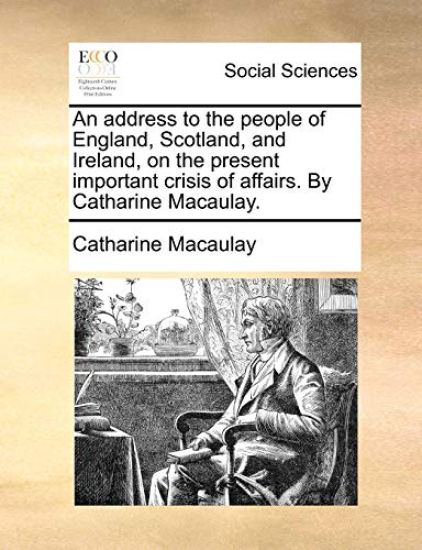
An Address to the People of England, Scotland, and Ireland, on the Present Important Crisis of Affairs. By Catharine Macaulay
The 18th century was a wealth of knowledge, exploration and rapidly growing technology and expanding record-keeping made possible by advances in the printing press. In its determination to preserve the century of revolution, Gale initiated a revolution of its own: digitization of epic proportions to preserve these invaluable works in the largest archive of its kind. Now for the first time these high-quality digital copies of original 18th century manuscripts are available in print, making them highly accessible to libraries, undergraduate students, and independent scholars.Delve into what it was like to live during the eighteenth century by reading the first-hand accounts of everyday people, including city dwellers and farmers, businessmen and bankers, artisans and merchants, artists and their patrons, politicians and their constituents. Original texts make the American, French, and Industrial revolutions vividly contemporary.++++The below data was compiled from various identification fields in the bibliographic record of this title. This data is provided as an additional tool in helping to insure edition identification: ++++British LibraryT020462Catharine Macaulay, afterwards Graham. Bath]: Printed by R. Cruttwell, in Bath, for Edward and Charles Dilly, London, 1775. 29, 1]p.; 8
Observations on a Pamphlet, Entitled, Thoughts on the Cause of the Present Discontents. By Catharine Macaulay. The Third Edition, Corrected
The 18th century was a wealth of knowledge, exploration and rapidly growing technology and expanding record-keeping made possible by advances in the printing press. In its determination to preserve the century of revolution, Gale initiated a revolution of its own: digitization of epic proportions to preserve these invaluable works in the largest archive of its kind. Now for the first time these high-quality digital copies of original 18th century manuscripts are available in print, making them highly accessible to libraries, undergraduate students, and independent scholars.Delve into what it was like to live during the eighteenth century by reading the first-hand accounts of everyday people, including city dwellers and farmers, businessmen and bankers, artisans and merchants, artists and their patrons, politicians and their constituents. Original texts make the American, French, and Industrial revolutions vividly contemporary.++++The below data was compiled from various identification fields in the bibliographic record of this title. This data is provided as an additional tool in helping to insure edition identification: ++++Bodleian Library (Oxford)N000211Author of 'Thoughts on the cause of the present discontents' = Edmund Burke. With a half-title.London: printed for Edward and Charles Dilly, 1770. 31, 1]p.; 8
Catharine Macaulay and Mercy Otis Warren

Catharine Macaulay and Mercy Otis Warren

Kate Davies

Oxford University Press
2005
sidottu
Catharine Macaulay and Mercy Otis Warren were radical friends in a revolutionary age. They produced definitive histories of the English Civil War and the American Revolution, attacked the British government and the United States federal constitution, and instigated a debate on women's rights which inspired Mary Wollstonecraft, Judith Sargent Murray, and other feminists. Drawing on new research (including recently discovered correspondence) this is the first book to consider Macaulay and Warren in the context of the revolutionary Atlantic. In a series of detailed interdisciplinary studies, Davies suggests the centrality of both women to transatlantic political cultures between the middle of the eighteenth century and the turn of the nineteenth. The experience of Anglo-American conflict formed Macaulay and Warren's friendship and radically changed their writing lives. In showing how it did so, Davies also explains how the revolutionary Atlantic shaped modern ideas of gender difference. Anglo-American separation had a politics of gender which defined Warren and Macaulay's awareness of themselves as women and of which their writing also offered important critiques. Davies's book reveals the political significance of Mercy Otis Warren and Catharine Macaulay to an era when the truths of patriotism, nationhood and empire were never wholly self-evident but were hotly contested.
Catharine Macaulay's Republican Enlightenment
The ‘celebrated’ Catharine Macaulay was both lauded and execrated during the eighteenth century for her republican politics and her unconventional, second marriage. This comprehensive biography in the 'life and letters' tradition situates her works in their political and social contexts and offers an unprecedented, detailed account of the content and influence of her writing, the arguments she developed in her eight-volume history of England and her other political, ethical, and educational works. Her disagreements with conservative opponents, David Hume, Edmund Burke, and Samuel Johnson are developed in detail, as is her influence on more progressive admirers such as Thomas Jefferson, Jacques-Pierre Brissot, Mercy Otis Warren, and Mary Wollstonecraft. Macaulay emerges as a coherent and influential political voice, whose attitudes and aspirations were characteristic of those enlightenment republicans who grounded their progressive politics in rational religion. She looked back to the seventeenth-century levellers and parliamentarians as important precursors who had advocated the liberty and political rights she aspired to see implemented in Great Britain, America, and France. Her defence of republican liberty and the equal rights of men offers an important corrective to some contemporary accounts of the character and origins of democratic republicanism during this crucial period.
Catharine Macaulay's Republican Enlightenment
The ‘celebrated’ Catharine Macaulay was both lauded and execrated during the eighteenth century for her republican politics and her unconventional, second marriage. This comprehensive biography in the 'life and letters' tradition situates her works in their political and social contexts and offers an unprecedented, detailed account of the content and influence of her writing, the arguments she developed in her eight-volume history of England and her other political, ethical, and educational works. Her disagreements with conservative opponents, David Hume, Edmund Burke, and Samuel Johnson are developed in detail, as is her influence on more progressive admirers such as Thomas Jefferson, Jacques-Pierre Brissot, Mercy Otis Warren, and Mary Wollstonecraft. Macaulay emerges as a coherent and influential political voice, whose attitudes and aspirations were characteristic of those enlightenment republicans who grounded their progressive politics in rational religion. She looked back to the seventeenth-century levellers and parliamentarians as important precursors who had advocated the liberty and political rights she aspired to see implemented in Great Britain, America, and France. Her defence of republican liberty and the equal rights of men offers an important corrective to some contemporary accounts of the character and origins of democratic republicanism during this crucial period.
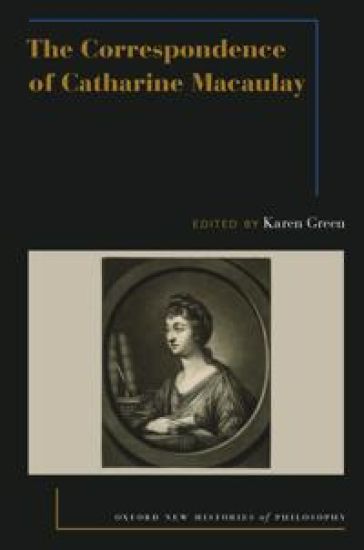
The Correspondence of Catharine Macaulay

The Correspondence of Catharine Macaulay

Oxford University Press Inc
2019
sidottu
Catharine Macaulay was a celebrated republican historian, whose account of the reasons for the seventeenth-century English Revolution, the parliamentary period, and its aftermath was widely read by the mothers and fathers of American Independence and by central players in the French Revolution. As well as publishing her eight volume history, spanning the period from the accession of James I to the Glorious Revolution of 1688, she wrote political pamphlets, offered a sketch of a republican constitution for Corsica, advocated parliamentary reform, and published a response to Edmund Burke's Reflections on the Revolution in France. Her Letters on Education of 1790 made a decisive impact on the thought of Mary Wollstonecraft, and her Treatise on the Immutability of Moral Truth opposed the skeptical and utilitarian attitudes being developed by Hume and others. This volume brings together for the first time all the available letters between her and her wide-ranging correspondents, who include George Washington, John Adams, Abigail Adams, Mercy Otis Warren, James Otis, Benjamin Rush, David Hume, James Boswell, Thomas Hollis, John Wilkes, Horace Walpole, Mary Wollstonecraft, Jacques-Pierre Brissot de Warville, and many other luminaries of the eighteenth-century enlightenment. It includes an extended introduction to her life and works and offers a unique insight into the thinking of her friends and correspondents during the period between 1760 and 1790, the crucible for the development of modern representative democracies. The Correspondence of Catharine Macaulay will appeal to scholars of philosophy, political thought, women's studies, and eighteenth-century history, as well as those interested in the development of democratic ideas.
The Correspondence of Catharine Macaulay

The Correspondence of Catharine Macaulay

Oxford University Press Inc
2019
nidottu
Catharine Macaulay was a celebrated republican historian, whose account of the reasons for the seventeenth-century English Revolution, the parliamentary period, and its aftermath was widely read by the mothers and fathers of American Independence and by central players in the French Revolution. As well as publishing her eight volume history, spanning the period from the accession of James I to the Glorious Revolution of 1688, she wrote political pamphlets, offered a sketch of a republican constitution for Corsica, advocated parliamentary reform, and published a response to Edmund Burke's Reflections on the Revolution in France. Her Letters on Education of 1790 made a decisive impact on the thought of Mary Wollstonecraft, and her Treatise on the Immutability of Moral Truth opposed the skeptical and utilitarian attitudes being developed by Hume and others. This volume brings together for the first time all the available letters between her and her wide-ranging correspondents, who include George Washington, John Adams, Abigail Adams, Mercy Otis Warren, James Otis, Benjamin Rush, David Hume, James Boswell, Thomas Hollis, John Wilkes, Horace Walpole, Mary Wollstonecraft, Jacques-Pierre Brissot de Warville, and many other luminaries of the eighteenth-century enlightenment. It includes an extended introduction to her life and works and offers a unique insight into the thinking of her friends and correspondents during the period between 1760 and 1790, the crucible for the development of modern representative democracies. The Correspondence of Catharine Macaulay will appeal to scholars of philosophy, political thought, women's studies, and eighteenth-century history, as well as those interested in the development of democratic ideas.