Kirjojen hintavertailu. Mukana 11 244 527 kirjaa ja 12 kauppaa.

Kirjahaku

Etsi kirjoja tekijän nimen, kirjan nimen tai ISBN:n perusteella.

1000 tulosta hakusanalla Charles E. Lindblom

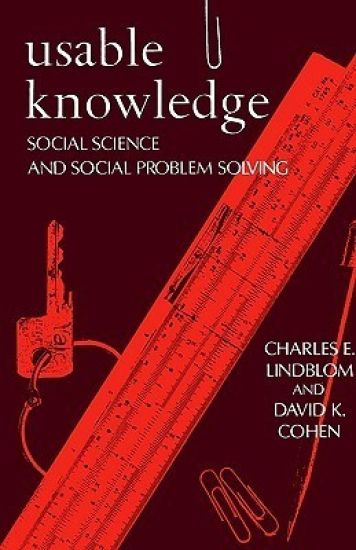
Usable Knowledge

Usable Knowledge

Charles E. Lindblom

Yale University Press
1979
pokkari
The problem that gives rise to this book is dissatisfaction with social science and social research as instruments of social problem solving. Policy makers and other practical problem solvers frequently voice disappointment with what they are offered. And many social scientists and social researchers think they should be more drawn upon, more useful, and more influential. Out of the discontent have come numerous diagnoses and prescriptions. This thoughtful contribution to the discussion provides an agenda of basic questions that should be asked and answered by those who are concerned about the impact of social science and research on real life problems. In general, Cohen and Lindblom believe that social scientists are crippled by a misunderstanding of their own trade, and they suggest that the tools of their trade be applied to the trade itself. Social scientists do not always fully appreciate that professional social inquiry is only one of several ways of solving a problem. They are also often engaged in a mistaken pursuit of authoritativeness, not recognizing that their contribution can never be more than a partial one. Cohen and Lindblom suggest that they reexamine their criteria for selecting subjects for research, study their tactics as compared to those of policy makers, and consider more carefully their role in relation to other routes to problem solving. To stimulate further inquiry into these fundamental issues, they also provide a comprehensive bibliography.
Inquiry and Change

Inquiry and Change

Charles E. Lindblom

Yale University Press
1992
pokkari
How do ordinary citizens, government officials, opinion leaders, or social scientists attempt to solve social problems? How competent are we at defining the problems, seeking information, and finding answers? In this important and controversial book, a distinguished social scientist meticulously analyzes our attempt to understand society so that we can reshape it. In so doing, he largely bypasses both epistemology and contemporary highly abstract theory on knowledge and society in order to acheive a far more concrete analysis of discourse and inquiry in social problem solving. There is a tragic discrepancy, argues Charles E. Lindblom, between our abilities to solve problems and the difficulty of the problems to be solved. We must make do with inadequate information and inconclusive analyses, for the task is less one of learning the truth than of proceeding in inquiry and decisions when the truth cannot be known. Lindblom discusses the many obstacles that prevent us from solving social problems, focusing in particular on learned incompetence. According to Lindblom, parents teach children not to think certain thoughts, and schools often engage more in indoctrination than education. Political rhetoric and commercial sales promotion feed a steady diet of misrepresentation. Social science does help. But because it is dependent on popular thought, it shares the impairments of thought found in both political figures and ordinary citizens. It also develops its own distinctive impairments and is to a degree crippled by its narrow view of scientific method--often more interested in proving than probing. Although social science can be improved in ways that Lindblom outlines in his book, social inquiry calls for such significant contributions from lay thought that it renders many conventional ideals of scientific problem solving inappropriate. Lindblom contends that the route to better social problem solving is not through either scientific or popular consensus or agreement, however much they are valued in the world of science and social science, but through a competition of ideas. The index of a society's competence, he states, is in its discord over ends, values, or purposes. "As usual, Lindblom cuts through to the core of the issue: How is society to understand its central problems and challenges? With originality and courage, he takes on the social scientists and the policy analysts, and presents an inspiring picture of a self-guiding democracy that continuously deliberates over means and ends. A signal contribution."--Robert B. Reich, Harvard University
The Market System

The Market System

Charles E. Lindblom

Yale University Press
2002
pokkari
In this clear and accessible book, an eminent political scientist offers a jargon-free introduction to the market system for all readers, with or without a background in economics. "A balanced and novel treatment of a very important set of questions. This is a book of grand scope by an outstanding scholar."—Samuel Bowles, University of Massachusetts, Amherst "Anyone who wants to know more about the market system’s plusses and minuses, how government can help or hinder its workings, and the direction in which it is likely to move should read this clear, fair, and fascinating book."—Robert Heilbroner, professor emeritus, New School University"The Market System resplendently assesses the character, rules, advantages, and shortcomings of the central institution coordinating modern economic and social life. Lindblom marshals his incisive intellect, uncommon range, and pellucid prose to clarify, probe, and exhort. The result is an unsurpassed guide."—Ira I. Katznelson, Columbia University
Charles E. Ives: Memos

Charles E. Ives: Memos

John Kirkpatrick; Charles Ives

W. W. Norton Company
1991
nidottu
Here are most of the previously unpublished writings of Charles E. Ives: a primary source book on this unique American composer. These "Memos," as Ives called them, were on separate leaves and dealt with his music, composition, criticism, autobiography, biography, and many other topics. During his lifetime Ives rearranged them, lent them out, mislaid and tucked them away in books so that, in the late 1940s, only about three-fifths of them were available to his biographer. After his death in 1954, Ives's papers were gradually put in order, and in time most of the remaining leaves came to light. These two "batches" are here dovetailed into a three-part form by John Kirkpatrick, who has devotedly arranged, edited, and annotated them. Part One, "Pretext," sets forth Ives's aims, his views on music, critics and criticism. In part Two, "Scrapbook," Ives discusses his music. Part Three, "Memories," is devoted to biographical and autobiographical remembrances.
Charles E. Maddry: an Autobiography

Charles E. Maddry: an Autobiography

Charles Edward 1876-1962 Maddry; Broadman Press

Hassell Street Press
2021
nidottu
This work has been selected by scholars as being culturally important and is part of the knowledge base of civilization as we know it.This work is in the public domain in the United States of America, and possibly other nations. Within the United States, you may freely copy and distribute this work, as no entity (individual or corporate) has a copyright on the body of the work.Scholars believe, and we concur, that this work is important enough to be preserved, reproduced, and made generally available to the public. To ensure a quality reading experience, this work has been proofread and republished using a format that seamlessly blends the original graphical elements with text in an easy-to-read typeface.We appreciate your support of the preservation process, and thank you for being an important part of keeping this knowledge alive and relevant.
Charles E. Callwell and the British Way in Warfare

Charles E. Callwell and the British Way in Warfare

Daniel Whittingham

Cambridge University Press
2020
sidottu
Daniel Whittingham presents the first full-length study of one of Britain's most important military thinkers, Major-General Sir Charles E. Callwell (1859–1928). It tells the story of his life, which included service in military intelligence, the South African War, and on the General Staff before and during the First World War. It also presents the first comprehensive analysis of his writing: from his well-known books Small Wars (1896) and Military Operations and Maritime Preponderance (1905), to a host of other books and articles that are presented here for the first time. Through a study of Callwell's life and works, this book offers a new perspective on the nature and study of military history, the character of British strategy, and on the army to which he belonged.
Charles E. Callwell and the British Way in Warfare

Charles E. Callwell and the British Way in Warfare

Daniel Whittingham

Cambridge University Press
2022
pokkari
Daniel Whittingham presents the first full-length study of one of Britain's most important military thinkers, Major-General Sir Charles E. Callwell (1859–1928). It tells the story of his life, which included service in military intelligence, the South African War, and on the General Staff before and during the First World War. It also presents the first comprehensive analysis of his writing: from his well-known books Small Wars (1896) and Military Operations and Maritime Preponderance (1905), to a host of other books and articles that are presented here for the first time. Through a study of Callwell's life and works, this book offers a new perspective on the nature and study of military history, the character of British strategy, and on the army to which he belonged.
The Camp-fires of the Everglades; or, Wild Sports in the South, by Charles E. Whitehead
This work has been selected by scholars as being culturally important, and is part of the knowledge base of civilization as we know it. This work was reproduced from the original artifact, and remains as true to the original work as possible. Therefore, you will see the original copyright references, library stamps (as most of these works have been housed in our most important libraries around the world), and other notations in the work.This work is in the public domain in the United States of America, and possibly other nations. Within the United States, you may freely copy and distribute this work, as no entity (individual or corporate) has a copyright on the body of the work.As a reproduction of a historical artifact, this work may contain missing or blurred pages, poor pictures, errant marks, etc. Scholars believe, and we concur, that this work is important enough to be preserved, reproduced, and made generally available to the public. We appreciate your support of the preservation process, and thank you for being an important part of keeping this knowledge alive and relevant.
Charles E. Wiggin, 1813-1888
This work has been selected by scholars as being culturally important, and is part of the knowledge base of civilization as we know it. This work was reproduced from the original artifact, and remains as true to the original work as possible. Therefore, you will see the original copyright references, library stamps (as most of these works have been housed in our most important libraries around the world), and other notations in the work.This work is in the public domain in the United States of America, and possibly other nations. Within the United States, you may freely copy and distribute this work, as no entity (individual or corporate) has a copyright on the body of the work.As a reproduction of a historical artifact, this work may contain missing or blurred pages, poor pictures, errant marks, etc. Scholars believe, and we concur, that this work is important enough to be preserved, reproduced, and made generally available to the public. We appreciate your support of the preservation process, and thank you for being an important part of keeping this knowledge alive and relevant.