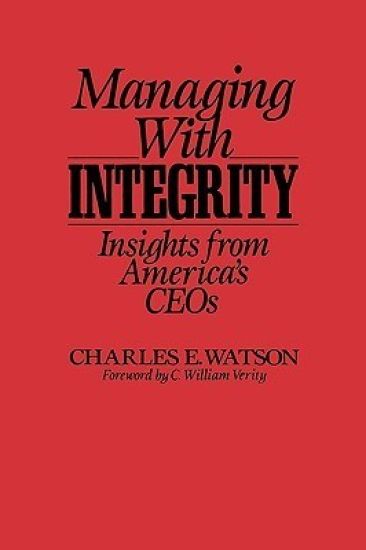
This compelling work draws on the experiences of America's most successful business leaders to examine the issue of character in business. Based on interviews with 125 CEOs of major U.S. corporations, Managing with Integrity shows how it is possible for the businessperson to do what is right and run a profitable company at the same time. A wealth of practical examples and anecdotes demonstrates that even today, corporate America's most powerful figures tend to place what is ethical over what is expedient and adhere to a higher standard than is generally assumed by the public. By revealing the strategies these leaders employ in the face of the myriad challenges to character encountered in the day-to-day business world, the author provides invaluable insights for executives, managers, supervisors, professionals, and entrepreneurs confronted with their own ethical dilemmas. Readers will find Managing with Integrity both an unusually candid look at the dimensions of executive decision making and an eminently practical guide to the development of a workable moral philosophy for business.Is it possible for a decent human being to succeed in business? How does one find meaning in the business life? These are some of the questions asked by the author as he explores the difficulties associated with ethical thinking within the context of business. Finding that those persons and organizations that aspire to serve worthwhile purposes are ultimately the most profitable, he shows how businesses can and do prosper when high ethical and moral standards underlie executive decision making. Finally, the author examines the concept of success in business and describes the various dimensions of success which are most mentioned most often by the senior executives interviewed for the book. Written in an engaging and nontechnical style and filled with hundreds of real-world examples, Managing with Integrity offers an important counterweight to the cynicism that so often pervades popular thinking about corporate America.
Against the all-too-familiar backdrop of corporate scandal and greed, Charles Watson provides what he calls a blueprint to help working men and women, from the tops of organizations to the bottoms, step forward and help restore and defend the integrity of business. Step by step, he outlines fifteen fundamental commandments of honest business—from put people first to be your own person—common-sensical approaches to making decisions, solving problems, and taking action in ways that deliver results without compromising on principles. Using dozens of compelling examples, from companies large and small, Watson demonstrates how honesty, integrity, and trust are at the root of such essential business concepts as creativity and innovation, risk taking, collaboration, attracting and retaining talented people, and anticipating and exceeding customer expectations. He also tackles such complex issues as how to prevent an ethical ego from becoming arrogant and how to stand your ground when faced with unethical competition, resistance from above or below, or the temptation to take the path of least resistance. Ultimately, he provides practical, not abstract or theoretical, recommendations for developing individuals and organizations that encourage authentic relationships, act in ways that society admires, and have the boldness to initiate action with conviction.Watson also tackles such complex issues as how to prevent an ethical ego from becoming arrogant and how to stand your ground when faced with unethical competition, resistance from above or below, or the temptation to take the path of least resistance. He reminds us that integrity is derived from the Latin integritas—oneness, a consistency of purpose, word, and deed. Applying this principle, he provides practical, not abstract or theoretical, recommendations for developing individuals and organizations that encourage authentic relationships, celebrate positive achievements, act in ways that society admires, and have the boldness to initiate action with conviction. Ultimately, Watson demonstrates that with courage and humility you can, indeed, do well by doing good—not only at work, but in all aspects of your life.
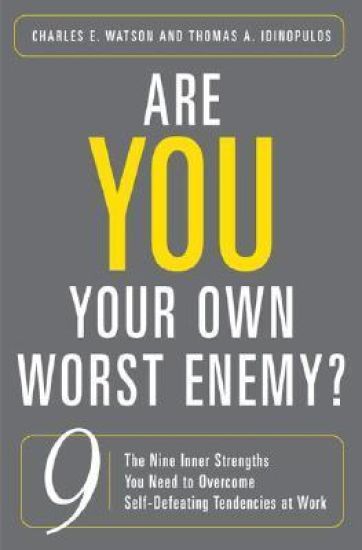
A management professor and a religion professor team up to provide a fresh, penetrating look at the obstacles that prevent people from achieving their full potential. As authors Charles Watson and Thomas Idinopulos demonstrate, inner demons like a lack of integrity, mindless conformity, passivity, or greed conspire to keep people from doing their best. But people can avoid becoming their own worst enemies by using their uniquely human capacities to their fullest—to be more responsible, more creative, more self-disciplined, and more honest. Using these strengths, the authors show, makes it easier to resolve ethical dilemmas, attain peak performance without burning out, maintain a positive outlook, and, ultimately, succeed in achieving treasured personal and professional goals. A management professor and a religion professor team up to provide a fresh, penetrating look at the obstacles that prevent people from achieving their full potential at work. As Watson and Idinopulos demonstrate, inner demons like a lack of integrity, mindless conformity, passivity, mediocrity, or greed conspire to keep people from doing their best. But people can avoid becoming their own worst enemies by using their uniquely human capacities to their fullest: to be more responsible, more insightful, more creative, more self-disciplined, more honest, and more concerned about others. Using these strengths, the authors show, makes it easier to resolve ethical dilemmas, attain peak performance without burning out, maintain a positive outlook, and, ultimately, succeed in achieving treasured personal and professional goals. The world of work is filled with treacherous shoals that constantly test the integrity, fortitude, and tolerance of employees. The stresses can be incapacitating. Faced with competing agendas, high expectations, sclerotic bureaucracies, and scarce resources, many people fall prey to demons that sap their energy or, worse, encourage them to act against their own interests by being dishonest or cutting corners. Are You Your Own Worst Enemy? shows readers how to take responsibility for their actions and their happiness. It discusses the on-going pressures, temptations, and traps in the workplace and how ordinary people can manage them constructively to remain effective and true to their ideals. Specifically, it shows how learning the following behaviors and attitudes can help people become more productive, more valuable, and more fully satisfied: -Develop the capacity to make things happen. -Make the most of who you are. -Sharpen thinking skills. -Be the kind of person others want to be around. -Break the chains of mindless routine. -Become an effective learner and continue learning. -Master the art of self-discipline. -Act with integrity. -Be of service to others. Using dozens of engaging stories from people in all types of organizations, the authors show how to overcome self-defeating behavior. The result for readers is a blueprint for success, reduced stress, better work/life balance, and fulfillment.
Here are most of the previously unpublished writings of Charles E. Ives: a primary source book on this unique American composer. These "Memos," as Ives called them, were on separate leaves and dealt with his music, composition, criticism, autobiography, biography, and many other topics. During his lifetime Ives rearranged them, lent them out, mislaid and tucked them away in books so that, in the late 1940s, only about three-fifths of them were available to his biographer. After his death in 1954, Ives's papers were gradually put in order, and in time most of the remaining leaves came to light. These two "batches" are here dovetailed into a three-part form by John Kirkpatrick, who has devotedly arranged, edited, and annotated them. Part One, "Pretext," sets forth Ives's aims, his views on music, critics and criticism. In part Two, "Scrapbook," Ives discusses his music. Part Three, "Memories," is devoted to biographical and autobiographical remembrances.
This work has been selected by scholars as being culturally important and is part of the knowledge base of civilization as we know it.This work is in the public domain in the United States of America, and possibly other nations. Within the United States, you may freely copy and distribute this work, as no entity (individual or corporate) has a copyright on the body of the work.Scholars believe, and we concur, that this work is important enough to be preserved, reproduced, and made generally available to the public. To ensure a quality reading experience, this work has been proofread and republished using a format that seamlessly blends the original graphical elements with text in an easy-to-read typeface.We appreciate your support of the preservation process, and thank you for being an important part of keeping this knowledge alive and relevant.
Daniel Whittingham presents the first full-length study of one of Britain's most important military thinkers, Major-General Sir Charles E. Callwell (1859–1928). It tells the story of his life, which included service in military intelligence, the South African War, and on the General Staff before and during the First World War. It also presents the first comprehensive analysis of his writing: from his well-known books Small Wars (1896) and Military Operations and Maritime Preponderance (1905), to a host of other books and articles that are presented here for the first time. Through a study of Callwell's life and works, this book offers a new perspective on the nature and study of military history, the character of British strategy, and on the army to which he belonged.
Daniel Whittingham presents the first full-length study of one of Britain's most important military thinkers, Major-General Sir Charles E. Callwell (1859–1928). It tells the story of his life, which included service in military intelligence, the South African War, and on the General Staff before and during the First World War. It also presents the first comprehensive analysis of his writing: from his well-known books Small Wars (1896) and Military Operations and Maritime Preponderance (1905), to a host of other books and articles that are presented here for the first time. Through a study of Callwell's life and works, this book offers a new perspective on the nature and study of military history, the character of British strategy, and on the army to which he belonged.
This work has been selected by scholars as being culturally important, and is part of the knowledge base of civilization as we know it. This work was reproduced from the original artifact, and remains as true to the original work as possible. Therefore, you will see the original copyright references, library stamps (as most of these works have been housed in our most important libraries around the world), and other notations in the work.This work is in the public domain in the United States of America, and possibly other nations. Within the United States, you may freely copy and distribute this work, as no entity (individual or corporate) has a copyright on the body of the work.As a reproduction of a historical artifact, this work may contain missing or blurred pages, poor pictures, errant marks, etc. Scholars believe, and we concur, that this work is important enough to be preserved, reproduced, and made generally available to the public. We appreciate your support of the preservation process, and thank you for being an important part of keeping this knowledge alive and relevant.