Kirjojen hintavertailu. Mukana 11 241 044 kirjaa ja 12 kauppaa.

Kirjahaku

Etsi kirjoja tekijän nimen, kirjan nimen tai ISBN:n perusteella.

1000 tulosta hakusanalla Charles Hermite

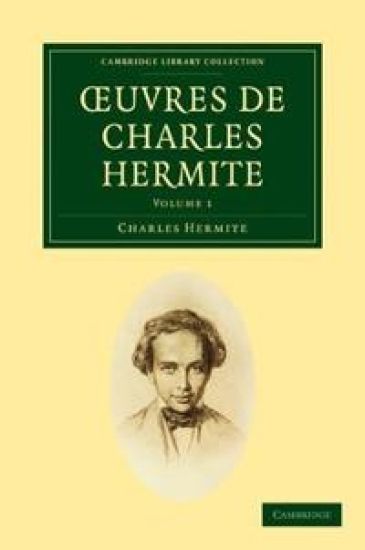
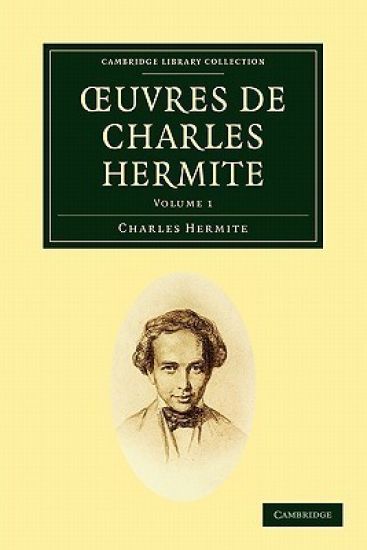
Œuvres de Charles Hermite

Œuvres de Charles Hermite

Charles Hermite

Cambridge University Press
2009
pokkari
Charles Hermite (1822–1901) was a French mathematician who made significant contributions to pure mathematics, and especially to number theory and algebra. In 1858 he solved the equation of the fifth degree by elliptic functions, and in 1873 he proved that e (the base of natural logarithms) is transcendental. The legacy of his work can be shown in the large number of mathematical terms which bear the adjective 'Hermitian'. As a teacher at the École Polytechnique, the Faculté des Sciences de Paris and the École Normale Supérieure he was influential and inspiring to a new generation of scientists in many disciplines. The four volumes of his collected papers were published between 1905 and 1908.
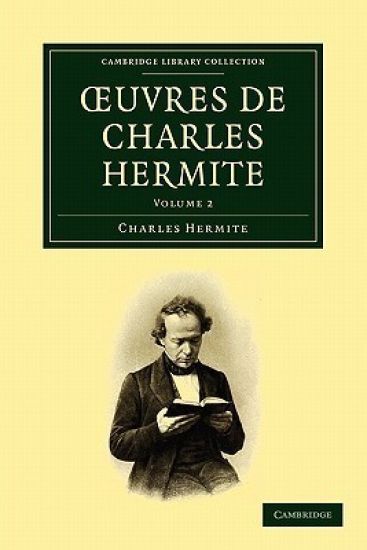
Œuvres de Charles Hermite

Œuvres de Charles Hermite

Charles Hermite

Cambridge University Press
2009
pokkari
Charles Hermite (1822–1901) was a French mathematician who made significant contributions to pure mathematics, and especially to number theory and algebra. In 1858 he solved the equation of the fifth degree by elliptic functions, and in 1873 he proved that e (the base of natural logarithms) is transcendental. The legacy of his work can be shown in the large number of mathematical terms which bear the adjective 'Hermitian'. As a teacher at the École Polytechnique, the Faculté des Sciences de Paris and the École Normale Supérieure he was influential and inspiring to a new generation of scientists in many disciplines. The four volumes of his collected papers were published between 1905 and 1908.
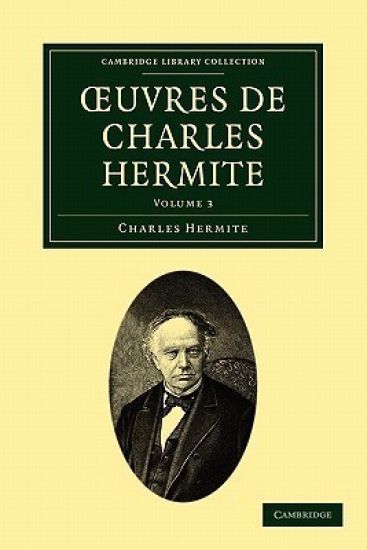
Œuvres de Charles Hermite

Œuvres de Charles Hermite

Charles Hermite

Cambridge University Press
2009
pokkari
Charles Hermite (1822–1901) was a French mathematician who made significant contributions to pure mathematics, and especially to number theory and algebra. In 1858 he solved the equation of the fifth degree by elliptic functions, and in 1873 he proved that e (the base of natural logarithms) is transcendental. The legacy of his work can be shown in the large number of mathematical terms which bear the adjective 'Hermitian'. As a teacher at the École Polytechnique, the Faculté des Sciences de Paris and the École Normale Supérieure he was influential and inspiring to a new generation of scientists in many disciplines. The four volumes of his collected papers were published between 1905 and 1908.
Œuvres de Charles Hermite

Œuvres de Charles Hermite

Charles Hermite

Cambridge University Press
2009
pokkari
Charles Hermite (1822–1901) was a French mathematician who made significant contributions to pure mathematics, and especially to number theory and algebra. In 1858 he solved the equation of the fifth degree by elliptic functions, and in 1873 he proved that e (the base of natural logarithms) is transcendental. The legacy of his work can be shown in the large number of mathematical terms which bear the adjective 'Hermitian'. As a teacher at the École Polytechnique, the Faculté des Sciences de Paris and the École Normale Supérieure he was influential and inspiring to a new generation of scientists in many disciplines. The four volumes of his collected papers were published between 1905 and 1908.
Œuvres de Charles Hermite 4 Volume Paperback Set

Œuvres de Charles Hermite 4 Volume Paperback Set

Hermite Charles

Cambridge University Press
2009
muu
Charles Hermite (1822–1901) was a French mathematician who made significant contributions to pure mathematics, and especially to number theory and algebra. In 1858 he solved the equation of the fifth degree by elliptic functions, and in 1873 he proved that e (the base of natural logarithms) is transcendental. The legacy of his work can be shown in the large number of mathematical terms which bear the adjective 'Hermitian'. As a teacher at the École Polytechnique, the Faculté des Sciences de Paris and the École Normale Supérieure he was influential and inspiring to a new generation of scientists in many disciplines. The four volumes of his collected papers were published between 1905 and 1908.