Kirjojen hintavertailu. Mukana 11 342 296 kirjaa ja 12 kauppaa.

Kirjahaku

Etsi kirjoja tekijän nimen, kirjan nimen tai ISBN:n perusteella.

1000 tulosta hakusanalla Charles P. Kindleberger

An Analysis of Charles P. Kindleberger's Manias, Panics, and Crashes
Perhaps the most peculiar feature of a financial bubble – one that Charles Kindleberger's classic work Manias, Panics and Crashes draws particular attention to – is the inability of those trapped inside it to grasp the seriousness of their predicament. They know in principle that bubbles exist, and they know that the financial crashes that result from them are capable of destroying individuals' wealth and entire economies. Yet whenever and wherever a bubble begins to form, we're told that this time things are different, that there are sound reasons to continue to invest and to presume that prices will continue to rise steadily forever.Kindleberger's achievement is to use the critical thinking skill of evaluation to examine this strange mindset and the arguments advanced in support of it. He harshly judges the acceptability of the reasons used to create such arguments, and highlights the issues of relevance and adequacy that give us every reason to doubt them. Kindleberger also uses his powers of reasoning to effect an unusual achievement – writing a work soundly rooted in economics that nonetheless engages and convinces a non-specialist audience of the correctness of his arguments.
World Economic Primacy: 1500 to 1990

World Economic Primacy: 1500 to 1990

Charles P. Kindleberger

Oxford University Press Inc
1996
sidottu
This book examines why certain countries have achieved, at some period in their history, economic superiority over all other countries. The author is particularly interested not only in the factors that lead to this primacy, but also the factors that cause the primacy to end. The study begins in 1350 with Italian city-states, and continues through Portugal, Spain, the Low Countries, Great Britain, and the United States. Additional chapters treat France as a perennial challenger, Germany which twice waged war to attain primacy, and Japan.
Multinational Excursions

Multinational Excursions

Charles P. Kindleberger

MIT Press
1984
pokkari
Charles P. Kindleberger is widely regarded as among the most accessible and intelligent practitioners of the economist's craft. This collection of his papers and lectures, articles and reviews, prepared over the past decade, focuses on the role of multinational corporations in the international economy, their relationships with home and host countries (both developed and less developed), the determinants of their size, the impetus to their investment behavior, their history, the literature about them, and their regulation. Chapters relate the phenomenon of the multinational corporation to the body of economic theory. They discuss multinational corporations in world affairs, size of firm and size of nation, the clash of economics and sociology and politics in the internationalization of business, restrictions on direct investment in host countries, direct investment in less developed countries and in militant developing nations, ownership and contract in international business, and multinationals and the small open economy. The origins of United States direct investment in France, and international banks and international business are taken up, followed by Kindleberger's reviews of major books on the multinational corporation and including his criticisms of such popular writing as Barnet and Moller's Global Reach, and Magdoff's Age of Imperialism. Kindleberger's policy statements before various national and international governments, in which he proposes the creation of a loose framework among national authorities to harmonize policies toward the multinational corporation are also included.
A Financial History of Western Europe

A Financial History of Western Europe

Charles P. Kindleberger

Routledge
2005
sidottu
This is the first history of finance - broadly defined to include money, banking, capital markets, public and private finance, international transfers etc. - that covers Western Europe (with an occasional glance at the western hemisphere) and half a millennium. Charles Kindleberger highlights the development of financial institutions to meet emerging needs, and the similarities and contrasts in the handling of financial problems such as transferring resources from one country to another, stimulating investment, or financing war and cleaning up the resulting monetary mess. The first half of the book covers money, banking and finance from 1450 to 1913; the second deals in considerably finer detail with the twentieth century.This major work casts current issues in historical perspective and throws light on the fascinating, and far from orderly, evolution of financial institutions and the management of financial problems. Comprehensive, critical and cosmopolitan, this book is both an outstanding work of reference and essential reading for all those involved in the study and practice of finance, be they economic historians, financial experts, scholarly bankers or students of money and banking.This groundbreaking work was first published in 1984.
A Financial History of Western Europe

A Financial History of Western Europe

Charles P. Kindleberger

Routledge
2007
nidottu
This is the first history of finance - broadly defined to include money, banking, capital markets, public and private finance, international transfers etc. - that covers Western Europe (with an occasional glance at the western hemisphere) and half a millennium. Charles Kindleberger highlights the development of financial institutions to meet emerging needs, and the similarities and contrasts in the handling of financial problems such as transferring resources from one country to another, stimulating investment, or financing war and cleaning up the resulting monetary mess. The first half of the book covers money, banking and finance from 1450 to 1913; the second deals in considerably finer detail with the twentieth century.This major work casts current issues in historical perspective and throws light on the fascinating, and far from orderly, evolution of financial institutions and the management of financial problems. Comprehensive, critical and cosmopolitan, this book is both an outstanding work of reference and essential reading for all those involved in the study and practice of finance, be they economic historians, financial experts, scholarly bankers or students of money and banking.This groundbreaking work was first published in 1984.
Marshall Plan Days (Routledge Revivals)

Marshall Plan Days (Routledge Revivals)

Charles P. Kindleberger

Routledge
2009
sidottu
Originally published in 1987 to commemorate the 40th anniversary of the Marshall Plan, this fascinating collection of essays, from an eminent ‘insider’ to the Marshall Plan, combines economics, politics and history to provide authoritative and personal insights into the creation of one of the greatest foreign aid programmes of the twentieth century.Any reader interested in the Marshall Plan itself, the inner workings of a major act of US foreign policy, and its many economic, political and historical facets will welcome the reissue of this valuable book from one of America’s most distinguished economists.
Marshall Plan Days (Routledge Revivals)

Marshall Plan Days (Routledge Revivals)

Charles P. Kindleberger

Routledge
2009
nidottu
Originally published in 1987 to commemorate the 40th anniversary of the Marshall Plan, this fascinating collection of essays, from an eminent ‘insider’ to the Marshall Plan, combines economics, politics and history to provide authoritative and personal insights into the creation of one of the greatest foreign aid programmes of the twentieth century.Any reader interested in the Marshall Plan itself, the inner workings of a major act of US foreign policy, and its many economic, political and historical facets will welcome the reissue of this valuable book from one of America’s most distinguished economists.
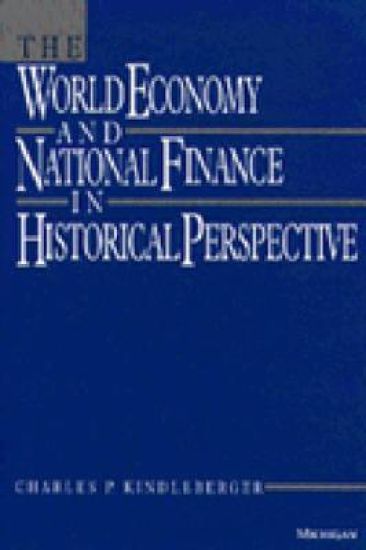
The World Economy and National Finance in Historical Perspective

The World Economy and National Finance in Historical Perspective

Charles P. Kindleberger

The University of Michigan Press
1995
sidottu
The World Economy and National Finance in Historical Perspective is a collection of essays and lectures by the distinguished economist, Charles P. Kindleberger. The main topic is the world economy of the past, present, and future, but the author also turns his deep historical understanding on a cluster of national financial problems faced by the United States and Germany. The essays deal with the world economy and the place within it of the United States and Europe. Other topics treated include the succession of world economic leaders, and the spread of booms and crashes from one country to another, the quality of debt, financial intermediation and disintermediation, and the German inflation of 1919-23. In an important discussion of the United States' role in the world economy, the author places special emphasis on the responsibility that a country with such a leading economic role has of bringing about and maintaining economic stability. This will appeal to economists, especially economic historians, and will also be of interest to the financial community. Among the many books written by Kindleberger are The World in Depression 1929-1939; Manias, Panics and Crashes: A History of Financial Crises, and A Financial History of Western Europe. In addition, he has published several previous collections of essays including Europe and the Dollar; Economic Response, Comparative Studies in Trade, Finance and Growth; International Money; Multinational Excursions; Keynesianism vs Monetarism and Other Essays in Financial History; Marshall Plan Days; The International Economic Order: Essays on Financial Crisis and International Public Goods; and Historical Economics: Art or Science?
Essays in History

Essays in History

Charles P. Kindleberger

The University of Michigan Press
1999
sidottu
Essays in History is a collection of papers and articles providing a breathtaking span across the twentieth century and delving into such diverse topics as economic and financial crises in the sixteenth century, retirement reading for bankers, and a first-hand account of the genesis and formation of the Marshall Plan. Who else to explore such far-flung topics, and bring such intelligence and wit to them, as Charles Kindleberger? Readers will find here a strong view on the need for economic history to guide theoretical research. They will also detect Kindleberger's doubtfulness regarding economic theory based on assumptions that all participants in society are honest, well informed, and make their judgments independently. Finally, they will be led to the conclusion that, in light of these views, those who think that finance and the economy should be completely unregulated are misguided. A foreword by Peter Temin, professor of economics at MIT and former student and colleague of Kindleberger's, history, Charlie Kindleberger still writes brilliantly--pro-foundly, but also intelligibly and wittily." --H.W. Arndt, Australian National University"Essays in History is not just extraordinarily well written, but a delightful and engaging read that helps put current financial land economic questions into proper historical perspective." --Douglas Irwin, Dartmouth CollegeCharles P. Kindleberger is Ford International Professor Emeritus of Economics, Massachusetts Institute of Technology.
International Capital Movements

International Capital Movements

Charles P. Kindleberger

Cambridge University Press
1988
pokkari
First published in 1988, this study of international capital movements looks at their historical role in the financing of trade and their dramatically increased role in the world economy in recent years. It examines the current economic theory and the policy implications of these changes. Beginning with an analysis of the balance of payments, the authors goes on to discuss international short-term and long-term capital movements, both historically and with reference to current events. A further chapter deals with financial deregulation and the progression during the last few years towards the integration of international capital markets. The author looks forward to two possible futures for international finance: a gradual federalisation of macro-economic behaviour on a world basis, or a move towards self-reliance and autarky. The book is based on the author's Marshall Lectures, given in the University of Cambridge. It will be of interest to those studying international and financial economies, graduate students and those involved in the formulation of policy.
Economic Laws and Economic History

Economic Laws and Economic History

Charles P. Kindleberger

Cambridge University Press
1997
pokkari
In this volume, Charles Kindleberger makes a powerful case against the idea that any one model could be used to unlock the basic secret of economic history. It is essentially an exercise in methodology, addressed to economists and economic historians alike. He argues that too many economists discover a relationship or a uniformity in economic behaviour, develop a model, and use it to explain more than it is capable of, including, on occasion, all economic behaviour. These lectures discuss four ‘laws’ in economics to show how uniformities can illuminate economic history in particular aspects. They illustrate the view that the economist or economic historian seeking to test analysis against historical data should have a variety of different models, and not just one. The implication is that however scientific and technical the tools, choosing them carefully to fit particular circumstances is itself an art.
Mariners and Markets

Mariners and Markets

Charles P. Kindleberger

Pearson Education Limited
1993
sidottu
In this volume, eminent economist Charles Kindleberger sets out to challenge the widespread belief that the market for seafarers, in the days before steam, was efficient, conforming more or less to a strong prior belief in the neo-classical economic model of supply and demand. Maritime history is traditionally strewn with references to crimping or shanghaiing, naval press-gangs, desertion, mutiny, marooning and shipwrecks due to drunkenness or negligence. In contrast, Kindleberger examines issues of recruitment and pay, the treatment of seamen, and the question of government intervention and its impact on efficiency, in the engaging narrative style that is his trademark. Offering an original and informative account of the markets for seafarers in the age of sail, Mariners and Markets will be welcomed by economic and maritime historians alike.
Manias, Panics, and Crashes

Manias, Panics, and Crashes

Robert Z. Aliber; Charles P. Kindleberger; Robert N. McCauley

Springer International Publishing AG
2023
nidottu
In the Eighth Edition of this classic text on the financial history of bubbles and crashes, Robert McCauley joins with Robert Aliber in building on Charles Kindleberger's renowned work. McCauley draws on his central banking experience to introduce new chapters on cryptocurrency and the United States as the 21st Century global lender of last resort. He also updates the book's coverage of the recent property bubble in China, as well as providing new perspectives on the US housing bubble of 2003-2006, and the Japanese bubble of the late 1980s. And he gives new attention to the social psychology that leads people to take the risk of investing in Ponzi schemes and asset price bubbles. For the first time in this revised and updated edition, figures highlight key points to ensure that today’s generation of finance and economic researchers, students, practitioners and policy-makers—as well as investors looking to avoid crashes—have access to this panoramic history of financial crisis.