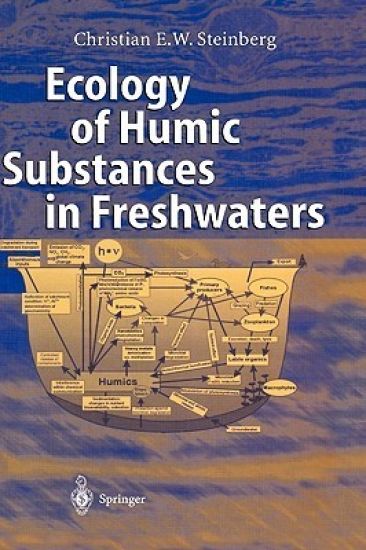
Humic Substances color all waters more or less brown. Their concentrations exceed all carbon of living organisms by at least one order of magnitude. Opposite to former paradigms, they participate in almost any metabolic pathway. They protect against UV-irradation, enable indirect photolysis and, thus, purify hazardous chemicals, they provide inorganic and organic nutrients, may form cryptic genes with DNA and dampen metabolic fluctuations. More recently they can increase adverse effects of hazardous chemicals and they can directly interfere with organisms. The book tries to relate effects to structural features.
Humic Substances color all waters more or less brown. Their concentrations exceed all carbon of living organisms by at least one order of magnitude. Opposite to former paradigms, they participate in almost any metabolic pathway. They protect against UV-irradation, enable indirect photolysis and, thus, purify hazardous chemicals, they provide inorganic and organic nutrients, may form cryptic genes with DNA and dampen metabolic fluctuations. More recently they can increase adverse effects of hazardous chemicals and they can directly interfere with organisms. The book tries to relate effects to structural features.
God is not an idea. Christian faith is not a set of propositions you either believe or reject. According to a proper Trinitarian understanding, God is essentially relationship, a relationship of sheer, active, ecstatic, self-giving love. If we truly are encountered by this magnificent love of the Trinity, then faith becomes a living and active daily practice. Just like a healthy marriage or a close and loyal friendship, it becomes something you choose every day. This "51% Christian" moniker is a ridiculous label with a deadly serious point. You now have permission to doubt, to question, to get angry at God. But, in the end, it's not about you. Faith is about relationship: a living, daily relationship, based on trust, and active in concrete, daily practices. With this sort of freedom ingrace, Stenberg takes a fresh new look at theology, thirteen topics that, one by one, examine the best of what the Bible and the history of Christian practitioners have to say. Looking through this grace-based, radically relational lens, the author offers a lively and engaging discussion of topics such as creation, violence, love, death, heaven, and hell. You might not always agree.
As sequel to Aquatic Animal Nutrition – A Mechanistic Perspective from Individuals to Generations, the present treatise on organic macro- and micronutrients continues the unique cross fertilization of aquatic ecology/ecophysiology and aquaculture. This treatise considers proteins and their constituents, carbohydrates from mono- to polysaccharides, fatty acids from free acids to fat, and waxes. It becomes obvious that these organic nutrients are more than only simple fuel for the metabolism of animals; rather, their constituents have messenger and controlling function for the actual consuming individual and even for succeeding generations. This aspect will become particularly clear by putting the organisms under consideration back into their ecosystem with their interrelationships and interdependencies. Furthermore, micronutrients, such as vitamins and nucleotides as well as exogenous enzymes, are in the focus of this volume with known and still-to-be-discovered controlling physiological and biomolecular functions.Aquatic Animal Nutrition – Organic Macro and Micro Nutrients addresses several gaps in nutritional research and practice. One major gap is the lack of common research standards and protocols for nutritional studies so that virtually incomparable approaches have to be compared. This applies also to the studied animals, since most approaches disregard intraspecific variabilities and the existence of epimutations in farmed individuals. Furthermore, recalling the Mechanistic Perspective from Individuals to Generations, dietary benefits and deficiencies have effects on succeeding generations. In most studies, this long-term and sustainable aspect is overruled by pure short-term production aspects. By comparing nutritional behavior and success of fishes and invertebrates, Aquatic Animal Nutrition points out different metabolic pathways in these animal groups and discusses how, for instance, fishes would benefit when having some successful metabolic pathway of invertebrates. Application of novel genetic techniques will help turn this vision into reality. However, a widely missing link in the current nutritional research is epigenetics regarding transgenerational heritages of acquired morphological and physiological properties. To increase public acceptance, nutritional optimization of farmed animals based on this mechanism, rather than genetical engineering, appears promising.
As sequel to Aquatic Animal Nutrition – A Mechanistic Perspective from Individuals to Generations, the present treatise on organic macro- and micronutrients continues the unique cross fertilization of aquatic ecology/ecophysiology and aquaculture. This treatise considers proteins and their constituents, carbohydrates from mono- to polysaccharides, fatty acids from free acids to fat, and waxes. It becomes obvious that these organic nutrients are more than only simple fuel for the metabolism of animals; rather, their constituents have messenger and controlling function for the actual consuming individual and even for succeeding generations. This aspect will become particularly clear by putting the organisms under consideration back into their ecosystem with their interrelationships and interdependencies. Furthermore, micronutrients, such as vitamins and nucleotides as well as exogenous enzymes, are in the focus of this volume with known and still-to-be-discovered controlling physiological and biomolecular functions.Aquatic Animal Nutrition – Organic Macro and Micro Nutrients addresses several gaps in nutritional research and practice. One major gap is the lack of common research standards and protocols for nutritional studies so that virtually incomparable approaches have to be compared. This applies also to the studied animals, since most approaches disregard intraspecific variabilities and the existence of epimutations in farmed individuals. Furthermore, recalling the Mechanistic Perspective from Individuals to Generations, dietary benefits and deficiencies have effects on succeeding generations. In most studies, this long-term and sustainable aspect is overruled by pure short-term production aspects. By comparing nutritional behavior and success of fishes and invertebrates, Aquatic Animal Nutrition points out different metabolic pathways in these animal groups and discusses how, for instance, fishes would benefit when having some successful metabolic pathway of invertebrates. Application of novel genetic techniques will help turn this vision into reality. However, a widely missing link in the current nutritional research is epigenetics regarding transgenerational heritages of acquired morphological and physiological properties. To increase public acceptance, nutritional optimization of farmed animals based on this mechanism, rather than genetical engineering, appears promising.
This volume first covers the supplementation of aquafeeds with terrestrial plant material used in human medicine and nutrition. Mainly based on the “trial and error” approach, many supplements enhance growth, immunity and resistance to stress. However, other supplements appear to be ineffective and some have adverse effects. A robust and guiding hypothesis for supplementation is not apparent. Therefore, the book proposes the use of artificial intelligence to end the trial-and-error phase. In addition, a graded dosing is rarely used, especially in the low-dose range, so the physiological mechanisms behind the supplements are often only partially understood. This topic of aquatic animal nutrition is still in its infancy. Chapters cover medicinal plants in general, selected medicinal plants in detail, food plants, fruits, essential oils, fermentation residues, and genetically modified plants. One chapter attempts to answer the question of what mechanism may underlie ineffective or even harmful supplementation. Overall, the importance of the intestinal microflora is becoming increasingly clear and points to the imperative need to include gut microbiota in replacement studies. Based on the few epigenetic studies currently available, the importance of these processes is demonstrated. The need to integrate such approaches into future studies is emphasized. The so-called hologenomics approach is inevitable. Can adverse effects be mitigated by adding functional feed ingredients such as prebiotics or probiotics? This volume concludes with aquatic plants (macroalgae, filamentous algae, and macrophytes) as food sources for natural and farmed aquatic animals. Can aquaculture learn from natural aquatic herbivores?
Not all stress is stressful; instead, it appears that stress in the environment, below the mutation threshold, is essential for many subtle manifestations of population structures and biodiversity, and has played a substantial role in the evolution of life. Intrigued by the behavior of laboratory animals that contradicted our current understanding of stress, the author and his group studied the beneficial effects of stress on animals and plants. The seemingly “crazy” animals demonstrated that several stress paradigms are outdated and have to be reconsidered.The book describes the general stress responses in microorganisms, plants, and animals to abiotic and biotic, to natural and anthropogenic stressors. These stress responses include the activation of oxygen, the biotransformation system, the stress proteins, and the metal-binding proteins. The potential of stress response lies in the transcription of genes, whereas the actual response is manifested by proteins and metabolites. Yet, not all stress responses are in the genes: micro-RNAs and epigenetics play central roles. Multiple stressors, such as environmental realism, do not always act additively; they may even diminish one another. Furthermore, one stressor often prepares the subject for the next one to come and may produce extended lifespans and increased offspring numbers, thus causing shifts in population structures.This book provides the first comprehensive analysis of the ecological and evolutionary effects of stress.
Not all stress is stressful; instead, it appears that stress in the environment, below the mutation threshold, is essential for many subtle manifestations of population structures and biodiversity, and has played a substantial role in the evolution of life. Intrigued by the behavior of laboratory animals that contradicted our current understanding of stress, the author and his group studied the beneficial effects of stress on animals and plants. The seemingly “crazy” animals demonstrated that several stress paradigms are outdated and have to be reconsidered.The book describes the general stress responses in microorganisms, plants, and animals to abiotic and biotic, to natural and anthropogenic stressors. These stress responses include the activation of oxygen, the biotransformation system, the stress proteins, and the metal-binding proteins. The potential of stress response lies in the transcription of genes, whereas the actual response is manifested by proteins and metabolites. Yet, not all stress responses are in the genes: micro-RNAs and epigenetics play central roles. Multiple stressors, such as environmental realism, do not always act additively; they may even diminish one another. Furthermore, one stressor often prepares the subject for the next one to come and may produce extended lifespans and increased offspring numbers, thus causing shifts in population structures.This book provides the first comprehensive analysis of the ecological and evolutionary effects of stress.
This report investigates the role of foreign direct investment (FDI) in helping developing countries participate in global value chains (GVCs). It aims to provide practical guidance for developing countries to develop strategies that use FDI to strengthen GVC participation and upgrading.
This book is a unique cross fertilization of aquatic ecology and aquaculture. It shows how diets structure the digestive tract and its microbiota and, in turn, the microbiota influences life history traits of its host, including behavior. Short-term starvation can have beneficial effects on individuals themselves and succeeding generations which may acquire multiple stress resistances – a mechanism strengthening the persistence of populations. From terrestrial, but not yet from aquatic animals, it is understood that circadian the rhythmicity makes toxins or good food. On the long-term, the dietary basis impacts succeeding generations and can trigger a sympatric speciation by (epi)-genetics. This volume defines gaps in nutritional research and practice of farmed fishes and invertebrates by referring to knowledge from marine and freshwater biology. It also points out that dietary benefits and deficiencies have effects on several succeeding generations, indicating that well designed diets may have the potential to successfully improve broodstock and breeding effort.
Based on positive experiences in human nutrition and healthy aging, individual and combined plant secondary metabolites are added to aquafeeds. The main compounds used are carotenoids, polyphenols, terpenes, and various alkaloids. The pile of supplementation studies with beneficial results is growing rapidly. These benefits include increased immunity, pathogen resistance, or improved gut microbiome diversity. However, a variety of adverse results cannot be ignored. Overall, in Aquatic Animal Nutrition research, this is another area of that is still in its early stages: as with supplementation of plant preparations (Aquatic Animal Nutrition – Plant Preparations), a robust and guiding hypothesis for supplementation is not apparent, and graded dosing is rarely used, especially in the low-dose range. Often, the high doses used lead to the classification of various compounds as anti-nutritional. However, appropriate low-dose supplementation demonstrates that and how aquatic animals can cope with ‘anti-nutritional’ factors within their adaptive response, indicating that even these compounds may have some nutritional value. In addition, knowledge of the underlying mechanisms of the adaptive response may provide physiological, transcriptomic, and epigenetic means to more sustainably utilize even this ‘worthless’ food source. The importance of the intestinal microflora is becoming increasingly clear and points to the imperative need to include gut microbiota in replacement studies. Based on the few epigenetic studies currently available, the importance of these processes is demonstrated. The need to integrate such approaches into future studies is emphasized. The so-called hologenomics approach is inevitable. Supplementing aquafeed with terrestrial plant material can introduce toxins and endocrine disruptors. The addition of adsorptive compounds (clay minerals) or functional feed ingredients (prebiotics, probiotics) can at least partially mitigate the adverse effects.
This book is a unique cross fertilization of aquatic ecology and aquaculture. It shows how diets structure the digestive tract and its microbiota and, in turn, the microbiota influences life history traits of its host, including behavior. Short-term starvation can have beneficial effects on individuals themselves and succeeding generations which may acquire multiple stress resistances – a mechanism strengthening the persistence of populations. From terrestrial, but not yet from aquatic animals, it is understood that circadian the rhythmicity makes toxins or good food. On the long-term, the dietary basis impacts succeeding generations and can trigger a sympatric speciation by (epi)-genetics. This volume defines gaps in nutritional research and practice of farmed fishes and invertebrates by referring to knowledge from marine and freshwater biology. It also points out that dietary benefits and deficiencies have effects on several succeeding generations, indicating that well designed diets may have the potential to successfully improve broodstock and breeding effort.