Kirjojen hintavertailu. Mukana 11 455 998 kirjaa ja 12 kauppaa.

Kirjahaku

Etsi kirjoja tekijän nimen, kirjan nimen tai ISBN:n perusteella.

1000 tulosta hakusanalla Christiane Tietz

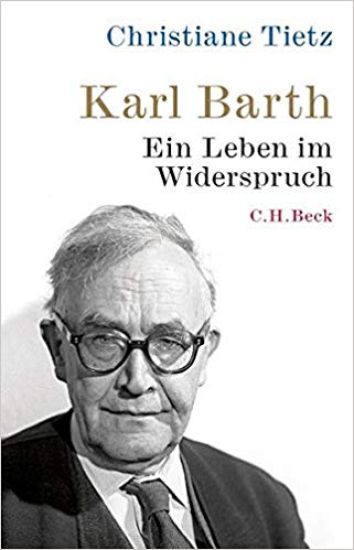
Karl Barth

Karl Barth

Christiane Tietz

Oxford University Press
2021
sidottu
From the beginning of his career, Swiss theologian Karl Barth (1886-1968) was often in conflict with the spirit of his times. While during the First World War German poets and philosophers became intoxicated by the experience of community and transcendence, Barth fought against all attempts to locate the divine in culture or individual sentiment. This freed him for a deep worldly engagement: he was known as "the red pastor," was the primary author of the founding document of the Confessing Church, the Barmen Theological Declaration, and after 1945 protested the rearmament of the Federal Republic of Germany. Christiane Tietz compellingly explores the interactions between Barth's personal and political biography and his theology. Numerous newly-available documents offer insight into the lesser-known sides of Barth such as his long-term three-way relationship with his wife Nelly and his colleague Charlotte von Kirschbaum. This is an evocative portrait of a theologian who described himself as "God's cheerful partisan," who was honored as a prophet and a genial spirit, was feared as a critic, and shaped the theology of an entire century as no other thinker.
Karl Barth

Karl Barth

Christiane Tietz

Oxford University Press
2023
nidottu
From the beginning of his career, Swiss theologian Karl Barth (1886-1969) was often in conflict with the spirit of his times. While during the First World War German poets and philosophers became intoxicated by the experience of community and transcendence, Barth fought against all attempts to locate the divine in culture or individual sentiment. This freed him for a deep worldly engagement: he was known as "the red pastor," was the primary author of the founding document of the Confessing Church, the Barmen Theological Declaration, and after 1945 protested the rearmament of the Federal Republic of Germany. Christiane Tietz compellingly explores the interactions between Barth's personal and political biography and his theology. Numerous newly-available documents offer insight into the lesser-known sides of Barth such as his long-term three-way relationship with his wife Nelly and his colleague Charlotte von Kirschbaum. This is an evocative portrait of a theologian who described himself as '"God's cheerful partisan"' who was honored as a prophet and a genial spirit, was feared as a critic, and shaped the theology of an entire century as no other thinker.
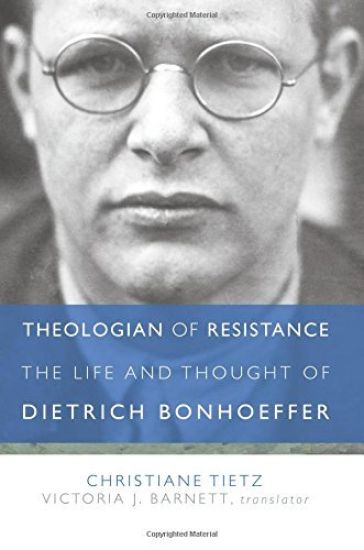
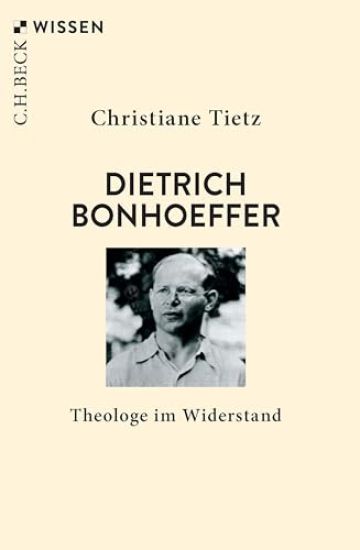
Theologian of Resistance

Theologian of Resistance

Christiane Tietz

Fortress Press,U.S.
2016
sidottu
Since Dietrich Bonhoeffer's death in 1945, executed by the Nazis as a political dissident, he has continued to fascinate and compel readers as a theologian, witness, and martyr. Bonhoeffer's theological brilliance, committed discipleship, ecumenical insight, and courageous participation in the struggle against fascism have profoundly shaped contemporary Christian understanding and action. In John W. de Gruchy's estimate, had Bonhoeffer lived "he might have dominated the theological scene in-the second half of the twentieth century in succession to Karl Barth, Rudolf Bultmann, and Paul Tillich. As it was, he became the paradigmatic martyr- theologian" for our time. In this new biography, Christiane Dietz masterfully portrays the interconnectedness of Bonhoeffer's life and thought, theology and politics, discipleship, witness, and resistance, tracing the path from his childhood to his imprisonment and execution. Brief, lucid, and imminently accessible, Tietz's new account brings Bonhoeffer's story and work to life in a vivid retelling, unfolding his important and widely read texts, and including new, previously unseen pictures.
Bonhoeffers Kritik der verkrümmten Vernunft

Bonhoeffers Kritik der verkrümmten Vernunft

Christiane Tietz-Steiding

Mohr Siebeck
1999
sidottu
In seiner Habilitationsschrift 'Akt und Sein' (1931) erörtert Dietrich Bonhoeffer im Dialog mit zeitgenössischen Positionen die Bedeutung von Transzendentalphilosophie und Ontologie für die systematische Theologie. Unter Einbeziehung von 'Sanctorum Communio' und anderen frühen Schriften Bonhoeffers rekonstruiert Christiane Tietz-Steiding die vernunftkritische Erkenntnistheorie, die als origineller Beitrag dieses Bonhoefferschen Frühwerks gelten kann. Dabei wird die zentrale Überzeugung des jungen Bonhoeffer deutlich: Nicht die Selbstverkrümmung der ratio in der Philosophie kann dem Menschen ein angemessenes Selbstverständnis eröffnen, sondern nur ein der Offenbarung zugewandter Glaube, in dem die Verkrümmtheit der menschlichen Vernunft aufgebrochen wird. Indem der Mensch sein Sein im Akt des Glaubens versteht, kommt er zu sich selbst.Christiane Tietz-Steiding zeigt - im Unterschied zur bisherigen, allzuoft glättenden Bonhoeffer-Interpretation - Brüche und Unstimmigkeiten in Bonhoeffers Argumentation auf und macht darüber hinaus deutlich, weshalb Bonhoeffer sich später von 'Akt und Sein' inhaltlich distanzieren mußte. Mit der Rekonstruktion von Bonhoeffers Auseinandersetzung mit Philosophen und Theologen seiner Zeit (Heidegger, Barth, Bultmann, Gogarten u.a.) gibt sie zugleich eine problemorientierte Einführung in die philosophische und theologische Diskussion der zwanziger Jahre.
Schiffbruch der Historiographie

Schiffbruch der Historiographie

Christiane Tetzner

AV Akademikerverlag
2012
pokkari
Inhaltlich unver nderte Neuauflage. Die Unterschiede zwischen Geschichtsschreibung und Literatur, d.h. zwischen Wissenschaft und Kunst, werden zunehmend eingeebnet. Hier stellt sich die Frage, inwieweit sich die postmoderne Historiographie zu ihren literarischen Wurzeln bekennt. Neuere Erz hlungen der historischen Erz hlungen bewegen sich in diesem Spannungsfeld von Geschichte und Literatur, indem sie den Prozess der (Re)konstruktion von Vergangenheit und darstellungstechnische Probleme der Historiographie ausstellen. In dieser reflexiven Grenz berschreitung, so die These dieser Arbeit, kommen dem literarischen Diskurs durch die berblendung von historiographischen und literarischen Erz hlmodellen Privilegien zu. Der systematische Teil widmet sich der Literarizit t des Geschichtsdiskurses, der Narrativit t der Geschichtsdarstellung und der Textualit t von Geschichte. Im analytischen Teil werden die reflexiven Grenz berschreiungen von Enzensbergers "Der Untergang der Titanic" und "Mausoleum" herausgearbeitet.
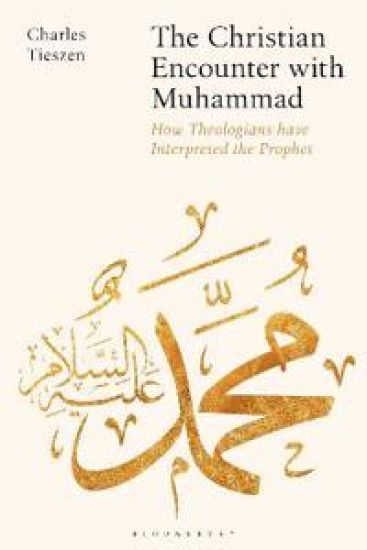
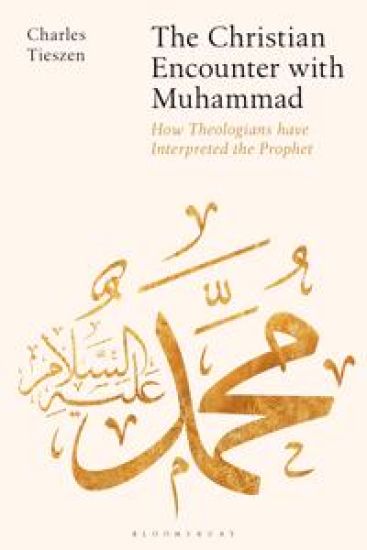
The Christian Encounter with Muhammad

The Christian Encounter with Muhammad

Charles Tieszen

Bloomsbury Academic
2020
sidottu
This book offers a fresh appraisal of Muhammad that considers the widest possible history of the ways in which Christians have assessed his prophethood.To medieval Christian communities, Muhammad—the leader of a religious and political community that grew quickly and with relative success—was an enigma. Did God really send him as a prophet with a revelation? Was the political success of the community he founded a divine validation? Or were he and his followers inspired by something evil? Despite their attempts, modern Christians continued to be puzzled by Muhammad. The Qur’an provided a framework for understanding and honouring Jesus; was it possible for Christians to reciprocate with regard to Muhammad?This book applies the same analysis to both medieval and modern assessments of Muhammad, in order to demonstrate the continuities and disparities present in literature from the two eras.
The Christian Encounter with Muhammad

The Christian Encounter with Muhammad

Charles Tieszen

BLOOMSBURY PUBLISHING PLC
2022
nidottu
This book offers a fresh appraisal of Muhammad that considers the widest possible history of the ways in which Christians have assessed his prophethood.To medieval Christian communities, Muhammad—the leader of a religious and political community that grew quickly and with relative success—was an enigma. Did God really send him as a prophet with a revelation? Was the political success of the community he founded a divine validation? Or were he and his followers inspired by something evil? Despite their attempts, modern Christians continued to be puzzled by Muhammad. The Qur’an provided a framework for understanding and honouring Jesus; was it possible for Christians to reciprocate with regard to Muhammad?This book applies the same analysis to both medieval and modern assessments of Muhammad, in order to demonstrate the continuities and disparities present in literature from the two eras.
Christian Identity amid Islam in Medieval Spain
In Christian Identity amid Islam in Medieval Spain Charles L. Tieszen explores a small corpus of texts from medieval Spain in an effort to deduce how their authors defined their religious identity in light of Islam, and in turn, how they hoped their readers would distinguish themselves from the Muslims in their midst. It is argued that the use of reflected self-image as a tool for interpreting Christian anti-Muslim polemic allows such texts to be read for the self-image of their authors instead of the image of just those they attacked. As such, polemic becomes a set of borders authors offered to their communities, helping them to successfully navigate inter-religious living.
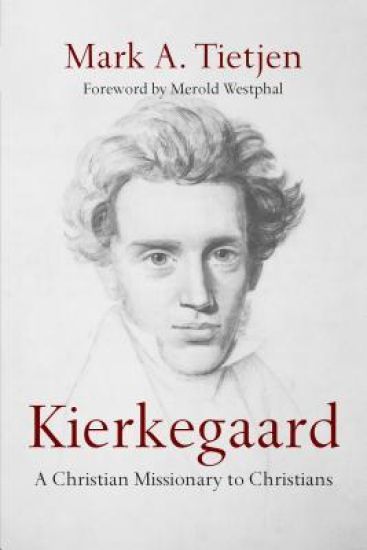
Kierkegaard – A Christian Missionary to Christians

Kierkegaard – A Christian Missionary to Christians

Mark A. Tietjen; Merold Westphal

Inter-Varsity Press,US
2016
nidottu
Søren Kierkegaard (1813-1855) had a mission. The church had become weak, flabby and inconsequential. Being a Christian was more a cultural heritage than a spiritual reality. His mission—reintroduce the Christian faith to Christians. How could he break through to people who were members of the church and thought they were Christians already? Like an Old Testament prophet, Kierkegaard used a variety of pointed and dramatic ways to shake people from their slumber. He incisively diagnosed the spiritual ailments of his age and offered a fresh take on classic Christian teaching. Mark Tietjen thinks that Kierkegaard's critique of his contemporaries strikes close to home today. We also need to listen to one of the most insightful yet complex Christian thinkers of any era. Through an examination of core Christian doctrines—the person of Jesus Christ, human nature, Christian witness and love—Tietjen helps us hear Kierkegaard's missionary message to a church that often fails to follow Christ with purity of heart.