Kirjojen hintavertailu. Mukana 11 244 527 kirjaa ja 12 kauppaa.

Kirjahaku

Etsi kirjoja tekijän nimen, kirjan nimen tai ISBN:n perusteella.

1000 tulosta hakusanalla Christina L. Davis

Food Fights over Free Trade

Food Fights over Free Trade

Christina L. Davis

Princeton University Press
2005
pokkari
This detailed account of the politics of opening agricultural markets explains how the institutional context of international negotiations alters the balance of interests at the domestic level to favor trade liberalization despite opposition from powerful farm groups. Historically, agriculture stands out as a sector in which countries stubbornly defend domestic programs, and agricultural issues have been the most frequent source of trade disputes in the postwar trading system. While much protection remains, agricultural trade negotiations have resulted in substantial concessions as well as negotiation collapses. Food Fights over Free Trade shows that the liberalization that has occurred has been due to the role of international institutions. Christina Davis examines the past thirty years of U.S. agricultural trade negotiations with Japan and Europe based on statistical analysis of an original dataset, case studies, and in-depth interviews with over one hundred negotiators and politicians. She shows how the use of issue linkage and international law in the negotiation structure transforms narrow interest group politics into a more broad-based decision process that considers the larger stakes of the negotiation. Even when U.S. threats and the spiraling budget costs of agricultural protection have failed to bring policy change, the agenda, rules, and procedures of trade negotiations have often provided the necessary leverage to open Japanese and European markets. This book represents a major contribution to understanding the negotiation process, agricultural politics, and the impact of international institutions on domestic politics.

Why Adjudicate?

Why Adjudicate?

Christina L. Davis

Princeton University Press
2012
pokkari
The World Trade Organization (WTO) oversees the negotiation and enforcement of formal rules governing international trade. Why do countries choose to adjudicate their trade disputes in the WTO rather than settling their differences on their own? In Why Adjudicate?, Christina Davis investigates the domestic politics behind the filing of WTO complaints and reveals why formal dispute settlement creates better outcomes for governments and their citizens. Davis demonstrates that industry lobbying, legislative demands, and international politics influence which countries and cases appear before the WTO. Democratic checks and balances bias the trade policy process toward public lawsuits and away from informal settlements. Trade officials use legal complaints to manage domestic politics and defend trade interests. WTO dispute settlement enables states and domestic groups to signal resolve more effectively, thereby enhancing the information available to policymakers and reducing the risk of a trade war. Davis establishes her argument with data on trade disputes and landmark cases, including the Boeing-Airbus controversy over aircraft subsidies, disagreement over Chinese intellectual property rights, and Japan's repeated challenges of U.S. steel industry protection. In her analysis of foreign trade barriers against U.S. exports, Davis explains why the United States gains better outcomes for cases taken to formal dispute settlement than for those negotiated. Case studies of Peru and Vietnam show that legal action can also benefit developing countries.
Discriminatory Clubs

Discriminatory Clubs

Christina L. Davis

PRINCETON UNIVERSITY PRESS
2023
pokkari
The discriminatory logic at the heart of multilateralismMember selection is one of the defining elements of social organization, imposing categories on who we are and what we do. Discriminatory Clubs shows how international organizations are like social clubs, ones in which institutional rules and informal practices enable states to favor friends while excluding rivals.Where race or socioeconomic status may be a basis for discrimination by social clubs, geopolitical alignment determines who gets into the room to make the rules of global governance. Christina Davis brings together a wealth of data on membership provisions for more than three hundred organizations to reveal the prevalence of club-style selection on the world stage. States join organizations to deepen their association with a particular group of states—most often their allies—and for the gains from policy coordination. Even organizations that claim to be universal, to target narrow issues, or to cover geographic regions use club-style admission criteria. Davis demonstrates that when it comes to the most important decision of cooperation—who belongs to the club and who doesn’t—geopolitical alignment can matter more than the merits or policies of potential members.With illuminating case studies ranging from nineteenth-century Japan to contemporary Palestine and Taiwan, Discriminatory Clubs sheds light on how, for global and regional organizations such as the WTO and the EU, alliance ties and shared foreign-policy positions form the basis of cooperation.
Discriminatory Clubs

Discriminatory Clubs

Christina L. Davis

PRINCETON UNIVERSITY PRESS
2023
sidottu
The discriminatory logic at the heart of multilateralismMember selection is one of the defining elements of social organization, imposing categories on who we are and what we do. Discriminatory Clubs shows how international organizations are like social clubs, ones in which institutional rules and informal practices enable states to favor friends while excluding rivals.Where race or socioeconomic status may be a basis for discrimination by social clubs, geopolitical alignment determines who gets into the room to make the rules of global governance. Christina Davis brings together a wealth of data on membership provisions for more than three hundred organizations to reveal the prevalence of club-style selection on the world stage. States join organizations to deepen their association with a particular group of states—most often their allies—and for the gains from policy coordination. Even organizations that claim to be universal, to target narrow issues, or to cover geographic regions use club-style admission criteria. Davis demonstrates that when it comes to the most important decision of cooperation—who belongs to the club and who doesn’t—geopolitical alignment can matter more than the merits or policies of potential members.With illuminating case studies ranging from nineteenth-century Japan to contemporary Palestine and Taiwan, Discriminatory Clubs sheds light on how, for global and regional organizations such as the WTO and the EU, alliance ties and shared foreign-policy positions form the basis of cooperation.
Practicing Christian Leadership, Student Workbook: Capstone Module 11, English
Perhaps nothing is more critical in the health of a Christian congregation than the practice of effective Christian Leadership. God has raised up gifted men and women to care for his people, to exercise oversight that heals and blesses in the midst of his Church. Truly, those called to lead demonstrate their devotion to the Savior by practicing a kind of leadership that both honors and glorifies our Lord and edifies and builds up his people.This module specifically covers four critical dimensions of effective Christian leadership. We begin with a focus on effective worship leading, with a special focus on the role of ministering the Word and Sacrament among the people of God. We also consider the role of the Christian leader in Christian education, dealing specifically with how we welcome and integrate new believers into our community life together. In addition, we discuss the concept of spiritual parenthood, of raising healthy spiritual children and discipling them in the context of the local assembly of believers. Next, we focus on practicing effective church discipline, the lost art of biblical exhortation, and why this ministry is so necessary for Christian leaders among God's people. We close our study by considering the work of effective biblical counseling. Our goal is to understand both the therapeutic and pastoral implications of counseling and leading God's people as they encounter the darker side of life, and its trials, tribulations, and distresses. This is the Student Workbook for TUMI's Capstone Module 11 English course, Practicing Christian Leadership, which is one of 16 modules in the Capstone Curriculum. This book is intended to be purchased by TUMI satellites, mentors, or site coordinators for use within a TUMI Satellite. The Urban Ministry Institute (TUMI) is a ministry of World Impact, Inc. TUMI Satellites are a part of the TUMI Network, where leaders are developed in the local church using TUMI's curriculum and training system.
Practicing Christian Leadership, Mentor's Guide: Capstone Module 11, English
This is the Mentor's Guide for TUMI's Capstone Module 11 English course, Practicing Christian Leadership, which is one of 16 modules in the Capstone Curriculum. This book is intended to be purchased by TUMI satellites, mentors, or site coordinators for use within a TUMI Satellite. The Quizzes, Final Exam, and Answer Keys for this module can be found on the TUMI Satellite Gateway (this is available to all approved TUMI satellites). The Urban Ministry Institute (TUMI) is a ministry of World Impact, Inc. TUMI Satellites are a part of the TUMI Network, where leaders are developed in the local church using TUMI's curriculum and training system. Perhaps nothing is more critical in the health of a Christian congregation than the practice of effective Christian Leadership. God has raised up gifted men and women to care for his people, to exercise oversight that heals and blesses in the midst of his Church. Truly, those called to lead demonstrate their devotion to the Savior by practicing a kind of leadership that both honors and glorifies our Lord and edifies and builds up his people.This module specifically covers four critical dimensions of effective Christian leadership. We begin with a focus on effective worship leading, with a special focus on the role of ministering the Word and Sacrament among the people of God. We also consider the role of the Christian leader in Christian education, dealing specifically with how we welcome and integrate new believers into our community life together. In addition, we discuss the concept of spiritual parenthood, of raising healthy spiritual children and discipling them in the context of the local assembly of believers. Next, we focus on practicing effective church discipline, the lost art of biblical exhortation, and why this ministry is so necessary for Christian leaders among God's people. We close our study by considering the work of effective biblical counseling. Our goal is to understand both the therapeutic and pastoral implications of counseling and leading God's people as they encounter the darker side of life, and its trials, tribulations, and distresses.
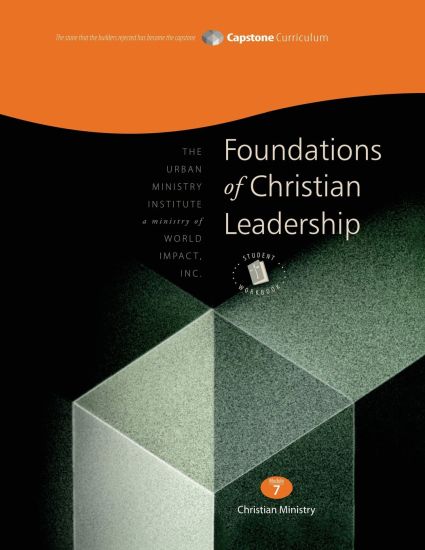
Foundations of Christian Leadership, Student Workbook: Capstone Module 7, English
The leaders of the Church of God are his precious gifts to his people throughout the ages. The evidence that Jesus loves his people dearly is that he has granted unto them apostles, prophets, evangelists, pastors and teachers to equip his people to represent the Kingdom of God in this fallen and soon-to-end world (Eph. 4.9-16). This module highlights the various roles and offices associated with this high and important task in the Kingdom of God.This course explores the roles and offices of four of the critical positions of the leadership in the Church. The Christian Leader as Deacon probes the foundations of Christian leadership as it relates to the offices and functions of the diaconate, or ministry of deacons, as a servant, a steward, and an assistant. The Christian Leader as Elder traces the notion from its OT root in the tribal system synagogue, the Sanhedrin, to the NT Church. The Christian Leader as Pastor outlines the biblical context of the idea of the pastorate, tracing historically the development of the idea of undershepherd of the flock. Finally, The Christian Leader as Bishop defines the dynamic concept of bishop as overseer, tracing its probable context from the council of elders in Jewish rulership to its development in the history of the Church. This is the Student Workbook for TUMI's Capstone Module 7 English course, Foundations of Christian Leadership, which is one of 16 modules in the Capstone Curriculum. This book is intended to be purchased by TUMI satellites, mentors, or site coordinators for use within a TUMI Satellite. The Urban Ministry Institute (TUMI) is a ministry of World Impact, Inc. TUMI Satellites are a part of the TUMI Network, where leaders are developed in the local church using TUMI's curriculum and training system.
Foundations for Christian Mission, Mentor's Guide: Capstone Module 4, English
This is the Mentor's Guide for TUMI's Capstone Module 4 English course, Foundations for Christian Mission, which is one of 16 modules in the Capstone Curriculum. This book is intended to be purchased by TUMI satellites, mentors, or site coordinators for use within a TUMI Satellite. The Quizzes, Final Exam, and Answer Keys for this module can be found on the TUMI Satellite Gateway (this is available to all approved TUMI satellites). The Urban Ministry Institute (TUMI) is a ministry of World Impact, Inc. TUMI Satellites are a part of the TUMI Network, where leaders are developed in the local church using TUMI's curriculum and training system. The theme of mission has not received the kind of focus and attention in our urban churches that it should. Having been seen largely as a work across the ocean in far flung corners of the world, we have failed to give it the kind of critical analysis that it deserves. From one vantage point, the entirety of the Christian faith could be seen as a response of mission, the call to go to the nations and proclaim Jesus of Nazareth as Lord and King of the reign of God. The NT is a collection of missionary documents given to churches that were founded by the apostles, the original missionaries of the Christian faith. God himself is the original missionary, coming to the world in Christ and reconciling it to himself (2 Cor. 5.18-21). Indeed, Christianity is mission.In this important module we explore various biblical perspectives of mission and God's people, from the perspective of Mission as Drama, as Romance, and as War. Each of these biblical images provides insight into the character of God's covenant promise and his working through the various epochs or sections of time to bring about redemption in Christ. We also explore two important subjects relevant especially to urban missions, the Bible's vision of ministry in the city and to the poor. From the beginning, God has charged his covenant community to live in such faithfulness to the Lord's covenant that justice would come to the city, and poverty would be replaced with justice and righteousness.
Foundations of Christian Leadership, Mentor's Guide: Capstone Module 7, English
This is the Mentor's Guide for TUMI's Capstone Module 7 English course, Foundations of Christian Leadership, which is one of 16 modules in the Capstone Curriculum. This book is intended to be purchased by TUMI satellites, mentors, or site coordinators for use within a TUMI Satellite. The Quizzes, Final Exam, and Answer Keys for this module can be found on the TUMI Satellite Gateway (this is available to all approved TUMI satellites). The Urban Ministry Institute (TUMI) is a ministry of World Impact, Inc. TUMI Satellites are a part of the TUMI Network, where leaders are developed in the local church using TUMI's curriculum and training system. The leaders of the Church of God are his precious gifts to his people throughout the ages. The evidence that Jesus loves his people dearly is that he has granted unto them apostles, prophets, evangelists, pastors and teachers to equip his people to represent the Kingdom of God in this fallen and soon-to-end world (Eph. 4.9-16). This module highlights the various roles and offices associated with this high and important task in the Kingdom of God.This course explores the roles and offices of four of the critical positions of the leadership in the Church. The Christian Leader as Deacon probes the foundations of Christian leadership as it relates to the offices and functions of the diaconate, or ministry of deacons, as a servant, a steward, and an assistant. The Christian Leader as Elder traces the notion from its OT root in the tribal system synagogue, the Sanhedrin, to the NT Church. The Christian Leader as Pastor outlines the biblical context of the idea of the pastorate, tracing historically the development of the idea of undershepherd of the flock. Finally, The Christian Leader as Bishop defines the dynamic concept of bishop as overseer, tracing its probable context from the council of elders in Jewish rulership to its development in the history of the Church.
End of Life Communication

End of Life Communication

Christine S. Davis; Jonathan L. Crane

Routledge
2019
sidottu
This book examines the dialectic between fictional death as depicted in the media and real death as it is experienced in a hospital setting. Using a Terror Management theoretical lens, Davis and Crane explore the intersections of life and death, experience and fiction, to understand the relationship between them. The authors use complementary perspectives to examine what it means when we speak and think of death as it is conceived in cultural media and as it is constructed by and circulates between patients, health professionals, and supportive family members and friends.Layering analysis with evocative narrative and an intimate tone, with characters, plot, and action that reflect the voices and experiences of all project participants, including the authors’ own, Davis and Crane reflect on what it means to pass away. Their medical humanities approach bridges health communication, cultural studies, and the arts to inform medical ethics and care.
End of Life Communication

End of Life Communication

Christine S. Davis; Jonathan L. Crane

Routledge
2019
nidottu
This book examines the dialectic between fictional death as depicted in the media and real death as it is experienced in a hospital setting. Using a Terror Management theoretical lens, Davis and Crane explore the intersections of life and death, experience and fiction, to understand the relationship between them. The authors use complementary perspectives to examine what it means when we speak and think of death as it is conceived in cultural media and as it is constructed by and circulates between patients, health professionals, and supportive family members and friends.Layering analysis with evocative narrative and an intimate tone, with characters, plot, and action that reflect the voices and experiences of all project participants, including the authors’ own, Davis and Crane reflect on what it means to pass away. Their medical humanities approach bridges health communication, cultural studies, and the arts to inform medical ethics and care.
Animal Emotions

Animal Emotions

Kenneth L Davis; Christian Montag

Punctum Books
2020
pokkari
Animal Emotions: How They Drive Human Behavior gives a concise overview of ancient mammalian emotions deeply rooted in the human brain. Jaak Panksepp, a world-renowned neuroscientist, dedicated his life career to the study of mammalian emotions and he carved out seven distinct emotional systems he called seeking, lust, care, and play (positive emotions), and fear, anger, and sadness (negative emotions), all exerting a tremendous influence on human behavior.Christian Montag, a neuroscientist and psychologist, and a long-time collaborator of Jaak Panksepp, revisits together with Kenneth L. Davis, one of Jaak's PhD students, Panksepp's theories and provides the reader with new insights into the nature of emotions and their role as survival tools, both for animals and for humans. They also raise new questions about the background of the research field Jaak Panksepp coined "Affective Neuroscience." How are personality and psychopathology linked to animal emotions? Do animals feel the same way as we do? What are our emotional needs in a digital society, and what is key to a happy life?Christian Montag is Professor of Molecular Psychology at Ulm University, Ulm, Germany. He also currently holds a position as Visiting Professor at the University of Electronic Science and Technology in Chengdu, China. Montag is an expert in the molecular genetics of personality and emotions. Moreover, he investigates the impact of digital societies on human brains. He has published numerous articles in journals and also serves on the editorial boards of the journals Personality Neuroscience, Addictive Behaviors, International Journal of Environmental Research and Public Health, and Digital Psychology. He is co-editor of the book series Studies in Neuroscience, Psychology and Behavioral Economics. Animal Emotions is his first popular science book in English. Get more information on his current projects at his website.Kenneth L. Davis completed his PhD with Jaak Panksepp on Opioids and the Social Behavior of Dogs. He has continued his work with Panksepp on developing the Affective Neuroscience Personality Scales (ANPS), and has since focused on adjectives closely related to the six primary emotions measured in the ANPS. He has recently developed a short adjective personality assessment called the ANPS-AR consisting of 24 adjectives, which can be used to self-rate personality but which can also be used by observers to rate the personalities of others such as therapy patients. With Panksepp he authored The Emotional Foundations of Personality: A Neurobiological and Evolutionary Approach (W.W. Norton, 2018).
555 Difficult Bible Questions Answered!: A Resource Manual for those looking for Answers.

555 Difficult Bible Questions Answered!: A Resource Manual for those looking for Answers.

Christian Herald; Barry L. Davis

Createspace Independent Publishing Platform
2011
nidottu
One of the great benefits of reading God's Word is the way that it makes us think. If you're like most people, when you read the Bible you are forced to begin to face issues and situations that you never have before. And that is a great thing But sometimes you run up against some Scriptures that leave you scratching your head...it's not easy reading accounts that were written in a different culture, with customs, sayings, and behavior that is foreign to you. And once in awhile you run into something you just plain don't understand.This resource will help you answer questions like: *Was there rain before the Flood? *What is the significance of Seven? *Who were the Lost Tribes? *Did God give Job over to Satan? *Why did Moses strike the rock? *Was John the Baptist Elijah? *How did Judas die? *What is the baptism of fire? *What is it to be risen with Christ? *Why was Jesus baptized?And 545 More
Christina Letter Tracing for Kids Trace my Name Workbook: Tracing Books for Kids ages 3 - 5 Pre-K & Kindergarten Practice Workbook
CHRISTINA Name Tracing Workbook - Preschoolers Kindergarten Practice Workbook - Toddlers Writing Notebook - Learn How to Write CHRISTINA - Preschoolers Activities Teaching your child the basics of writing is a difficult task especially if he or she is full of energy and finds it more difficult to focus. In order to give him a push in the first years of school or kindergartner, we are presenting a revolutionary way of teaching your baby the basics of the alphabet: the name tracing workbook for children. Why our workbook? The name tracing workbook has been designed specifically to teach children the basic of spelling and writing. By learning to write his own name, your child will develop the abilities and skills needed in the first years of schools while having fun. The 100 pages activity book is the perfect choice if you are searching to invest in your child's education from the beginning so don't hesitate and get him the only workbook he needs LEARNING THE FIRST LETTERS teaching your toddler the first letters and how to spell his or her name is difficult, which is why we have designed a special workbook that will make the learning process easier and a lot more fun, adding to the baby's educational fund. PERSONALIZED WORKING: the name is the first word any child should learn how to spell, but it is almost impossible to find special help for that task. CHRISTINA Name Tracing Workbook is divided in 12 themed chapters that will teach your toddler how to spell his or her name in a fun and interactive way. WHAT IT CONTAINS: CHRISTINA Name Tracing Workbook counts no less than 100 pages divided in 12 themed sheets that propose recognition activities, letter tracing practice and letter games, that are sure to teach your child the basics of writing and spelling. FOR TODDLERS: CHRISTINA Name Tracing Workbook is made especially for children aged 3 to 6 so your son or daughter will be well prepared for both kindergarten and first grade Learning the alphabet will be a piece of cake if your kid will already have the foundation letter tracing so why not give him a head start in school. THE PERFECT GIFT: offering a present to a toddler that is both fun and parents-approved is an almost impossible task, but the name tracing workbook has it all: it is educational, personalized and made especially for youngsters ages 3 to 6 so, if you're trying to bring a smile on a kid's face, this is it
The Struggle for a Multilingual Future

The Struggle for a Multilingual Future

Christina P. Davis

Oxford University Press Inc
2020
nidottu
In The Struggle for a Multilingual Future, Christina Davis examines the tension between ethnic conflict and multilingual education policy in the linguistic and social practices of Sri Lankan minority youth. Facing a legacy of post-independence language and education policies that were among the complex causes of the Sri Lankan civil war (1983–2009), the government has recently sought to promote interethnic integration through trilingual language policies in Sinhala, Tamil, and English in state schools. Integrating ethnographic and linguistic research in and around two schools during the last phase of the war, Davis's research shows how, despite the intention of the reforms, practices on the ground reinforce language-based models of ethnicity and sustain ethnic divisions and power inequalities. By engaging with the actual experiences of Tamil and Muslim youth, Davis demonstrates the difficulties of using language policy to ameliorate ethnic conflict if it does not also address how that conflict is produced and reproduced in everyday talk.
The Struggle for a Multilingual Future

The Struggle for a Multilingual Future

Christina P. Davis

Oxford University Press Inc
2020
sidottu
In The Struggle for a Multilingual Future, Christina Davis examines the tension between ethnic conflict and multilingual education policy in the linguistic and social practices of Sri Lankan minority youth. Facing a legacy of post-independence language and education policies that were among the complex causes of the Sri Lankan civil war (1983–2009), the government has recently sought to promote interethnic integration through trilingual language policies in Sinhala, Tamil, and English in state schools. Integrating ethnographic and linguistic research in and around two schools during the last phase of the war, Davis's research shows how, despite the intention of the reforms, practices on the ground reinforce language-based models of ethnicity and sustain ethnic divisions and power inequalities. By engaging with the actual experiences of Tamil and Muslim youth, Davis demonstrates the difficulties of using language policy to ameliorate ethnic conflict if it does not also address how that conflict is produced and reproduced in everyday talk.